Yes: in the United States, federal law enforcement investigates significant cryptocurrency scams, while local police will take a report but prioritize cases based on solvability and scale. Agencies like the FBI, Secret Service, IRS Criminal Investigation, and the Department of Justice actively pursue large or organized schemes. File with IC3 and the FTC immediately and preserve every transaction detail you can find.
TL;DR:
- Federal agencies like the FBI, Secret Service, and IRS focus on large, organized crypto scams, while local police typically handle smaller cases and forward significant ones.
- Law enforcement relies on public ledger analysis, such as transaction graph mapping and wallet clustering, but faces obstacles from privacy tools, mixers, and cross-jurisdiction transfers.
- Reporting to IC3 and the FTC immediately with detailed evidence increases chances of investigation, while timely preservation of transaction data and communications is crucial.
- For complex laundering or jurisdictions, paid forensic investigations can provide court-ready reports and deeper tracing beyond basic wallet analysis.
- Recovery of stolen funds via law enforcement remains uncommon; most efforts aim to disrupt networks and seize assets rather than individual restitution.
Table of Contents
- How Law Enforcement Investigates Cryptocurrency Scams
- Who Investigates Crypto Scams and When
- Exactly How to Report a Crypto Scam in the U.S.
- What Evidence to Preserve Right Now
- Realistic Chances of Recovery and the Forfeiture Process
- When to Hire a Forensic Investigator
- A Note From Working Alongside Victims and Investigators
- Recovera Forensics: Professional Tracing When You Need a Court-Ready Report
- FAQ
- Sources
- Official Reporting and Primary Sources
How Law Enforcement Investigates Cryptocurrency Scams
Every cryptocurrency transaction lives on a public ledger. Investigators start there: wallet addresses and transaction hashes create a trail that never disappears, even when the person behind it tries to hide. That permanence is both the promise and the limit of crypto investigations. The record is public, but tying a string of characters to a real person still takes legal process and technical skill.
Trained analysts use several layered methods to follow stolen funds:
- Transaction graph analysis maps how funds move between wallets to reveal patterns consistent with layering or cash-out attempts.
- Clustering groups addresses likely controlled by the same entity, often based on shared spending patterns.
- UTXO tracing follows unspent transaction outputs on ledgers like Bitcoin to track exact coin movement.
- Cross-chain tracing follows funds as they move between different blockchains through bridges or swap services.
None of this works without legal authority to unmask the people behind the addresses. Investigators use subpoenas to compel exchanges to hand over know-your-customer records, mutual legal assistance treaties to request cooperation from foreign governments, and seizure or forfeiture orders once they can tie funds to a wallet. The IC3 exists specifically to collect the raw material, transaction details and victim statements, that feeds these legal requests.
Tracing stalls in predictable places. Mixers and privacy tools deliberately obscure the path of funds. Bridges between blockchains can break continuity for less sophisticated tools. Unhosted wallets have no custodian to subpoena, and transfers routed through jurisdictions with weak anti-money-laundering enforcement can go cold entirely. The D.C. Scam Center Strike Force had frozen, seized, and forfeited cryptocurrency worth more than $580 million as of February 2026, proof that these obstacles are surmountable when agencies commit sustained resources to a case.
Who Investigates Crypto Scams and When
Reporting a scam does not automatically trigger a full investigation. Different agencies handle different scales of crime, and understanding that hierarchy helps you set realistic expectations.
- Local police will usually take your report and issue a case number, but most departments lack the blockchain expertise and jurisdiction to pursue funds that cross state or national lines; they often forward significant cases to state or federal partners.
- The FBI, through IC3 and its Virtual Assets Unit, handles complex and high-value crypto fraud, especially cases tied to organized criminal networks.
- The U.S. Secret Service investigates financial crimes involving digital currency, particularly where fraud touches the broader payment system.
- IRS Criminal Investigation pursues cases with tax implications or large-scale money laundering through crypto.
- DOJ Strike Forces, including the Scam Center Strike Force, target transnational scam operations and coordinate multi-agency takedowns.
Agencies triage cases using a few consistent criteria: the dollar amount lost, whether the scheme shows signs of organized or transnational activity, whether pursuing it could disrupt a larger network, and whether the available evidence is strong enough to support legal action. A single victim’s $2,000 loss rarely becomes a federal case on its own. That same pattern reported by thousands of victims can become the backbone of a coordinated operation. Operation Level Up had notified thousands of victims and saved victims an estimated hundreds of millions of dollars as of April 2026, a result built on exactly that kind of aggregated reporting and coordinated strike force action.
Exactly How to Report a Crypto Scam in the U.S.
Reporting correctly matters as much as reporting quickly. A vague complaint gives investigators nothing to work with, while a detailed one can feed directly into an active case.
- File with IC3 at www.ic3.gov first. Include every wallet address and transaction hash involved, exact dates and times, the names of any platforms used, and copies of all communications with the scammer. Our step-by-step IC3 filing guide walks through the exact fields the form asks for.
- Report to the FTC at ReportFraud.ftc.gov and to your state attorney general or consumer protection office. The FTC warns that crypto transactions are typically irreversible, which is exactly why reporting fast matters for any chance at disruption.
- Notify the exchange or platform the scammer used. Request an account hold or freeze and ask for copies of your own account records, including deposit and withdrawal history.
- File a local police report if advised to by IC3 or the FTC, bringing your exported evidence with you, and request a copy of the report for your own records and for any future insurance or legal claims.
- Keep every record you generate through this process. If you or the victim is 60 or older, the Department of Justice’s elder fraud hotline at 833-372-8311 provides dedicated support.
Pro Tip: File with IC3 before contacting the exchange: a timestamped federal complaint number strengthens any freeze request you make afterward.
The FBI has also warned that it does not partner with private recovery firms, and that many so-called crypto recovery services are scams targeting people who already lost money once. Any forensic or recovery service you consider should be vetted independently of anything a stranger messages you after your report becomes visible online.
What Evidence to Preserve Right Now
Investigators can only act on what you give them. The window to capture clean evidence closes fast, since scammers often delete accounts, abandon domains, and move funds within hours of being confronted.
Prioritize these categories:
- Transaction data: complete wallet addresses, full transaction hashes, block explorer links, exact amounts, and timestamps for every transfer.
- Communication logs: screenshots of chats, original emails saved as .eml files rather than forwarded copies, exported chat dumps, and any phone records tied to the scam.
- Platform and account evidence: screenshots of your know-your-customer verification, withdrawal records, emails from the exchange, and IP logs if your platform provides them.
- Domain and website evidence: screenshots of any fraudulent site, including the URL bar and date, since these pages often disappear quickly.
Export everything into files you control rather than relying on screenshots alone, and keep original copies untouched. Note the date and method of every export you make. This creates a basic chain of custody, a simple record of who touched the evidence and when, that matters if the case moves toward prosecution or civil litigation later. Our guide on preserving digital evidence for court covers the technical side of this process in more depth.
Pro Tip: Never respond to a scammer again after you decide to report, even to “confirm” details; any further contact can complicate the evidence trail and may tip them off to move funds faster.
Realistic Chances of Recovery and the Forfeiture Process
It helps to separate two different goals: disrupting criminal networks and recovering your specific funds. Law enforcement is generally far more successful at the first than the second.
Large federal operations have shown that major recoveries are possible. The D.C. Scam Center Strike Force has frozen, seized, and forfeited cryptocurrency worth more than $580 million as of February 2026, figures that only become possible once enough victim reports expose the full scope of a network. But those seizures target organized operations, not individual scammers acting alone, and an individual victim’s funds recovering through this path is uncommon.
When assets are forfeited, the Department of Justice or a U.S. Attorney’s office may open a formal remission or claims process that lets victims petition for a share of the recovered funds. The department’s compensation process for OneCoin fraud victims is one example of how this works after a forfeiture is finalized, though the timeline from seizure to actual payout can run for years and depends heavily on the specifics of each case.
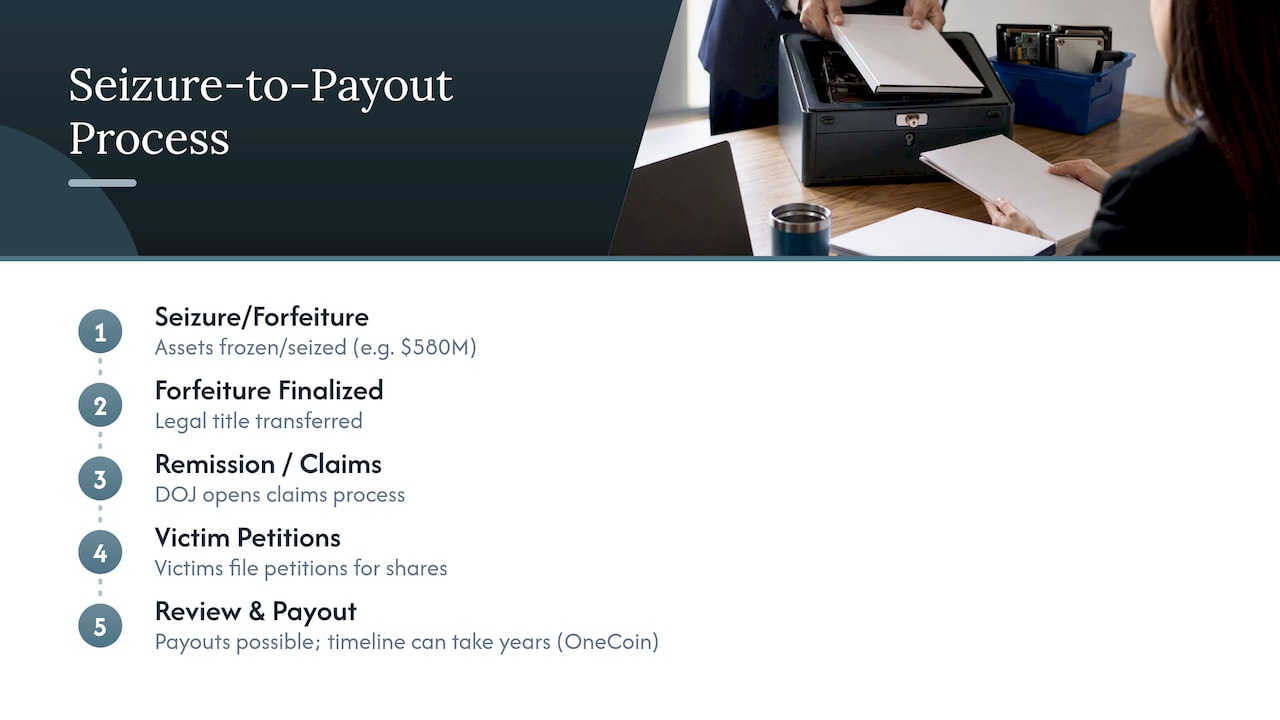
The practical takeaway: your individual report may not recover your money directly, but it adds to the aggregated intelligence that makes seizures like these possible in the first place.
When to Hire a Forensic Investigator
Law enforcement investigations move on their own timeline and their own priorities, which rarely align with an individual victim’s need for answers. That gap is where paid forensic work becomes a reasonable option, particularly when a case involves mixers, cross-chain bridges, or funds that have moved through several jurisdictions before going quiet.
A forensic engagement typically produces:
- Transaction tracing that follows funds through complex paths, including swaps and bridges.
- Wallet clustering analysis that connects addresses likely controlled by the same actor or network.
- Chain-of-custody documentation that shows exactly how evidence was collected and preserved.
- Court-ready technical reports written so a prosecutor, judge, or civil attorney can use them without a technical background.
This kind of work tends to matter most when a case involves layered laundering, multiple jurisdiction hops, or when a victim is preparing a civil suit or restitution claim rather than waiting on a criminal case alone. We build our investigations around deeper tracing than basic wallet lookups allow, documenting every step so the resulting report holds up outside a casual conversation with an investigator.
A Note From Working Alongside Victims and Investigators
Every victim who reaches out is working through the same two feelings at once: urgency and uncertainty about whether anyone will actually look into it. The honest answer is that speed matters more than almost anything else. Every hour you spend deciding whether to report is an hour a scammer has to move funds further away.
File your official reports the same day you realize what happened, and do not wait until you feel like you have the full picture. Aggregated reports are what turn individual losses into cases federal agencies take seriously.
— cristian
Recovera Forensics: Professional Tracing When You Need a Court-Ready Report
When local police can’t prioritize your case and a federal investigation remains uncertain, a paid forensic investigation can fill that gap with a documented, usable record of what happened to your funds. We investigate stolen cryptocurrency, run OSINT attribution to help identify possible wallet activities, preserve digital evidence in a defensible format, and build technical reports designed for a legal proceeding rather than casual reading.
- Cryptocurrency scam investigation that traces stolen funds across wallets and exchanges.
- OSINT investigations and digital attribution to research wallet activity.
- Evidence preservation that documents chain of custody from the start.
- Court-ready technical reports built for prosecutors, civil attorneys, or your own records.
If your case involves complex laundering, multiple jurisdictions, or you are preparing for civil action after law enforcement declined to prioritize it, our recovery and investigation services page is the place to start an intake conversation and get a scope estimate for your specific situation.
FAQ
What is cryptocurrency?
Cryptocurrency is digital money secured by cryptography and recorded on a public, decentralized ledger called a blockchain, rather than being issued or controlled by a central bank. Bitcoin and Ethereum are the most widely known examples, and ownership is tracked through wallet addresses rather than named accounts.
Can police do anything about a scammer?
Local police can take a report and may refer significant cases to state or federal agencies, but most lack the specialized tools to trace crypto across exchanges and borders on their own. Federal agencies including the FBI, Secret Service, and IRS Criminal Investigation have the legal authority and forensic capability to pursue larger or organized schemes, particularly when aggregated victim reports reveal a pattern.
What are some of the most current crypto scams?
Common current schemes include romance scams that pressure victims into fake crypto investment platforms, “pig butchering” scams that build trust over weeks before directing funds to fraudulent exchanges, fake job offers requiring upfront crypto payments, impersonation of government agencies demanding crypto payment, and fraudulent giveaway scams run through social media and messaging apps. The FTC tracks these patterns and notes that crypto payments are typically irreversible, which makes prevention and fast reporting especially important.
What should I do immediately after being scammed?
File a complaint with IC3 at www.ic3.gov and with the FTC at ReportFraud.ftc.gov the same day you discover the fraud, including every wallet address, transaction hash, and piece of communication you have. Preserving this evidence quickly, before accounts or websites disappear, gives any future investigation the best chance of succeeding.
Will hiring a forensic firm guarantee my money is recovered?
No investigation, whether run by law enforcement or a private forensic firm, can guarantee recovery of stolen crypto, since funds often move through mixers or jurisdictions that limit tracing. What a forensic engagement can reasonably offer is a documented trace of where funds went and a technical report that supports a law enforcement referral or civil claim.
Sources
- Scam Center Strike Force takes major actions against Southeast Asian scam centers — U.S. Department of Justice
- Cryptocurrency investment fraud — FBI
- Cryptocurrency — Internet Crime Complaint Center (IC3)
- D.C. Scam Center Strike Force seizures of cryptocurrency tops $580 million — IRS Criminal Investigation
- What to know about cryptocurrency scams — FTC
Official Reporting and Primary Sources
Use these official channels first when reporting a scam or verifying any claim about how investigations work.
- Internet Crime Complaint Center (IC3): the FBI’s central intake point for crypto fraud complaints, where submissions are analyzed and may be referred to federal, state, local, or international law enforcement.
- FBI cryptocurrency investment fraud guidance: explains what information to include in a report and warns against for-profit recovery firms claiming FBI partnerships.
- DOJ: Scam Center Strike Force press release: details on Operation Level Up and coordinated federal action against transnational scam networks.
- IRS Criminal Investigation: D.C. Scam Center Strike Force seizures: figures on seized and forfeited cryptocurrency tied to transnational fraud networks.
- FTC: what to know about cryptocurrency scams: how to report through ReportFraud.ftc.gov and common scam patterns to watch for.
- Recovera Forensics recovery and investigation services: where to start an intake conversation for paid forensic tracing and court-ready reporting.