If you lost crypto to a scam, file an IC3 complaint now and preserve every transaction hash and message, and do not pay anyone who promises recovery for a fee. Call your local FBI field office if the loss is large or involves extortion. Restitution or Department of Justice remission may help in some cases, but full recovery is rare, so plan for a long process.
TL;DR:
- File with IC3 and the FTC, notify your state attorney general, and contact the exchange or ATM operator immediately to request a freeze or reversal.
- Submit available wallet addresses, transaction hashes, dates, amounts, and messages even if details are incomplete; copying identifiers directly avoids transcription errors.
- DOJ remission uses forfeited assets and is discretionary, while restitution requires a conviction; either route can take years and may return less than your loss.
- Fake recovery law firms solicit victims for upfront fees; the FBI and IC3 reported over $9.9 million in losses from February 2023 to February 2024.
Table of Contents
- Where do you report crypto fraud and what details should you submit?
- How do restitution, forfeiture and DOJ remission work?
- How can you spot recovery scams that target victims?
- What should you do in the first 24 to 72 hours?
- What rights do crypto fraud victims have during an investigation?
- What victim compensation programs exist for crypto fraud?
- How do you document the emotional and financial impact of the fraud?
- How can you communicate securely with law enforcement?
- What other recovery scams should you watch for?
- What can paid blockchain forensics deliver, and what can’t it?
- How do we help U.S. crypto fraud victims?
- FAQ
- Sources
Where do you report crypto fraud and what details should you submit?
Start at the FBI’s Internet Crime Complaint Center. The FBI’s victim guidance says to file at www.ic3.gov and include as much specific information as you can. Filing does not guarantee a case will be opened or funds returned, but it puts your loss on record where investigators can connect it to others. Our walkthrough on filing an IC3 complaint covers the form itself.
Submit these fields if you have them:
- Cryptocurrency addresses for you and for the recipient
- Transaction hashes or IDs, with dates and amounts
- The platform, exchange or ATM operator used
- Every communication with the scammer, including usernames and phone numbers
- Your own account details and any receipts
Report to other agencies too. The FTC takes reports at ReportFraud.ftc.gov, and its advice on being scammed also tells you to contact the exchange or ATM operator right away to ask about a reversal or freeze. Add your state attorney general, and the SEC or CFTC portals if an investment product was involved.
If you lack full transaction data, file anyway. IC3’s cryptocurrency page asks for identifiers but encourages reporting regardless. For what actually triggers police interest, see what to report to trigger crypto investigations.
Pro Tip: Copy wallet addresses and hashes directly from the blockchain explorer or your wallet instead of retyping them, because a single wrong character sends investigators to the wrong account.
How do restitution, forfeiture and DOJ remission work?
These are two different remedies. Restitution is a court order requiring a convicted offender to repay victims. Remission uses assets the government has forfeited, and the Department of Justice decides at its discretion whether to compensate victims from them. DOJ’s restitution process page explains that remission is governed by 28 C.F.R. Part 9, is not guaranteed, and can limit restoration to the value of your loss on the date it occurred. That matters in crypto, where prices move sharply. DOJ’s FAQ on compensating victims with forfeited assets adds that remission petitions require no fee and that seizing agencies identify victims.
What you can do to be ready:
- Give investigators any information about where the stolen assets went
- Complete victim-impact statements when you are asked for them
- Keep your contact details current in the Victim Notification System so disbursement notices reach you
- Talk to an attorney about civil remedies alongside the criminal track
Be realistic about timing and odds. Investigations, prosecutions and collection can stretch across years, and recovered funds rarely make victims whole. Our guide to evidence in civil versus criminal crypto fraud cases shows why the same records serve both paths.
How can you spot recovery scams that target victims?
Once you have been scammed, you are on a list. The FTC warns that refund and recovery scammers buy lists of earlier victims and contact them offering help for an upfront fee. The FBI and IC3 have reported that fictitious law firms claiming recovery abilities caused over $9.9 million in additional losses between February 2023 and February 2024. The FBI and FTC also note that legitimate government agencies do not charge victims to investigate or recover funds.
Follow these steps when someone contacts you:
- Stop replying and do not click any links they sent.
- Never send money, gift cards, private keys or personal and banking details.
- Look up the firm or agency yourself and call a phone number you found independently, never the one the contact gave you.
- Ask for verifiable credentials, such as a state bar number you can check with the bar itself.
- Report the contact to IC3 and the FTC as a new complaint.
Common red flags include pressure to act fast, unsolicited outreach claiming official ties, and requests to move funds to a “safe” wallet.
Pro Tip: Real agencies already have your complaint, so a stranger who says they “found” your case and need a fee to release funds is giving you a reason to hang up.
What should you do in the first 24 to 72 hours?
Speed gives investigators and exchanges the best shot at acting on your case. Work through this order:
- Screenshot messages, save emails, export chat logs and save the scammer’s web pages.
- Copy wallet addresses and transaction hashes exactly as they appear.
- Contact the exchange or ATM operator, ask for an account suspension or recipient hold, and write down the name of the agent you spoke with.
- File your IC3 and FTC reports, then notify your state attorney general.
- Move everything into one secure folder and log each contact and step with a date and time.
Some practical details help:
- Back up evidence in two places, one offline
- Do not delete the app, wallet or account involved
- Do not confront the scammer
- Include incomplete data in reports rather than waiting for the perfect file
Forensic practitioners often describe the first 24 to 72 hours as critical, because funds can move across wallets and exchanges quickly. We keep a stolen crypto steps guide and an investigator checklist for readers who want more detail.
What rights do crypto fraud victims have during an investigation?
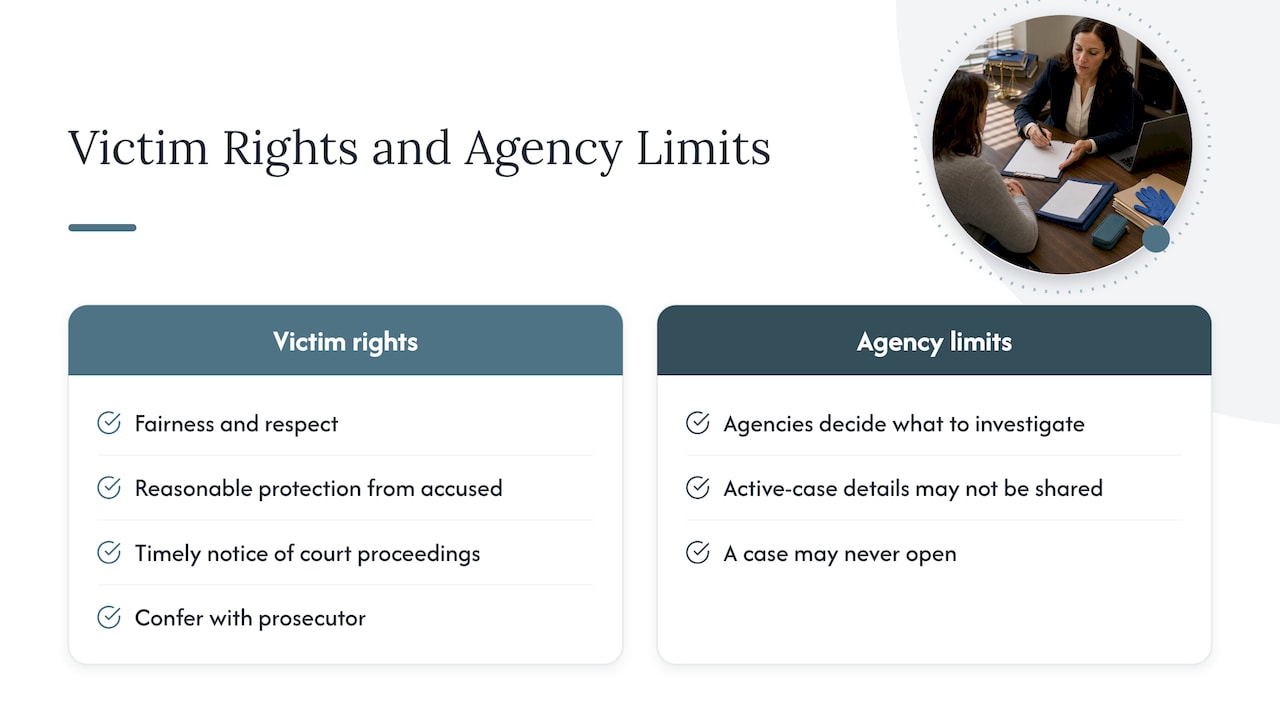
Crypto fraud is a federal crime when it involves wire fraud or similar offenses, so victims of those offenses generally fall under federal crime victims’ protections. Those protections include being treated with fairness and respect, being reasonably protected from the accused, and receiving timely notice of court proceedings. They also include the right to confer with the prosecutor and to seek restitution. Check the exact scope for your case with an attorney, because rights attach to specific offenses and stages of a case.
In practice, you will usually learn of these rights from a victim specialist once a case opens. The FBI runs a victims information form for crypto fraud investigations that helps determine victim status under federal law and connects victims with assistance they may be entitled to.
Rights do not mean control. Agencies decide what to investigate, they may not share details of an active case, and a case may never open. Your best leverage is a complete, well-organized report and prompt follow-up when asked for more. Keep your contact details current, answer agency requests quickly, and save every notice you receive, since those letters can matter later in a restitution or remission claim.
What victim compensation programs exist for crypto fraud?
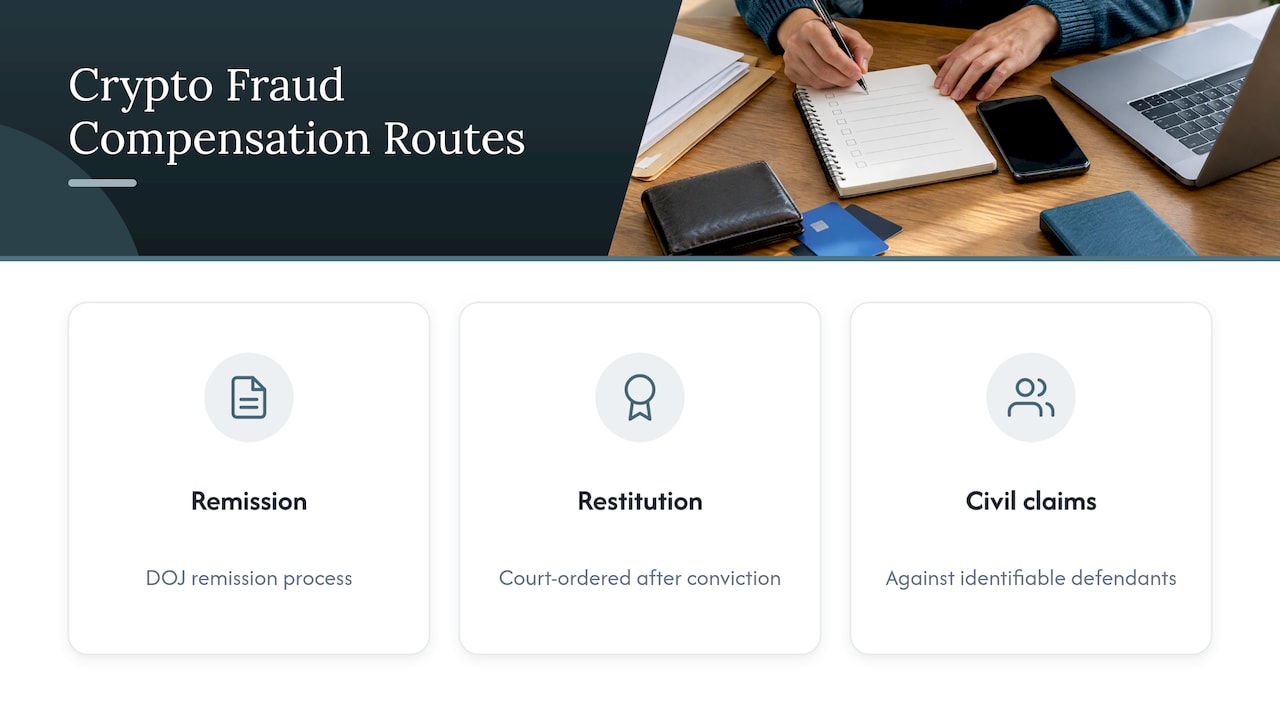
There is no dedicated federal fund that automatically repays crypto fraud losses. The realistic routes are the DOJ remission process described above, court-ordered restitution after a conviction, and civil claims against identifiable defendants, which an attorney can evaluate.
State crime victim compensation programs exist, but they generally focus on costs tied to violent crime, and eligibility for pure financial fraud varies by state. Contact your state’s program or the victim assistance office tied to your case and ask directly what it covers.
Treat any compensation offer with caution. The Office for Victims of Crime has issued a fraud alert about scammers claiming to be with OVC or the FBI, stating that OVC will never ask victims for payment to provide compensation. Legitimate remission petitions also require no fee. If a “fund” asks for money first, it is a scam.
How do you document the emotional and financial impact of the fraud?
Courts and prosecutors weigh documented harm. Build the record while details are fresh:
- Keep a dated timeline of the fraud, from first contact to final transfer
- Record every loss: amounts sent, fees, and costs from the fraud such as credit monitoring or lost work time
- Note the dollar value on the date of each transfer, since remission may be tied to loss-date value
- Save bank statements, exchange histories and tax records that show where funds came from
- Write a personal account of how the loss affected your finances, health, sleep and relationships
Keep emotional documentation factual. Dated notes about specific changes, such as missed work or delayed medical care, read better than general statements. If you see a doctor or counselor, keep records of those visits, since they can support a victim-impact statement. Overseas DeFi explains how to build a transaction ledger for tax reporting, and the same ledger habits help you present losses clearly.
How can you communicate securely with law enforcement?
Protect your information while you cooperate. Use the official channels: file through ic3.gov and reach agents through phone numbers listed on fbi.gov or your local field office page. Anyone who contacts you first claiming to be an agent should be verified by calling back an independently found number, and the FTC has published infographic tips on spotting government impostors.
A few habits reduce exposure:
- Never share private keys or seed phrases with anyone, including someone who says they are investigating
- Send documents through the agency’s secure portal or in person, not through unknown email addresses
- Share only what the investigation needs, and keep a copy of everything you send
- Use a device you trust, update your passwords and enable two-factor authentication on exchange and email accounts
- Keep a log of every agent name, date and case number
If you retain a private investigator or attorney, put confidentiality terms in writing and confirm in the engagement who will receive your evidence.
What other recovery scams should you watch for?
Fake law firms are only one type. Others you may meet:
- Fake recovery software: programs or “wallet scanners” that claim to retrieve funds but steal your keys or install malware
- Fraudulent recovery agents: people on social media, Telegram or forums who claim insider access to exchanges or hackers
- Government and OVC impersonators: callers who say a compensation fund is waiting once you pay a “release fee” (see the OVC alert above)
- “Hacker” services: offers to hack the scammer’s wallet, which is illegal and usually a second scam
- Phony testimonials and review sites: polished pages with invented success stories
The tells repeat. They ask for payment before results, guarantee recovery, insist on speed and secrecy, and avoid verifiable names and addresses. Ask for a written scope, a physical business address and named professionals you can check independently. Anyone who asks for your seed phrase is stealing, not recovering.
What can paid blockchain forensics deliver, and what can’t it?
Forensics can show where funds went, which wallets are linked and how the money was laundered. It cannot guarantee that anyone gets the money back.
In our view, a forensic investigation is worth considering when the loss is large, the laundering is complex or you plan civil or criminal action. Typical deliverables include tracing flows across wallets and exchanges, clustering related addresses, identifying mixer or bridge use and writing a technical report suited to legal proceedings. Those reports support law enforcement and attorneys; they do not replace your IC3 complaint. Bring transaction hashes, wallet addresses, communications and exchange account details at intake. The sooner your evidence is organized, the more an investigator can do with it.
— cristian
How do we help U.S. crypto fraud victims?
We trace stolen crypto across public blockchains, run OSINT investigations, preserve evidence and prepare technical reports suitable for legal use. You can see the full list on our recovery scams services page. We work with victims directly and with their attorneys, and we do not promise that funds will be returned.
Bring these to intake:
- Transaction hashes and wallet addresses
- Screenshots and message history
- Exchange account details and any KYC information you hold
After we review your material, we outline what can be traced and what reasonable next steps and timelines look like. Current pricing details are on our site. To get started, read our crypto fraud investigation guide and contact us from there.
This article is general information, not a substitute for advice from a qualified financial advisor. Consult a qualified financial professional about your own circumstances before acting on anything here.
FAQ
Can the FBI recover scammed money?
Sometimes, but it is not typical. The FBI says filing a complaint does not guarantee a case will be opened or funds returned. When funds are seized and forfeited, DOJ may compensate victims through remission.
What is the main problem with cryptocurrency for fraud victims?
Transfers are fast and usually cannot be reversed once confirmed. Scammers move funds across wallets and exchanges quickly, which is why prompt reporting and contacting the exchange matter.
Where do you report crypto theft?
Report to the FBI’s IC3 at ic3.gov and the FTC at ReportFraud.ftc.gov, then add your state attorney general. Contact the exchange or ATM operator you used right away, as the FTC advises.
Can police trace crypto transactions?
Yes, public blockchains record transfers, so investigators can follow funds between addresses. Tracing is harder when funds pass through mixers or are cashed out through unregulated services.