Civil crypto fraud cases let victims sue for compensation and only need to prove their claim is more likely true than not. Criminal cases are brought by the government to punish offenders and require proof beyond a reasonable doubt, with prison time and forfeiture as possible outcomes. Pursuing both tracks at once is often the smartest move, and the first thing to do is file a report with the Internet Crime Complaint Center while preserving every transaction record you have.
TL;DR:
- Victims should file an IC3 complaint immediately and preserve all transaction records to enable effective tracing and evidence collection.
- Civil crypto fraud claims require lower proof standards and can deliver damages, restitution, or court orders, but are less effective for small or untraceable losses.
- Criminal prosecutions rely on proving intent beyond a reasonable doubt and often use wire fraud and conspiracy statutes linked to large-scale seizures worth hundreds of millions.
- Running civil and criminal cases simultaneously can speed up asset recovery, especially when civil freeze orders or subpoenas unmask anonymous wallet holders early.
- Prosecutors and regulators frequently work on parallel tracks, with civil penalties and forfeitures complementing criminal proceedings, but cross-border jurisdiction complicates enforcement.
Table of Contents
- What civil crypto fraud claims look like and what victims can recover
- How criminal crypto fraud prosecutions work in the U.S.
- How civil and criminal tracks work together for victims
- Statutes and enforcement actions every victim should know
- What forensic investigators and courts need from blockchain evidence
- What to do right now if you think you were scammed
- Differences in legal consequences and potential penalties
- Landmark cases that show how these paths diverge
- How jurisdiction shapes civil and criminal crypto fraud cases
- Proving intent in criminal cases versus liability in civil cases
- Why speed and one overlooked record often decide the outcome
- How Recovera Forensics supports victims and their attorneys
- FAQ
- Sources
What civil crypto fraud claims look like and what victims can recover
A civil crypto fraud case is a private lawsuit, not a government prosecution. Under the legal definition of fraud, civil fraud is a tort resolved between private parties seeking damages, which is a lower bar than the government must meet in a criminal court. Victims typically bring claims for fraud, misrepresentation, conversion, unjust enrichment, or breach of contract when a platform or counterparty promised something it never delivered.
Courts can grant several forms of relief in these suits:
- Compensatory damages that aim to make the victim financially whole.
- Restitution ordering the return of specific funds or assets.
- Injunctive relief or a temporary restraining order to stop further dissipation of funds.
- A John Doe subpoena that forces an exchange to disclose the real identity behind an anonymous wallet or account.
Civil suits make the most sense when the loss is large enough to justify legal fees and when there is a traceable, solvent defendant. Litigation can run from several months to a few years depending on jurisdiction and whether the defendant contests the case, so victims with modest losses often find the cost-to-recovery math unfavorable.
How criminal crypto fraud prosecutions work in the U.S.
Criminal cases are brought by federal or state prosecutors, not by the victim, and the government must prove guilt beyond a reasonable doubt rather than meet the lower civil standard. That gap matters in practice: prosecutors decline many promising leads because the evidence, while suggestive, cannot clear the criminal threshold.
Federal prosecutors lean on a narrow set of statutes in most crypto fraud indictments:
- Wire fraud under 18 U.S.C. § 1343, the workhorse charge for schemes that use electronic communications to deceive victims.
- Money laundering under 18 U.S.C. § 1956, often charged alongside wire fraud when proceeds move through mixers or multiple wallets.
- Conspiracy charges that let prosecutors reach every participant in a scheme, not just the person who collected the funds.
Federal strike-force operations have seized and moved to forfeit more than $580 million in cryptocurrency tied to transnational scam networks, according to a Department of Justice announcement, showing what forfeiture can achieve at scale even though the proceeds go through the government before any victim sees a dollar.
Outcomes in a successful criminal case include imprisonment, fines payable to the court, court-ordered restitution to victims, and forfeiture of any crypto law enforcement manages to seize.
How civil and criminal tracks work together for victims
The two systems are not mutually exclusive, and running them in parallel often produces better results than picking one. A civil subpoena or John Doe motion can unmask an anonymous wallet holder months before a criminal case reaches that stage, handing investigators a lead they would otherwise spend a long time chasing.
There are trade-offs to weigh before committing resources:
- Check whether a criminal investigation is already active: an open case can mean sealed filings or an informal request from investigators to hold off on civil discovery that might tip off a target.
- Weigh the time horizon: criminal restitution and forfeiture can take years to resolve, while a civil freeze order can sometimes happen in days.
- Decide whether the loss justifies forensic and legal spending: a six-figure theft with a traceable wallet is a different calculation than a small loss with funds already scattered across a mixer.
A criminal freeze can protect assets that a civil case later recovers for you, so the two paths frequently reinforce each other rather than compete.
Statutes and enforcement actions every victim should know
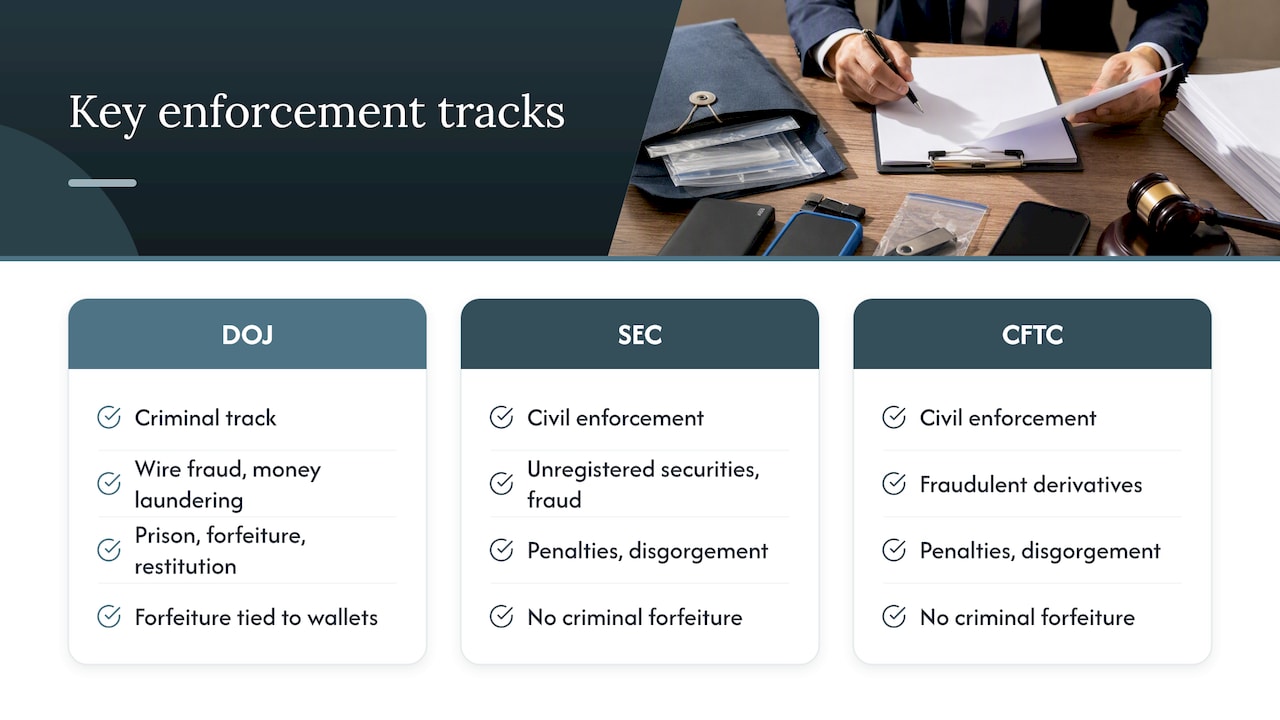
Beyond the DOJ’s criminal forfeiture program, civil regulators run their own enforcement tracks. The Securities and Exchange Commission and the Commodity Futures Trading Commission bring civil actions against unregistered securities offerings and fraudulent derivatives schemes, seeking penalties and disgorgement rather than prison time. A single crypto scheme can draw attention from multiple agencies at once: the DOJ pursuing criminal wire fraud and money laundering charges while the SEC or CFTC pursues a parallel civil penalty.
Federal indictments in large crypto schemes, like the complaint filed by the U.S. Attorney’s Office for the Eastern District of New York, commonly pair wire fraud and money laundering counts with forfeiture allegations tied to specific wallet addresses. That pairing matters for victims because forfeiture claims depend on prosecutors identifying and tracing the exact crypto tied to the fraud, which is exactly the kind of work forensic analysts do before a case is ever filed. Asset forfeiture that results from a criminal case can eventually benefit victims through a restitution process, but the Department of Justice’s own forfeiture program makes clear that process runs separately from the criminal case itself and can take years to conclude.
What forensic investigators and courts need from blockchain evidence
A technical report only holds weight in court when it can show exactly where funds went and prove the data was not altered along the way. That means transaction graph analysis, wallet clustering to group addresses controlled by the same actor, linking flagged wallets to identifiable exchange accounts, and a documented chain of custody for every piece of digital evidence.
Victims can speed this process up dramatically by preserving the right records before they disappear:
- Wallet addresses and transaction hashes tied to the theft, which anchor every later trace.
- Exact dates and times of transfers, which help investigators match activity across platforms.
- Exchange account logs and KYC records, which can connect a wallet to a real identity.
- Chat logs or emails with the scammer, which often contain admissions or other wallet addresses.
The FBI and IC3 guidance on cryptocurrency fraud stresses that this kind of granular transaction data is what connects individual victim complaints into larger case patterns that investigators can act on.
Pro Tip: Export your exchange transaction history as a CSV or PDF the moment you suspect fraud, since some platforms purge older account activity after a set retention window.
Mixers and cross-border transfers remain the biggest limits on any trace, since funds that pass through privacy tools or offshore exchanges with weak compliance can go cold fast. That is why forensic work has to start within days of discovering the fraud, not weeks.
What to do right now if you think you were scammed
Acting quickly protects both your civil and criminal options, and the order of operations matters.
- Write down every wallet address, transaction hash, and timestamp connected to the loss before you do anything else.
- File an IC3 complaint with the FBI and file a report with your local police department, since many exchanges require a case number before they will act on a preservation request.
- Contact any exchange involved directly, citing your IC3 or police case number, and ask them in writing to preserve account records and freeze any remaining balance.
- Save every chat log, email, and screenshot tied to the scammer’s communications, since these often surface later as evidence of intent.
- Decide whether to retain a civil attorney, a forensic investigation firm, or both, based on the size of the loss and whether the funds appear traceable.
Costs for forensic tracing and legal representation vary by case complexity, and most firms will tell you upfront whether a trace looks viable before you commit money to it. Realistic expectations matter here: a criminal case can take years to produce restitution, while a civil freeze order, when a court grants one, can sometimes protect funds within days.
Differences in legal consequences and potential penalties
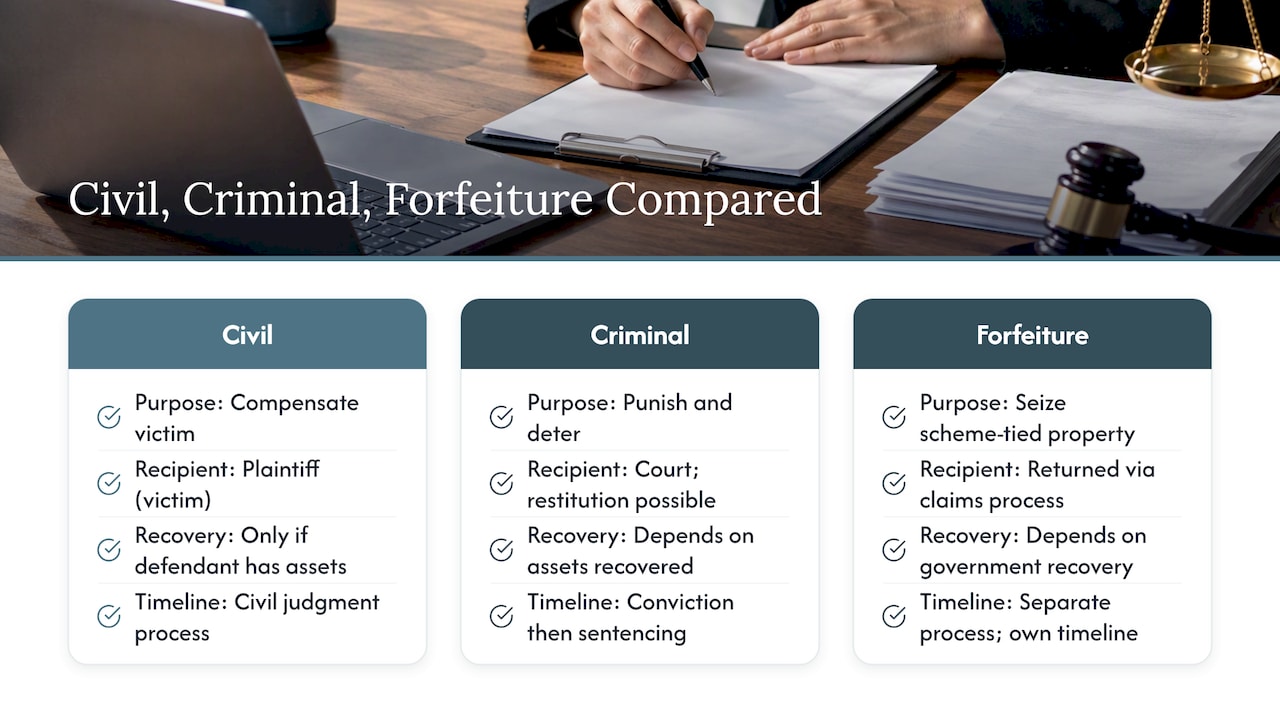
The penalties in civil and criminal crypto fraud cases point in different directions, and conflating them leads to unrealistic expectations. A civil judgment is a debt the defendant owes the plaintiff: compensatory damages, sometimes punitive damages, and court costs. Collecting on that judgment depends entirely on whether the defendant has assets within reach, and a court win does not guarantee a dollar ever changes hands if the defendant is judgment-proof or has already moved funds overseas.
Criminal penalties are about punishment and deterrence rather than making the victim whole, with details on criminal consequences explained at Jeff T. Gorman Law Offices. A conviction for wire fraud or money laundering can carry years in federal prison and substantial fines payable to the court, not the victim. Judges can order criminal restitution as part of sentencing, but that restitution competes with other creditors and depends on what assets the government actually recovers, which is often a fraction of what was stolen.
Forfeiture sits in between. When prosecutors seize crypto tied to a scheme, that property can eventually be returned to victims through a formal claims process, but as the DOJ’s Asset Forfeiture Program explains, that process is separate from both the criminal case and any civil judgment, and it moves on its own timeline. The practical takeaway is that a criminal conviction punishes the offender and can unlock forfeiture, while a civil judgment creates a direct path to compensation, but only if there is something left to collect.
Landmark cases that show how these paths diverge
Large-scale DOJ strike-force actions illustrate what criminal forfeiture can accomplish when investigators move fast and identify the right wallets. The seizure actions that pushed recovered cryptocurrency past $580 million show how, once investigators trace funds to a specific exchange account or cluster of wallets, the government can move to freeze and eventually forfeit that property even across a transnational network.
Federal indictments built around wire fraud and money laundering counts, like the complaint from the Eastern District of New York, show the other half of the picture: prosecutors naming specific wallet addresses in forfeiture allegations as part of a criminal case, tying the legal theory directly to blockchain evidence.
On the civil side, regulators bring a different kind of action entirely. The CFTC’s enforcement actions against unregistered or fraudulent crypto derivatives schemes seek civil penalties and disgorgement rather than prison sentences, often running alongside a parallel criminal case against the same defendants. These cases show why victims sometimes deal with more than one government agency and why a civil regulator’s win does not substitute for a private victim’s own lawsuit.
How jurisdiction shapes civil and criminal crypto fraud cases
Jurisdiction gets complicated fast in crypto fraud because the victim, the defendant, and the exchange holding the funds can sit in three different countries. Criminal jurisdiction in the U.S. generally depends on where the fraudulent communications originated or landed, which is why wire fraud charges under 18 U.S.C. § 1343 can reach defendants overseas as long as U.S. wires or interstate communications were used in the scheme.
Civil jurisdiction works differently and depends on where the defendant can be served and where a court can assert personal jurisdiction over them, which is often much harder when a scammer operates entirely offshore with no U.S. presence. This is part of why a John Doe subpoena aimed at a U.S.-based exchange can matter so much: it can unmask an account holder without needing to establish jurisdiction over them directly, at least at the discovery stage.
Cross-border cases also slow down cooperation between law enforcement agencies, since freezing or seizing assets held on a foreign exchange typically requires working through that country’s legal process, which can take far longer than a domestic freeze order.
Proving intent in criminal cases versus liability in civil cases
Criminal prosecutors have to prove the defendant acted with intent to defraud, beyond a reasonable doubt, which is a genuinely hard bar to clear in crypto cases where defendants often claim they were running a legitimate, if failed, investment platform. Intent requires showing the defendant knew the scheme was fraudulent, not just that investors lost money, and that distinction has sunk prosecutions where the evidence showed poor judgment but not deliberate deception.
Civil plaintiffs face an easier task by comparison. Under the preponderance of the evidence standard described in Cornell Law’s overview of fraud, a plaintiff only needs to show it is more likely than not that the defendant made a material misrepresentation the victim relied on to their detriment. Negligent misrepresentation or reckless disregard for the truth can sometimes support a civil claim even when the facts fall short of proving criminal intent.
That gap explains why some notorious crypto schemes result in a civil judgment years before, or even instead of, a criminal conviction: the civil case simply has a lower hill to climb.
Why speed and one overlooked record often decide the outcome
Stolen crypto moves fast, often through several wallets within hours, so delay is the biggest threat to recovery. One record victims consistently forget: platform support tickets and IP logs tied to their account, which can place a scammer’s access and location on the record long after chat messages are deleted. When losses run into real money, bringing in forensic support early, rather than after a civil suit stalls, tends to change what is still recoverable.
— cristian*
How Recovera Forensics supports victims and their attorneys
We provide technical services that support civil attorneys and criminal investigators, including transaction tracing across wallets and exchanges, OSINT work to attribute anonymous accounts to real identities, and evidence preservation in line with court standards. Technical reports can turn raw blockchain data into exhibits usable by judges or prosecutors, supporting actions like John Doe subpoenas or law enforcement referrals.
Engagements typically involve preparing technical reports, outreach to exchanges for relevant account data, and coordination with attorneys or investigators on the case. If you are weighing whether civil action, a criminal report, or both make sense for your situation, our recovery and investigation services page outlines what an initial consult covers and what documentation to bring to it.
This article is general information, not a substitute for advice from a qualified lawyer. Consult a qualified legal professional about your own circumstances before acting on anything here.
FAQ
What is the difference between criminal and civil fraud?
Civil fraud is a private lawsuit where the plaintiff must prove their case by a preponderance of the evidence and can recover damages. Criminal fraud is prosecuted by the government, requires proof beyond a reasonable doubt under statutes like wire fraud, and can result in prison time rather than direct compensation to the victim.
Can crypto be traced by police?
Yes, blockchain transactions are recorded on a public ledger, which lets investigators and forensic analysts follow fund movements across wallets and exchanges. Tracing gets harder once funds pass through mixers or offshore platforms, which is why the FBI and IC3 urge victims to report and preserve data quickly.
Is fraud considered civil or criminal?
Fraud can be both at once: the same conduct can give rise to a private civil lawsuit for damages and a separate criminal prosecution by the government. The Cornell Law overview of fraud confirms these are two independent legal tracks that can proceed in parallel.
Should I file both a civil case and a criminal report?
Filing an IC3 report costs nothing and should happen immediately, regardless of whether you also plan to sue. A civil suit makes the most sense when the loss is substantial and the funds or the defendant are traceable, so many victims pursue both tracks at the same time rather than choosing one.
Sources
These primary U.S. government and legal sources back the statutes, enforcement examples, and reporting steps covered above.
- Fraud | Wex | Legal Information Institute | Cornell Law School
- Cryptocurrency – Internet Crime Complaint Center (IC3)
- D.C. Scam Center Strike Force Seizures of Cryptocurrency from Chinese Transnational Criminals Tops $580 Million | United States Department of Justice