File a complaint with the FBI’s Internet Crime Complaint Center (IC3) today. That single action costs nothing, and it’s the fastest way to get investigators moving before stolen funds disappear into a mixer or an offshore exchange. From there, your crypto fraud legal options split into three lanes you can pursue at the same time: a law-enforcement report, a civil lawsuit if the money can be traced to a real account, and a complaint with a securities or commodities regulator if the scheme involved investment fraud.
Each lane moves at a different speed. A freeze at a regulated exchange can happen quickly. A civil judgment generally takes a moderate amount of time. Criminal restitution often takes a long time and may only return a portion of what victims lost.
Two things to avoid right away: never share a private key or seed phrase with anyone claiming they can “recover” your funds, and never pay an upfront fee to a recovery service. Those are almost always a second scam layered on top of the first. A blockchain forensics firm like Recoveraforensics builds the evidence trail your lawyer needs. It doesn’t promise guaranteed recovery, and you should be skeptical of anyone who promises that.
- File IC3 immediately — free, and it can trigger investigative referrals.
- Preserve every wallet address, transaction hash, and message before you do anything else.
- Pursue a civil claim only if funds are traceable to a KYC exchange or identifiable defendant.
Quick fact: the FTC warns that crypto payments carry none of the chargeback protections you’d get with a credit card, which is exactly why acting fast and documenting everything matters so much here.
TL;DR:
- Filing an immediate IC3 complaint is crucial, as it often triggers fast investigations, asset freezes, and builds the foundation for legal action.
- Preserving transaction hashes, wallet addresses, and chat logs early ensures crucial evidence remains available for police, attorneys, and forensic reports.
- Civil lawsuits are most effective when stolen funds are traceable to regulated exchanges or identifiable accounts, not through anonymous wallets or mixers.
- Forensic tracing reports that map transaction chains and link them to exchange accounts critically strengthen your chances of asset freezes and court recovery efforts.
- Federal agencies like the SEC, CFTC, and DOJ can pursue longer-term actions, but criminal restitution often takes years and depends on what assets are still recoverable from the defendant.
Table of Contents
- What Are Your Legal Options After Crypto Fraud?
- Can You Sue Someone for Crypto Fraud?
- What Can the SEC, CFTC, and DOJ Actually Do?
- Why Does a Forensic Investigation Matter for Your Case?
- How Do You Choose the Right Attorney and Forensics Team?
- Key Takeaways
- What the Research Actually Supports
- Get Forensic Support for Your Crypto Fraud Case
- Sources
- FAQ
What Are Your Legal Options After Crypto Fraud?
Reporting isn’t optional paperwork. It’s the trigger for everything that follows, including any asset freeze.
- File with IC3 first. Go to ic3.gov and submit wallet addresses, transaction hashes, dollar amounts, exact timestamps, and any screenshots of the scammer’s communications. The FBI’s own guidance says to file even if you’re not sure money is fully lost. Investigators sometimes link isolated complaints into larger takedowns.
- File with the FTC at reportfraud.ftc.gov. The FTC doesn’t investigate individual cases, but it feeds a shared database that state and federal agencies use to spot patterns and build enforcement priorities.
- Contact your state attorney general’s office. Many states have consumer protection divisions that can act faster than federal agencies on smaller-dollar cases.
- Ask the exchange to freeze the receiving account, if you know where the funds landed. This request usually needs to come through counsel with a subpoena, since exchanges rarely act on a victim’s request alone.
- Preserve everything now: export transaction CSVs, screenshot chat logs, save every email, and never delete a conversation with the scammer, even if it’s upsetting to reread.
Pro Tip: Save the original transaction hash in plain text somewhere outside your crypto wallet app. If your phone or exchange account gets locked during the investigation, you’ll still have the one piece of evidence every agency and attorney will ask for first.
Can You Sue Someone for Crypto Fraud?
Yes, when you can identify a defendant or trace the funds to an account someone controls. Civil litigation gives you control that a police report simply doesn’t. You decide when to file, what to ask for, and how aggressively to pursue it, rather than waiting on a prosecutor’s caseload.
Several legal theories typically apply:
- Fraud — the scammer made false representations you relied on to your financial detriment.
- Conversion — someone took your property (in this case, digital assets) without authorization.
- Unjust enrichment — the defendant benefited at your expense with no valid contract behind it.
- Breach of contract — relevant if a fake investment platform or “advisor” made specific promises in writing.
- RICO or class claims — worth exploring when the same scheme victimized a group of people, since damages and legal costs scale better collectively.
Speed matters more than most people expect. A temporary restraining order or an emergency asset freeze, filed within days of discovery, can lock down funds sitting at a regulated exchange before they move further. Prejudgment remedies like these are often more decisive than the eventual judgment, because a judgment against a defendant with no assets left is worth very little.
California residents have a particularly sharp tool available. Penal Code section 496© lets victims of theft-like conduct sue for treble damages plus attorney’s fees. That statute alone can turn a modest claim into serious settlement leverage, and it’s worth asking any attorney you consult, in California or elsewhere, whether a comparable statute exists in your state.
Civil litigation and criminal reporting aren’t competing options. File the IC3 report the same week you talk to a lawyer about a civil suit. One doesn’t wait on the other, and evidence you gather for one often strengthens the other.
Civil cases make economic sense when funds moved through a KYC-compliant exchange or a custodial platform that can be subpoenaed. They rarely make sense when the money vanished into an anonymous wallet cluster or an offshore mixer with no identifiable custodian on the other end. An honest attorney will tell you which situation you’re in before taking a retainer.
What Can the SEC, CFTC, and DOJ Actually Do?
Federal agencies operate on a longer timeline than a private lawsuit, but they can reach outcomes an individual victim usually can’t.
- The SEC steps in when the scheme involved a digital asset marketed or sold as a security, typically an unregistered token offering or a fraudulent investment platform. It can obtain injunctions and disgorgement, sometimes returning funds to harmed investors through Fair Fund distributions.
- The CFTC handles fraud and manipulation tied to commodities, including many crypto trading and derivatives scams, and holds similar anti-fraud authority to seek restitution.
- The DOJ pursues criminal charges. When convictions lead to forfeited assets, victims can potentially recover funds through remission or restoration processes, but only from whatever the defendant still has.
That last point matters more than most victims realize. Restitution is capped by what’s actually recoverable from the defendant, and criminal cases often take years to reach distribution, if they reach it at all. Contact these agencies alongside, not instead of, your civil case. Evidence often flows both directions, and a parallel criminal investigation can strengthen the discovery you get in a private suit.
Why Does a Forensic Investigation Matter for Your Case?
A forensic tracing report is what turns raw blockchain data into something a judge can act on. Without it, “the money went to a wallet” is a story. With it, that story becomes exhibits.
A usable report typically includes a transaction flow map showing every hop the funds took, wallet clustering that groups related addresses under a likely single owner, direct links between those addresses and named exchanges, timestamps for every transfer, and a chain-of-custody narrative that holds up under scrutiny in court.
- Timing is everything. Tracing done in the first days after a theft supports a TRO or freeze request before funds pass through a mixer or an off-ramp that erases the trail.
- A report that connects wallet activity to a KYC-compliant exchange gives your lawyer grounds to subpoena account records, which is often the step that identifies a real, sueable defendant.
- Recoveraforensics builds these reports specifically for legal proceedings, tying transaction patterns to exchange accounts rather than stopping at a basic wallet lookup.
Pro Tip: Contact a forensics provider the same week you file your IC3 report, not after you’ve already hired an attorney. A tracing report finished early can shape which court filings your lawyer even bothers making.
Watch for red flags in this space: guaranteed recovery promises, requests for your private keys or seed phrase, and any “recovery agent” asking for payment in crypto upfront. Legitimate forensic firms bill for investigative work, not for a promised outcome.
How Do You Choose the Right Attorney and Forensics Team?
- Ask about crypto-specific experience. Has the attorney actually obtained an asset freeze or TRO in a digital asset case, or is crypto a side note to their general fraud practice?
- Ask how forensic costs get handled. Some firms build tracing costs into their fee structure; others expect you to hire a forensics provider separately and hand over the report.
- Clarify the fee structure up front. Contingency arrangements suit cases with an identifiable, collectible defendant. Hourly billing is more common when the path to recovery is still uncertain.
- Gather your documents before the first call: transaction hashes, exchange account IDs, every message from the scammer, and any KYC information you already have on the receiving party.
- Expect early motions, not a slow start. A competent attorney typically confirms your IC3 filing is done, requests an exchange freeze where possible, prepares TRO paperwork, and retains a forensics firm for a report within the first couple of weeks.
Key Takeaways
Victims who file an IC3 complaint immediately and pair it with a traceable civil claim have the strongest realistic shot at recovering stolen crypto.
| Point | Details |
|---|---|
| File IC3 first | It’s free and can trigger investigative referrals faster than any other single step. |
| Preserve evidence immediately | Save wallet addresses, transaction hashes, screenshots, and messages before contacting anyone else. |
| Civil suits need traceable funds | Fraud, conversion, and unjust enrichment claims work best when money hits a KYC exchange. |
| California offers treble damages | Penal Code §496© allows treble damages and attorney’s fees in qualifying theft cases. |
| Forensic reports enable legal action | Recoveraforensics builds transaction trace reports designed to support subpoenas and asset freezes. |
What the Research Actually Supports
The conventional advice you’ll find in most scam-recovery articles treats reporting and litigation as sequential: report first, wait, then maybe sue. That sequencing is backwards for anyone whose funds are still traceable. The agencies that can freeze money fastest, meaning the exchanges holding it, respond to legal process, not to a police report sitting in a queue. Waiting for a criminal investigation to conclude before starting a civil case usually means the funds have already moved.
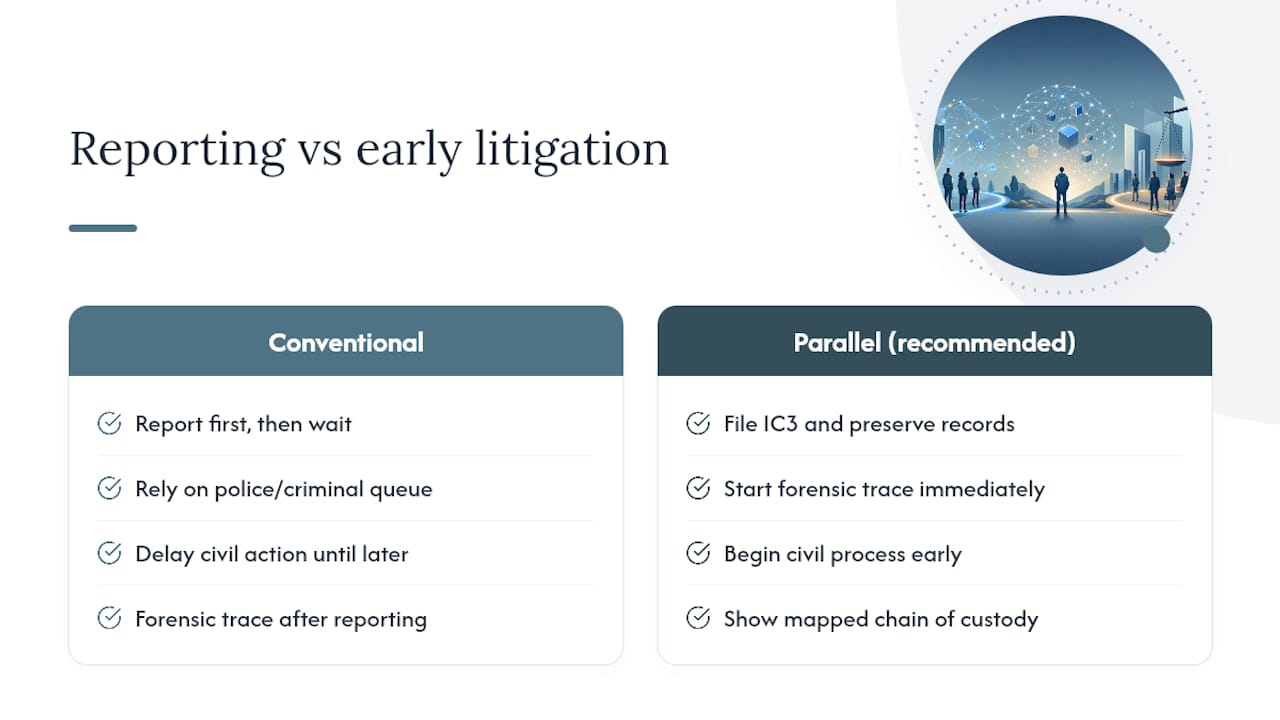
What’s underrated is how much leverage a forensic report creates before you’ve filed anything in court. It’s not just documentation. It’s the difference between telling a judge “we believe the funds went somewhere” and showing a mapped chain of custody that points to a named exchange account. That distinction decides whether a freeze request gets granted in days or gets dismissed for lack of specificity.
If you take one thing from this, prioritize speed and evidence over waiting for permission from any single agency. File IC3, preserve your records, and start a forensic trace in parallel, not in sequence.
— cristian
Get Forensic Support for Your Crypto Fraud Case
Filing reports and researching statutes only gets a victim so far without the transaction-level evidence a court actually needs. Recoveraforensics is built for exactly that gap: instead of a basic wallet lookup, its investigators trace transaction flows, cluster related wallets, and connect stolen funds to named exchange accounts in a report formatted for subpoenas and freeze requests. That’s the piece most victims are missing when their attorney asks for evidence to file a TRO.

If you’ve already filed with IC3 and preserved your transaction records, the next move is getting that evidence organized into something legally usable. Reach out through the Recoveraforensics contact page to start a case review and find out whether your funds can be traced to a subpoenable account.

This article is general information, not a substitute for advice from a qualified lawyer. Consult a qualified legal professional about your own circumstances before acting on anything here.
Sources
Start with the IC3 cryptocurrency reporting page to file your complaint, then submit a parallel report through the FTC’s consumer fraud page. For forensic support tied to legal proceedings, Recoveraforensics outlines its process on its recovery services page, and you can start a case review through its contact page.
- Cryptocurrency – Internet Crime Complaint Center (IC3)
- California Penal Code §496© civil remedy explanation — Shouse Law
- Crypto fraud & asset recovery — Digital Asset Law
- What to know about cryptocurrency and scams — FTC Consumer Information
FAQ
Can You Get Your Money Back After a Crypto Scam?
Sometimes, but it depends almost entirely on whether the funds can be traced to a regulated exchange or identifiable person. Fast reporting and early forensic tracing significantly improve the odds compared to waiting weeks to act.
Who Investigates Crypto Fraud in the United States?
The FBI’s IC3 unit handles initial complaints, while the SEC and CFTC pursue civil enforcement depending on whether the fraud involved securities or commodities. The DOJ handles criminal prosecution and asset forfeiture.
What Should I Do Immediately After Falling Victim to Crypto Fraud?
File an IC3 complaint and a report with the FTC right away, preserve every transaction record and message, and avoid any recovery service that asks for upfront payment or your private keys. Contacting a forensics provider like Recoveraforensics early can help preserve evidence before funds move further.
How Do I Try to Recover Funds Sent to a Scammer?
Start with an IC3 report, then have a blockchain forensics investigation trace the funds to see if they landed at a KYC-compliant exchange. If they did, an attorney can pursue a subpoena and potentially a civil claim for conversion or fraud against the account holder.