Paid blockchain-forensic investigations can materially improve your odds of recovering stolen cryptocurrency, but no legitimate firm can guarantee full recovery, and any provider who promises one is a red flag. What actually moves the needle: how fast you act, whether the stolen funds hit a custodial chokepoint like an exchange before they scatter into mixers, and how well-documented your forensic evidence is when it lands in front of a judge or exchange compliance team.
That third factor is where most victims lose ground without realizing it. A trace that isn’t hashed, timestamped, and tied to specific TXIDs is just a story, not evidence. Firms like Recovera Forensics build reports designed to hold up under FRE 702/Daubert scrutiny, with expert witnesses ready to testify if the case reaches litigation.
What determines whether paid forensics is worth pursuing:
- Speed of engagement. Hours matter far more than days.
- Custodial touchpoints. Funds sitting at an exchange are freezable; funds churned through a mixer are much harder to trace.
- Evidence quality. Chain-of-custody logs, hashed exports, and expert-ready reports are what turn a trace into a court order.
Partial recovery is common in cases where specialist tooling and fast exchange notification get involved early, though full recovery remains the exception rather than the rule.
Key Takeaways
Paid blockchain-forensic investigations improve recovery odds when they combine fast action, exchange-level chokepoints, and evidence built to survive courtroom scrutiny.
| Point | Details |
|---|---|
| Speed decides outcomes | Exchanges can move funds in minutes, so notification and triage need to start within hours, not days. |
| Documentation is the product | Hashed exports, TXID-level narratives, and chain-of-custody logs turn a trace into usable evidence. |
| Pricing varies by scope | Expect triage fees, hourly billing, retainers, or fixed-scope pricing depending on case complexity. |
| Vet before you pay | Ask about Daubert experience, methodology transparency, and retainer availability before signing anything. |
| Recovera Forensics builds court-ready cases | Its reports pair blockchain tracing with hashed exhibits and expert witness availability for legal proceedings. |
Table of Contents
- What Happens in a Paid Blockchain-Forensic Investigation?
- How Long Does Crypto Recovery Take, and What Does It Cost?
- How Do You Vet a Blockchain-Forensics Provider?
- Can Forensic Reports Actually Be Used in Court?
- What Should You Do in the First 48 Hours?
- What the Recovery Industry Doesn’t Want You to Notice
- Working With Recovera Forensics on a Recovery Case
- Sources
- FAQ
What Happens in a Paid Blockchain-Forensic Investigation?
A crypto recovery scam almost always exploits confusion about what a legitimate investigation actually involves. If a provider skips straight to promising a dollar amount back, that’s your first clue something is off. Real forensic work follows a sequence, and understanding it helps you separate serious firms from opportunists.
- Triage and evidence preservation. Investigators immediately collect transaction IDs, wallet addresses, device logs, and screenshots, then hash every export so the data can’t later be challenged as altered.
- On-chain tracing. This is where clustering analysis, demixing, and cross-chain tracing come in. Specialist tools such as Chainalysis, TRM Labs, or Elliptic are typically required here, since a standard block explorer can’t attribute wallet clusters to real entities or unwind a mixer.
- Off-chain corroboration. Investigators work to connect on-chain activity to real identities through exchange KYC records, IP logs, and, when needed, subpoenas or court orders.
- Legal coordination. Findings get packaged for counsel, law enforcement, or exchange compliance teams, often as the basis for a freeze request or subpoena.
The deliverable at the end isn’t a vague summary. It’s a forensic report with exhibits tied to specific TXIDs and block heights, a documented chain-of-custody log, and, where the case warrants it, an expert available to testify.
Pro Tip: Ask upfront whether the report will include a reproducibility appendix, meaning the tool version, query parameters, and heuristics used. If a provider can’t answer that question, they likely aren’t building something a court will accept.
How Long Does Crypto Recovery Take, and What Does It Cost?
Exchanges can move funds within minutes of a deposit landing in a wallet under their control. That means the real recovery window is often hours to a couple of days, not weeks. Every hour a victim spends deciding whether to hire someone is an hour the stolen funds have to keep moving through wallets, bridges, and mixers.
Pricing in this space generally includes models such as triage fees, hourly investigations, retainers for immediate response, and fixed-scope engagements based on case complexity.
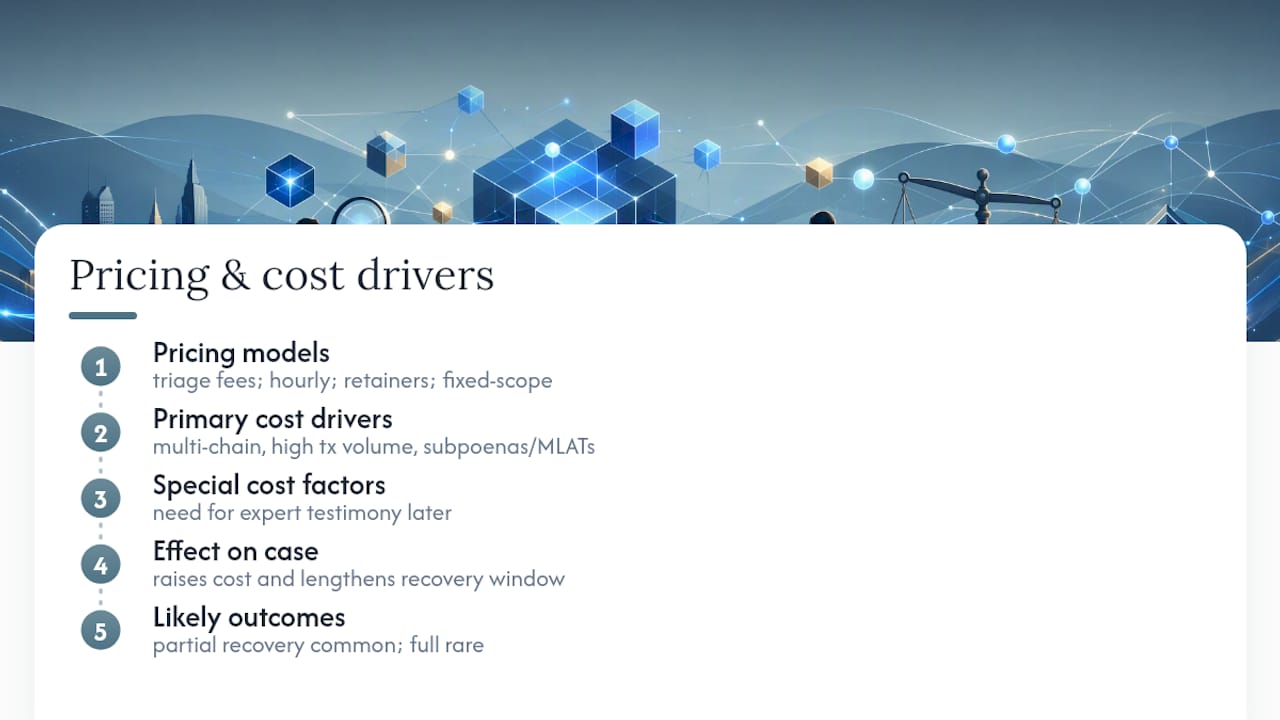
What drives the number up: multi-chain complexity, high transaction volume, the need for subpoenas or Mutual Legal Assistance Treaty requests to reach offshore custodians, and whether expert testimony becomes necessary later.
On outcomes: partial recovery is the realistic expectation in most cases where funds are traced and frozen, while full recovery is rare. Cases where funds hit an identifiable exchange wallet before scattering have meaningfully better odds than cases where funds go straight into a mixer, since speed and custodial chokepoints are the two biggest levers on whether anything gets frozen at all.
How Do You Vet a Blockchain-Forensics Provider?
A crypto recovery scam often looks like a legitimate service until you ask the wrong question and get a vague answer. Here are ten questions worth asking before you sign anything, plus what a real answer sounds like.
- Have you produced reports admitted in court? Ask for a general description of outcomes under FRE 702 or a Daubert challenge, not case names if confidentiality is an issue.
- How do you hash and preserve raw exports? A serious firm can explain this in one sentence without hesitation.
- How is wallet clustering validated? They should describe a methodology and a category of tooling, not just a brand name-dropped for reassurance.
- What certifications do your investigators hold? Vague answers here are a warning sign.
- Is an expert witness available if this goes to litigation? Recovery without a legal path forward is often just a trace with no teeth.
- What’s your relationship with exchanges and counsel? Faster relationships mean faster freezes.
- Do you offer a retainer for urgent cases? Firms without one may take hours just to onboard you.
- What’s your SLA for initial triage? Same-day response should be the baseline, not the exception.
- What does the final deliverable actually look like? Ask to see a sample report structure.
- What happens if the trace goes cold? Honest firms will tell you plainly, rather than promising a result they can’t back.
Pro Tip: Treat any firm that asks for a large non-refundable payment upfront, without a clear scope document, as a serious warning sign, regardless of how confident they sound on the phone.
Can Forensic Reports Actually Be Used in Court?
Forensic reports only matter if they can survive scrutiny once a case moves toward litigation, freeze requests, or subpoenas. Several evidence rules govern that path: FRE 901/902 for authentication, FRE 803(6) for business records, FRE 702 alongside the Daubert standard for expert testimony, and FRE 1006 when summaries of large data sets are presented.
A court-ready report typically includes raw exports, cryptographic hashes proving the data hasn’t been altered, documented tool versions and query parameters, and a transaction-by-transaction narrative tied to specific TXIDs and block heights. Courts have accepted this kind of evidence when it’s paired with a qualified expert and corroborating off-chain material.
Blockchain records carry evidentiary weight only in proportion to the context of their collection. Courts increasingly expect expert testimony to separate the technical reliability of the blockchain itself from the accuracy of the specific entries being interpreted, a distinction that has shaped outcomes in recent civil litigation.
A solid trace still enables real leverage: exchange freeze requests, injunctive relief, subpoenas for KYC data, and MLATs for offshore custodians. But limitations are real too. Attribution is often probabilistic, mixers and chain-hopping complicate even strong traces, and jurisdictional walls can block recovery even after a technically perfect investigation.
What Should You Do in the First 48 Hours?
The single biggest mistake victims make is waiting a day or two to “figure things out” before contacting anyone. That delay is often the difference between a frozen wallet and a cold trail.
- Do not move any assets from a potentially compromised device or wallet. Preserve the state exactly as it is.
- Collect everything, TXIDs, wallet addresses, token contract addresses, timestamps, screenshots, and any communications with the scammer.
- Notify the relevant exchange immediately, with precise TXID and address information, and formally request an urgent freeze.
- Contact a blockchain-forensic investigator and counsel, and consider a retainer arrangement, since a pre-incident retainer accelerates response time by skipping hours of onboarding.
- File a police or cybercrime report, and preserve off-chain logs like emails, chat histories, and IP records.
What the Recovery Industry Doesn’t Want You to Notice
The conventional advice on this topic treats “hire a forensic firm” as the whole answer. It isn’t. The real determinant of outcome is almost always decided before the investigation even starts, in the first few hours after the theft, by whether the victim froze their own reaction instead of freezing the funds.
Most guides underweight documentation. Victims fixate on finding someone who can “trace the money,” as if tracing were the hard part. Tracing is often the easy part. What separates a report that gets an exchange to act from one that gets ignored is whether it’s hashed, timestamped, and structured the way a court would expect to see it. A firm that skips that rigor isn’t offering a cheaper version of the same service. It’s offering a different, weaker product.
If you take one thing from this, prioritize speed and evidentiary discipline over the size of a firm’s marketing claims. A modest, well-documented trace submitted within hours beats an exhaustive one submitted two weeks late, every time.
— cristian
Working With Recovera Forensics on a Recovery Case
Recovera Forensics is the direct option for readers who want more than a trace. It’s a paper trail built to survive a courtroom. The firm specializes in recovering stolen cryptocurrency through advanced blockchain forensics, producing reports with the hashed exports, chain-of-custody documentation, and expert-witness readiness that separate a usable case from a dead end.
A typical engagement starts with immediate triage, moves into a scope estimate, then into full investigation and legal coordination, and ends with report delivery and, where needed, expert testimony support. Before reaching out, gather your TXIDs, wallet addresses, screenshots, device logs, and a timeline of what happened. That’s what lets Recovera start working immediately instead of spending your first hours on intake questions.
If you’re a victim, an investor, or a law firm supporting a client through this, start the conversation now rather than after another exchange transfer window closes.
Sources
- Building strong cases with blockchain evidence | TRM Labs
- The evidentiary value of blockchain in civil litigation: comparative insights and future directions | Frontiers
- Blockchain Forensics: Tracing Stolen Funds and Investigating Crypto Hacks | Security4Web3
FAQ
Is Paying for Crypto Recovery a Scam?
Legitimate blockchain-forensic investigations, billed per engagement with clear scope and no guaranteed outcome, are different from a crypto recovery scam that promises guaranteed fund return for an upfront fee. The distinction is whether the firm delivers documented forensic work or just a promise.
How Much Does a Blockchain-Forensic Investigation Cost?
Costs vary by pricing model, triage fee, hourly billing, retainer, or fixed scope, and rise with multi-chain complexity, transaction volume, and the need for subpoenas or expert testimony.
Can Stolen Cryptocurrency Really Be Recovered?
Partial recovery is common when funds are traced quickly and hit a custodial chokepoint like an exchange, but full recovery is rare, and no legitimate firm can guarantee it.
What Makes a Forensic Report Admissible in Court?
Reports need raw hashed exports, documented tool metadata, transaction narratives tied to TXIDs and block heights, and qualified expert testimony under FRE 702 and the Daubert standard.
How Fast Should I Contact an Investigator After a Theft?
Within hours, not days. Exchanges can move funds quickly, and firms like Recovera Forensics recommend immediate triage alongside exchange notification to preserve any chance of a freeze.