Address poisoning plants a lookalike wallet address in your transaction history so you copy the wrong one and send funds straight to an attacker. Your private keys stay safe. The danger is entirely behavioral: you paste a poisoned address instead of the real one, and once that transaction confirms, the money is gone. The fix is simple and non-negotiable: never copy an address from your history, always check the middle characters against a verified source, and confirm the destination on your hardware wallet screen before you approve anything.
TL;DR:
- Address poisoning exploits lookalike wallet addresses generated to resemble legitimate contacts and targets wallets through tiny transfers or counterfeit tokens without compromising private keys.
- Over 270 million poisoning attempts targeted approximately 17 million wallets from July 2022 to June 2024, resulting in confirmed losses of at least $83.8 million.
- Wallet providers like MetaMask, Ledger, and Trust Wallet use heuristics, such as address similarity alerts and direct verification, but manual checks remain essential for security.
- Valid verification involves confirming the full address, especially middle characters, on a hardware wallet screen and using verified sources rather than copying from transaction history.
- Rapid action, including evidence preservation and contacting exchanges or forensic experts, improves chances of recovery if funds are sent to poisoned addresses.
Table of Contents
- How Address Poisoning in Crypto Actually Works
- What Are the Common Address Poisoning Attack Methods?
- How Big Is the Address Poisoning Problem?
- How Do MetaMask, Ledger, and Trust Wallet Detect Poisoned Addresses?
- What’s the Right Verification Workflow Before Sending Crypto?
- What Should You Do If You Sent Funds to a Poisoned Address?
- What Do Regulators Say About Address Poisoning Scams?
- Address Poisoning vs. Phishing and Typosquatting: What’s the Difference?
- How Can Developers Prevent Address Poisoning in dApps?
- Recovera Forensics’ Perspective: Why Professional Tracing Matters
- How Recovera Forensics Helps Victims of Address Poisoning
- Sources
- FAQ
How Address Poisoning in Crypto Actually Works
Attackers use vanity address generators to create wallets whose first four and last four characters match one you regularly send to. Generating a matching prefix and suffix is computationally cheap. Matching the entire address is not, which is exactly why the middle of the address matters so much later.
Once the lookalike exists, attackers seed it into your transaction history. They might send a tiny amount of crypto to your wallet, trigger a zero-value token event that still shows up in your log, or drop a counterfeit token transfer that mimics a real payment. Your wallet doesn’t distinguish intent. It just records that an address interacted with yours.
The real trap is the interface. Most wallets abbreviate addresses as something like 0xABCD…WXYZ, and most people copy their “last used address” straight from history instead of typing or re-verifying it. MetaMask’s own guidance confirms the mechanism directly: poisoning does not compromise your private keys or seed phrase; it exploits the fact that you trust what you see in your recent activity.
What Are the Common Address Poisoning Attack Methods?
Attackers use a handful of repeatable techniques, and each leaves a slightly different fingerprint in your wallet activity.
- Dust transfers. A tiny, often negligible amount of ETH, BNB, or a token lands in your wallet from an address that closely resembles one you use often. It looks harmless, which is the point.
- Zero-value transferFrom events. This exploits a quirk in the ERC-20 standard that lets an attacker trigger a transfer event showing “0” tokens moved, without needing your approval or holding any balance. It still appears in your history as if a real interaction happened.
- Counterfeit token transfers. Fake tokens with names like “USDT” or “USDC” get sent to your address from a poisoned wallet, appearing convincingly normal in a token list that doesn’t verify contract authenticity.
Ethereum and BSC see the highest volume of these attacks because both chains support the permissive transferFrom semantics attackers rely on. Any EVM-compatible chain shares similar exposure.
How Big Is the Address Poisoning Problem?
The scale here isn’t anecdotal. A large academic measurement study tracked activity across Ethereum and BSC from July 2022 through June 2024 and identified more than 270 million poisoning attempts targeting roughly 17 million wallets. Of those attempts, 6,633 succeeded, and confirmed losses totaled at least $83.8 million, making it one of the largest phishing schemes ever measured on-chain.
Real cases back up the numbers. Chainalysis documented an incident where a victim nearly lost $68 million in WBTC after falling for a poisoned address, only narrowly avoiding the loss. A separate incident in December 2025 saw a large USDT transfer misdirected to a poisoned address, reigniting industry attention on the exploit.
Recovery odds hinge on speed. Funds that hit a centralized exchange within hours can sometimes be frozen. Funds routed through a mixer or swapped across a decentralized exchange within minutes become dramatically harder to trace or recover.
How Do MetaMask, Ledger, and Trust Wallet Detect Poisoned Addresses?
Wallet providers have built real defenses, but every one of them is a heuristic, not a guarantee.
- MetaMask now flags destination addresses that closely resemble a previously used one and displays warnings before you confirm a send transaction.
- Ledger recommends never copying an address from your transaction history and instead verifying the destination address directly on the device’s physical screen, where malware on your computer can’t alter what’s displayed.
- Trust Wallet compares outgoing destinations against known poisoning databases and shows side-by-side address comparisons when a match looks suspicious.
- On the deposit side, hiding zero-value and dust transfers from your default activity view reduces the chance you’ll mistake a planted address for a legitimate contact.
These protections catch a lot, but attackers actively test and adapt around vendor heuristics. That’s why manual verification still matters even on a wallet with every safety feature turned on.
What’s the Right Verification Workflow Before Sending Crypto?
Run this sequence every time you send a meaningful amount, especially to a new address:
- Pull the destination from a verified source, not your transaction history. Use a saved address book entry, a signed message from the recipient, or their official receive page.
- Check at least six characters in the middle of the address, not just the prefix and suffix. Vanity generators can cheaply fake the first and last few characters but can’t cheaply reproduce a matching middle string.
- Confirm the address on your hardware wallet’s screen before approving, since a compromised computer display can show one thing while the device shows another.
- Send a small test transfer, $20 to $50, for any new payment corridor, and wait for full confirmation before sending the full amount.
- Never rely on any single step alone. A test transfer sent early doesn’t protect you if the recipient’s history gets poisoned afterward, so pair it with the middle-character check and a fresh out-of-band confirmation right before the real transaction.
Pro Tip: Save every address you send meaningful amounts to in a dedicated address book inside your wallet, and disable “copy from history” as a habit entirely. It removes the exact behavior address poisoning depends on.
What Should You Do If You Sent Funds to a Poisoned Address?
Move fast. Blockchain transactions are irreversible once confirmed, but quick action still changes outcomes in some cases.
- Preserve every piece of evidence immediately: transaction hashes, timestamps, wallet addresses involved, and any messages or communications tied to the incident.
- Contact the receiving exchange or stablecoin issuer as soon as possible to request a freeze or ask about tracing options, since issuers like Tether have frozen wallets tied to confirmed fraud in the past.
- Bring in a blockchain forensics team when the funds moved through multiple wallets or platforms, since transaction graph analysis can trace flows that are otherwise invisible without specialized tools.
- Understand that laundering steps shrink your window fast. Once funds pass through a decentralized exchange swap or a mixer, tracing becomes significantly harder and time sensitivity increases sharply.
Rapid evidence preservation, paired with fast outreach to custodial endpoints, produces the best realistic chance of recovery according to the same research measuring these attacks at scale.
What Do Regulators Say About Address Poisoning Scams?
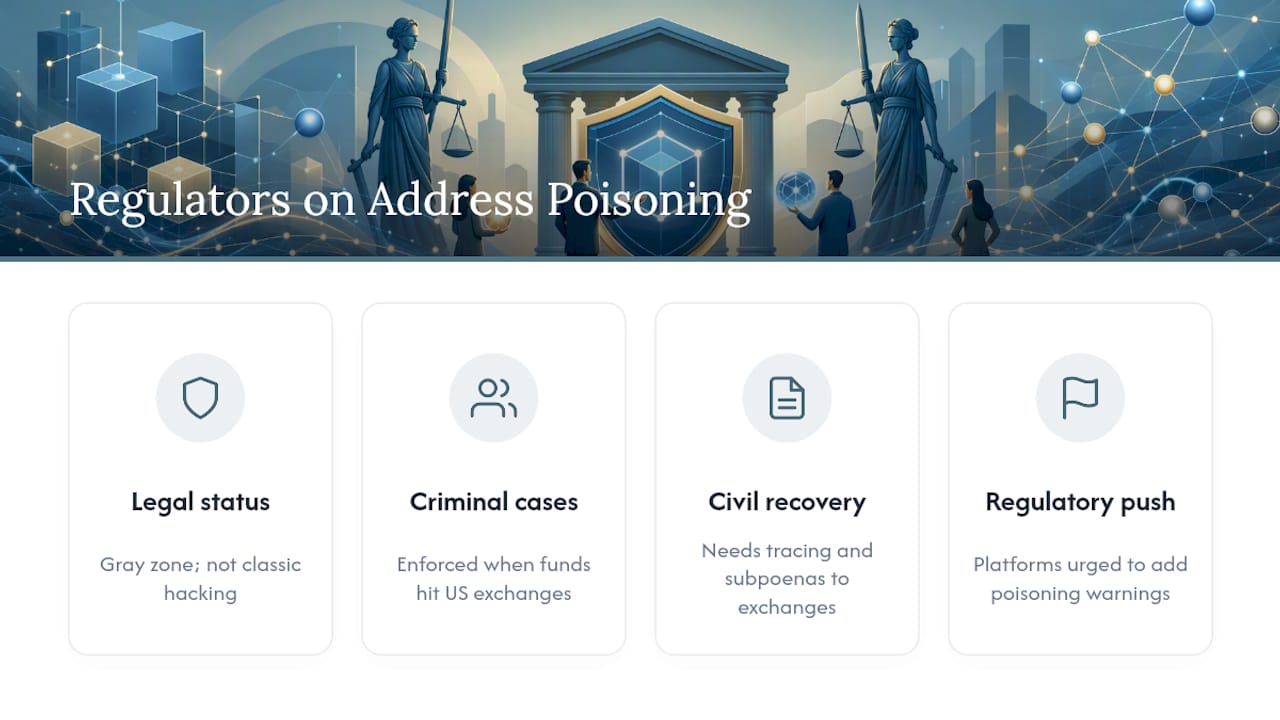
Address poisoning sits in a gray zone that most existing fraud statutes weren’t written for. It isn’t hacking in the traditional sense, since no system is breached and no key is stolen. It’s closer to a confidence trick executed through blockchain mechanics, which makes it harder to prosecute under laws written around unauthorized access or theft.
In the United States, agencies like the FBI’s Internet Crime Complaint Center (IC3) and the Secret Service’s cyber fraud task forces do take reports involving crypto scams, including address poisoning, but enforcement depends heavily on whether funds pass through a regulated, U.S.-based exchange. Once funds route through offshore platforms or non-KYC protocols, jurisdiction gets murky fast, and criminal referrals slow down or stall entirely.
Civil recovery is a separate track from criminal prosecution. Victims can pursue civil claims against identified perpetrators, but identification is the hard part, and that’s where forensic tracing and legal-grade documentation matter. A report prepared to evidentiary standards can support subpoenas to exchanges, which is often the only path to unmasking a pseudonymous attacker.
Regulatory bodies including the SEC and CFTC have shown growing interest in platform-level accountability, pushing wallet providers and exchanges to build in stronger scam detection rather than leaving prevention entirely to end users. That pressure is part of why MetaMask, Ledger, and Trust Wallet have all shipped poisoning-specific warnings in recent years. Expect that trend to continue as losses keep climbing into the tens of millions.
Address Poisoning vs. Phishing and Typosquatting: What’s the Difference?
These three attacks get lumped together constantly, but the mechanics are distinct, and knowing the difference changes how you defend against each one.
Phishing tricks you into voluntarily revealing your private key or seed phrase, usually through a fake website, email, or support chat that impersonates a legitimate service. The attacker gets full wallet control the moment you type in your recovery phrase.
Typosquatting relies on URL or domain confusion, registering a domain like “unisvvap.org” instead of “uniswap.org” to catch users who mistype or misread a web address. It targets your navigation habits, not your transaction history.
Address poisoning doesn’t touch your keys or your browser at all. It targets your copy-paste habit and your trust in transaction history, planting a convincing decoy address so you send funds directly, voluntarily, and irreversibly to the wrong destination.
The practical distinction matters for defense. Phishing defenses focus on never entering your seed phrase anywhere except your original wallet setup. Typosquatting defenses focus on bookmarking real URLs and double checking domains. Address poisoning defenses focus entirely on address verification at the moment of sending, which is why hardware wallet screens and middle-character checks are the specific countermeasures that work here and nowhere else.
How Can Developers Prevent Address Poisoning in dApps?
Developers building wallets, dApps, or smart contracts carry real responsibility for reducing this attack surface, since much of what makes poisoning scale is a UI and protocol design problem, not just a user error problem.
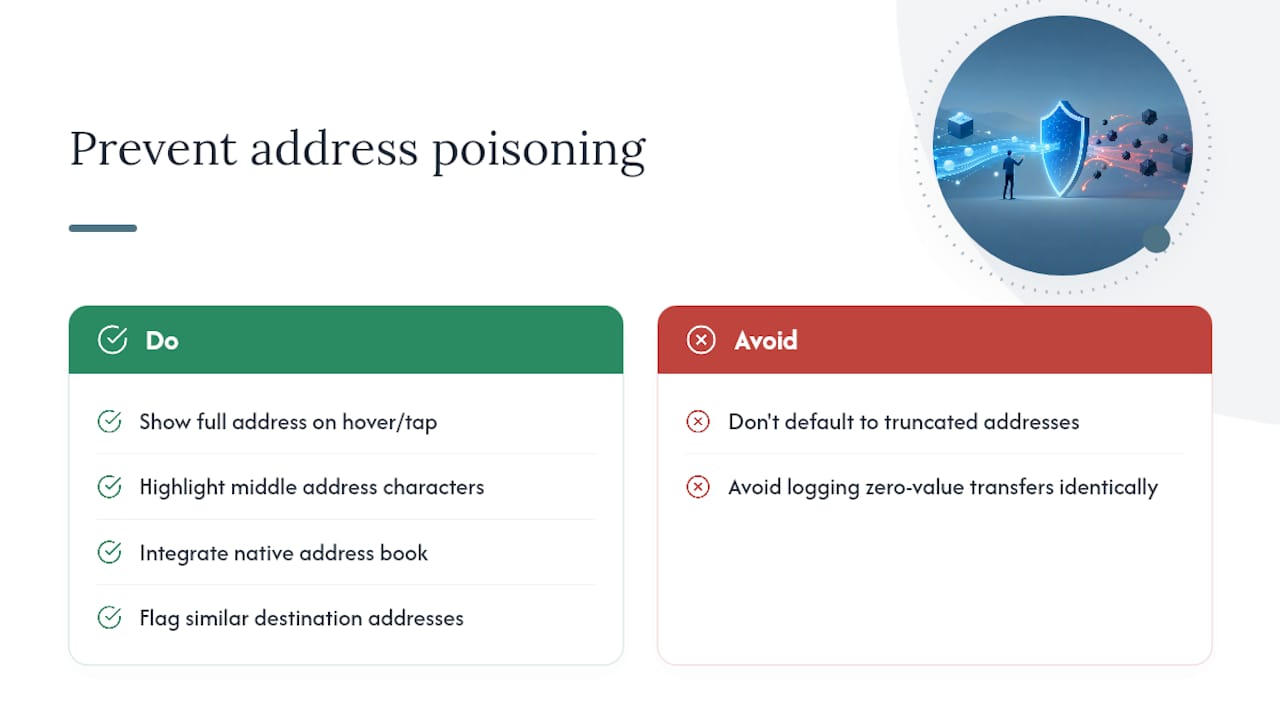
At the interface level, avoid displaying abbreviated addresses as the default in any transaction history or activity feed. If truncation is necessary for space, show the full address on hover or tap, and highlight the middle characters distinctly from the prefix and suffix so users can compare them at a glance.
At the contract level, the zero-value transferFrom loophole in the ERC-20 standard is a known root cause. Projects building new token standards or wrapper contracts should consider rejecting or clearly flagging zero-value transfer events rather than logging them identically to real transfers.
For dApp interfaces specifically, integrate address book functionality natively rather than forcing users to rely on copy-paste from history, and build in similarity detection that flags when a destination address resembles a recently used one, the same pattern MetaMask has already deployed. Deposit-side filtering that hides dust and zero-value transfers by default, with an opt-in toggle to view them, removes much of the visual noise attackers depend on. None of these fixes require exotic engineering. They require treating address poisoning as a first-class threat model during design, not an afterthought bolted on after user complaints pile up.
Recovera Forensics’ Perspective: Why Professional Tracing Matters
Address poisoning losses feel final the moment you hit confirm, and often they are. But funds don’t disappear, they move, and every hop leaves a trace on a public ledger. When stolen funds pass through an exchange, even briefly, tracing the flow and building a legal-grade report can turn a dead end into a real lead for law enforcement or civil counsel. Speed and documentation decide whether that trace holds up.
— cristian
How Recovera Forensics Helps Victims of Address Poisoning
If you sent funds to a poisoned address and the trail runs through exchanges, DEX swaps, or multiple wallets, Recovera Forensics traces that flow and builds a technical report suited for legal proceedings, not just a wallet lookup. The team analyzes transaction patterns across public blockchains, links wallet activity to potential fraud networks, and prepares documentation that can support exchange freeze requests or a civil claim.
To start, Recovera will ask for your transaction hashes, exact timestamps, wallet addresses involved, and any screenshots or messages connected to the incident. That evidence, gathered quickly, is what separates a case with a real shot at recovery from one that goes cold. If you’re weighing whether paid forensics makes sense for your situation, the step-by-step action guide walks through what to expect, and you can start a case review directly to see what your options look like.
Sources
- Blockchain Address Poisoning (USENIX / Tsuchiya et al.)
- Address poisoning scams | MetaMask Help Center
- Address poisoning scams — Ledger Support
- Anatomy of an Address Poisoning Scam – Chainalysis
FAQ
Can Someone Steal My Crypto With Just My Wallet Address?
No. Your public wallet address alone can’t be used to move your funds; only your private key or seed phrase grants that access. Address poisoning works by tricking you into sending funds voluntarily to a lookalike address, not by extracting anything from your wallet.
Can the FBI Trace a Bitcoin Address?
Yes, in many cases. Blockchain transactions are permanently recorded and traceable, and agencies like the FBI use transaction graph analysis, often supported by forensic firms, to follow funds through exchanges where identity verification exists. Tracing gets significantly harder once funds pass through mixers or non-KYC platforms.
Can You Get Your Money Back If You Get Scammed on Crypto?
Sometimes, but it depends heavily on speed and where the funds ended up. If stolen funds reach a centralized exchange quickly, a freeze request paired with forensic evidence and law enforcement outreach can lead to recovery; funds routed through mixers or swapped repeatedly become far harder to reclaim.
Can the IRS See My Crypto Wallet?
The IRS can access crypto transaction data through exchange reporting requirements and blockchain analysis tools, particularly for wallets connected to a KYC-verified exchange account. Self-custodial wallets without any exchange link are harder to directly associate with an identity, though transaction patterns can still be analyzed.
Does MetaMask Protect Against Address Poisoning?
MetaMask flags destination addresses that closely resemble ones you’ve used before and displays a warning prior to sending, but this protection is a heuristic and won’t catch every lookalike address. Manual verification of the middle characters remains necessary even with the warning enabled.