If your seed phrase was stolen or exposed, treat it as compromised right now and start moving funds to a fresh seed on a clean device. There is no waiting period, no benefit of the doubt. A stolen recovery phrase gives an attacker the same access you have, and in one documented case, an exposed Ledger seed led to roughly $4.8 million in tokens being drained within a short window of exposure.
Do these three things now:
- Do not type your seed into any website, app, or “recovery” tool, and do not send funds to the compromised wallet for any reason.
- Set up a new seed on a clean, factory reset hardware wallet, then test a small transfer before moving the rest.
- If the loss is significant or funds have already hit an exchange, loop in a professional forensic investigator alongside your own moves.
Key Takeaways
A stolen seed phrase requires immediate key replacement on a clean device, evidence preservation, and professional forensic support when losses are significant.
| Point | Details |
|---|---|
| Treat exposure as total compromise | Never wait to see if funds move. Start the safe transfer process immediately. |
| Never fund the old wallet | Sending gas or tokens to a compromised address usually triggers an instant automated drain. |
| Test before you sweep | Send a small amount to the new wallet first and confirm on-chain receipt before moving the rest. |
| Revoke token approvals early | Compromised EVM wallets need approval revocation, not just a native token transfer, to stop future drains. |
| Document before you delete | Save transaction hashes, timestamps, and phishing evidence before wiping any device. |
Table of Contents
- What to Do If Your Seed Phrase Is Stolen: The First Hour
- How to Generate a Clean Seed and Move Your Assets Safely
- Why Token Approvals Complicate an EVM Wallet Rescue
- What Evidence to Save and Where to Report It
- When It Makes Sense to Bring in a Forensic Investigator
- The Second Scam That Targets Theft Victims
- Getting Professional Help After a Seed Compromise
- A Practical Take on Forensic-Aware Recovery
- Manufacturer Guides and Reporting Resources
- Sources
- FAQ
What to Do If Your Seed Phrase Is Stolen: The First Hour
Speed matters more than perfection here. The goal isn’t to solve everything in the first hour, it’s to stop the bleeding and preserve what you’ll need later for evidence or forensic tracing.
- Disconnect suspect devices. If you suspect malware, a fake wallet extension, or a phishing site touched your machine or phone, disconnect it from the internet and stop using it for anything crypto related. Do not log into any wallet, exchange, or “support” chat from that device until it’s been wiped or replaced.
- Set up a watch alert on the compromised address. Most block explorers and several wallet apps let you add an address to a watchlist with movement notifications. This buys you visibility even if you can’t move funds instantly.
- Warn your exchanges before you need to. If you hold accounts on centralized exchanges, contact their support now, not after a transfer lands. Give them the compromised wallet address and any transaction hashes you already have. Exchanges can sometimes flag or freeze incoming funds tied to reported theft faster than law enforcement can act.
- Never send additional crypto to a compromised wallet. This is the mistake that costs people the most money on top of the original theft. Sending “just enough gas” to try to move remaining tokens before the attacker does almost never works, because automated sweeping bots monitor compromised addresses and drain new deposits within seconds.
Pro Tip: Screenshot everything before you touch anything else. Balances, pending transactions, wallet addresses, timestamps. You can’t go back and recreate this evidence later, and a forensic investigator will ask for exactly this.
How to Generate a Clean Seed and Move Your Assets Safely
Once the immediate bleeding has stopped, the real work is transferring value out of reach of whoever has your old phrase. This is where rushing causes second losses, so follow the order below.
- Buy or reset a hardware wallet from a source you trust. A new device purchased directly from the manufacturer, or an existing device wiped through its official factory reset process, is the baseline. Never use a device that arrived pre-configured or came from a secondhand marketplace listing you can’t verify.
- Generate the new seed on the device itself, never on a computer or phone. The screen on the hardware wallet should display the words, and you write them down by hand. Typing a seed phrase into any keyboard, note app, or cloud document is exactly how the Ledger Academy’s 163 ETH case happened in the first place.
- Verify the receive address on the device screen, not just the app. Malware that swaps addresses in clipboard or software display is common enough that this step isn’t optional.
- Send a small test transaction first. Confirm it arrives on-chain before moving anything else.
- Sweep the remaining balance once the test clears. Use a reasonable network fee so the transaction doesn’t sit stuck in the mempool.
A few things to keep in mind as you do this:
- Avoid reusing the exact same receive address for every asset. Fresh addresses per transaction reduce the trail an attacker or observer can follow.
- If you hold assets across multiple chains, repeat this process per chain. A clean Ethereum wallet does nothing for a compromised Solana seed.
- Write your new backup on steel if you’re storing meaningful value long term. Paper burns, fades, and gets thrown out by someone who doesn’t know what it is.
Why Token Approvals Complicate an EVM Wallet Rescue
If your compromised wallet touched decentralized exchanges, lending platforms, or NFT marketplaces, you likely granted token approvals at some point. Those approvals let a smart contract, or an attacker who controls that contract, move your tokens without needing your native ETH for gas. This is why simply moving your ETH out doesn’t fully protect you.
- Use an approval-scanner tool from a clean device to list every active allowance tied to your wallet address and revoke the ones you don’t recognize or no longer need.
- Do this before you try to move remaining tokens, if it’s safe to do so, since revoking first can stop an automated drain in progress.
- Never send extra gas to a compromised wallet hoping to “beat” a sweeper to the punch. Attackers script these drains, and manual timing rarely wins.
- If revocation isn’t realistically possible before funds move, prioritize whatever can be moved safely and shift your focus to documenting the loss for evidence.
Pro Tip: If you don’t recognize half the approvals listed for your wallet, that’s normal. Revoke anything you can’t identify. An unused, forgotten approval from two years ago is exactly the kind of thing an attacker exploits.
What Evidence to Save and Where to Report It
Documentation is what turns “I think I got hacked” into something an exchange, investigator, or law enforcement agency can actually act on. Capture this before memories fade or pages get taken down.
- Transaction hashes, wallet addresses (yours and the attacker’s), and exact timestamps for every suspicious movement.
- The original phishing URL, message, or app that led to the compromise, saved as a screenshot and, where possible, the raw link.
- Any communication from someone claiming to be support, an investigator, or a “recovery specialist.”
File a complaint with the Ic3 portal, notify every exchange involved with your transaction details, and give both a clear timeline. Once attackers are operating with valid access, only a minority of their subsequent actions get blocked by standard protections, which is exactly why fast, well-documented reporting to exchanges matters. Rapid, specific reports sometimes trigger a freeze on funds that land in a custodial exchange account. Save immutable copies, PDFs and signed reports work well, so you have something consistent to hand to an investigator or attorney later.
When It Makes Sense to Bring in a Forensic Investigator
Not every case needs a professional, but some clearly do. If your losses are significant, if funds have already moved through an exchange, or if you’re likely to pursue legal action, forensic tracing changes what’s possible.
- Blockchain forensics can map exactly how funds moved across wallets and exchanges, turning a confusing trail into a documented timeline suitable for legal proceedings.
- Investigators can engage directly with exchange compliance teams and law enforcement in ways an individual victim often can’t on their own.
- Forensic work improves your odds. It does not guarantee your funds come back, and any provider promising a guaranteed recovery should raise a red flag immediately.
- Vet any firm for transparent, upfront billing, verifiable past casework, and a firm policy of never asking for your seed phrase or private keys. Recovera Forensics follows exactly that model: formal case intake, a documented on-chain timeline, and a forensic report built for attorneys, exchanges, and law enforcement to act on.
Pro Tip: Ask any forensic provider for a sample or redacted version of a past report before you sign anything. A legitimate firm will have one ready.
The Second Scam That Targets Theft Victims
Getting your seed phrase stolen makes you a target twice. The first time is the original theft. The second is the wave of “recovery experts” who show up in your DMs promising to get everything back for an upfront fee.
- Any service asking for payment before doing any work, or asking you to hand over a new seed phrase “to verify your wallet,” is running a scam.
- Watch for unsolicited support messages on Discord or Telegram, lookalike domains that mimic real wallet or exchange support pages, and browser extensions pitched as “recovery tools.”
- Work only with vendors who put terms in writing and can point to real, checkable case history, not just testimonials on their own site.
- When something feels off, pause the transaction and get a second opinion from a vetted forensic investigation service before paying anyone.
Getting Professional Help After a Seed Compromise
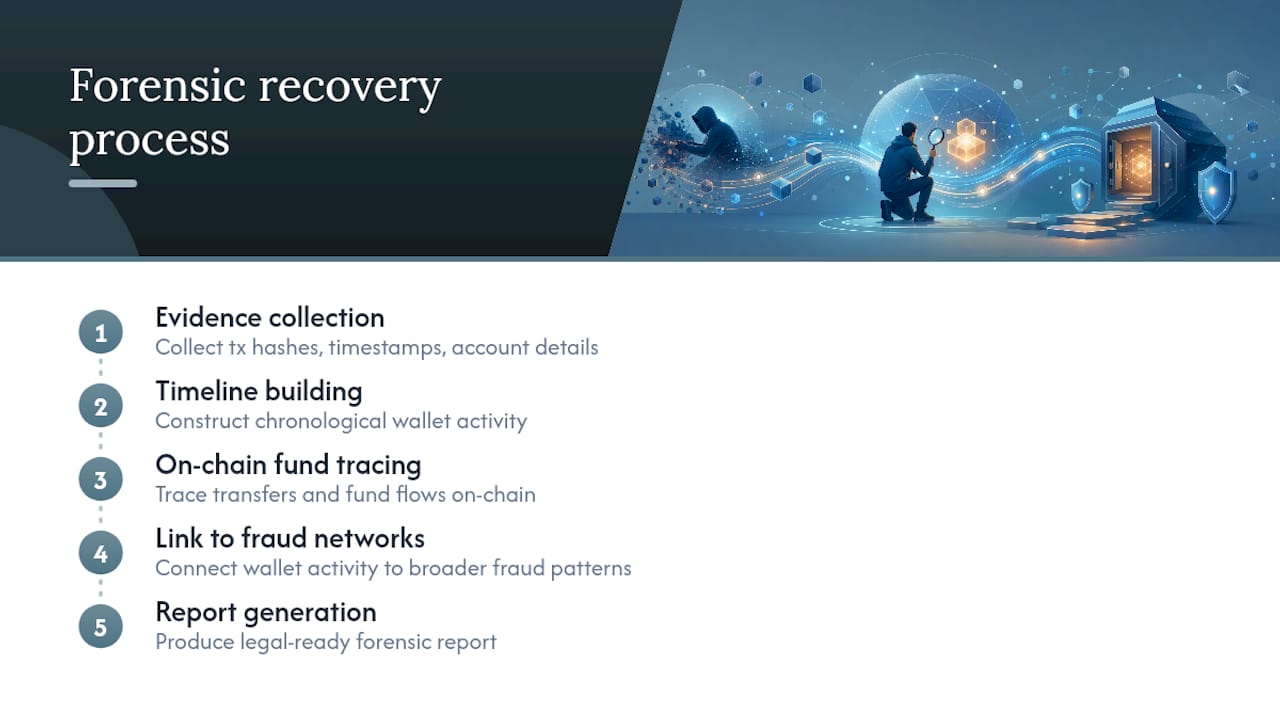
If your case involves a meaningful balance, funds already sitting on an exchange, or the possibility of legal action, this is the point where a do-it-yourself approach starts to cost you time you don’t have. Recoveraforensics builds forensic reports designed for exactly this situation: tracing on-chain flows, connecting wallet activity to broader fraud patterns, and producing documentation that exchanges, attorneys, and law enforcement can actually use.
The intake process starts with the same evidence you should already be collecting from the sections above, transaction hashes, timestamps, and a clear account of what happened. From there, Recoveraforensics builds a timeline and a report suitable for legal proceedings, without ever asking for your seed phrase or private keys. If you’re weighing whether your case justifies professional investigation, reach out through Recoveraforensics’s contact page to discuss what a forensic report could realistically show for your specific situation.
A Practical Take on Forensic-Aware Recovery
The conventional advice on this topic stops at “move your funds and report it,” which is true but incomplete. What most guides skip is the tension between speed and evidence quality. Rushing to sweep every wallet in a panic sometimes means overwriting or losing the exact transaction detail a forensic report needs later. The better sequence is: stop the bleeding fast, but slow down just enough to screenshot and log before each move.
Law enforcement resources for individual crypto theft cases are thin, and most victims who file with IC3 alone will wait a long time for any action, if action comes at all. That’s not a reason to skip the report. It’s a reason to treat forensic documentation as the thing that actually moves cases forward with exchanges and attorneys, rather than assuming a police report does the heavy lifting. Prioritize the safe-move first, evidence capture second, and professional forensic support the moment your losses exceed what you’re willing to write off entirely.
— cristian
Manufacturer Guides and Reporting Resources
For hands-on reset steps and reporting, start with your device manufacturer’s official documentation and government reporting channels rather than third-party tutorials.
- Ic3 for filing a formal U.S. federal complaint.
Sources
- $4.8M in crypto stolen after Korean tax agency exposes wallet seed
- What do I do if my seed phrase is lost or stolen?
FAQ
What Should I Do If Someone Steals My Seed Phrase?
Treat the wallet as fully compromised immediately: stop using it, avoid sending it any more funds, and set up a new seed phrase on a clean, reset hardware wallet to move remaining assets out.
Can a Seed Phrase Actually Be Hacked?
Yes, seed phrases get exposed through phishing sites, malware, physical theft of written backups, or accidental disclosure like photos or cloud storage, and anyone with the phrase has full wallet access.
I Lost $16,000 in Stolen Crypto. Can I Get It Back?
Recovery isn’t guaranteed, but documenting transaction hashes and timelines quickly and working with a forensic investigator to trace the funds and engage exchanges gives you a realistic shot at escalation, even if full recovery can’t be promised.
Can I Recover My Wallet Without the Seed Phrase?
Generally no. If you never backed up your seed and lost access to the device, the funds are typically unrecoverable unless you have another backup method, like a multisig cosigner or a passphrase-protected wallet, in place beforehand.