

Short answer: no, bitcoin mixers are not categorically illegal everywhere. But operating one, and in some cases even using one, can expose you to criminal or civil liability under money-transmission, sanctions, or anti-money-laundering laws, depending on the mixer’s structure and your jurisdiction.
The distinction that matters most is custody. A centralized mixer that holds your coins while it blends them with everyone else’s funds operates like a financial business, and financial businesses get regulated. A non-custodial tool like CoinJoin, where you never hand your coins to a third party, sits in murkier legal territory. In the United States, three levers decide how much heat you’re in:
- FinCEN treats certain custodial mixers as money services businesses subject to registration and reporting rules.
- OFAC can sanction mixer protocols directly, blacklisting anyone who transacts with them.
- DOJ prosecutes operators, and occasionally users, under money laundering and unlicensed money transmission statutes.
Key Takeaways
Bitcoin mixers are not illegal everywhere by default, but custodial operators and knowing users of tainted funds face real prosecution risk under existing money-transmission, AML, and sanctions laws.
| Point | Details |
|---|---|
| Custody determines risk | Custodial mixers face MSB registration duties; non-custodial CoinJoin tools sit in a legal gray area. |
| Operators bear the heaviest exposure | DOJ has convicted mixer operators like Bitcoin Fog’s for money laundering conspiracy. |
| Sanctions can taint coins regardless of intent | OFAC’s designation of Tornado Cash made interacting with it a liability for any user. |
| Mixing does not guarantee anonymity | Timing analysis and address clustering let investigators unwind many mixed transaction flows. |
| Policy is shifting, not settling | Treasury commentary in 2026 signals movement toward compliant-privacy frameworks, not blanket bans. |
Table of Contents
- How Bitcoin Mixers and CoinJoin Actually Work
- Is Coin Mixing Legal Around the World?
- What Do FinCEN, OFAC, and the DOJ Actually Enforce?
- Can Investigators Actually Trace Mixed Bitcoin?
- What to Do if Your Funds Got Mixed or Frozen
- When Is Using a Mixer Especially Risky?
- Are New Mixer Laws Coming?
- How Do the EU and UK Treat Bitcoin Mixers?
- What Happens to Users, Not Just Mixer Operators?
- How Can You Use Privacy Tools Without Breaking the Law?
- Authoritative Documents and Reports Cited
- Legal Uncertainty Is the Honest Answer, Not a Cop-Out
- Sources
- FAQ
How Bitcoin Mixers and CoinJoin Actually Work
A bitcoin mixer, sometimes called a tumbler, takes coins from multiple users and blends them together before sending them back out, breaking the direct transaction trail a blockchain would otherwise show. The goal is obfuscation, not encryption. Bitcoin’s ledger is public, so mixing exists specifically to make the “who sent what to whom” trail harder to follow.
There are two fundamentally different models:
- Custodial mixers. You send coins to a service, it pools them with other users’ deposits, and it sends back a different set of coins later, often for a fee. You are trusting a third party with your money the entire time.
- Non-custodial CoinJoin. Multiple participants build one joint transaction with multiple inputs and outputs, so no single party ever takes custody. Wallets like Wasabi and Samourai built this directly into their software.
The custody question matters for more than legal exposure. Custodial services often log IP addresses, timestamps, and deposit and withdrawal amounts, whether for their own recordkeeping or because they got hacked or subpoenaed. That metadata is exactly what investigators use to unwind the mixing later, and it’s a big reason law enforcement has had more success against custodial operators than against pure protocols.
Is Coin Mixing Legal Around the World?
Most countries don’t have a law that names “bitcoin mixers” and bans them outright. Instead, mixing gets swept into existing anti-money-laundering and money-transmission frameworks, and the practical effect depends entirely on how a given regulator chooses to apply those rules.
A few patterns show up repeatedly across jurisdictions:
- No explicit ban, heavy indirect regulation. Most of the EU, the UK, and the U.S. don’t outlaw the concept of mixing. They regulate the business of moving other people’s money, which catches custodial mixers whether or not they call themselves that.
- Operators face more scrutiny than protocols. Regulators generally go after the entity running a service and collecting fees, not the underlying math. That’s why prosecutors chase mixer operators far more often than they chase the developers of open-source privacy code.
- A handful of jurisdictions sanction the protocol itself. The U.S. Treasury’s use of sanctions against Tornado Cash was different from a criminal case against an operator. It targeted the smart contract addresses directly, which raised new questions about whether code itself can be “designated.”
- Policy is shifting toward “compliant privacy.” Recent Treasury commentary has started acknowledging that mixers serve legitimate privacy purposes for people who simply don’t want their salary or medical payments visible to the world, while still pushing Congress to clarify AML expectations for DeFi tools.
That last point is worth sitting with. The regulatory conversation is moving away from “privacy tech is inherently suspicious” and toward “how do we let privacy coexist with traceability when law enforcement needs it.” Nothing about that shift makes today’s enforcement risk disappear, though.
What Do FinCEN, OFAC, and the DOJ Actually Enforce?
The United States runs three parallel enforcement tracks, and they don’t always move in sync.
FinCEN’s guidance on convertible virtual currency business models makes clear that custodial mixing services can qualify as money services businesses, which triggers Bank Secrecy Act obligations: registration, a written AML program, and suspicious activity reporting. FinCEN has already used this authority. It penalized the operator of a bitcoin mixer for failing to register and comply with these rules, the first civil action of its kind against a mixer.

OFAC works differently. It doesn’t need a company to prosecute, because it sanctions addresses and protocols directly through the Specially Designated Nationals list. When OFAC designated Tornado Cash, U.S. persons faced potential liability simply for interacting with the sanctioned smart contracts, regardless of intent. That designation has since been the subject of ongoing legal challenges over whether autonomous code can be sanctioned the same way a person or entity can.
DOJ enforcement has produced the clearest precedents:
- The operator of Bitcoin Fog was convicted of money laundering conspiracy after running one of the longest-operating darknet-linked mixers.
- Operators connected to Blender.io and related services faced parallel DOJ charges for running unlicensed mixing operations.
- Developers tied to the Samourai Wallet faced charges over its Whirlpool mixing feature, treating the software’s operators as a money-transmitting business.
- The Tornado Cash criminal trial produced a split verdict: a founder was convicted on an unlicensed money-transmitting charge, but the jury deadlocked on broader conspiracy counts, leaving developer liability for open-source privacy code legally unresolved.
That split verdict is the single most important data point in this entire debate. It shows prosecutors can win against someone who profits from operating a mixing service, but a jury wasn’t willing to extend the same certainty to the harder question of whether writing the underlying code is itself a crime.
Can Investigators Actually Trace Mixed Bitcoin?
Mixing does not guarantee anonymity, and treating it that way is the single biggest mistake users make. Forensic investigators have gotten considerably better at “unmixing” flows because most mixers, even sophisticated ones, tend to reuse patterns: consistent fee percentages, predictable timing windows, and recurring entry and exit addresses. Investigators run timing analysis, cluster addresses by behavior, and correlate deposit amounts against withdrawal amounts to rebuild links a mixer was supposed to sever.
The consequences for ordinary users can be severe even without a criminal charge:
- Exchanges routinely flag or freeze deposits that touch known mixer addresses, sometimes closing the account entirely.
- Coins that pass through a sanctioned mixer like Tornado Cash can become effectively “tainted,” making them difficult or impossible to cash out anywhere compliant.
- Custodial mixers themselves are a common exit-scam vector. Plenty of “mixing services” have simply taken deposits and vanished.
Pro Tip: If you ever suspect your funds passed through a mixer without your knowledge, or a mixing service scammed you outright, preserve every transaction ID, wallet address, timestamp, and wallet backup immediately. Don’t move the funds again until you’ve documented the full trail. Overwriting that trail with more transfers is the fastest way to make a recoverable case unrecoverable.
What to Do if Your Funds Got Mixed or Frozen
If an exchange froze your account, a mixer scammed you, or you discovered your coins passed through a tainted address, the first hour matters more than most people realize.
- Stop moving funds. Every additional transaction adds noise that makes reconstruction harder for anyone trying to help you later.
- Snapshot everything. Screenshot balances, export transaction histories, and save every wallet address and private key backup you have access to.
- Document the timeline. Write down when funds moved, through what platform, and any communication with the service involved.
- Bring in a forensic investigator before you contact anyone else. Exchanges and courts expect a technical chain-of-custody report, not a personal account of what happened.
This is where a firm like Recovera Forensics does the actual technical work. Blockchain forensics means tracing wallet-to-wallet flows across a public ledger, clustering related addresses, and connecting a chaotic transaction history back to specific fraud patterns or exchange accounts where funds landed. Recovera Forensics builds these findings into forensic reports designed to hold up with exchanges, law enforcement, and in legal proceedings, and can provide expert support when a case moves toward litigation.
The difference between “my coins disappeared into a mixer” and “here is the documented chain connecting these seven addresses to the exchange account where your funds settled” is the entire value of a forensic investigation.
Self-help works for simple cases. Once tainted funds, sanctioned addresses, or a custodial mixer’s exit scam are involved, the technical investigation and reporting Recovera Forensics provides becomes the difference between a dead end and an actionable case.
When Is Using a Mixer Especially Risky?
The people facing real legal exposure fall into three groups: mixer operators running unregistered money-transmitting businesses, custodial services that ignore AML obligations, and individual users who knowingly route funds through a mixer to hide proceeds of a crime. Simply valuing privacy is not the same as any of those.
Watch for these red flags before touching any mixing service:
- A custodial mixer with no public compliance information or terms of service is a legal and financial liability wrapped into one.
- Any service tied to a sanctioned protocol, Tornado Cash included, can taint your coins regardless of your intent.
- “Guaranteed anonymity” marketing claims are the biggest tell of an exit scam in progress.
If you’ve already used one and something went wrong, preserve every record, avoid moving funds further, and talk to counsel and a forensic investigator before you talk to anyone else.
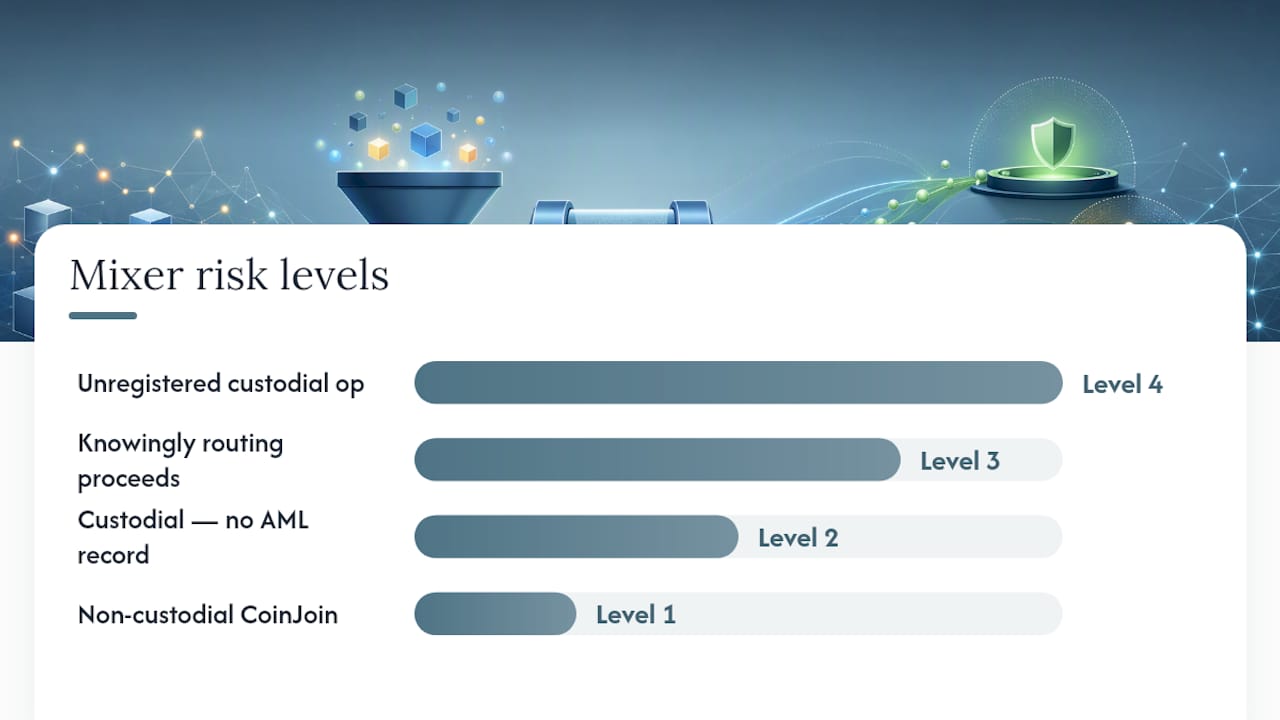
| Risk Level | Situation |
|---|---|
| Highest | Running or operating a custodial mixer without MSB registration |
| High | Knowingly routing crime proceeds through any mixer |
| Moderate | Using a custodial mixer without AML compliance history |
| Lower | Non-custodial CoinJoin used for ordinary privacy, no sanctioned protocol involved |
Are New Mixer Laws Coming?
The legal framework around mixers is not static, and 2026 is shaping up to be a turning point rather than a settled chapter. The Tornado Cash split verdict pushed the unresolved question of developer liability into sharper focus, and lawmakers and regulators are responding to that uncertainty rather than ignoring it.
The clearest signal came from the U.S. Treasury itself, which has started acknowledging legitimate privacy uses for mixing technology while urging Congress to clarify AML obligations for DeFi and privacy tools more broadly. That’s a meaningfully different posture than treating every mixer as inherently criminal infrastructure, and it opens the door to frameworks sometimes described as “compliant privacy,” where privacy-preserving technology could operate alongside disclosure requirements triggered by specific thresholds or red flags.
Congress hasn’t passed comprehensive mixer-specific legislation yet, and proposals so far have mostly extended existing AML frameworks to cover DeFi protocols more explicitly rather than creating an entirely new mixer category. Expect the fight to center on a few recurring questions: should sanctions target protocols the same way they target people or entities, does writing open-source privacy code carry the same liability as operating a service for profit, and how granular should AML reporting get for tools that were never designed to collect user identity in the first place. None of these questions have settled answers yet, which is exactly why the “legal uncertainty” framing fits this topic better than a flat yes-or-no.
How Do the EU and UK Treat Bitcoin Mixers?
The European Union approaches mixers through its anti-money-laundering directives rather than a mixer-specific ban, and the practical effect lands close to the U.S. model: exchanges and custodial services operating in the EU face enhanced due diligence obligations when transactions touch mixing services, and several EU member states have flagged mixer-linked funds as automatically higher risk for reporting purposes.
The UK’s Financial Conduct Authority regulates cryptoasset businesses under money-laundering regulations that require registered firms to apply enhanced scrutiny to transactions connected with mixing or tumbling services. As in the U.S., the UK framework targets the regulated business handling the funds, meaning an exchange, rather than criminalizing the concept of mixing outright for an individual acting alone.
The practical throughline across the U.S., EU, and UK is remarkably consistent: no major Western jurisdiction has passed a law that says “mixing bitcoin is illegal” in those words. Instead, each treats custodial mixing as a regulated financial activity, applies existing AML and sanctions tools when operators or funds cross into criminal territory, and leaves individual non-custodial privacy use in a gray zone that’s defined more by enforcement priorities than by clear statute. If you’re moving between jurisdictions or dealing with a service that operates across borders, that consistency matters less than the specific enforcement posture of whichever country’s authorities end up looking at your transaction.
What Happens to Users, Not Just Mixer Operators?
Most enforcement headlines focus on operators, but individual users are not automatically in the clear, and the consequences scale with what you knew and when you knew it.
A user who sends funds through a mixer without any connection to criminal proceeds faces mostly practical risk: frozen exchange accounts, rejected withdrawals, and the burden of proving your funds are clean to a compliance team that doesn’t want to hear it. That’s frustrating, but it’s not usually a criminal matter.
The picture changes sharply if a user knowingly mixes funds tied to a crime, whether that’s proceeds from a scam, a hack, or sanctions evasion. At that point, the same money laundering and structuring statutes that catch operators can reach the user directly, and the sanctions exposure from interacting with a designated protocol like Tornado Cash applies to anyone who transacts with it, not just the people running it. Penalties in these cases can include asset forfeiture, civil monetary penalties, and in serious cases, criminal charges carrying prison time.
Even short of prosecution, a documented connection to mixed or tainted funds can follow you. Exchanges share compliance flags, and a wallet address once linked to a sanctioned mixer rarely gets a clean slate just because time passes. That’s why the practical guidance in this article leans so heavily on documentation and professional forensic help rather than “wait and see.”
How Can You Use Privacy Tools Without Breaking the Law?
Staying on the right side of the law while still valuing financial privacy comes down to a few consistent habits rather than any single magic tool.
Favor non-custodial tools over custodial ones whenever privacy is the goal. A CoinJoin implementation built into a wallet you control keeps you out of the counterparty risk that comes with trusting a third party with your coins, and it avoids the money-transmission questions that attach specifically to custodial services.
Check sanctions status before you interact with any protocol. OFAC’s SDN list is public, and a five-minute check before using an unfamiliar mixing tool is far cheaper than discovering after the fact that your coins are now tainted by association with a designated address.
Keep records regardless of which tool you use. If a regulator or exchange ever asks you to explain a transaction, having your own timestamped record of what you did and why beats reconstructing it after the fact from memory.
Treat “guaranteed anonymity” claims as a warning sign, not a selling point. Legitimate privacy tools describe their technical limitations honestly. Services that promise total untraceability are usually the ones with the worst track record for actually delivering it, and they’re disproportionately represented among the operators DOJ has already prosecuted.
If you’re ever uncertain whether a specific use case crosses a line, that’s a legal question worth asking an attorney directly, not a question to resolve by reading forum threads.
Authoritative Documents and Reports Cited
- FinCEN guidance on virtual currency business models
- DOJ: Bitcoin Fog operator conviction
- U.S. Secret Service public advisory on cryptocurrency mixing
- Mayer Brown analysis of the Tornado Cash trial
- Chainalysis on crypto mixer AML compliance
Legal Uncertainty Is the Honest Answer, Not a Cop-Out
Most coverage of this topic wants a clean yes or no, and that’s exactly the wrong instinct. The Tornado Cash split verdict is the most honest data point we have: a jury convicted on one charge and deadlocked on another, involving the same defendant and the same conduct. If prosecutors and jurors can’t agree on where the line sits, no article should pretend the answer is simple.
The conventional advice, “just don’t use mixers,” misses the more useful question, which is whether you’re dealing with a custodial service or a non-custodial protocol, and whether the specific address you’re touching has ever been sanctioned. Those two facts predict your actual risk far better than the word “mixer” alone.
If you’re reading this because something already went wrong, whether that’s a frozen exchange account, a scam involving a mixing service, or funds that turned up tainted, the priority is documentation first, professional forensic tracing second, and legal counsel before you make any more moves. The technology that obscured your transaction trail is the same technology forensic investigators now specialize in reading through.
Sources
- FinCEN guidance: application of regulations to certain business models
- Public Advisory: Cryptocurrency Mixing (U.S. Secret Service)
- The Tornado Cash Trial’s mixed verdict: implications for developer liability (Mayer Brown)
- DOJ: Bitcoin Fog operator convicted of money laundering conspiracy
FAQ
Are Bitcoin mixers traceable?
Often, yes. Investigators use timing analysis, address clustering, and pattern matching to unwind many mixed transaction flows, especially with mixers that reuse predictable patterns.
Can the FBI track Bitcoin transactions?
The FBI and other federal agencies regularly trace bitcoin transactions using blockchain analysis, and they’ve successfully built prosecutions against mixer operators like Bitcoin Fog’s using exactly this kind of tracing.
What is a Bitcoin mixer?
A bitcoin mixer, or tumbler, pools coins from multiple users and redistributes them to obscure the direct transaction trail between sender and recipient on the public blockchain.
Does the IRS know if you sell Bitcoin?
Exchanges operating in the U.S. generally report transaction data to the IRS, and taxpayers are separately required to report crypto sales, so routing funds through a mixer does not eliminate your tax reporting obligation.
Is using a Bitcoin mixer illegal?
Using a mixer is not automatically illegal, but knowingly mixing funds tied to a crime, or interacting with a sanctioned protocol like Tornado Cash, can expose users to civil or criminal liability.