Stolen NFTs can sometimes be traced and even recovered, but the window for meaningful action is short. Your immediate priorities: capture every transaction hash and token ID tied to the theft, revoke any remaining wallet approvals, notify the marketplace where the item was listed, and file a report with local police and the FBI’s IC3 portal before the trail goes cold.
TL;DR:
- The first 24 to 72 hours are critical for collecting timestamped transaction hashes, revoking approvals, and documenting all suspicious activity to aid recovery efforts.
- Tracing stolen NFTs involves reconstructing the approval signature process, identifying the “drain window,” and following the flow of funds across addresses and chains.
- Proper evidence collection includes transaction hashes, wallet and recipient addresses, screenshots, device logs, and a clear timeline to improve chances of law enforcement and marketplace action.
- Marketplaces like OpenSea can freeze listings but cannot reverse blockchain transfers, so victims should report to all platforms and law enforcement for maximum impact.
- High-value thefts or complex trails require professional forensic analysis to document wallet clusters, approval abuse, and create court-ready reports to improve asset recovery chances.
Table of Contents
- Quick Action Checklist for the First 24 to 72 Hours
- How Does NFT Theft Tracing Actually Work?
- What Evidence Should You Collect and How Should You Present It?
- What Can Marketplaces Like OpenSea Actually Do?
- How Do You Report NFT Theft to Law Enforcement?
- When Should You Bring in a Professional Forensic Investigator?
- Key Official Pages and Reporting Portals to Consult
- The Case for Speed Over Perfection
- Get Legal-Grade Forensic Support From Recoveraforensics
- Sources
- FAQ
Quick Action Checklist for the First 24 to 72 Hours
The hours right after you discover a theft matter more than almost anything else in the recovery process. Marketplaces and investigators need specific, timestamped data, and a lot of that evidence disappears or gets buried once the thief moves assets through a mixer or across a bridge.
Work through this order:
- Record the transaction hash, token ID, your original wallet address, the recipient (thief’s) address, and the exact timestamp of the drain transaction.
- Screenshot every suspicious approval request, phishing message, Discord DM, or fake mint page connected to the incident.
- Revoke lingering operator approvals on any EVM wallet you still control, using a token approval checker, and move remaining assets to a fresh wallet.
- Open a support ticket with the marketplace hosting the stolen item and begin drafting your police and IC3 report.
- Save device logs, browser extension activity, and any related emails or messages somewhere you won’t accidentally overwrite them.
Pro Tip: Export your wallet’s full transaction history as a CSV the moment you notice something wrong. Explorers sometimes reorganize how they display older transactions, and having a raw export protects you from losing formatting or context later.
How Does NFT Theft Tracing Actually Work?
Forensic tracing starts before the theft itself, at the approval transaction. Most NFT drains do not happen through a stolen password. They happen because the victim signed a malicious setApprovalForAll request or a Permit2 signature, often through a fake mint site or a compromised Discord link. That single signature hands the attacker standing permission to move every token in a collection, and the actual sweep can happen minutes or weeks later.
Investigators reconstruct what’s often called the “drain window,” the gap between the approval signature and the first bulk transfer. Identifying that window matters because marketplace abuse desks and law enforcement both want to see the exact moment consent was manipulated, not just the moment assets moved. Approval abuse of this kind is now one of the most common drain patterns tracked in NFT theft cases, which is why any serious investigation begins there rather than at the sweep itself.
From that starting point, the workflow generally covers:
- Pulling the drain transaction and every preceding approval transaction from a block explorer, with contract address and token ID annotated for each.
- Clustering the destination addresses to see whether funds converge on a single wallet, a known exchange hot wallet, or a chain of intermediary addresses designed to obscure the path.
- Watching for new marketplace listings created from the stolen tokens, since a resale attempt is often the first sign the thief is trying to cash out.
- Tracking bridge transactions that move assets to another chain, which sharply reduces recovery odds once tokens land somewhere with weaker compliance tooling.
- Compiling the findings into an annotated timeline with proof of the approval abuse, since a focused, annotated transaction timeline is the single artifact investigators and attorneys ask for first.
The output of this process is not a guess. It’s a documented chain of custody for the digital evidence itself, built the same way a financial crimes unit would build a paper trail for a wire fraud case.
What Evidence Should You Collect and How Should You Present It?
Marketplaces and police departments both act faster on organized submissions than on a panicked email with screenshots attached at random. Build your file methodically.
Essential technical evidence includes:
- The drain transaction hash and the contract address and token ID for each stolen item.
- Your wallet address, the destination address, and any intermediate addresses funds passed through.
- Screenshots of the approval request, the marketplace listing history, and any phishing content that triggered the theft.
Device and account evidence adds weight to your case:
- Browser session logs and wallet extension activity around the time of the incident.
- IP address information if your platform or wallet provider retains it.
- Saved copies of any messages, emails, or social posts connected to the scam.
Assemble it as a CSV of the relevant transactions, a folder of annotated screenshots (label what each one shows and when it was taken), and a short written timeline narrative that a non-technical reader, like a detective or a claims’ adjuster, could follow. For chain of custody, keep original files untouched, never edit metadata, and note who accessed or exported each piece of evidence and when. This documentation, built through methods used in blockchain forensics investigations, is what turns a personal loss into a case a platform or court can actually act on.
Pro Tip: Never rename your original screenshot or export files. Keep a separate, labeled copy for presentation and leave the originals exactly as captured, timestamps included.
What Can Marketplaces Like OpenSea Actually Do?
Marketplaces can freeze the listing. They cannot undo the blockchain transfer itself. That distinction trips up a lot of victims who assume reporting a theft to a platform is equivalent to getting the item back.
OpenSea’s stolen item policy allows a flagged NFT to be disabled from trading for roughly 90 days, with extensions possible when law enforcement gets involved. That window buys you time to pursue a police report or a forensic investigation, but it does not put the token back in your wallet. Under OpenSea’s own prohibited content and disputed items policy, disabling a listing is a moderation action, not a legal remedy.
| What you provide | What the marketplace can do |
|---|---|
| Proof of prior ownership (old listing, mint transaction) | Verify the token’s history against your claim |
| Transaction hashes for the theft | Flag the item and disable active listings |
| Police report or case number | Extend the disable period beyond the standard window |
| Timeline of the incident | Prioritize the ticket and route it to trust and safety |
Report to every marketplace where the token could resurface, not just the one where it was originally listed. Thieves frequently relist stolen NFTs on secondary platforms hoping victims only watch one venue.
How Do You Report NFT Theft to Law Enforcement?
Filing a report with law enforcement rarely produces an overnight recovery, but it creates the paper trail that makes every later step, subpoenas, exchange freezes, civil claims, possible.
Your main channels:
- IC3 (FBI): the federal portal for reporting internet crime, including crypto and NFT theft; cases showing higher dollar values or signs of organized fraud rings tend to get more attention.
- Local police cyber units: file a report even if the department seems unfamiliar with NFTs. You need the case number for marketplace and civil purposes.
- Civil remedies: conversion claims and injunctions are increasingly viable, since courts have begun treating NFTs as property under certain legal frameworks, opening the door to subpoenas that compel exchanges to release account records tied to the thief’s wallet.
A forensic report carries real weight here. Exchanges and courts respond to documented, timestamped evidence far more readily than to a verbal account of what happened.
When Should You Bring in a Professional Forensic Investigator?
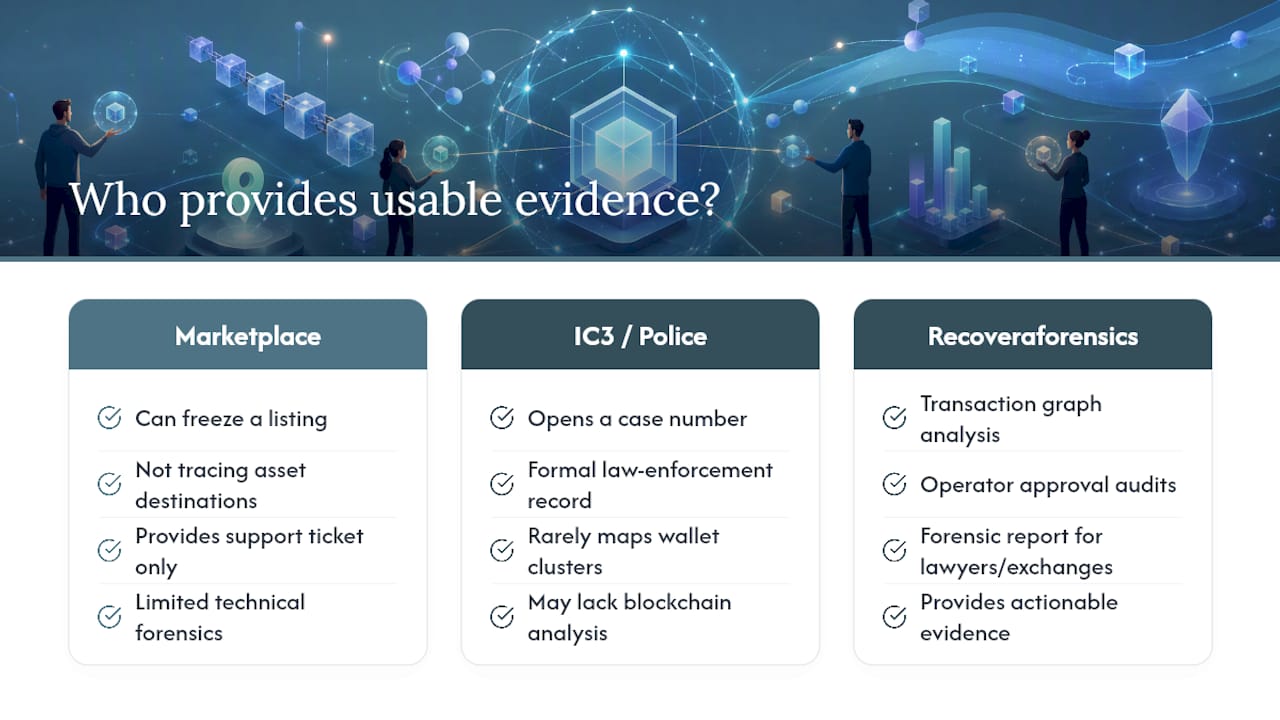
High-value thefts, fast cashout attempts, or a trail that runs through multiple wallets and a bridge are the situations where DIY tracing hits its limit. That’s the point where a firm like Recoveraforensics earns its fee: transaction graph analysis, operator approval audits, and a court-ready forensic report that names the drain window, clusters the destination addresses, and documents the flow toward any exchange on-ramp.
Professional engagements that package a clustered address graph with a sworn timeline materially improve the odds an exchange honors a freeze request, because compliance teams respond to structured, defensible evidence, not raw screenshots. Deliverables typically include an annotated timeline, wallet clustering charts, and a full evidence package built for attorneys, law enforcement, or marketplace trust and safety teams. Case work in this space shows that combining blockchain tracing with marketplace reporting and legal pressure has recovered assets in documented incidents, even when the initial trail looked cold.
Key Official Pages and Reporting Portals to Consult
Bookmark these before you need them. OpenSea’s stolen-item policy explains exactly how takedown requests work. The FBI’s IC3 portal is where federal complaints get filed and documented. Legal primers on property classification, like Cornell’s overview of securities and property frameworks, help you understand what civil remedies might apply to your case.
The Case for Speed Over Perfection
Most victims waste their first 48 hours trying to understand exactly what happened instead of documenting it. That instinct is backwards. You don’t need to know why the approval got signed or which Discord link did it; you need the hash, the timestamp, and the destination address written down before the thief bridges the assets somewhere harder to trace.
The conventional advice, “contact the platform and wait,” undersells how much a victim can do alone in the first few hours. Screenshotting approvals, exporting a CSV, and revoking remaining permissions costs nothing and takes twenty minutes. Where that advice falls short is treating professional forensics as a last resort rather than a parallel track. Once a theft crosses into six figures or the thief starts moving funds through a bridge, waiting to see if the marketplace flag “works” often burns the exact window a forensic report needs to be useful for a subpoena.
Prioritize documentation first, reporting second, and professional help the moment the trail gets complicated. Everything else is secondary.
— cristian
Get Legal-Grade Forensic Support From Recoveraforensics
There are other paths available to you here: reporting directly to the marketplace, filing with IC3 on your own, or pursuing a civil claim without technical backup. Each has real limits. A marketplace can freeze a listing but can’t trace where your assets actually went. A police report opens a case number but rarely comes with someone mapping the wallet clusters for you. Recoveraforensics fills that gap: transaction graph analysis, operator approval audits, and a forensic report built to hold up with law firms, exchanges, and marketplace compliance teams, not just a summary of what you already suspected. That is the difference between hoping a platform notices your ticket and handing them evidence they can act on. If your case involves a high-value theft, a fast cashout attempt, or a trail that already crosses multiple wallets, get a forensic investigation started before the assets move again.
This article is general information, not a substitute for advice from a qualified financial advisor. Consult a qualified financial professional about your own circumstances before acting on anything here.
Sources
- What is OpenSea’s stolen item policy?
- Ethereum NFT Drain — Trace Stolen ERC-721 & ERC-1155 Collections | Tracefunds
FAQ
Can the police do anything about stolen crypto or NFTs?
Yes, though action depends on the case. Local police can open a report and higher-value or organized-fraud cases tend to draw more attention, especially once paired with a forensic report and an IC3 filing.
What does “NFT scammer” mean?
An NFT scammer is anyone who uses phishing links, fake mint sites, malicious approval requests, or impersonation to trick a holder into signing away control of their tokens or wallet.
I lost thousands of dollars when my NFT or crypto was stolen. How can I recover it?
Start by documenting the transaction hashes, token IDs, and timestamps immediately, then report to the marketplace and file with IC3. For larger losses, a professional forensic investigation through a firm like Recoveraforensics builds the evidence exchanges and courts need to act.
Can NFT or crypto theft actually be traced?
Yes. Blockchain transactions are public, so investigators can follow the flow of funds from the drain transaction through connected wallets, though recovery odds drop once assets are bridged to another chain or run through a mixer.
What is OpenSea’s stolen item policy?
OpenSea disables flagged stolen items from trading for about 90 days, with possible extensions when law enforcement is involved, but this only stops resale on that platform and doesn’t reverse the transfer itself.