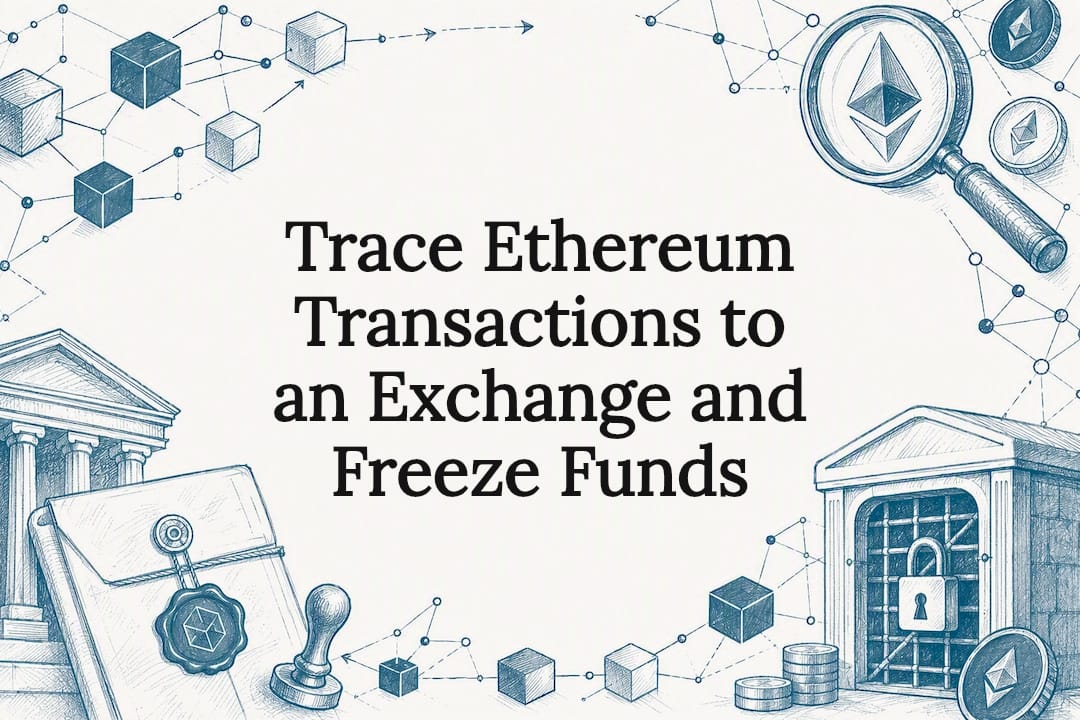
A forensic tracing engagement can usually follow stolen ETH to its likely cash-out point and produce court-ready evidence, provided the funds touch an exchange or another regulated custodial service. The trail can get murky through mixers or cross-chain bridges, but murky isn’t the same as dead. Before you do anything else: preserve your device, write down every transaction hash and timestamp you have, stop moving any remaining funds, and save every message or screenshot connected to the scam.
TL;DR:
- Funds that touch regulated exchanges are the most actionable targets because they can freeze assets and reveal account identities through legal means.
- Investigators must decode complex token transfers, internal contract calls, and cross-chain swaps, requiring detailed analysis and off-chain intelligence.
- Building a court-ready forensic report demands comprehensive documentation, including raw data exports, hash values, tool versions, and a chain-of-custody record for every step.
- Tracing can take from hours in simple cases to weeks for multi-hop, cross-chain thefts, with delays primarily caused by legal procedures and the complexity of the scam.
- Focusing on chokepoints like exchange wallets provides a practical path to recovery, as chasing every wallet connection often wastes resources without actionable outcomes.
Table of Contents
- What Forensic Tracing of Ethereum Transactions Means for Recovery and Litigation
- The Investigator’s Workflow: From Intake to Chokepoint
- From Trace to Testimony: Building a Legal-Grade Report
- How Long It Takes and What It Costs
- Why Recovera Prioritizes Chokepoints Over Chasing Every Hop
- Start Your Investigation with Recovera Forensics
- Sources
- FAQ
What Forensic Tracing of Ethereum Transactions Means for Recovery and Litigation
Checking a wallet on Etherscan tells you where funds moved. It doesn’t tell you who moved them, why, or whether that information will hold up in a courtroom. Forensic tracing is a different discipline entirely: an investigative service that reconstructs the full path of stolen assets, ties wallet behavior to real-world identities, and packages the findings into evidence a judge or opposing counsel can’t easily dismiss.
Ethereum makes this harder than it looks on the surface. A single scam transaction often triggers a cascade of ERC-20 token transfers, internal contract calls, and swaps that never show up as a simple ETH transfer. Investigators have to decode the Transfer event signature (0xddf252ad) embedded in transaction logs, because a trace that only follows native ETH movement will miss where the money actually went.
On-chain data only gets you halfway. Blockchain forensics combines that on-chain work with off-chain intelligence such as exchange KYC records, IP logs, and open-source intelligence, turning a wallet cluster into an actual lead law enforcement can act on.
Scammers know this and try to break the trail using:
- Privacy mixers that pool funds from many senders
- Cross-chain bridges that hop assets to another network entirely
- Chain-hopping through multiple intermediary wallets
- Rapid conversion into stablecoins or other tokens to obscure the original asset
None of these tactics are automatic dead ends. They add hours to the analysis, but a patient investigator working the transaction graph can usually still narrow the search to a manageable set of destination addresses.
The Investigator’s Workflow: From Intake to Chokepoint
Every serious tracing engagement follows a similar sequence. What you hand over on day one determines how fast it moves.
- Client intake. Investigators need transaction IDs, the wallet addresses involved, approximate timestamps, device logs if available, and copies of any communications or screenshots tied to the scam. The more precise the timestamps, the faster the analysis narrows.
- Data collection. This means pulling node exports, indexed event logs, internal transaction records, and relevant smart contract addresses. Everything gets hashed and stored securely the moment it’s collected, before any analysis begins.
- Graph construction and decoding. Investigators build a transaction graph mapping every hop, decode token events, and follow swaps and bridge crossings as far as the data allows.
- Clustering. Addresses get grouped using conservative heuristics, meaning an investigator would rather under-claim a connection than assert one the evidence doesn’t fully support.
- Chokepoint identification. The analysis specifically hunts for deposit patterns matching known exchange wallets, because that’s where the trail can actually convert into legal action.
Investigators follow roughly this same scoping, collection, analysis, and reporting sequence across most cases, adjusting depth based on how many hops separate the theft from a cashout.
The prioritization on chokepoints isn’t arbitrary. Exchanges and other virtual asset service providers can freeze funds and disclose account holder identity under legal process, which is exactly what turns a trace into a recovery path rather than an academic exercise.
Pro Tip: Watch for the internal transaction trap. A huge share of tracing errors happen because someone follows only the ETH that moved as a “normal” transaction and misses value shifted through a smart contract’s internal calls. Internal transactions and token logs are a routine source of broken traces for anyone who isn’t specifically pulling and decoding that internal call data alongside the main transaction log.

From Trace to Testimony: Building a Legal-Grade Report
A trace that lives only in an investigator’s head, or in an unlabeled spreadsheet, is close to useless in a legal proceeding. What separates a legal-grade report from a casual lookup is documentation rigorous enough that a stranger could reproduce every conclusion.
A defensible report typically includes:
- A written narrative connecting the theft to its destination, citing specific TXIDs, block heights, and timestamps at every step
- Raw data exports alongside their cryptographic hash values, proving nothing was altered after collection
- The exact tool versions and query parameters used, so the analysis can be rerun and checked
- Labeled exhibits mapping each claim in the narrative to its supporting on-chain data
That level of reproducibility isn’t optional if the report might end up in front of a judge. Court-ready blockchain evidence needs preserved raw exports, hash values, documented tool versions, and a clear chain-of-custody log showing exactly who handled the data and when.
There’s a subtler point that trips up a lot of first-time reports: a blockchain analytics tool tagging an address as “Exchange X, high confidence” is a lead, not a fact. Vendor labels have to be treated as investigative signal until corroborated with subpoena records or exchange disclosures that independently confirm identity.
Blockchain analytics methods have survived Daubert scrutiny in U.S. courts when the analyst clearly explained the methodology and backed the tool’s output with corroborating evidence rather than presenting it as an unquestionable conclusion.
That single distinction, documented methodology plus independent corroboration, is what has let blockchain analytics clear Daubert and Federal Rules of Evidence challenges in the cases that have tested it.
How Long It Takes and What It Costs
Nobody gets stolen ETH back overnight, but the timeline isn’t as glacial as most victims assume, either.
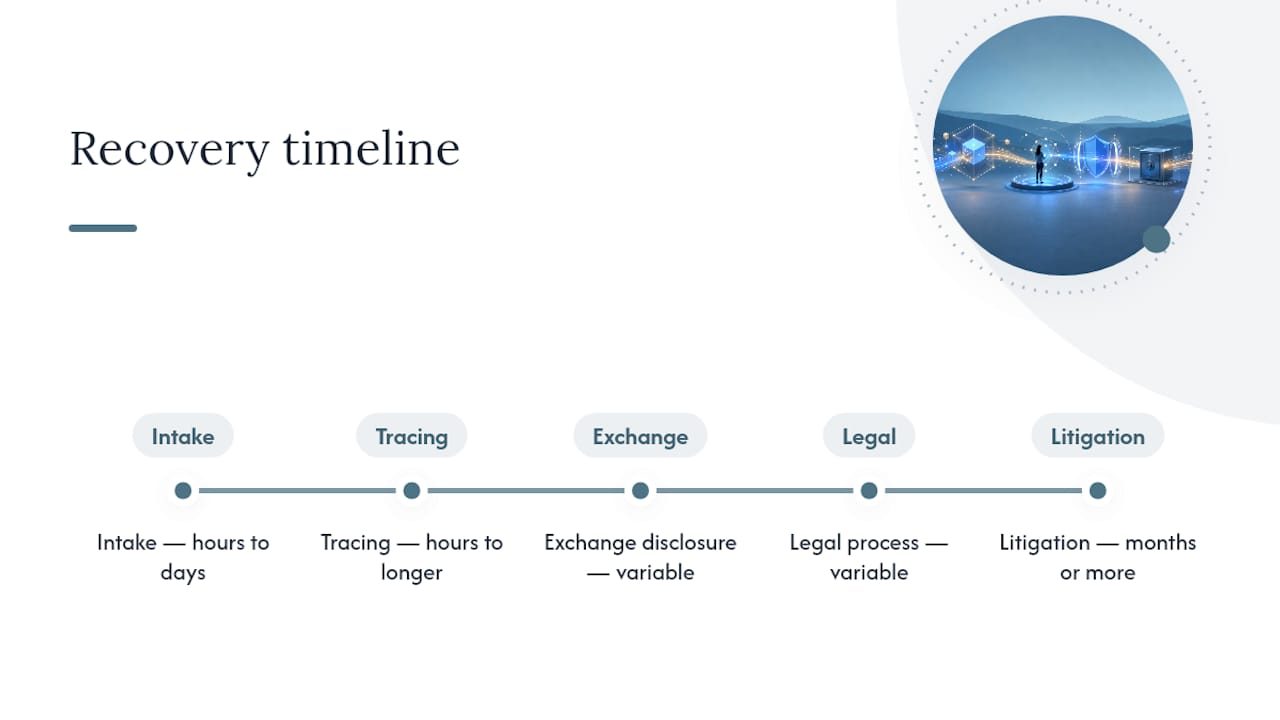
Intake and preservation usually takes some hours to a few days, depending on how quickly you supply transaction data and device logs. The tracing itself can take from a few hours for simple cases to longer periods for complex multi-hop or cross-chain thefts. Legal processes, such as subpoenas or exchange disclosure requests, generally take a variable amount of time depending on the exchange’s jurisdiction and compliance posture. Litigation, if it occurs, can last months or more.
The single biggest factor in whether you see any money back is whether the stolen funds landed on a regulated exchange before being withdrawn. Fast notification to that exchange and to law enforcement measurably improves the odds, because a delayed report gives the thief more time to cash out and vanish.
Pricing for a paid engagement tracks complexity: how many hops the funds took, whether mixers or cross-chain bridges are involved, and whether the case needs an expedited subpoena or expert testimony down the line. A straightforward two-exchange trace costs far less than a six-month investigation spanning three blockchains and a courtroom appearance. Whatever the scope, start collecting your intake documentation now. Investigators can’t work faster than the evidence you hand them.
Why Recovera Prioritizes Chokepoints Over Chasing Every Hop
Some investigations chase every possible wallet connection trying to build the most exhaustive map imaginable. Recoveraforensics doesn’t work that way, and honestly, I think the exhaustive-map approach mostly wastes a victim’s money. A trace is only useful if it ends somewhere actionable. That means we weight our analysis toward exchange touchpoints and custodial chokepoints from the first hour of an engagement, because that’s where legal process can actually freeze funds or unmask an identity.
The same discipline applies to reporting. Every conclusion gets tied to documented methodology, hashed exports, and a clear chain-of-custody log, and we work directly with retained counsel or law enforcement rather than handing over a report and disappearing. A trace nobody can act on isn’t worth much, no matter how many wallets it maps.
— cristian
Start Your Investigation with Recovera Forensics
If you’re staring at a wallet that just got drained, the clock matters more than almost anything else. Recoveraforensics moves fast because our intake process is built for exactly this moment: send us your transaction IDs, the wallet addresses involved, screenshots of the scam communication, and any device logs you have, and stop moving any remaining funds before we look at it.
From there, we build the transaction trace, document every step with hashed exports and reproducible methodology, and produce a legal-grade forensic report with labeled exhibits your attorney can actually use. We coordinate directly with counsel on exchange requests and subpoenas rather than leaving you to translate technical findings into legal action alone.
Start your case with Recovera Forensics and get your evidence preserved before the trail goes cold.
Sources
- Blockchain Forensics for Stolen Crypto Recovery
- Building strong cases with blockchain evidence (TRM Labs)
- When blockchain analytics meet the Daubert test (Norton Rose Fulbright reprint)
FAQ
Can Stolen Ethereum Actually Be Traced?
Yes. Investigators can usually follow stolen ETH through its transaction history to a likely cashout point, especially when the funds eventually touch a regulated exchange.
What Information Should I Gather Before Contacting an Investigator?
Collect every transaction ID, the wallet addresses involved, approximate timestamps, device logs, and any screenshots or messages tied to the scam before your first call.
Do Mixers and Bridges Make Tracing Impossible?
No, but they add significant complexity. A skilled investigator can often still narrow the destination addresses even after funds pass through a mixer or cross-chain bridge.
How Long Does an Ethereum Tracing Investigation Take?
Tracing itself typically runs from a few hours for simple cases to several weeks for multi-hop or cross-chain theft, while legal process to freeze or disclose funds can take days to months.
What Makes a Tracing Report Legally Admissible?
A report needs documented methodology, preserved raw data with hash values, recorded tool versions, and a clear chain-of-custody log, which is exactly how Recoveraforensics structures every case file it delivers to counsel.