Yes, blockchain records can be admitted in US federal and state courts, but nothing about a blockchain makes evidence self-proving. Judges still run it through the same gauntlet as any other digital record: authentication under Federal Rule of Evidence 901, hearsay screening under FRE 801 and 802, and, if an expert is walking the jury through wallet flows, a Rule 702 reliability check. The 2017 additions of FRE 902(13) and 902(14) give proponents a faster lane: a qualified person can certify that a hash of the proffered record matches the original, which self-authenticates the evidence without live testimony.
For a filing deadline, the short version is this. Get a qualified-person certification or expert declaration built on independent hash verification and a documented chain of custody. Draft your hearsay-exception argument before opposing counsel forces the issue, usually under FRE 803(6) or the narrower FRE 807 residual exception. Assume a Daubert challenge to any analytics tool is coming and build your methodology record now, not after the motion lands.
Pro Tip: File your Rule 902(13)/(14) certification alongside your complaint or initial disclosures rather than waiting for a motion in limine fight. Courts respond better to authentication that looks routine than to authentication that looks improvised under pressure.
Key Takeaways
Blockchain evidence gains admissibility in US courts through documented hash authentication, a clear hearsay exception, and expert methodology that survives Rule 702 scrutiny.
| Point | Details |
|---|---|
| Authentication starts with hashing | Independent, matching cryptographic hashes are the backbone of any FRE 902(13)/(14) certification. |
| Hearsay needs a named exception | Plan for FRE 803(6) business records first; treat FRE 807 as a narrow backup, not a primary strategy. |
| Expert reports must be reproducible | Courts under Rule 702 want tested methodology, documented error rates, and inspectable raw data. |
| Attribution requires off-chain proof | A wallet address alone never identifies a person; pair it with KYC records, IP logs, or admissions. |
| Recovera Forensics builds litigation-ready reports | Its preservation, hashing, and expert-reporting process is designed to meet FRE 901, 902, and 702 standards for court submission. |
Table of Contents
- Which Federal Rules Actually Control Blockchain Evidence Admissibility
- How Do You Authenticate Blockchain Records for Court?
- When Does Hearsay Block Blockchain Evidence?
- Meeting Daubert and Rule 702 for Blockchain Analytics
- Forks, Attribution Gaps, and Other Ways Blockchain Evidence Gets Challenged
- What Our Forensic Team Sees in Practice
- Get Your Blockchain Evidence Litigation Ready
- Primary Sources and Further Reading
- Sources
- FAQ
Which Federal Rules Actually Control Blockchain Evidence Admissibility
Blockchain evidence admissibility runs through five overlapping rules, and litigators who treat them as separate hurdles instead of one connected framework tend to lose ground unnecessarily.
FRE 901 sets the floor: the proponent must produce evidence sufficient to support a finding that the item is what it claims to be. For a blockchain record, that typically means showing the ledger entry, the address involved, and the transaction hash line up with an authentic, unaltered copy of the chain data.
FRE 902(13) and 902(14), added in the 2017 amendments, let a qualified person self-authenticate electronic records by certifying that a hash of the proffered evidence matches the original file, cutting out the need for a live authentication witness at trial. This is the single most useful procedural tool available to anyone submitting blockchain records, and the Federal Judicial Center’s own guidance on the amendment spells out exactly what the certification needs to say.
Hearsay is where things get harder. Under FRE 801 and 802, a blockchain entry offered to prove the truth of what it records (a transfer happened, an amount changed hands) is an out-of-court statement unless it falls under an exception. FRE 803(6), the business records exception, works when the ledger data was kept in the regular course of a business activity with a custodian who can speak to that process. When 803(6) doesn’t fit, some litigants have turned to FRE 807, the residual exception, though academic analysis calls this the “blockchain paradox”: technically reliable data that still struggles to clear a doctrinal hearsay bar built for paper records.
Expert testimony explaining blockchain analytics gets tested under FRE 702 and Daubert. And FRE 201 judicial notice occasionally lets a court accept undisputed facts about how a particular blockchain functions without requiring proof at trial.
- A handful of states, including Vermont, Ohio, and Arizona, have passed statutes that make blockchain records self-authenticating under state law, which can matter a great deal if your case sits in state rather than federal court.
How Do You Authenticate Blockchain Records for Court?
Authentication is a sequencing problem. Do the steps in order, document each one, and you convert a technical dataset into something a judge can rely on without a fight.
- Preserve the original data first. Pull the raw transaction data, wallet addresses, and block references before anything else touches the record. Preservation that happens after litigation is announced looks reactive and invites challenge.
- Calculate multiple independent hashes. Generate a cryptographic hash (SHA-256 is standard) of the evidence at collection, and have a second, unaffiliated party generate their own hash independently. Matching hashes are the core of the FRE 902(13)/(14) certification.
- Capture timestamps and node snapshots. Record when data was pulled, from which node or explorer, and under what network conditions, since fork disputes later hinge on exactly this detail.
- Collect off-chain metadata. Exchange records, IP logs, KYC documentation, and account records tie an anonymous address to a real person or entity, which the ledger alone cannot do.
- Preserve custodial service logs where available. If a centralized exchange or wallet provider was involved, request their internal logs before they age out of retention policies.
A solid qualified-person certification states the hash match result, the exact method and software version used, who performed the custody steps, and precisely when collection occurred. Vague certifications (“records appear accurate”) get picked apart on cross.
Some forensic frameworks now combine on-chain hash anchoring with encrypted off-chain storage, aligning with standards like ISO/IEC 27037 for digital evidence handling. That hybrid approach gives you a chain-of-custody record that survives scrutiny even when the underlying blockchain data is publicly accessible and, in theory, alterable in how it’s presented.
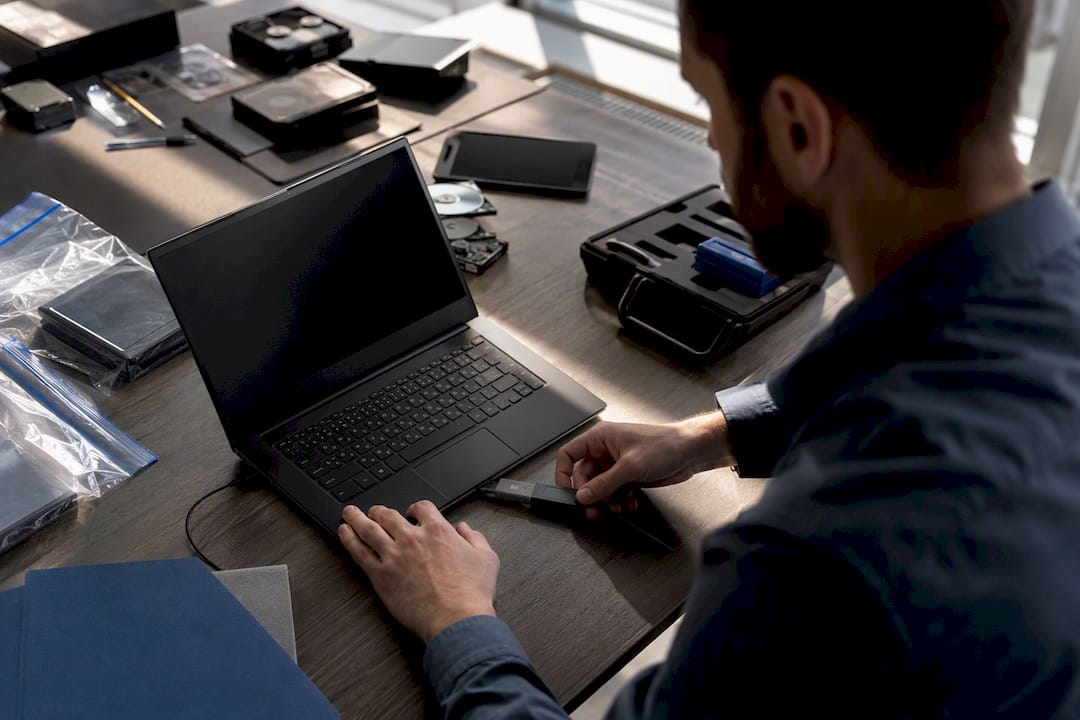
Pro Tip: Store your independent hashes in at least two separate trusted locations, such as a court filing, a neutral escrow service, and a third-party timestamping authority. If one copy is ever challenged as compromised, the others corroborate it.
When Does Hearsay Block Blockchain Evidence?
The threshold question is simple to state and hard to apply: is the blockchain entry an out-of-court statement offered for the truth of what it asserts? If a party offers a ledger entry to prove a transfer actually happened, courts generally treat that as hearsay under FRE 801 unless an exception applies.
The business records exception, FRE 803(6), is the most durable path. It works when the records were kept in the regular course of a regularly conducted activity and a custodian or qualified witness can testify to that process. A crypto exchange’s internal transaction logs often fit this mold better than raw public blockchain data does, since the exchange is the “business” keeping records in its ordinary course.
The residual exception, FRE 807, gets invoked when 803(6) doesn’t quite fit, but it’s a narrower, riskier road. Courts apply it case by case, and academic commentary warns that leaning on 807 as a primary strategy leaves too much discretion in one judge’s hands.
Blockchain evidence sits in an odd spot: technically about as reliable as evidence gets, cryptographically verified and tamper-evident, yet still filtered through hearsay doctrine built for witnesses and paper files rather than distributed ledgers.
Some litigants argue blockchain entries are machine-generated, non-human “statements” that fall outside hearsay entirely, an argument courts have accepted for other automated records like server logs, though it remains unsettled specifically for blockchain.
Meeting Daubert and Rule 702 for Blockchain Analytics
Expert testimony explaining how blockchain analytics traced a wallet to a suspect, or reconstructed a transaction chain, has to survive Rule 702’s gatekeeping test before a jury ever hears it. The amended rule and Daubert factors ask whether the expert’s methodology was actually tested, whether it has a known or estimated error rate, whether it’s been subject to peer review, and whether it’s generally accepted in the relevant technical community.
Courts increasingly expect expert reports to show reproducible methodology, not just a conclusion. In United States v. Sterlingov, the court found by a preponderance that blockchain tracing analysis produced using proprietary software, including tools like Chainalysis, was the product of reliable principles and methods, and it denied the defense’s motion to exclude that testimony under Rule 702.
Before you file, require your expert or analytics provider to hand over:
- A written methodology statement describing exactly how the tracing or hash-matching was performed.
- Testable, reproducible outputs, not just summary conclusions.
- Known or potential error rates and any validation testing performed on the method.
- Raw export files the opposing party and the court can independently inspect.
Pro Tip: Ask your expert directly for the tool’s documented error rate before you file. Courts are treating that single data point as central to the Rule 702 inquiry, and an expert who can’t answer it is an expert who invites exclusion.
A methodology that can be tested, replicated, and audited by the other side survives Daubert far more often than one presented as a black box, no matter how sophisticated the underlying software.
Forks, Attribution Gaps, and Other Ways Blockchain Evidence Gets Challenged
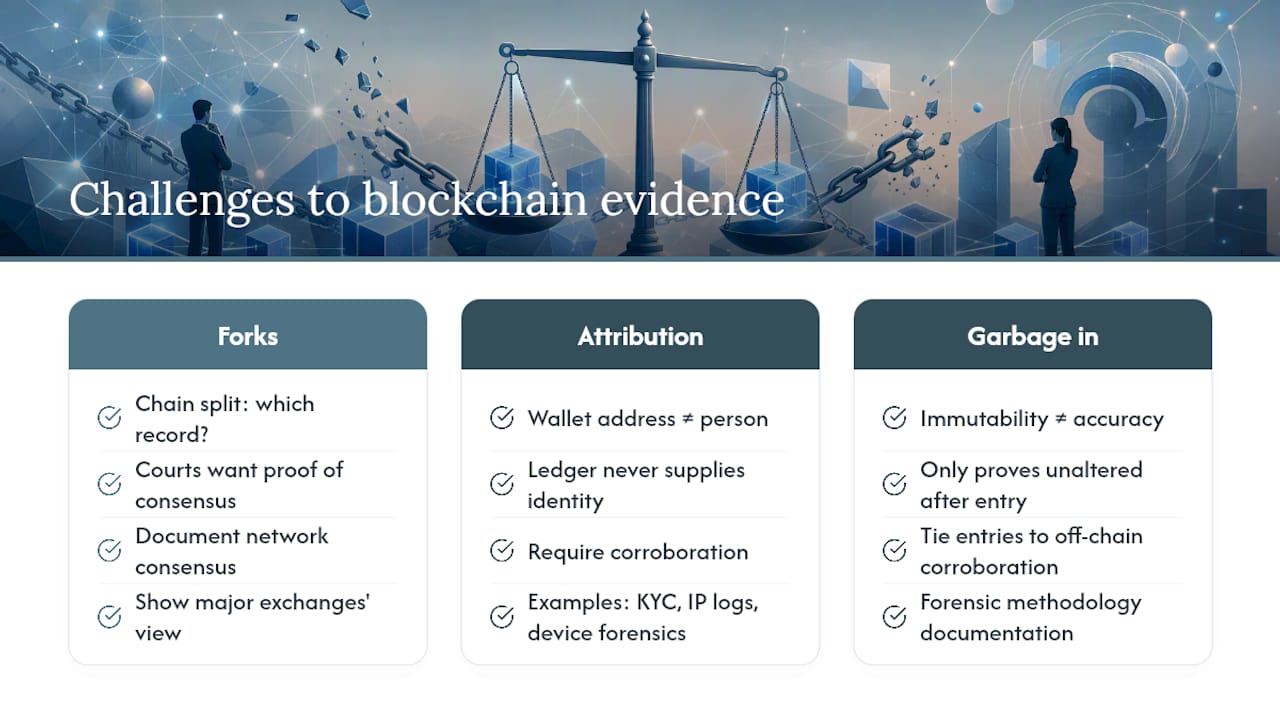
Three recurring problems sink blockchain evidence more than any other objection.
Forks. When a blockchain splits, which fork is the “real” record? Document which chain the broader network and major exchanges treated as canonical at the relevant time, since courts want proof of consensus, not just a technical explanation of the split.
Attribution limits. A wallet address is not a person. Linking an anonymous address to an identified individual requires corroboration: exchange KYC records, IP logs, device forensics, or admissions, since the ledger itself never supplies that identity.
Garbage in, garbage out. Immutability only guarantees the data hasn’t been altered after entry. It says nothing about whether the underlying real-world transaction was accurately recorded in the first place, so forensic literature stresses tying every on-chain entry to independent off-chain corroboration.
Budget accordingly: expert hours for methodology write-ups, time for the analytics vendor to validate and document their process, and extra discovery cycles if the opposing side demands raw data exports, all add real weeks to a litigation timeline that a simple document production wouldn’t require.
What Our Forensic Team Sees in Practice
Our workflow at Recovera Forensics starts with preservation and independent hashing before an expert ever writes a word of analysis, because a report built on shaky custody collapses under cross-examination regardless of how good the tracing looks. Redundant collection and transparent, disclosed methodology head off most authentication and hearsay fights before they start. Clients with documented chain-of-custody and clear methodology consistently have an easier time getting their evidence in front of a jury than those who treat forensics as an afterthought.
Get Your Blockchain Evidence Litigation Ready
A methodology statement and a hash certification only carry weight in court when they come from a team that’s built them before, and that’s the gap Recovera Forensics closes for attorneys and their clients pursuing stolen crypto or building a fraud case for trial. Our forensic investigation and recovery services cover the full chain: preservation of original transaction data, independent hash certification suitable for a Rule 902(13)/(14) filing, and expert reports built to survive a Daubert challenge, with our analysts available to testify as qualified witnesses when a case goes to hearing.
If you’re preparing a filing or defending against one, reach out through our contact page for U.S. fraud cases with your case timeframe, any wallet addresses or transaction IDs involved, and whatever exchange or custodial logs you already have. We’ll tell you within one review what’s admissible-ready and what still needs work.
Primary Sources and Further Reading
For attorneys drafting motions or briefs, these are the sources worth citing directly or attaching as exhibits:
- The Federal Judicial Center’s summary of the 2017 evidence amendments covering FRE 902(13) and 902(14).
- Frontiers in Blockchain’s analysis of evidentiary significance and procedural implications for blockchain in US courts.
- The SMU Law Review piece on “The Blockchain Paradox”, useful for framing hearsay doctrine tension in a brief.
- The Fordham Law Review’s comparative review of state statutory developments on Vermont, Ohio, and Arizona.
- Norton Rose Fulbright’s analysis of how blockchain analytics meet the Daubert test.
Recovera Forensics also maintains practitioner background and contact resources for attorneys who need forensic support attached to an active matter.
This article is general information, not a substitute for advice from a qualified lawyer. Consult a qualified legal professional about your own circumstances before acting on anything here.
Sources
- Blockchain in the courtroom: exploring its evidentiary significance and procedural implications in U.S. judicial processes
- Amendments to the Federal Rules: evidence 2017 — self-authenticating records
- The Blockchain Paradox: Almost Always Reliable, Almost Never Admissible
- Blockchain evidence (comparative and state statutory developments) — Fordham Law Review excerpt
- When blockchain analytics meet the Daubert test
FAQ
Can Blockchain Evidence Be Used in Court?
Yes. US courts admit blockchain records when the proponent authenticates them under FRE 901 or 902(13)/(14), clears a hearsay exception, and supports any expert analysis with reliable, tested methodology under Rule 702.
What Is FRE 902 Blockchain Evidence?
FRE 902(13) and 902(14) let a qualified person self-authenticate electronic records, including blockchain data, by certifying that a hash of the submitted record matches the original file, avoiding the need for live authentication testimony.
Does Blockchain Immutability Mean It’s Automatically Admissible?
No. Immutability shows the record hasn’t been altered after entry, but it says nothing about whether the underlying transaction was accurately recorded or who controlled the wallet, which is why courts still require independent authentication and corroboration.
How Do Courts Handle Blockchain Analytics Under Daubert?
Courts apply the standard Rule 702 factors: testing, error rates, peer review, and general acceptance. In United States v. Sterlingov, the court found blockchain tracing analysis reliable enough to reach the jury after the proponent demonstrated its methodology.
Can Recovera Forensics Help Prepare Evidence for Litigation?
Recovera Forensics builds forensic reports designed around FRE 901, 902, and 702 standards, including independent hash certification, chain-of-custody documentation, and expert reporting suitable for courtroom testimony.