SPL token tracing means reconstructing who sent, received, and holds tokens on Solana by reading on-chain balance changes and resolving token accounts back to wallet owners. The fastest starting check is a manual diff of postTokenBalances against preTokenBalances on a single transaction. For anything production-grade or forensic, that manual check breaks down fast, and you need Substreams’ map_spl_instructions module to get resolved ownership and complete transfer records instead.
TL;DR:
- Diffing
preTokenBalancesandpostTokenBalancesprovides the fastest way to identify token movements in a transaction without parsing instructions.- Relying solely on
accountKeysto identify wallet activity misses cases where the owner is only specified in theownerfield of balance changes.- Tracking both Tokenkeg and Token-2022 program IDs is necessary, as they handle different token types and transfers without cross-visibility.
- Using Substreams’
map_spl_instructionsoffers out-of-the-box owner resolution at scale, reducing the need for custom resolver development.- For complex or legally sensitive cases, professional forensic services ensure complete, chain-of-custody compliant reports with owner histories and verified timestamps.
Table of Contents
- What Is SPL Token Tracing, and Why the Basics Matter
- How to Read Transactions for SPL Token Movement
- Choosing a Tracing Workflow: Substreams, Live Tails, or Dashboards
- Why Owner Resolution Breaks and How to Fix It
- Forensic Best Practices for Trace Evidence
- Your Starter Checklist for Tracing a Token Right Now
- Correlating Token Transfers With SOL Fees and Movement
- How Freezing, Delegation, and Multisig Complicate a Trace
- Security and Privacy Considerations Worth Taking Seriously
- Author Perspective: Knowing When to Hand It Off
- How Recoveraforensics Turns a Trace Into Evidence
- Sources
- FAQ
What Is SPL Token Tracing, and Why the Basics Matter
Before you write a single line of tracing code, you need to know what you’re actually reading. Solana doesn’t store token balances the way Ethereum stores ERC-20 balances in a contract’s storage slot. Instead, every SPL token balance lives in its own account, and that structural choice is the entire reason token tracing has its own quirks.
Three account types matter here, and confusing them is the single most common mistake developers make when they start tracing.
- Mint account. This represents the token itself, not a balance. It stores the total supply, decimals, and mint/freeze authority. There is exactly one mint account per token type.
- Token account. This holds an actual balance for one wallet, one mint. A wallet with five different tokens needs five separate token accounts.
- Associated token account (ATA). This is a token account whose address is deterministically derived from the wallet address and the mint. It’s a program-derived address, meaning it’s computed, not randomly generated, and a wallet gets exactly one ATA per mint.
That derivation matters for tracing because it means you can predict a wallet’s token account address for a given mint without querying anything, which is useful when you’re building a watch list.
Two program IDs run this system. The original Tokenkeg program (commonly called the SPL Token program) handles the vast majority of tokens in circulation. Token-2022, sometimes called the Token Extensions program, is a newer, separate program ID that adds features like transfer fees and confidential transfers baked into the token itself. If your tracing pipeline only watches Tokenkeg, you will silently miss every Token-2022 transfer, and there’s no error message telling you that. The instruction types you care about are consistent across both: Transfer, TransferChecked (which validates decimals and mint), MintTo, and Burn.
How to Read Transactions for SPL Token Movement
Once you understand the account model, the actual tracing work comes down to reading transaction data correctly. Here’s the sequence that works, in the order you’d actually run it.
- Pull the transaction or block. Call
getTransactionfor a single signature, orgetBlockwhen you’re scanning a range. RequestjsonParsedencoding so instruction data comes back readable instead of as raw base58. - Check
postTokenBalancesfirst, not the instructions. Every transaction response includespreTokenBalancesandpostTokenBalancesarrays. Diffing them tells you exactly which token accounts changed balance and by how much, without you needing to parse a single instruction. - Match on the
ownerfield, not the account address. Each entry inpostTokenBalancescarries anownerfield showing which wallet controls that token account. This is the detail that saves you the most work: you can match directly against a watched wallet set instead of resolving the token account address separately. - Fall back to inner instructions only when balances alone are ambiguous. Balance arrays tell you what changed but not always why. If you’re tracing a multi-hop swap through a DEX router, or you need to distinguish a
Transferfrom aBurnthat happens to zero out a balance, you need to walk the inner instruction list. - Handle the missing-wallet case. A wallet often won’t appear anywhere in
accountKeyseven though it received tokens, because the instruction only references the token account, not the owning wallet. This is exactly why theownerfield inpostTokenBalancesexists and why relying onaccountKeysalone under-counts activity.
For repeated or historical work, five JSON RPC methods cover almost everything: getBlock for scanning ranges, getTransaction for single signatures, getTokenAccountsByOwner for enumerating every token account a wallet controls, getTokenAccountBalance for a point-in-time balance check, and getProgramAccounts for the rare case where you need to scan every account owned by a specific program (expensive, and usually a last resort given the data volume it returns).
Choosing a Tracing Workflow: Substreams, Live Tails, or Dashboards
The technique you just read works fine for one transaction. It falls apart at scale, and picking the right tool pattern depends entirely on how much volume and completeness you actually need.
Substreams with map_spl_instructions is the strongest option when you need resolved ownership without building a resolver yourself. The solana-spl-token Substreams package parses SPL instruction types directly and enriches output with owner addresses, so what comes out the other end is a clean transfer record, not a raw instruction you still have to decode. Configuring it means setting the token mint address you’re watching and its decimals in the manifest parameters, then consuming the module’s transfer, mint, and burn outputs directly.
A live tail plus a reconcile sweep is the pattern to reach for when completeness is non-negotiable, which it usually is for forensic work. A gRPC live-tail approach streams transactions as they land, giving you low latency, but streams drop connections and miss slots. Pairing that stream with a periodic getBlock backfill sweep closes those gaps and gives you a completeness guarantee a live tail alone cannot.
Dashboards like Dune are the right call for fast, exploratory questions. “How many wallets received this token last week” doesn’t need a custom pipeline. But dashboards are built for aggregation, not chain-of-custody, and they rarely expose the row-level detail an investigation needs.
- Substreams: best owner resolution out of the box, moderate setup cost.
- Live tail + reconcile: best completeness guarantee, highest maintenance burden.
- Dashboards: fastest to a rough answer, weakest on evidentiary detail.
- Raw RPC scripting: cheapest to start, worst at scale past a handful of wallets.
Pro Tip: Don’t build a live tail without a reconcile sweep from day one. Teams almost always add the backfill step after discovering a gap in production, and by then you’ve usually already lost the data you needed for the period the stream dropped.
Why Owner Resolution Breaks and How to Fix It
Here’s the uncomfortable truth about SPL transfers: the instruction itself never names a wallet. It only references token accounts. Resolving that token account back to a real owner is where naive tracing scripts fall apart, and it’s the whole reason a dedicated ownership store exists in serious indexing pipelines.
A resolver that holds up under load typically runs four tiers, checked in order until one hits:
- In-memory cache for token accounts you’ve already resolved in this session, since re-querying the same account repeatedly wastes RPC calls.
- Transaction balance hints, meaning the
ownerfield already sitting inpreTokenBalances/postTokenBalances, which is often free data you already have. - A durable token account to owner table in your own database, built up over time from prior lookups.
- A live
getAccountRPC call as the fallback, since the token account layout stores the owner field directly and you can decode it yourself.
Edge cases will still bite you. A token account created in the same transaction it’s used in won’t have prior history to reference. A closed account (one that’s had its balance withdrawn and the account itself closed to reclaim rent) disappears from getAccount entirely, so your resolver needs to have already captured its owner before closure. And program-owned token accounts, ones controlled by a smart contract rather than a personal wallet, need to be flagged differently in a report, since attributing that balance to “a person” is simply wrong.
Track Token-2022 accounts through this same pipeline. Extensions like transfer fees can change the numbers your balance diff produces, so treat Token-2022 as a parallel program ID requiring the same resolver, not an edge case you patch in later.
Forensic Best Practices for Trace Evidence
Developer-grade tracing and forensic-grade tracing look similar on the surface and diverge hard in the details.
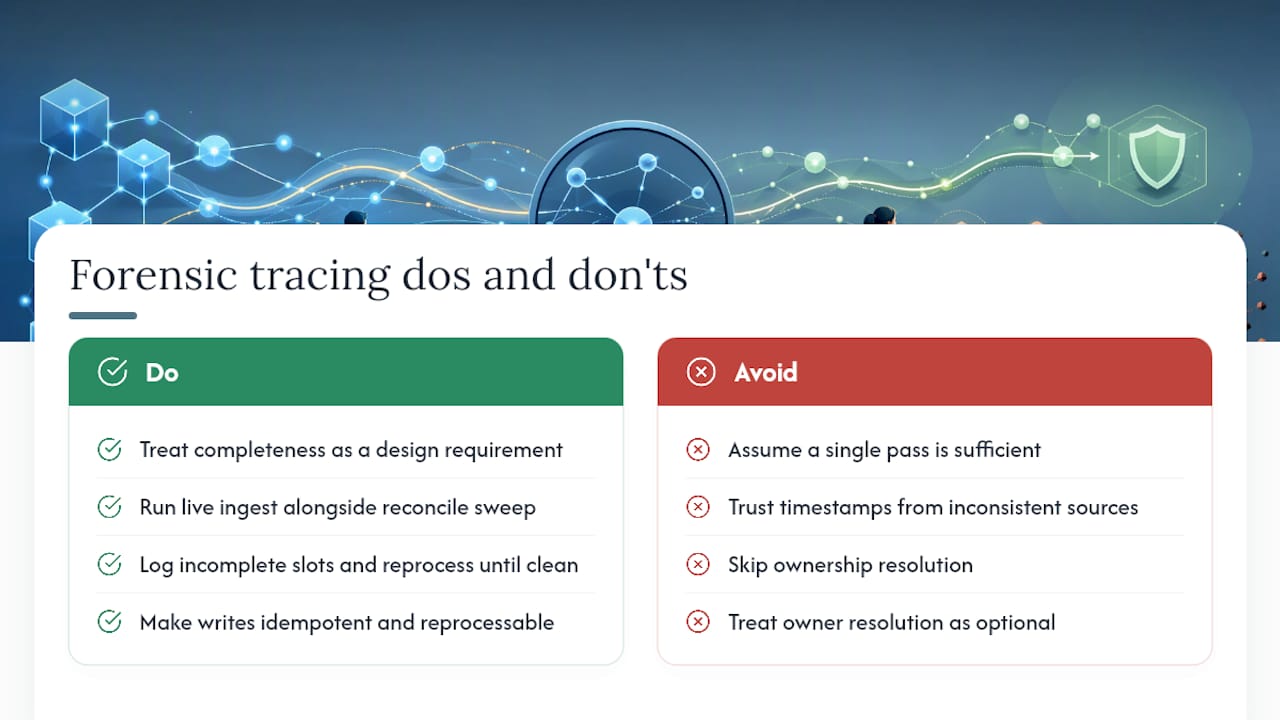
Comprehensive tracing treats completeness as a design requirement, not an aspiration, and benefits greatly from using a Crypto Trading Journal – Track Edge & Execution | The Final Tape to maintain immutable records and audit trails. That means always running a live ingest alongside a reconcile sweep, logging every slot that comes back incomplete, and reprocessing those flagged slots until the record is clean rather than assuming a single pass caught everything. Writes should be idempotent, keyed on (signature, instruction_index), so reprocessing a slot never creates a duplicate transfer row. block_time deserves its own lookup table keyed by slot rather than trusting whatever timestamp a transfer row happens to carry, which avoids the ordering errors that show up when timestamps get pulled from inconsistent sources.
A report built for legal proceedings needs specific elements a casual trace doesn’t: the full resolved owner chain for every hop, exact timestamps tied to verifiable slot numbers, a plain-language note on the method used to resolve each disputed owner, and a chain-of-custody statement showing exactly how the data was pulled and preserved.
Ownership resolution isn’t a nice-to-have step you bolt on later. The transfer instruction only ever points to a token account. Without a resolver that can prove which wallet controlled that account at that moment, you don’t have a transfer record. You have an anonymous number moving between addresses nobody can name.
Recoveraforensics builds its transaction graph analysis work on exactly this standard, treating a resolved owner chain as the minimum bar for a report that can actually stand up in a legal proceeding.
Your Starter Checklist for Tracing a Token Right Now
Run these steps in order for a fast first pass, then layer in the pipeline pieces for anything ongoing.
- Call
getTransactionorgetBlock, then diffpreTokenBalancesagainstpostTokenBalancesto spot every balance change. - Note the mint address and token accounts involved, and pull the
ownerfield for each. - If you’re moving past a one-off lookup, add Substreams and configure
map_spl_instructionswith the mint address and decimals you’re tracking. - Turn on a reconcile/backfill sweep alongside any live tail so you catch dropped slots.
- For anything that might end up as evidence: record every signature, slot,
block_time, and resolved owner, flag incomplete slots explicitly, and upsert rows so reprocessing never duplicates a transfer.
Pro Tip: Export at minimum signature, slot, block_time, mint, resolved sender, resolved receiver, and amount for every row. That’s the smallest field set that still lets a third party independently verify your trace later.
Correlating Token Transfers With SOL Fees and Movement
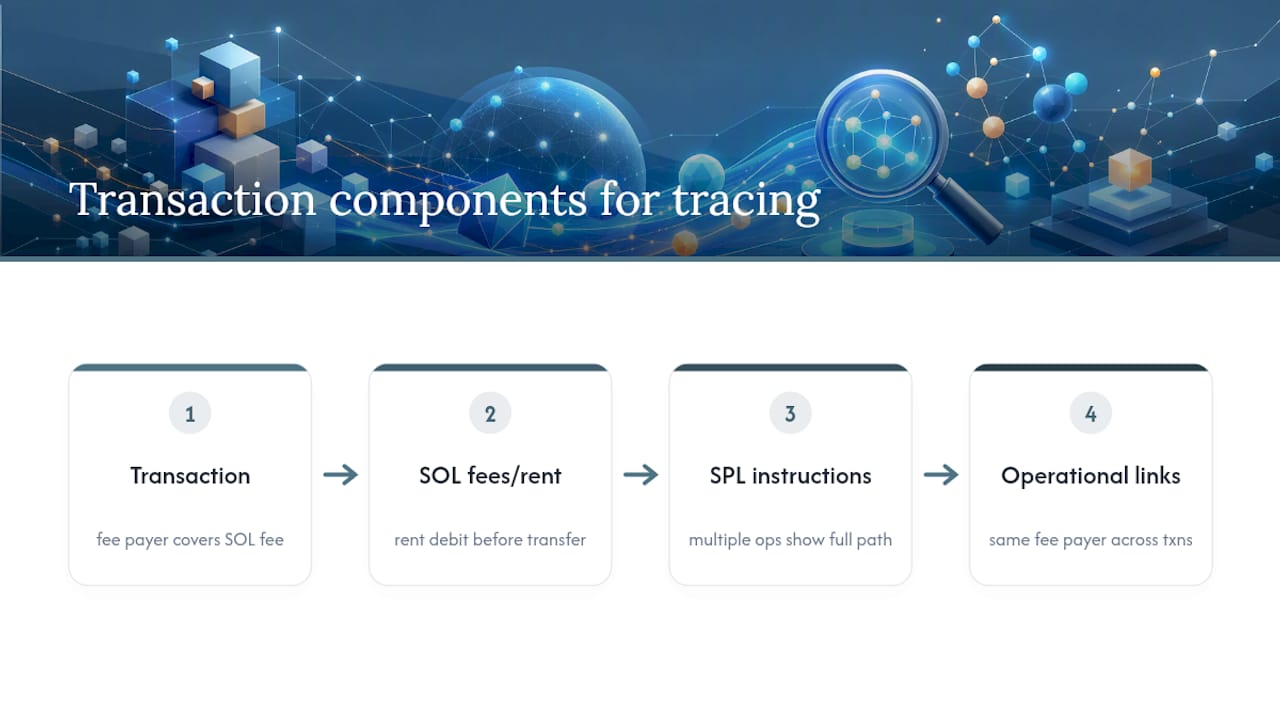
Every SPL transfer rides inside a transaction that also touches SOL, and ignoring that side of the ledger leaves gaps a careful trace shouldn’t have. The transaction’s fee payer covers the network fee in SOL regardless of which token moved, and that fee payer is often the actual controller of the wallet, even when a different account signed the token instruction.
Watch for a few specific patterns. A wallet funding a brand-new token account will show a small SOL debit for rent exemption right before the first token transfer lands, which is a useful marker for spotting freshly created accounts in a laundering chain. Closing a token account later refunds that rent in SOL back to whichever address is named as the destination, and that destination is worth checking independently since it doesn’t have to match the original funder.
Multi-hop transfers routed through a swap or bridge program typically bundle several SPL instructions and one or more SOL transfers into a single transaction. Pulling the full instruction list, not just the balance diff, is the only reliable way to see the whole path rather than just the net result. Matching SOL fee-payer patterns across multiple transactions can also reveal which wallets are operationally linked even when the token transfers themselves look unrelated on their own. A single fee payer covering gas for a dozen “unrelated” wallets is a pattern worth flagging on its own.
How Freezing, Delegation, and Multisig Complicate a Trace
Three token features change what a trace actually proves, and skipping past them produces reports that look complete but aren’t.
Freezing. A mint’s freeze authority can lock a specific token account so it can’t send or receive, and a frozen account sitting untouched for weeks doesn’t mean the owner walked away; it can mean someone else froze it. A trace that treats silence as inactivity without checking the freeze state can miss the reason a chain of transfers suddenly stopped.
Delegation. SPL tokens support delegated authority, where an owner grants another address permission to move a set amount of tokens on their behalf. A transfer signed by a delegate looks, on the surface, like the owner’s own action, and a trace that doesn’t check for an active delegate can misattribute who actually initiated a movement.
Multisig. Some token accounts are controlled by a multisig authority requiring multiple signers to approve a transfer. A trace can name the multisig account as the sender easily enough, but attributing intent to a specific individual behind a multisig requires cross-referencing which signers actually approved that instruction, information that isn’t always visible from the transfer record alone.
All three cases share a lesson: a trace that stops at “tokens moved from A to B” is incomplete the moment authority structures get involved. Recoveraforensics’ flow-of-funds analysis work factors in exactly these authority layers, since a report that ignores delegation or multisig control can name the wrong party as responsible.
Security and Privacy Considerations Worth Taking Seriously
Tracing on a public blockchain means the underlying data is already visible to anyone. That doesn’t mean tracing carries no risk, and treating it as risk-free is a mistake that shows up in both security and privacy terms.
On the security side, RPC endpoints you rely on for tracing can rate-limit, return stale data during congestion, or in the case of free public endpoints, simply go down. Building a pipeline that treats a single RPC provider as authoritative without a fallback creates a single point of failure in what’s supposed to be an evidentiary record. Storing resolved owner data and cached wallet mappings also means you’re holding a dataset that links wallets to identities, and that dataset itself becomes something worth securing, not just the trace output.
On the privacy side, tracing a wallet’s full history can surface far more than the transaction you set out to investigate. A trace built to follow stolen funds can incidentally expose a legitimate user’s unrelated spending pattern if the wallet was reused. Scoping a trace to the specific transfers and time window relevant to the case, rather than pulling a wallet’s entire lifetime history by default, keeps the investigation focused on what it’s actually meant to answer. Firms doing this work professionally also need a documented basis for why a given wallet was investigated at all, since blockchain data being public doesn’t erase the expectation that an investigation has a legitimate, stated purpose behind it.
Author Perspective: Knowing When to Hand It Off
Self-tracing works well for a single wallet or a handful of transactions. Once losses cross into six figures, span multiple chains, or need to hold up in court, the resolver edge cases and completeness gaps described above stop being minor and start being case-breaking.
— cristian
How Recoveraforensics Turns a Trace Into Evidence
A DIY trace answers “where did the tokens go.” Recoveraforensics builds on that same technical foundation, reconciled ownership resolution, live-tail plus backfill completeness, idempotent record-keeping, and turns it into a report a court or law firm can actually use. That’s the gap between a script output and an admissible chain-of-custody document, and it’s where paid forensic work earns its cost.
Recoveraforensics’ investigators run transaction-graph analysis, resolve token account owners across Tokenkeg and Token-2022 activity, and document every step with the timestamps and method notes a legal proceeding requires. If you’ve traced a suspicious transfer as far as your own tools allow and need a report built to legal standards, Recoveraforensics’ blockchain forensics service is the next step, and you can also review Recoveraforensics’ chain-of-custody guidance for U.S. cases before reaching out.
Sources
FAQ
What Is SPL Token Tracing?
SPL token tracing is the process of reconstructing token transfers, mints, and burns on Solana by reading balance changes and resolving token accounts to their real wallet owners.
What’s the Fastest Way to Check a Single Transaction?
Diff preTokenBalances against postTokenBalances in the transaction response. That shows exactly which token accounts changed and by how much without parsing any instructions.
Why Doesn’t a Wallet Show Up in accountKeys Even Though It Received Tokens?
SPL transfer instructions reference token accounts, not wallets directly, so the receiving wallet often only appears in the owner field inside postTokenBalances, not in accountKeys.
Do I Need to Track Both Tokenkeg and Token-2026?
Yes. They are separate program IDs, and a pipeline watching only one will silently miss every transfer processed under the other.
When Should I Use Substreams Instead of Raw RPC Calls?
Use Substreams’ map_spl_instructions once you need resolved ownership at scale, since it enriches transfer, mint, and burn events with owner addresses instead of leaving you to build a resolver yourself.
When Should I Hire a Forensic Investigator Instead of Tracing Myself?
Escalate to a specialist when losses are significant, funds have crossed multiple chains or mixed through swaps, or the trace needs to support a legal filing rather than personal curiosity.