If a U.S. exchange notifies you of a subpoena, it has likely been ordered to hand over your identity and transaction records, not your private keys. That alone doesn’t mean forfeiture is coming, but it can trigger account freezes or follow-on warrants. Preserve every record you have, avoid moving funds, and get a lawyer before you respond to anything.
TL;DR:
- Most exchange subpoenas request customer identity and transaction records, which do not include private keys or noncustodial wallet data.
- Courts generally allow law enforcement to access third-party exchange records without a warrant under the third-party doctrine, though scope challenges are possible.
- Respond promptly by exporting transaction histories, downloading KYC files, and consulting a lawyer before reacting to any freeze or subpoena.
- Legal challenges can often limit the scope of the subpoena, especially if it is overly broad or irrelevant to the investigation.
- Forensics expertise is crucial for tracing funds, building court-ready evidence, and negotiating the scope or contesting forfeiture.
Table of Contents
- What Is a Crypto Exchange Subpoena, and Who Issues One?
- What Records Can an Exchange Actually Hand Over?
- How Do Exchanges Handle Subpoenas and Notify Customers?
- Does the Fourth Amendment Protect Your Exchange Records?
- Your Account Was Frozen or Subpoenaed: What to Do Right Now
- Can You Challenge or Narrow a Crypto Exchange Subpoena?
- How Does Crypto Forfeiture Work, and How Do You File a Claim?
- When Should You Bring in a Blockchain Forensic Investigator?
- What Patterns Actually Move These Cases Forward
- Get Forensic Support Before You Respond to a Subpoena
- Sources
- FAQ
What Is a Crypto Exchange Subpoena, and Who Issues One?
A crypto exchange subpoena is a legal order compelling a platform like Coinbase or Kraken to produce customer records, and the type of order shapes what happens next. Federal prosecutors typically use grand jury subpoenas, which carry strict secrecy rules under Federal Rule of Criminal Procedure 6(e) and often bars the exchange from telling you anything at all. The IRS relies on a different tool: an administrative summons under 26 U.S.C. § 7602, which lets the agency demand records without a court order first, though the target can sometimes challenge it before compliance.
Civil subpoenas show up in private litigation, like a divorce or fraud lawsuit where one party wants to trace assets. Regulatory subpoenas come from the CFTC or SEC when they suspect market manipulation or unregistered securities activity.
-
Grand jury subpoenas: DOJ and FBI, criminal investigations, usually sealed
-
IRS summonses: tax enforcement, can be “John Doe” summonses targeting unnamed groups of users
-
CFTC/SEC subpoenas: market abuse or securities violations, often disclosed to the customer
-
Civil subpoenas: private lawsuits, asset tracing, divorce or fraud disputes
Secrecy rules vary sharply by instrument. A grand jury subpoena can come with a gag order that keeps you in the dark for months. A CFTC subpoena is more likely to generate the kind of customer email you can actually act on.
What Records Can an Exchange Actually Hand Over?
Exchanges hold far more than trade history. When served, they typically produce your KYC file (government ID, proof of address, selfie verification), full transaction logs, linked deposit and withdrawal wallet addresses, IP and device login data, and sometimes internal support ticket correspondence.
That’s the practical inventory investigators work from, and it’s worth understanding the boundary line clearly:
- Identity records: name, date of birth, address, government ID scans
- Transaction data: buy/sell history, transfers in and out, timestamps
- Network data: IP addresses, device fingerprints, login patterns
- Correspondence: support tickets, chat logs, account notes
What exchanges cannot produce is anything they never had. A custodial platform holds your account data, but it has no access to private keys for a noncustodial wallet like MetaMask or a hardware wallet you control. Public blockchain data (every transaction on Bitcoin or Ethereum) is visible to anyone, but it’s anonymous by default. The exchange’s KYC file is usually the missing link that turns an anonymous wallet address into a named person, which is exactly why investigators target exchange records instead of the blockchain itself.
Pro Tip: If you’ve moved funds through several wallets before reaching an exchange, don’t assume distance protects you. Forensic tracing tools follow the full path, and the exchange’s IP and device logs can tie every hop back to one identity.
How Do Exchanges Handle Subpoenas and Notify Customers?
Most major exchanges run dedicated law-enforcement portals and in-house legal teams that review every request before producing anything. Coinbase, for example, states publicly that it evaluates government requests and will push back on ones it considers overbroad or legally deficient rather than complying automatically.
When a subpoena does clear legal review, the exchange follows a fairly predictable sequence:
- Preservation hold: the exchange locks down relevant account data so nothing gets deleted
- Internal legal review: attorneys check the request’s scope and legal sufficiency
- Production or freeze: records go to the requesting agency, and the account may be frozen
- Possible follow-on action: a warrant or seizure order can follow if the records raise red flags
Customer notice depends entirely on what kind of order was served. In 2025, Coinbase emailed customers that it “may be required” to turn over account information tied to a CFTC subpoena involving the prediction market Polymarket, a notice vague enough to leave most recipients confused about their actual exposure. Reporting on an earlier CFTC subpoena similarly found that some customers received notices despite no direct connection to the investigation’s actual target. Grand jury secrecy rules, by contrast, often prevent any notice at all until an indictment unseals.
Does the Fourth Amendment Protect Your Exchange Records?
The short answer is no, not in the way most people assume. Courts have consistently applied the third-party doctrine, the legal principle that you lose your reasonable expectation of privacy in information voluntarily handed to a third party like a bank or, in this case, an exchange.
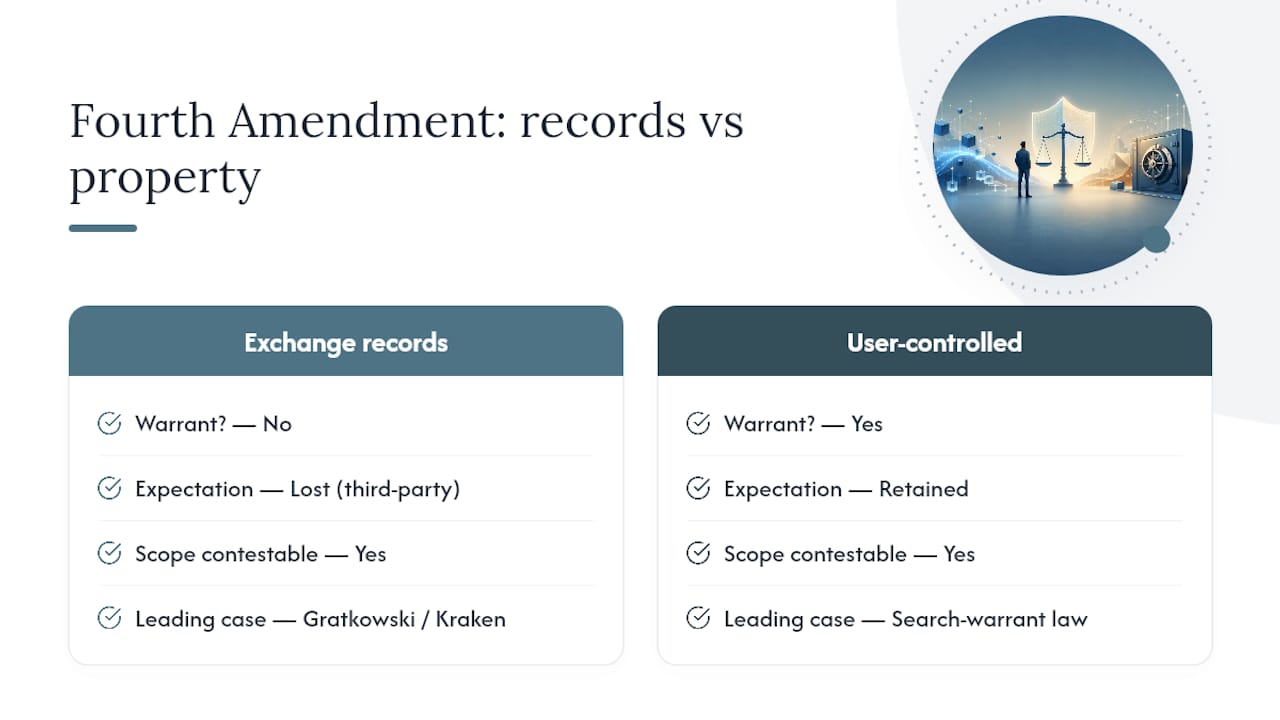
The Fifth Circuit made that explicit in United States v. Gratkowski, ruling that no search warrant is required to obtain Bitcoin transaction records held by an exchange, because the user voluntarily shared that data with a business intermediary. That’s the case every subsequent exchange-subpoena dispute is measured against.
But that doesn’t mean the government gets unlimited access with zero pushback. Courts distinguish between a subpoena or summons for records already in a third party’s possession, which requires no warrant, and a search of property you still control, which does. Recent litigation over an IRS summons served on Kraken shows judges are willing to scrutinize scope even under the third-party doctrine.
The court in the Kraken summons litigation required the government to justify each category of data it sought, rather than accepting a blanket request at face value, and pushed toward a narrower, phased production starting with basic account information before more intrusive categories.
The practical lesson: the Constitution rarely blocks a lawfully issued subpoena to an exchange, but the scope of that subpoena is very much fair game to fight.
Your Account Was Frozen or Subpoenaed: What to Do Right Now
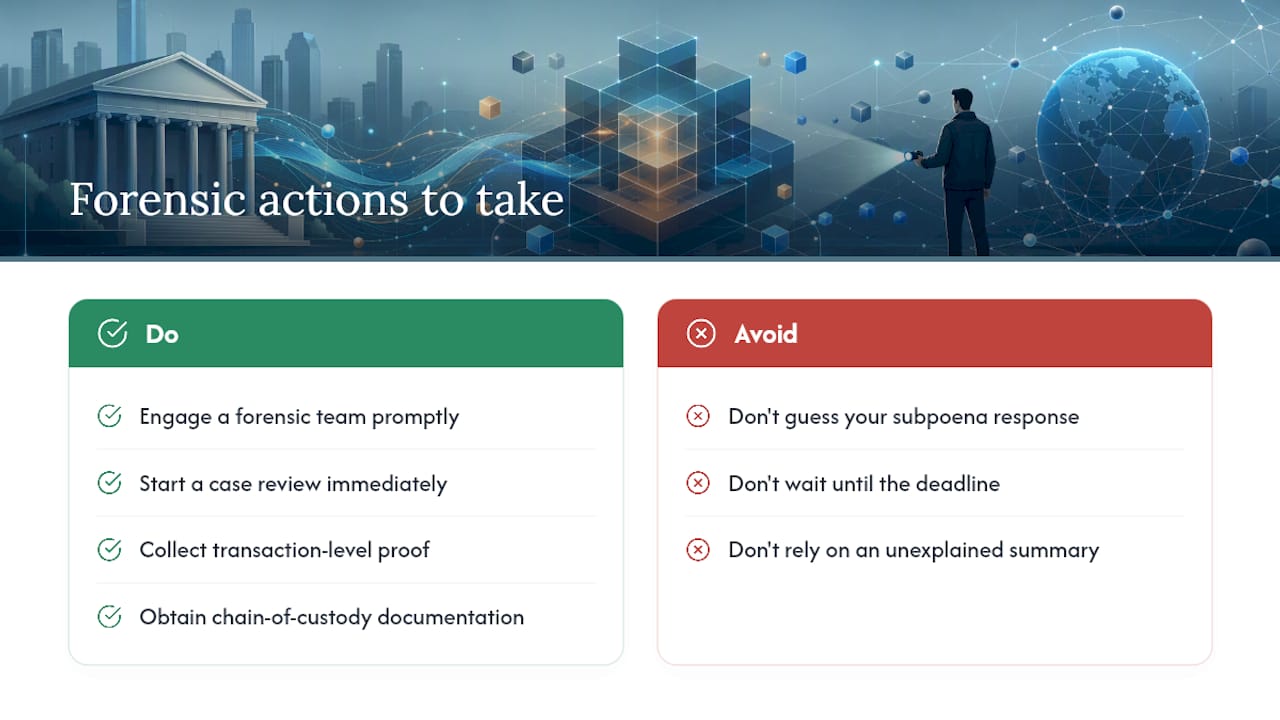
The first 48 hours matter more than almost anything that follows. Move carefully and document everything.
- Export your full trade and transaction history immediately, before any access restriction locks you out.
- Download your KYC file and account settings if the platform still allows it.
- Save every email, in-app notice, and support ticket ID related to the freeze or subpoena, with timestamps.
- Do not transfer, convert, or attempt to move any remaining assets. This looks like evasion even when it isn’t.
- Avoid discussing the situation in writing beyond what’s necessary; casual messages can become evidence.
- Contact an attorney experienced in crypto or white-collar matters before you respond to any request.
- Consider a forensic investigator early to preserve chain of custody on the blockchain side of the story.
Pro Tip: Screenshot the exact wording of any freeze notice. Exchanges sometimes use boilerplate language that says less than customers assume, and the precise phrase can matter later if you’re arguing the freeze exceeded what the underlying order actually required.
Reviewing a step-by-step action guide built for fraud victims can help you sequence these steps correctly under pressure, since the order you take them in affects what evidence survives.
Can You Challenge or Narrow a Crypto Exchange Subpoena?
Yes, and courts increasingly expect it. A motion to quash or a request for a protective order can succeed on grounds of overbreadth, irrelevance to the stated investigation, constitutional violations, or conflict with foreign privacy law when the exchange or account holder sits outside the U.S.
- Overbreadth challenges: arguing the request sweeps in far more than the investigation needs
- Phased production requests: pushing courts to require basic identity data first, deeper transaction detail only if justified
- Forensic declarations: an investigator’s sworn statement on data scope or chain of custody, filed to support narrowing
The Kraken litigation set a template other courts are now following: start narrow, force the government to justify escalation. That timeline usually runs weeks, not days, so early legal engagement matters more than speed.
How Does Crypto Forfeiture Work, and How Do You File a Claim?
Seizure and forfeiture are two different legal tracks, and confusing them costs people their filing deadlines. Administrative forfeiture is the more common route for crypto: an agency (often the FBI or IRS) seizes assets and sends notice, and if no one contests it within the deadline, ownership transfers to the government without a judge ever ruling on it. Criminal forfeiture happens only after a conviction, tied directly to the underlying case.
- Administrative notice typically sets a strict window, often around 30 to 35 days, to file a claim
- Claims start at Forfeiture, the DOJ’s official portal for contesting seized property
- Missing the deadline generally forfeits your right to contest administratively, pushing you into costlier judicial forfeiture proceedings
- A forensic report establishing provenance, ownership timeline, and clean chain of custody strengthens a claim significantly
The single biggest mistake people make here is waiting for a lawyer before starting the clock. File the claim to preserve your rights, then build the substantive case.
When Should You Bring in a Blockchain Forensic Investigator?
Legal representation handles procedure. Forensic investigation handles proof. Once a subpoena or freeze is in play, the question shifts from “what happened” to “can you show it,” and that’s where a transaction-graph analysis matters. Recoveraforensics builds court-ready reports that trace exchange withdrawal addresses through downstream wallet clusters, establishing provenance and linking outside wallets back to a named account.
Counsel typically needs three things fast: a documented chain of custody, a visual transaction map, and a written report an expert can testify to. Onboarding usually starts with your exported trade history, wallet addresses, and any exchange correspondence. From there, a forensic team can produce a transaction graph that turns raw blockchain data into evidence a court can actually use.
What Patterns Actually Move These Cases Forward
Working through cases involving exchange subpoenas, three patterns show up again and again. Requests creep in scope. What starts as “identity and last 90 days of transactions” often grows once investigators see what’s in the initial production, so pushing for narrow, phased disclosure early pays off later.
Users almost always wait too long to act on notice, partly because exchange emails are vague by design. That delay is the single most fixable mistake in this entire process. And cases resolve faster when a lawyer and a forensic investigator work in parallel from day one instead of sequentially, because the forensic report often becomes the evidence that lets counsel negotiate scope or contest forfeiture with something concrete on the table, rather than an argument alone.
— cristian
Get Forensic Support Before You Respond to a Subpoena
Recoveraforensics is the alternative to guessing your way through a subpoena response alone. Where a general practice attorney can advise you on procedure, our forensic team builds the transaction-level proof, chain-of-custody documentation, and court-ready reports that actually change outcomes in narrowing motions and forfeiture claims. We trace stolen or disputed funds across wallets and exchanges, document provenance, and hand counsel a report they can put in front of a judge rather than a summary they have to explain from scratch.
If your account has been frozen or you’ve received a subpoena notice, don’t wait for the deadline to close in. Start a case review with Recoveraforensics to find out what your transaction history can prove before you file anything.
This article is general information, not a substitute for advice from a qualified lawyer. Consult a qualified legal professional about your own circumstances before acting on anything here.
Sources
- No Search Warrant Required for Records of Bitcoin Transactions, the Fifth Circuit Holds
- Coinbase receives CFTC subpoena for customer data related to Polymarket
- FinCEN — Suspicious Activity Report (SAR) advisory and key terms
- Forfeiture
FAQ
Can the FBI Track Bitcoin Transactions?
Yes. Bitcoin’s blockchain is public, and the FBI routinely combines that data with exchange-held KYC records obtained through subpoenas to link wallet addresses to real identities.
Can the IRS See Your Crypto Wallet?
The IRS can’t see a private, noncustodial wallet directly, but it can use an administrative summons under 26 U.S.C. § 7602 to compel an exchange to hand over the identity and transaction data tied to accounts linked to that wallet.
What Crypto Exchanges Are Legal in the United States?
Exchanges registered as money services businesses and compliant with FinCEN’s AML reporting requirements, such as Coinbase and Kraken, operate legally in the U.S. and are the platforms most commonly served with subpoenas.
Is the CLARITY Act Going to Pass?
The CLARITY Act, which would clarify CFTC and SEC jurisdiction over digital assets, remains under congressional debate with no enacted version yet; its outcome would directly affect which agency issues future crypto subpoenas.
Do I Need a Lawyer If I Get a Subpoena Notice From My Exchange?
Yes. Even a vague notice signals an active investigation, and an attorney can assess whether the request is narrowable, whether you need to respond at all, and when a forensic report would strengthen your position.