File an official Internet Crime Complaint at Ic3 using the online form. Gather your evidence first (emails, transaction records, wallet addresses), submit the form in one sitting since it can’t be saved partway through, then print or save your confirmation page. IC3 reviews and may refer your case to law enforcement, but it can’t promise a personal callback or recovery.
TL;DR:
- Most complaints, especially involving cryptocurrency or financial transfers, require detailed transaction data, including exact amounts, dates, and wallet or bank information, to be effective.
- Filing must be done in one sitting since the IC3 form cannot be saved or edited later, making preparation and drafting crucial before starting.
- Providing comprehensive evidence such as full email headers, transaction IDs, blockchain explorer links, and original screenshots increases the likelihood of the complaint being routed for investigation.
- IC3 does not guarantee investigation or direct contact but helps identify patterns for larger case building, with responses depending on the type and severity of the crime.
- Prompt action, including immediate bank alerts and pairing IC3 filing with forensic analysis for crypto cases, can improve chances of recovery before funds are moved or laundered.
Table of Contents
- How Do You File an IC3 Complaint, and When Should You?
- Step-by-Step: Completing the IC3 Online Complaint Form
- What Evidence Should You Include (and How Do You Preserve It)?
- What Happens After You File an IC3 Complaint?
- When Should You Use Other Reporting Channels Instead of IC3?
- How a Forensic Firm Can Help After You File
- Ready to Trace Your Stolen Funds? Here’s What Comes Next
- Sources
- FAQ
How Do You File an IC3 Complaint, and When Should You?
IC3 is the FBI’s central intake point for cyber-enabled crime. It doesn’t investigate every case itself. It collects reports, looks for patterns across thousands of similar complaints, and routes actionable ones to FBI field offices or partner agencies.
You should file at IC3 if you’ve experienced:
- Online fraud, including romance scams, investment fraud, and fake online stores
- Phishing attempts that led to stolen credentials or funds
- Business email compromise (BEC), where a scammer impersonated a vendor or executive to redirect payments
- Ransomware attacks on personal or business devices
- Auction fraud or marketplace scams on platforms like eBay or Facebook Marketplace
A few situations need a different door. Child sexual exploitation material goes to the National Center for Missing and Exploited Children (NCMEC) first, not IC3. Immediate danger means calling 911. Threats of violence or terrorism belong at tips.fbi.gov. Filing still matters even when nothing happens to your specific case, since your report becomes one data point in a pattern the FBI uses to build larger cases.
Step-by-Step: Completing the IC3 Online Complaint Form
The IC3 online form is broken into seven sections. Knowing what each one wants before you start saves you from scrambling halfway through.
- Who is filing. State whether you’re the victim, a parent, or reporting on behalf of a business.
- Complainant information. Your name, address, phone, and email, exactly as they appear on your ID or business records.
- Financial transaction details. Every dollar amount, date, and account or wallet identifier tied to the loss. Round numbers help nobody. Use exact figures like $4,283.17, not “about four grand.”
- Subject information. Anything you know about the scammer: names (even fake ones), email addresses, phone numbers, usernames, physical addresses if known.
- Description of the incident. A chronological narrative. Start with first contact and end with your last interaction.
- Other information. This is where technical evidence goes, which we’ll cover next.
- Privacy and signature. You confirm accuracy and submit.
For each dollar amount, log the exact transaction date, not just the month. For crypto losses, drop in the full transaction ID (txid) and wallet address, not a screenshot description of them. For email-based scams, copy and paste the entire message, including full headers, rather than summarizing what it said.
Pro Tip: Open a blank document before you start the form and draft your incident narrative there first. The IC3 form has no autosave, and a browser crash or timeout mid-entry means starting over from scratch.
There’s no “submit and edit later” option here. Once you hit submit, that version is final. The form cannot be saved and resumed, and IC3 does not accept file attachments of any kind, so everything, screenshots included, has to be described or pasted directly into the text fields. When your confirmation page appears, print it or save it as a PDF immediately. IC3 will not email you a copy afterward, and there’s no dashboard to log back into and retrieve it later.
What Evidence Should You Include (and How Do You Preserve It)?
The single biggest factor separating a complaint that goes somewhere from one that gets buried is completeness. Complete metadata increases the odds analysts can act on a report, and vague, screenshot-only submissions tend to sit unprocessed.
For financial transactions, include:
- Bank reference numbers, wire confirmation codes, SWIFT or ACH transaction identifiers
- Exact dates and dollar amounts for every transfer
- Receiving account numbers or routing details where you have them
For email-based fraud, paste the full message body and full email headers directly into the description field. A summary like “he sent a fake invoice” tells an analyst almost nothing; the raw header data can trace the sending server.
For cryptocurrency losses, collect wallet addresses, transaction IDs, and blockchain explorer links, along with timestamps for any conversion to or from fiat currency. These details let investigators trace movement across public blockchains toward an exchange or off-ramp.

Round out your file with IP addresses if you have them, chat logs, phone numbers used by the scammer, receipts, and timestamped screenshots. Keep every original. IC3 does not collect attachments, so if an investigation opens later, agencies will ask you directly for the source files, not a printout. Save copies locally on a drive you control rather than relying solely on emails still sitting in your inbox, since deleted threads or a compromised account can wipe out your only record.
What Happens After You File an IC3 Complaint?
Your report goes through analyst review, then possible routing to an FBI field office or a partner agency, depending on the type of crime and where it occurred. Individual complaints often don’t result in a personal callback, but aggregated data helps the FBI spot organized fraud rings that a single report never could.
A few things worth knowing while you wait:
- IC3 does not guarantee an investigation or contact for any specific complaint; the decision to act sits with the receiving agency
- If new information surfaces later, file a fresh complaint referencing your original confirmation number rather than trying to amend the old one
- Keep that confirmation number somewhere safe; it’s your only proof the report exists
- Notify your bank immediately, place fraud alerts, and hold onto every piece of evidence in case an investigator eventually asks for it
Filing at both FTC and IC3 when your case straddles consumer fraud and cyber-enabled crime puts your report in front of more specialized eyes.
When Should You Use Other Reporting Channels Instead of IC3?
IC3 isn’t always the right first stop. If you’re in immediate physical danger, call 911 or your local police department before doing anything else. Threats of violence or terrorism go to tips.fbi.gov, separate from the cybercrime intake form.
Child sexual exploitation material should be reported to NCMEC directly, since they have specialized intake built for that exact purpose. For general consumer fraud, ReportFraud.ftc.gov works alongside IC3 rather than replacing it, and filing both often means a wider net of investigators sees your case.
Speed matters most with active financial transfers. Calling your bank within hours, not days, gives the Recovery Asset Team a real shot at coordinating a freeze before funds move again.
How a Forensic Firm Can Help After You File
Filing your IC3 complaint is the starting line, not the finish. For crypto losses especially, technical blockchain forensics can trace funds toward exchange on-ramps and off-ramps in ways a standard police report rarely attempts.
Consider bringing in a specialist when:
- The loss involves cryptocurrency moved through multiple wallets or mixing services
- You need a court-ready technical report to support civil litigation or a criminal referral
- Your case involves a laundering chain too complex to untangle from transaction IDs alone
Pro Tip: Before contacting a forensic investigator, gather your IC3 confirmation number, every transaction record you have, and copies of all communications with the scammer. Investigators move faster with a complete file than with a verbal summary.
Why filing promptly protects your case
File immediately, preserve every original, and pair your IC3 report with a bank alert and FTC filing. For serious crypto losses, specialist forensic help fills the gap general reporting can’t.
— cristian
Ready to Trace Your Stolen Funds? Here’s What Comes Next
An IC3 complaint puts your case into the federal system, but it doesn’t trace where your crypto actually went. That’s a different job, one that requires pulling transaction histories off public blockchains and connecting wallet activity to real exchanges and real people. Recovera Forensics builds that connection through detailed wallet tracing and fraud pattern analysis, then packages the findings into a forensic report suitable for law enforcement or a courtroom.
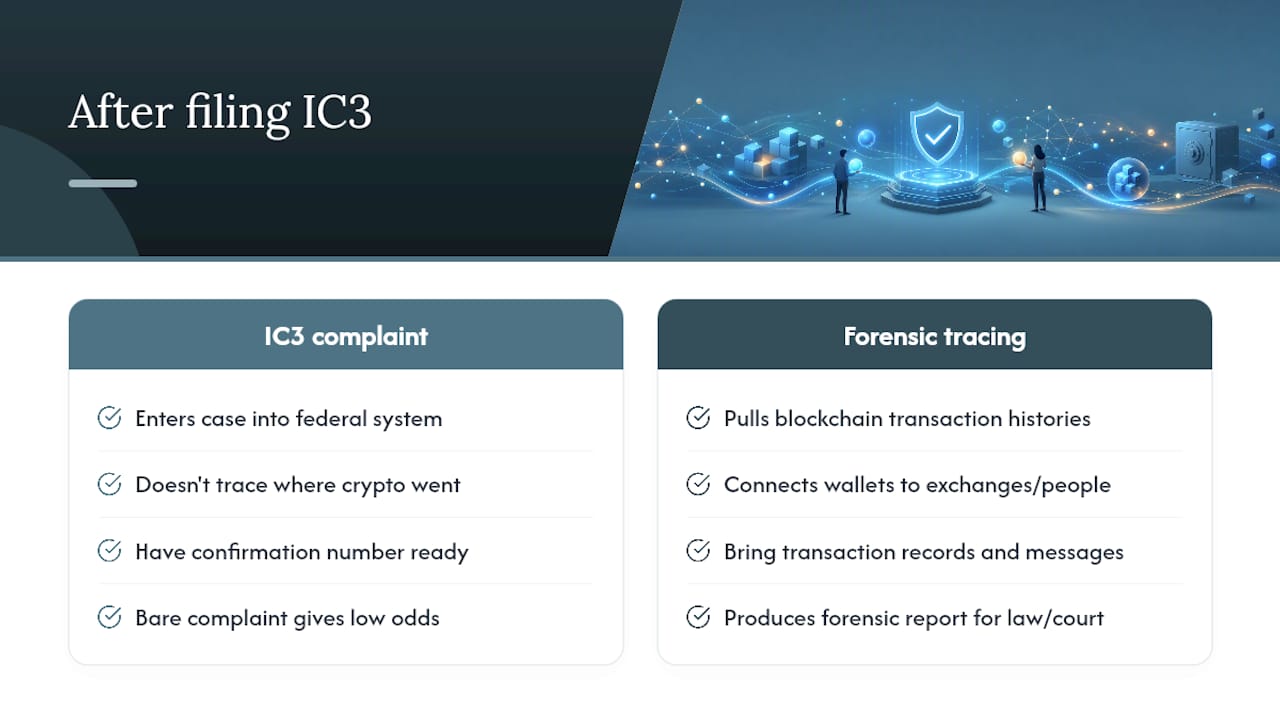
If you’ve already filed with IC3, hold onto that confirmation number. It’s one of the first things worth having ready when you reach out for a recovery consultation, alongside your transaction records and any communications with the scammer. Recovera works as a paid technical investigation service, not a guarantee of recovered funds, but a properly built forensic case file gives your report far better odds of going somewhere than a bare-bones complaint alone.
Sources
- Home Page – Internet Crime Complaint Center (IC3)
- IC3 Online Internet Crime Complaint form
- Where to Report Scams: FTC, IC3, and Local Agencies – LegalClarity
FAQ
Does Filing a Complaint With IC3 Actually Do Anything?
Yes, though not always visibly. Individual reports feed a larger database that helps the FBI identify patterns and build cases against organized fraud networks, even when no single complaint gets an individual response.
Will Filing With IC3 Get My Money Back?
Not directly. IC3 doesn’t process refunds or recover funds itself; it routes complaints to agencies that may investigate, and any recovery depends on whether an investigation opens and where the money went. For crypto losses, working with a firm that offers technical wallet tracing improves your odds of building a case an investigator or court can act on.
Does the FBI Respond to Every IC3 Complaint?
No. IC3 explicitly does not guarantee a response or investigation for every complaint filed; whether to pursue a case or contact the filer is left to the discretion of the receiving agency.
How Do I Report Someone to IC3?
Go to ic3.gov, click through to the online complaint form, and fill in the sections covering your information, the transaction details, and everything you know about the person or group involved. Have your evidence, including transaction dates, amounts, and any wallet addresses or email headers, ready before you start since the form has no save function.
Should I File With Both the FTC and IC3?
Yes, when your case involves both consumer fraud and cyber-enabled crime. Filing with both agencies increases the chance specialized investigators in either system see your case.