A forex scam investigation is the work of reconstructing what happened to your money: who ran the platform, where your deposits went, and what a lawyer, regulator or law enforcement agency can do with that record. It starts with preserving evidence and tracing the transfers. It does not start with anyone promising to “get your money back” for a fee. If you paid a fake broker by bank wire or crypto, the first 24 to 72 hours matter most, and the steps below show what to do in that window.
TL;DR
- A real investigation produces a documented timeline, transaction tracing and a report that counsel or investigators can use. It is not a guarantee of recovery.
- Check any broker’s registration in the NFA BASIC database before you trade. If you can’t find it, treat that as a major red flag.
- Report to the CFTC and the FBI’s IC3, and keep transaction hashes, bank records, screenshots and chat logs in original form.
- Be wary of anyone who contacts you after a loss and asks for up-front fees. The FBI has warned that this is a second wave of fraud.
- If crypto was involved, blockchain forensics can follow the funds to the exchanges that received them. Whether anything is frozen depends on legal process.
Table of Contents
- What a forex scam investigation actually is
- Before you hire anyone: check the broker
- The first 72 hours: what to do and in what order
- The evidence an investigator needs from you
- How tracing works when crypto is involved
- Recovery scams: the second fraud
- Our perspective: what a good report is for
- How we can help with a forex or trading fraud case
- Choosing an investigator: what to compare
- Related fraud patterns worth knowing
- FAQ
- Sources
What a forex scam investigation actually is
Most forex scams look the same from the outside. A website with a polished dashboard shows rising balances. You deposit through a bank wire, card or cryptocurrency. Withdrawals then fail, a “tax” or “verification fee” appears, or the account manager disappears. The platform often never executed a single trade.
An investigation answers four questions:
- What was the platform? Domain history, hosting, company names, advertising and the social accounts that recruited you.
- Where did the money go? Bank routing for fiat, and wallet-to-wallet flows for crypto.
- Who is connected? Reused wallets, shared infrastructure, and the same people appearing across several fake brands.
- What can be proven? A clear, dated record that stands up when a lawyer, regulator or court asks how you know.
The FBI’s Internet Crime Complaint Center makes a point that shapes this whole field. Crypto transactions are permanently recorded on public blockchains, but the speed and international reach of the assets make recovery hard. The IC3’s cryptocurrency guidance frames the value of an investigation less as tracing for its own sake and more as building an evidentiary package that authorities can act on.
That is the honest framing. A forensic report is a tool for legal action. It is not a recovery mechanism by itself.
Before you hire anyone: check the broker
If you haven’t deposited yet, or you’re checking whether a platform you used was ever legitimate, start with registration. The CFTC tells the public to verify registration with the NFA before trading futures, options, forex or other derivatives. Registration indicates that principals have passed background checks, that the firm meets minimum financial requirements and that it has agreed to regulatory supervision.
A short vetting routine:
- Search the firm and its principals in NFA BASIC. A name that is close to a registered firm but not identical is a common trick.
- Check the CFTC’s warning lists for unregistered websites offering forex or derivatives trading.
- Be skeptical of any “manager” who found you through a dating app, a text from a wrong number, or a social media group, and who pushes you to deposit through crypto.
- Look at how the firm describes risk. Guaranteed returns are a sign of fraud, not of skill. A sober overview such as these forex risk management tips for retail traders shows what honest discussion of drawdowns and position sizing looks like.
The NFA’s president has described the core of investigative work as “connecting the dots”: audit data, registration files and customer complaints read together reveal patterns that don’t add up. The same logic applies to you as a victim. Individual details look harmless, but a timeline of them does not.
The first 72 hours: what to do and in what order
Speed matters because scammers move funds quickly, and because platforms and chat accounts get deleted. These steps are practical, not legal advice. If you lost a large amount, speak with an attorney experienced in fraud or securities matters early.
- Stop sending money. Never pay more to unlock a withdrawal. The CFTC states plainly that a request for more money to recover funds is a warning sign.
- Freeze your own exposure. Change passwords, revoke wallet approvals if you connected a wallet, and secure the email and phone number tied to your accounts.
- Capture everything before it disappears. Take full-page screenshots of the dashboard, account statements, deposit instructions and every conversation. Export chats where the app allows it.
- Contact your bank or card issuer. Ask about wire recalls or disputes. Banks have their own deadlines, and the earlier you call the better.
- File reports. Submit a complaint to the CFTC, which invites customers to report suspicious activity to its Division of Enforcement, and to the FBI through ic3.gov. The IC3 encourages complaints even when no money was lost.
- Preserve, don’t edit. Don’t crop, annotate or re-save the originals. Keep a separate working copy.
Our own step-by-step crypto fraud action guide walks through the same sequence with more detail, and our page on what to report to trigger police crypto investigations explains how reports reach investigators.
The evidence an investigator needs from you
The quality of an investigation depends on what you can hand over. The CFTC lists the most valuable data as transaction hashes, cryptocurrency addresses, exact dates and times of transfers, and communication logs such as screenshots, phone numbers and social media profiles. An organized, verified timeline moves a case along faster than a verbal account.
A useful evidence pack looks like this:
| Item | Why it matters | Where to find it |
|---|---|---|
| Platform URL and screenshots of the dashboard | Identifies the site and its claims | Browser history, saved pages |
| Bank wire or card records | Shows the receiving institution and account | Bank statements, wire confirmations |
| Wallet addresses and transaction hashes | Starting point for on-chain tracing | Your exchange history, wallet app |
| Date and time of every transfer, with time zone | Lets investigators match flows precisely | Statements, exchange exports |
| Chat logs, emails, call numbers | Links individuals and accounts to the scheme | Messaging apps, email headers |
| Any identity documents you gave the platform | Shows identity-theft risk and onboarding data | Your email, uploads folder |
Put these into a single dated spreadsheet: one row per transfer, with amount, currency, sender, recipient, hash or reference, and the conversation that prompted it. If the case later goes to counsel, this saves hours. For the legal side of keeping evidence usable, see our guides on digital evidence preservation and chain of custody for crypto.
How tracing works when crypto is involved
Many forex scams now take deposits in crypto, even when the victim thinks they are funding a trading account. That helps the investigation in one way: every transfer is recorded on a public ledger.
The process usually runs like this:
- Start at your transaction. The hash shows the destination address.
- Follow the hops. Scam operations rarely leave funds where you sent them. They consolidate deposits from many victims, split them and forward them through intermediary wallets.
- Identify obfuscation. Mixers, cross-chain bridges and swaps are used to break the visible trail. Reconstructing flows through these takes specialist tooling and manual review.
- Find the cash-out points. Funds eventually reach exchanges or payment services, where customers are identified under compliance rules.
- Cluster the wallets. Shared patterns can link your case to a wider network of victims.
The limits are real. Exchanges freeze or hand over accounts based on their internal policies or legal process, not because a private report was submitted. Scammers also bridge and mix assets across jurisdictions quickly, so a trace often ends at a point where only law enforcement or a court can compel action. The IC3’s cryptocurrency page describes this tension directly.
If you want the technical detail, read our guides on tracing the flow of funds for legal recovery, tracing Ethereum transactions to an exchange and blockchain forensics.
Recovery scams: the second fraud
The most dangerous moment after a loss is when someone offers to fix it. The FBI has documented an emerging tactic in which criminals pose as law firms targeting cryptocurrency scam victims and offer to recover funds. The same alert reports that people already defrauded lost over $9.9 million to such offers between February 2023 and February 2024.
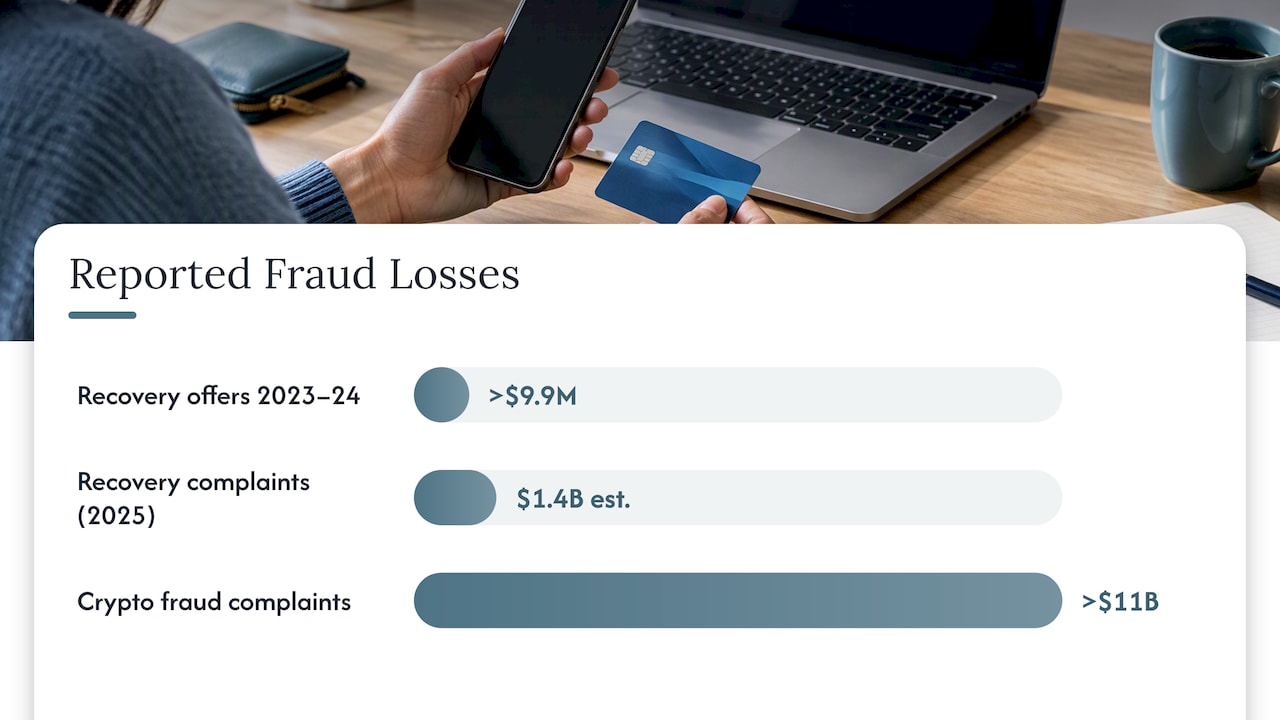
The scale is growing. A summary of the FBI’s 2025 Internet Crime Report says the IC3 received more than 10,500 recovery scam complaints with an estimated $1.4 billion in losses, and that cryptocurrency fraud complaints totaled more than $11 billion.
Red flags that should end the conversation:
- Contact arrives unprompted by Telegram, WhatsApp, text or social media.
- You are asked for an up-front fee, a “tax”, a “release payment” or a donation to unlock funds.
- The firm claims a special relationship with the FBI or another agency.
- It guarantees a percentage or timeline for recovery.
- It offers to “hack back” the scammer.
The UK regulator has also warned that scammers impersonate authorities. Its report of almost 5,000 fake FCA scam reports in the first half of 2025 is a UK figure, but the impersonation pattern is the same one US victims describe.
A legitimate forensic firm is a service provider. It documents, traces and reports. It does not hold your money, and it does not promise an outcome it cannot control.
Our perspective: what a good report is for
We see the same misunderstanding repeatedly. A victim wants one thing: the money back. A fraud like this is a chain of facts, and a recovery depends on whether someone with legal power can act on them.
We built our approach around that. We analyze transaction patterns on public blockchains, follow the funds, and connect wallet activity to wider fraud networks instead of stopping at a single address. We write the findings into a forensic report that a lawyer, a regulator or an investigator can read without a translator. We also work directly with law firms that need technical support on digital and financial fraud cases.
We will tell you early if the trace is thin, if the funds have moved beyond reach, or if your best next step is a lawyer rather than us. That honesty is part of a victim-centered process. People who have been deceived once deserve a clear account of what can and cannot be done.
— cristian
How we can help with a forex or trading fraud case
If you lost money to a fake broker or trading platform, our team handles the technical investigation: tracing, OSINT work on the people and infrastructure behind the platform, evidence preservation and a report prepared for legal proceedings. We also support cases involving online trading and gambling operators. Details of each service are on our investigation services page, and law firms can see how we support counsel on our professional offices page.
To discuss a case, start from our homepage or the reporting and recovery contact page. Bring the evidence pack described above and we can tell you quickly what the trail looks like.
Choosing an investigator: what to compare
Not every provider does the same job. Compare them by type and by method:
| Type of provider | What it does well | Where it falls short |
|---|---|---|
| Government agencies (CFTC, FBI) | Legal authority, subpoenas, prosecutions | Limited capacity per case, slow, no private updates |
| Fraud and securities attorneys | Legal strategy, demand letters, litigation | Rely on technical evidence from someone else |
| Basic wallet-tracking tools or reports | Quick view of a single address | Often stop at mixers, bridges or exchange hops |
| Forensic investigators | Deep tracing, attribution, court-ready reports | Cannot compel exchanges or promise recovery |
Questions to ask any investigator:
- Do you charge anything contingent on recovered funds, or ask for money to “release” assets?
- What will the deliverable look like, and who can use it?
- How do you document your method and preserve chain of custody?
- Can you work with my attorney?
- What are the realistic limits in my case?
Our reports follow the standard we describe in admitting blockchain evidence in US court, because a report no one can use in a proceeding is not worth paying for.
Related fraud patterns worth knowing
Forex fraud rarely arrives alone. Some of the most common entry points:
- Romance and relationship-led schemes. A friendly contact builds trust over weeks, then introduces a “profitable platform”. Our guide to romance crypto scams explains the pattern.
- Task and job scams. The FTC reported that losses to these schemes involving crypto rose from $21 million in 2023 to $41 million in the first half of 2024, and that these figures capture only a fraction of the harm.
- Wire fraud. If you paid by bank transfer, see our overview of crypto wire fraud and fast action.
- Phishing. Fake login pages can drain accounts within minutes. Our phishing recovery playbook covers the first hours.
FAQ
Is forex trading itself a scam?
No. Forex is a legitimate market, but it is risky and heavily targeted by fraud. The key is whether the firm is registered and supervised. The CFTC points customers to NFA BASIC to confirm registration before trading.
How do I check if a forex broker is legitimate?
Search the firm and its principals in NFA BASIC and check the CFTC’s warning lists. If the firm isn’t found, treat that as a major red flag. Also be wary of guaranteed returns and pressure to deposit via crypto.
Can a forex scam investigation get my money back?
Not on its own. An investigation traces funds and builds an evidence package that attorneys or law enforcement can use. Exchanges freeze accounts based on policy or legal process, so outcomes depend on how quickly you act and where the funds went.
Who should I report a forex scam to?
Report to the CFTC through its complaint page and to the FBI’s IC3 at ic3.gov. Notify your bank or card issuer as well. Keep copies of everything you submit.
How can I tell a real investigator from a recovery scam?
A real firm does not contact you unprompted, demand up-front fees to release funds or promise a recovery. It explains its deliverables and limits in writing. If someone claims FBI ties to win your trust, walk away and verify independently.
Sources
- CFTC: Be Smart, Check Registration and Backgrounds Before You Trade
- CFTC: Don’t be Re-Victimized by Recovery Frauds
- CFTC: Charges Companies and Individual with Forex Fraud and Registration Violations
- FBI IC3: Fictitious Law Firms Targeting Cryptocurrency Scam Victims
- FBI IC3: Cryptocurrency
- ASIS: Half of 2025 U.S. Fraud Losses Were Linked to Cryptocurrency Scams
- FTC: Paying to get paid, gamified job scams drive record losses
- FCA: Almost 5,000 fake FCA scams reported in first 6 months of 2025
- NFA comments on File No. 4-588 (SEC)