An online trading scam investigation has two tracks that should run side by side: official reports to the FBI and FTC, and a technical trace of where your money went. The first puts your case in front of law enforcement. The second gives you, or your attorney, a documented map of the transactions. Both depend on evidence you can still save today, so start there.
This guide walks through how these scams work, what to preserve, where to report, what a forensic investigation can and cannot do, and how to avoid the second scam that often follows the first.
TL;DR
- Stop sending money. Any request for a “tax,” “fee” or “commission” to release your balance is a standard advance-fee tactic.
- Save raw evidence first: URLs, emails with headers, chat logs, wallet addresses and transaction hashes. Do not delete anything.
- Report to the FBI’s IC3 and the FTC at ReportFraud.ftc.gov. Government agencies do not charge victims for investigations.
- A private forensic investigation traces funds and produces a report for lawyers and agencies. It cannot seize or freeze assets by itself, and anyone promising a guaranteed recovery is a red flag.
Table of Contents
- How online trading scams actually work
- What to do in the first 72 hours
- Where to report an online trading scam in the U.S.
- What a forensic investigation of a trading scam involves
- What an investigation cannot do
- The second scam: fake recovery services
- Checking whether a platform was ever registered
- Our perspective
- How Recovera can help
- FAQ
- Sources
How online trading scams actually work
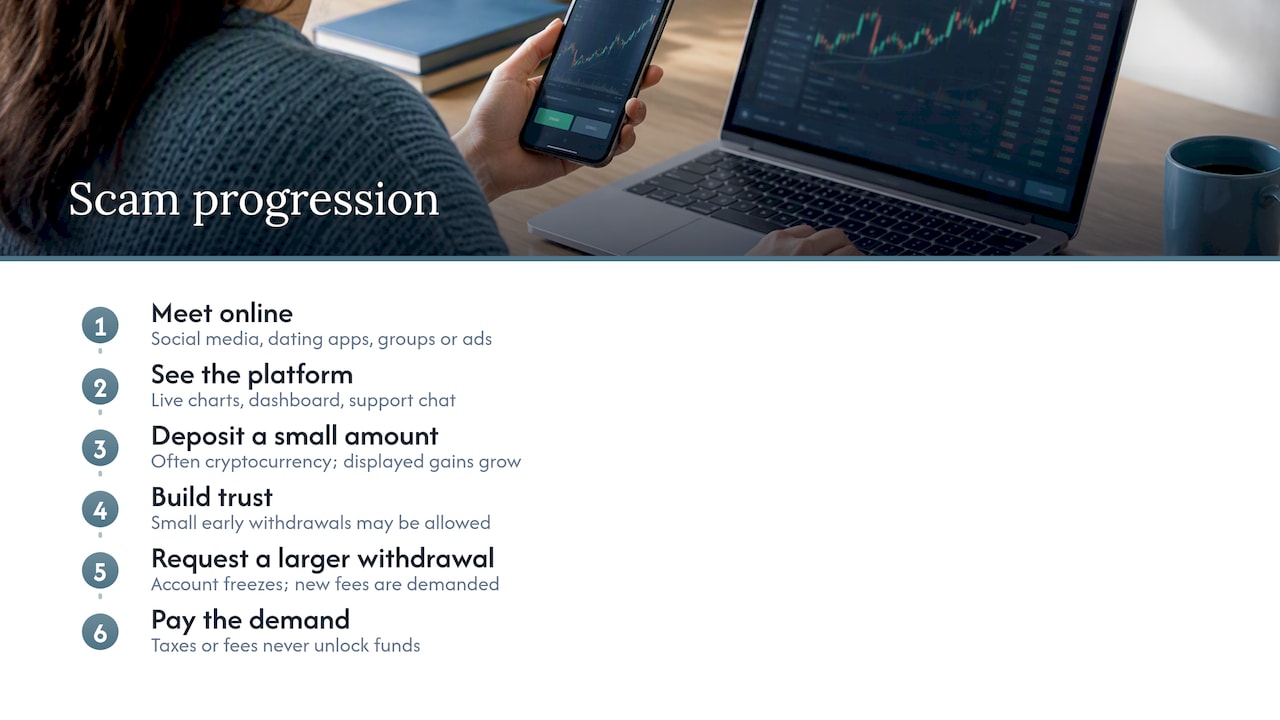
Most cases follow the same script. You meet someone through social media, a dating app, a messaging group or an ad. They introduce a trading platform that looks professional: live charts, a dashboard, a support chat. You deposit a small amount, often in cryptocurrency, and watch it grow.
The profits are fictitious. According to the CFTC, these platforms display made-up gains and let victims withdraw small amounts early to build trust. When you try to take out a larger sum, the account freezes and a new demand appears: pay taxes, fees or a “verification deposit” first. Paying never unlocks the money.
The scale is large. The FBI’s 2025 Internet Crime Report names cryptocurrency investment fraud as the biggest source of financial losses to Americans, at $7.2 billion reported. Through the third quarter of 2025, the median loss for investment scam victims was $10,000.
Red flags worth recognizing
The CFTC lists several warning signs: promises of guaranteed high returns (20 to 50 percent with little or no risk), talk of a “proprietary” trading system, and pressure to act immediately. Add two more that we see in case files: a platform you can only reach through a link sent by a contact, and a refusal to let you withdraw to a bank account in your own name.
What to do in the first 72 hours
Speed matters because scam sites disappear and chat accounts get deleted. The most time-sensitive task is preserving raw data before the scammer removes the website or your access. LegalClarity describes the essentials: capture email headers, which contain routing information, copy URLs instead of clicking them, and export transaction history and hashes from your own wallet.
Use this checklist:
- Stop all payments. Do not pay “release fees,” even if the demand looks official.
- Screenshot and export everything. Platform dashboards, deposit instructions, account balances, support chats, emails and voice messages.
- Collect transaction details. Wallet addresses you sent to, transaction hashes (TXIDs), dates, amounts and the exchange you sent from.
- Record the identities used. Names, phone numbers, usernames, profile links and payment instructions.
- Call your bank or card issuer if any part of the payment went through a card, wire or app. Ask about disputes and recalls right away.
- Do not confront the scammer. It tips them off and invites more pressure.
For a deeper version of this, see our guide to saving evidence in the first 72 hours and the digital evidence preservation guide, which explains why handling matters if the material ends up in court.
Where to report an online trading scam in the U.S.
File with both federal channels. According to this reporting guide, victims should file with the FBI’s Internet Crime Complaint Center (IC3.gov) and the FTC (ReportFraud.ftc.gov). IC3 reports help investigators spot patterns across cases and jurisdictions, which supports asset seizures.
| Where | What it is for | What to include |
|---|---|---|
| IC3.gov | Federal cybercrime complaints | Timeline, wallet addresses, TXIDs, scammer contact details |
| ReportFraud.ftc.gov | Consumer fraud database | Platform name, website, how you were contacted, amounts lost |
| Your state securities regulator | Unregistered or fraudulent investment offers | Platform details and proof of payments |
| Your bank or card issuer | Disputes, recalls, account protection | Dates, amounts, payment method |
We walk through the complaint itself in filing an IC3 complaint in seven steps, and explain realistic expectations in what to report to trigger a police crypto investigation.
What a forensic investigation of a trading scam involves
A police report starts a process you do not control. A private forensic investigation gives you a documented picture of the money trail. Here is what the work typically covers.
Tracing the funds on the blockchain
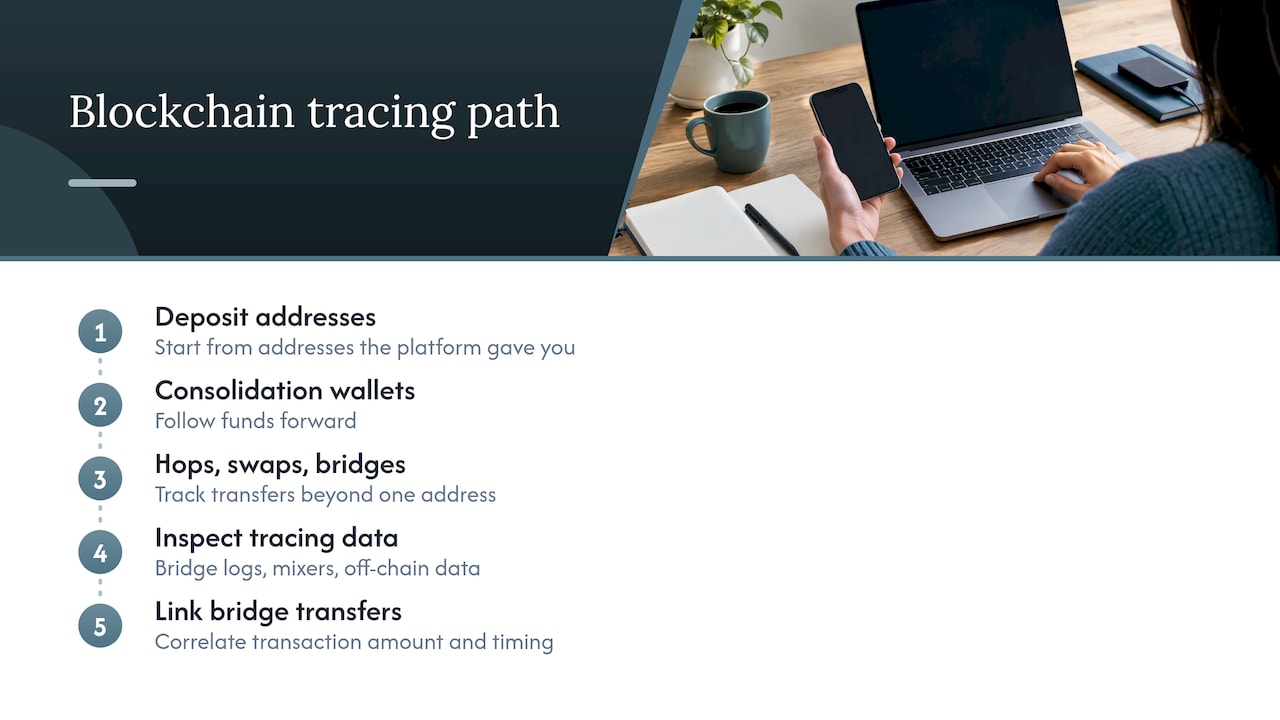
Public blockchains record every transfer. Investigators start from the deposit addresses the platform gave you and follow the funds forward: consolidation wallets, intermediate hops, swaps and bridges. Good tracing goes beyond following one address. Technical guidance on crypto tracing notes that it requires analyzing bridge event logs, mixers such as CoinJoin or Tornado Cash, and off-chain data, and that investigators correlate transactions by amount and timing to link both sides of a bridge transfer.
Our own approach is described in how blockchain forensics traces and proves crypto fraud, and in our piece on identifying scam wallets within hours.
Finding the off-ramp
Stolen funds usually have to become spendable money somewhere. Law enforcement uses blockchain analysis to trace funds to centralized exchanges, where legal process can reach know-your-customer records. That is why detailed transaction logs saved early matter so much. A report that clearly shows funds arriving at a named exchange gives a lawyer or agency something specific to act on.
OSINT and attribution
Open-source investigation looks at the scam’s infrastructure: domain registration patterns, reused ad accounts, social profiles, and recurring wallet clusters. This can link your case to a wider fraud network, which strengthens reports to authorities. It is also where weak, wallet-only tracking falls short.
The report
The deliverable is a technical report that documents methods, findings and limits in a form attorneys can use. If the matter heads to court, see how blockchain evidence is admitted in U.S. court and why a documented chain of custody matters.
What an investigation cannot do
Be skeptical of any firm, including ours, that overpromises. The FBI has warned that third-party recovery services lack legal authority to issue seizure orders or force exchanges to release funds. Only courts and law enforcement can do that.
What forensics does: it identifies where funds went, documents it to a standard others can rely on, and supports the people who do have legal authority, such as your attorney, prosecutors and exchange compliance teams. Outcomes depend on how fast you act, which chains and services were used, and whether funds reached a regulated exchange. Nobody can guarantee recovery.
The second scam: fake recovery services
Victims are often targeted again. The FBI has issued a warning about fictitious law firms that contact crypto scam victims offering to recover funds, typically for an up-front fee. They may provide inaccurate tracing reports and then demand more “taxes” or “fees.”
Before hiring anyone, check:
- Did they contact you first? Unsolicited outreach is a warning sign.
- Do they claim government ties or guaranteed results? Legitimate investigators do not.
- Can they explain their method in plain terms? You should understand what you are paying for and what the report will contain.
- Is the deliverable defined? A scoped investigation and report is different from a vague promise to “get your money back.”
Our article on whether paid forensics is worth the recovery-scam risk covers this decision in detail.
Checking whether a platform was ever registered
Before funding any platform, and when documenting a case, check registration. Experts recommend verifying broker registration on Investor.gov or through state securities regulators. FINRA also offers BrokerCheck, and warns that bad actors sometimes falsely claim registration and supply doctored information, so look the firm up yourself rather than using a link they send.
It also helps to know what a real product’s documentation looks like. For instance, documentation for an automated trading platform shows how a legitimate service explains navigation, features and settings in public, rather than steering you to a private chat. Being absent from the registries is a strong warning sign, not proof by itself, but it belongs in your timeline and in your complaint.
Our perspective
We see the same pattern again and again: victims lose weeks hunting for a magic fix while the trail goes cold. In our view, the order of work matters more than any single tool. Preserve first, report second, trace third, and only then decide what legal route makes sense.
We also think victims deserve transparency. A forensic report should say what was found, how, and where the evidence stops. Trading scam cases often involve mixers, bridges and several hops, and reconstructing those flows is where deeper analysis separates a useful report from a list of wallet addresses. We work directly with attorneys, because the report only has value if it can be used.
And we say plainly what we cannot do: we cannot seize funds, and we do not promise recovery. What we can do is give you a clear, documented account of your case.
— cristian
How Recovera can help
Recovera Forensics investigates cryptocurrency and online trading fraud through blockchain tracing, OSINT, evidence preservation and technical reports built for legal proceedings. We also support law firms through our professional services for attorneys. If you lost money to a fake trading platform, you can review our investigation services or follow our step-by-step crypto fraud investigation guide to prepare your case. Related cases we cover include binary options scams and crypto gambling fraud.
FAQ
What is the best way to report an online trading scammer?
File with the FBI’s IC3 and the FTC, and notify your bank if any payment went through it. Include timelines, wallet addresses, TXIDs and screenshots. Also consider your state securities regulator if the platform offered investments.
How can I tell if a trading site is legit?
Look up the firm and the individual on Investor.gov, FINRA BrokerCheck or your state regulator, using the site yourself rather than a link they sent. Be wary of guaranteed returns, pressure to deposit quickly, and withdrawal fees. If the firm is not registered, treat it as a serious warning.
Can a private investigator get my crypto back?
Not on their own. Private firms cannot issue seizure orders or compel exchanges to release funds. A forensic investigation can trace the funds and produce evidence that your attorney or law enforcement can use.
Should I pay a fee to unlock my trading account?
No. Demands for taxes, commissions or fees to release a balance are a known advance-fee tactic. Stop paying and preserve the messages as evidence.
Sources
- FBI IC3, 2025 Internet Crime Report
- CFTC, Watch Out for Digital Fraud
- LegalClarity, How to Report Scam Emails to the FTC and FBI
- Axis Intelligence, How to Report an Online Scam
- Cryptocurrency Assets: Investigation, Tracing, Attribution and Disclosure
- Detroit Free Press, FTC record consumer fraud losses
- FBI IC3, PSA on third-party recovery services
- FBI IC3, Fictitious law firms targeting crypto scam victims
- LegalClarity, Trading scams: types, red flags and what victims should do
- FINRA, Check Registration