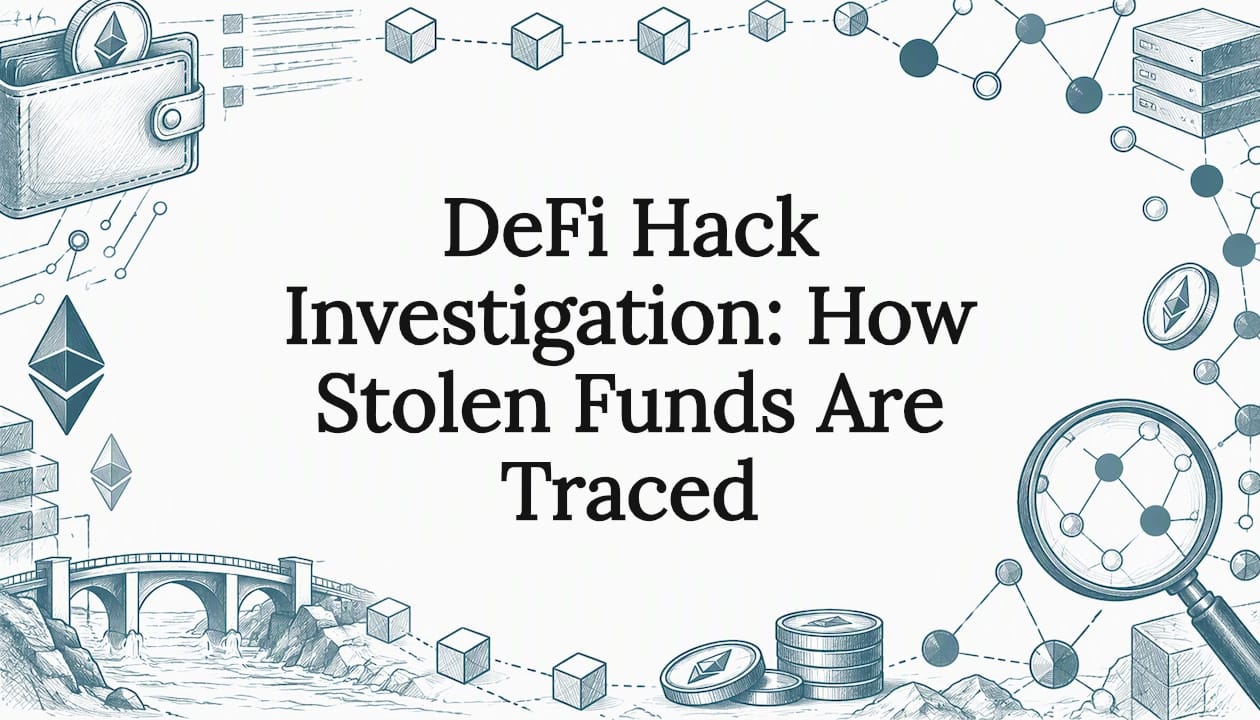
A DeFi hack investigation reconstructs what happened on-chain: how the attacker got in, where the funds went, and who may be behind the wallets. The result is a documented trail that exchanges, law enforcement and courts can act on. It does not reverse a transaction. If you lost money in an exploit, a phishing drainer or a malicious approval, the first hours decide how much of that trail can still be followed.
This guide explains how these investigations work, what is realistic, what to preserve, and how to tell a legitimate forensic firm from a second scam.
TL;DR
- A DeFi hack investigation traces stolen assets across wallets, bridges, swaps and mixers, then packages the findings in a report usable by lawyers and authorities.
- Public blockchains make movement visible. Identifying the person behind an address usually needs legal process directed at exchanges or other centralized services.
- Report to the FBI’s IC3 and preserve transaction hashes, addresses, screenshots and approvals right away.
- Be wary of any “recovery” service that demands upfront fees or guarantees results. The FBI has warned that such companies are often fraudulent.
- Recovery is mostly a legal and exchange-cooperation process. Forensics is what makes that process possible.
Table of Contents
- What a DeFi hack investigation actually covers
- How funds are traced, step by step
- What to do in the first 24 to 72 hours
- What is realistic, and what is not
- Why DeFi losses matter at the individual level
- How to spot a fake recovery service
- Our perspective
- Working with a forensic team
- What a good report contains
- FAQ
- Sources
What a DeFi hack investigation actually covers
“DeFi hack” describes several different events, and the investigation changes with each:
- Protocol exploits. A smart contract flaw, oracle manipulation, a governance attack or a compromised admin key drains a pool or vault. Many victims lose funds at once.
- Wallet drainers and phishing. You sign a malicious transaction or approval, and a contract sweeps your tokens.
- Rug pulls and fake projects. Developers or impersonators take liquidity and vanish.
- Bridge attacks. Assets are stolen at the point where value moves between chains.
In all four cases the work follows the same logic. An investigator identifies the entry transaction, follows the outflows, clusters wallets that behave as one operator, flags where funds touch a service that holds customer identity, and documents each step so another expert could reproduce it.
How funds are traced, step by step
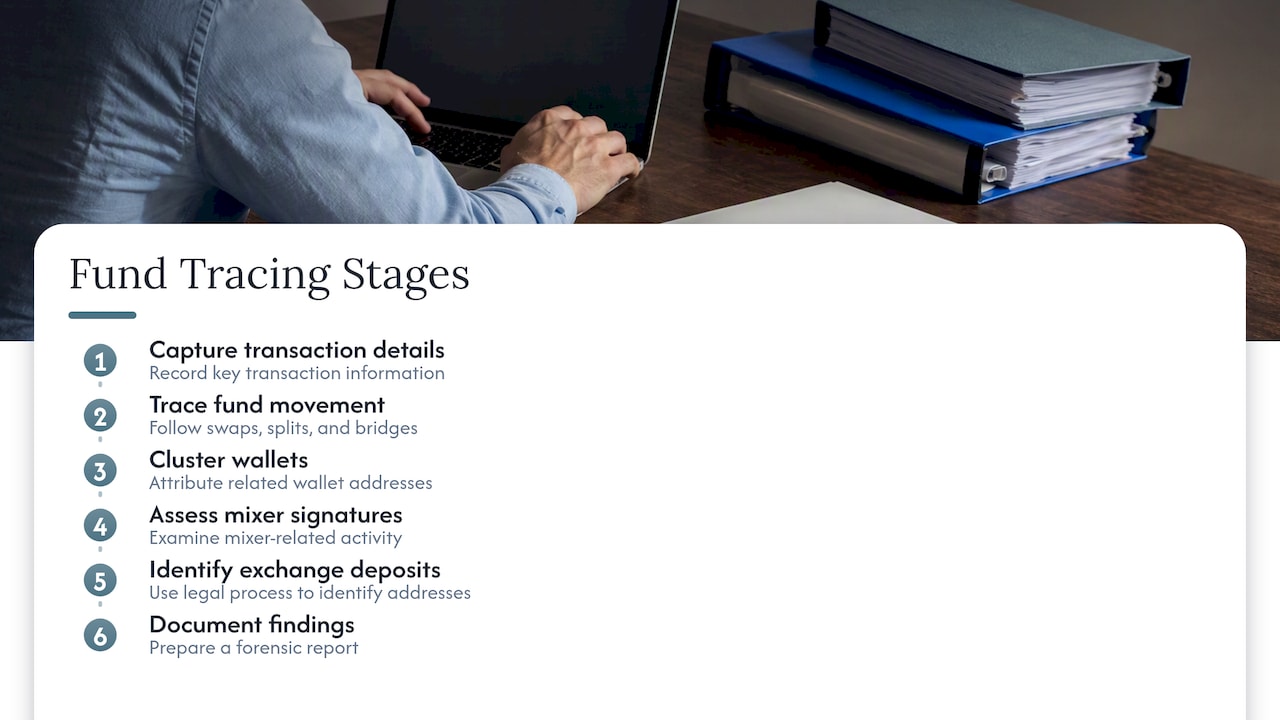
1. Fix the starting point
Everything begins with the exact transactions: hashes, wallet addresses, contract addresses, token contracts, timestamps and amounts. Block explorers show these, but the quality of the investigation depends on how precisely you captured them before they scroll out of memory or a front end disappears. We cover this in our step-by-step guide to crypto fraud investigation.
2. Follow the outflows
Attackers rarely hold stolen assets where they land. Typical moves include swapping volatile tokens into stablecoins or ETH, splitting funds across dozens of fresh wallets, and sending them through cross-chain bridges. Each hop is public. The challenge is volume and speed, not secrecy. Our page on blockchain forensics and proving crypto fraud explains how this is documented.
3. Cluster and attribute wallets
Behavioral patterns link addresses: shared funding sources, identical timing, reused gas patterns, common deposit addresses. Clustering turns a messy graph into a smaller set of actors. If you need to know whether a wallet belongs to a known scam network, see how we identify scam wallets within hours.
4. Deal with obfuscation
U.S. Treasury has noted that illicit actors use virtual currency mixers such as Tornado Cash and Sinbad, and illicit over-the-counter traders, to hide the origin and destination of funds. Mixers and bridges break simple tracking, but they leave statistical and timing signatures. Reconstructing flows through them takes more than a wallet-tracker dashboard, and the report should state clearly which conclusions are certain and which are probabilistic.
5. Reach the off-ramp
Most attackers eventually need to cash out or move into assets they can spend. That is where identity can surface. A federal court filing in a money laundering case explains the limit well: the ledger is public, but identifying the human behind an address usually takes blockchain analysis plus legal process to obtain subscriber information from centralized services. A forensic report can pinpoint which exchange deposit address received the funds. A subpoena, warrant or court order is what gets the account holder’s details.
6. Write it up for decision-makers
The final product is a technical report: scope, methods, a transaction map, a timeline, a glossary a judge can follow, and clear separation of fact from inference. How that report holds up in court is covered in our guide to admitting blockchain evidence in U.S. court.
What to do in the first 24 to 72 hours
Speed matters because attackers move funds fast and exchanges can only freeze what is still sitting with them.
- Stop the bleeding. Revoke token approvals from the affected wallet using a reputable approvals checker, and move any remaining assets to a new wallet created on a clean device. Do not reuse a seed phrase that may be exposed.
- Save everything. Copy transaction hashes, wallet and contract addresses, dates, times and amounts. Screenshot the site, chat, Discord or Telegram messages, and any signing prompts. Do not delete accounts or conversations.
- Report to the FBI. The FBI directs victims to file a report with IC3 at ic3.gov, including transaction hashes, addresses, dates, times and amounts. Our checklist on what to report to trigger police crypto investigations explains how to make the report usable.
- Notify the platforms involved. If funds went through a centralized exchange, tell its compliance team with the hashes. Our note on what to do when your exchange will not help covers the next move if they stall.
- Preserve the digital footprint. Evidence that is not preserved properly is hard to use later. See our digital evidence preservation guide for U.S. admissibility.
For a compact version, use the 24 to 72 hour crypto investigator checklist and our 24-hour steps for U.S. victims.
What is realistic, and what is not
Honest expectations protect you from the second scam. Three points are worth keeping in mind.
Tracing is not recovery. A forensic report shows where funds went. Getting them back typically depends on a freeze by a cooperating exchange, a civil claim, or a criminal forfeiture. None of these can be promised by anyone.
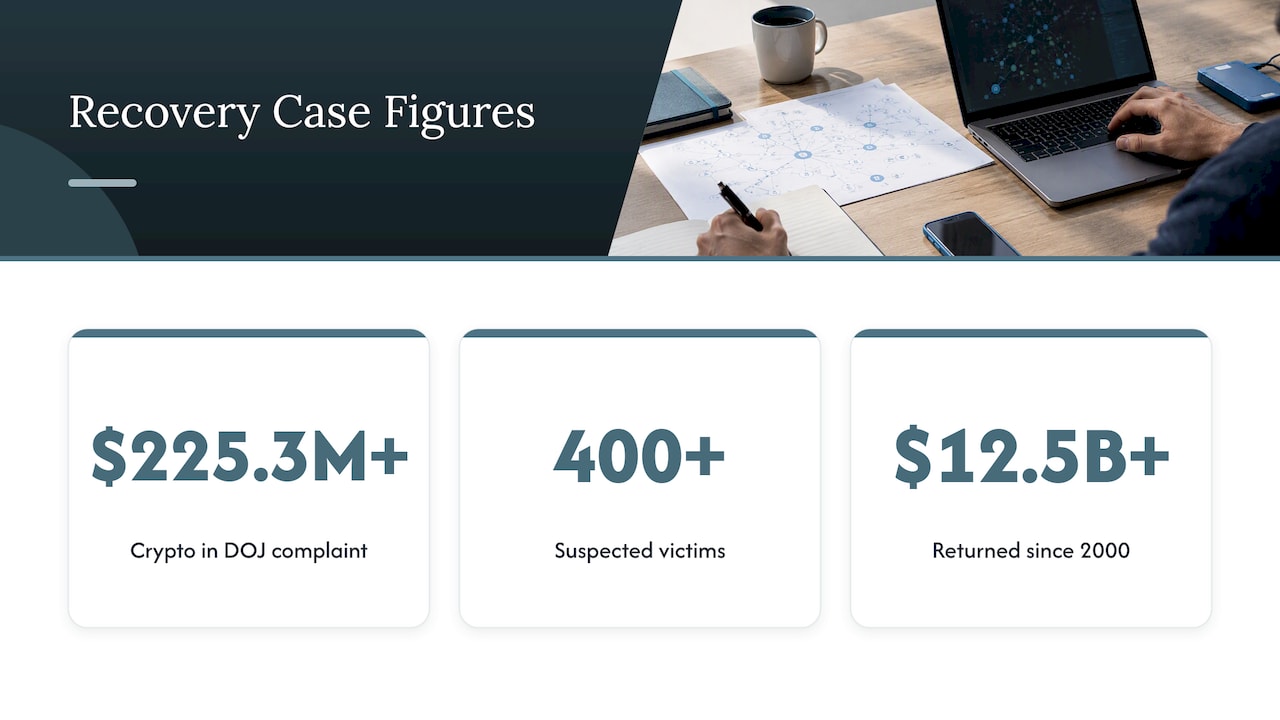
Law enforcement can recover at scale, slowly. In June 2025 the Department of Justice filed a civil forfeiture complaint against more than $225.3 million in cryptocurrency tied to confidence-scam laundering, the largest seizure in the history of the U.S. Secret Service, involving more than 400 suspected victims. Cases like this show that blockchain analysis can lead to seizures, but they run through courts on government timelines. Returns to victims come through a formal remission process. The DOJ says its program has returned more than $12.5 billion to victims since 2000.
Counter-exploits are not for individuals. In rare protocol-level incidents, funds have been clawed back through specialized, court-authorized operations. That is not a route open to an individual victim, and anyone offering to “hack back” your funds is describing something illegal or fraudulent.
Why DeFi losses matter at the individual level
Headline hacks tend to be protocol-sized, but the victims are individuals with wallets. The wider fraud picture in the U.S. is large: the FBI’s 2024 report counted $16.6 billion in total reported losses, with 256,256 complaints reporting an actual loss and an average loss of $19,372, and crypto investment fraud was a significant share. For a broader legal and statistical view of the problem across jurisdictions, this overview of global cryptocurrency fraud trends is a useful companion read.
How to spot a fake recovery service
After a hack, victims get contacted by people claiming they can recover funds. The FBI has issued a public warning about companies falsely claiming an ability to recover funds lost in crypto investment scams, noting that scammers impersonate legal services or law enforcement to extract more money or personal data from people already harmed. The FBI also says the government does not charge for law enforcement services to victims, and its crypto guidance tells victims to be wary of recovery services demanding upfront fees.
Use these filters before you pay anyone:
| Red flag | What a legitimate investigator does instead |
|---|---|
| Guarantees to recover your funds | Promises a documented investigation, not an outcome |
| Contacts you first on social media or Telegram | Is found by you through your own research or a lawyer referral |
| Asks for your seed phrase or wallet access | Needs only public data: hashes and addresses |
| Claims a private “hack back” or backdoor | Works from public blockchain data and legal channels |
| Vague deliverables | Defines the scope and the report you will receive |
| Pressure to pay immediately | Explains the process and lets you consult counsel first |
No legitimate investigator ever needs your private keys or seed phrase.
Our perspective
We see the same pattern in DeFi cases. Victims usually come to us after days of trying things on their own, and by then the most valuable evidence is often a half-remembered screen. The chain itself rarely loses data. What gets lost is context: which approval was signed, which link was clicked, which chat preceded it.
We also think the industry oversells. A wallet tracker can draw a graph, but a graph is not evidence. A report only helps a lawyer, an exchange or an agency if it explains method, separates fact from inference, and can be reproduced. That is why we build our work around reports suitable for legal proceedings and treat mixers and bridges as problems to be reconstructed, not as dead ends.
And we say plainly what forensics cannot do. We cannot reverse a transaction, and we cannot force an exchange to freeze an account. What we can do is give you, or your attorney, the strongest factual basis to ask. Our approach is victim-centered: you should understand every step and every limit before you decide to proceed.
— cristian
Working with a forensic team
If your loss is significant, or if a lawyer is already involved, a paid investigation can turn scattered hashes into a coherent case file. Our cryptocurrency scam investigation, OSINT attribution and evidence preservation services cover tracing, wallet analysis and documentation. Law firms can use our technical analysis and reporting for professional offices. To start, contact Recovera Forensics with your hashes and a short timeline.
What a good report contains
Whether you hire us or someone else, hold the deliverable to a standard:
- Scope and assumptions: which transactions, chains and dates were examined.
- Method: the tools and techniques used, and how clustering conclusions were reached.
- Transaction map and timeline: readable by a non-technical reader.
- Off-ramp findings: which services received funds, with addresses and amounts, so counsel can direct legal requests.
- Confidence levels: certain, likely or possible for each attribution.
- Evidence integrity notes: how data was captured and preserved.
If your case involves related fraud types, such as BEP-20 token tracing, NFT scams or crypto wire fraud, the same structure applies with chain-specific detail.
FAQ
Can stolen DeFi funds be recovered?
Sometimes, but never reliably. Recovery usually depends on funds reaching a cooperating exchange that can freeze them, or on a legal process such as forfeiture followed by remission. Forensics makes those routes possible by documenting where the assets went. Be skeptical of anyone who guarantees an outcome.
Should I report a DeFi hack to the FBI?
Yes. The FBI asks victims to report crypto fraud at ic3.gov with transaction hashes, addresses, dates, times and amounts. A report does not guarantee an investigation, but it creates an official record and can link your case to others involving the same wallets.
Is a blockchain investigation anonymous to the attacker?
Not from the attacker’s side of the ledger, since every transaction is public. Identifying a real person is harder and generally requires data from centralized services obtained through legal process. A forensic report identifies which services to ask.
How much does a DeFi hack investigation cost?
It depends on the number of transactions, chains and hops involved, so we do not publish a fixed price. Scope is defined before work starts. Be cautious of any firm that asks for a large payment before explaining exactly what you will receive.
Sources
- FBI IC3 2024 Internet Crime Report
- FBI IC3: Cryptocurrency fraud guidance
- FBI IC3 PSA: Companies falsely claiming an ability to recover lost crypto funds
- U.S. Department of Justice: $225M civil forfeiture complaint
- U.S. Department of Justice: AirBit Club compensation process
- U.S. Department of Justice: sealed affidavit, Case No. 24-mj-08113-ADM
- U.S. Treasury press release on mixers and illicit OTC traders