Yes: federal wire fraud law, 18 U.S.C. § 1343, is routinely applied to schemes involving cryptocurrency. A conviction can carry years in prison per count, substantial fines, and civil forfeiture of the crypto itself. Because crypto transfers are usually irreversible, the practical reality for victims and targets alike is that speed, in reporting, in preserving records, and in getting legal and forensic help, often matters more than anything else.
TL;DR:
- An unsuccessful scheme can still support attempt or conspiracy charges under Section 1349, and exchange subpoenas can help link wallet addresses to real identities.
- Blockchain investigators map public transaction records and use address clustering plus exchange records to reconstruct fund flows, even after transfers pass through mixers or bridges.
- Victims should report to IC3 and the FTC, contact their bank and receiving exchange, and preserve hashes, wallet addresses, screenshots, and login logs.
- Recovery prospects fall once funds clear an exchange’s hold window; verify any recovery offer through an official government address before sharing information or paying.
- Moving or converting alleged proceeds to hide their source can bring separate money laundering counts, while courts may order restitution alongside fines, imprisonment, and forfeiture.
Table of Contents
- How wire fraud law applies to cryptocurrency transactions
- How federal prosecutors build a crypto wire fraud case
- Related charges and what a conviction can cost you
- How blockchain tracing turns transactions into evidence
- What to do if you are a victim or under investigation
- Prevention, recovery odds, and realistic timelines
- What a forensic investigator wants you to know
- Recovera Forensics: forensic support for crypto fraud victims and legal teams
- FAQ
- Sources
How wire fraud law applies to cryptocurrency transactions
Wire fraud under 18 U.S.C. § 1343 requires prosecutors to show a scheme to defraud, intent to deceive, and the use of interstate wire communications to carry it out. Courts and the Department of Justice treat emails, text messages, domain-based phishing pages, and blockchain network transmissions as wire communications, since they travel across state or national lines through internet infrastructure. That means a fraudulent token sale pitched over email, or a phishing link that drains a wallet, satisfies the wire element the same way an old-fashioned bank wire scam would.
Prosecutors also reach for 18 U.S.C. § 1349, which criminalizes attempt and conspiracy to commit wire fraud, so a scheme does not need to succeed for charges to follow. DOJ forfeiture filings have repeatedly treated cryptocurrency as traceable proceeds of a wire fraud scheme, which is part of how the government justifies seizing wallets tied to an alleged fraud before a case even reaches trial.
How federal prosecutors build a crypto wire fraud case
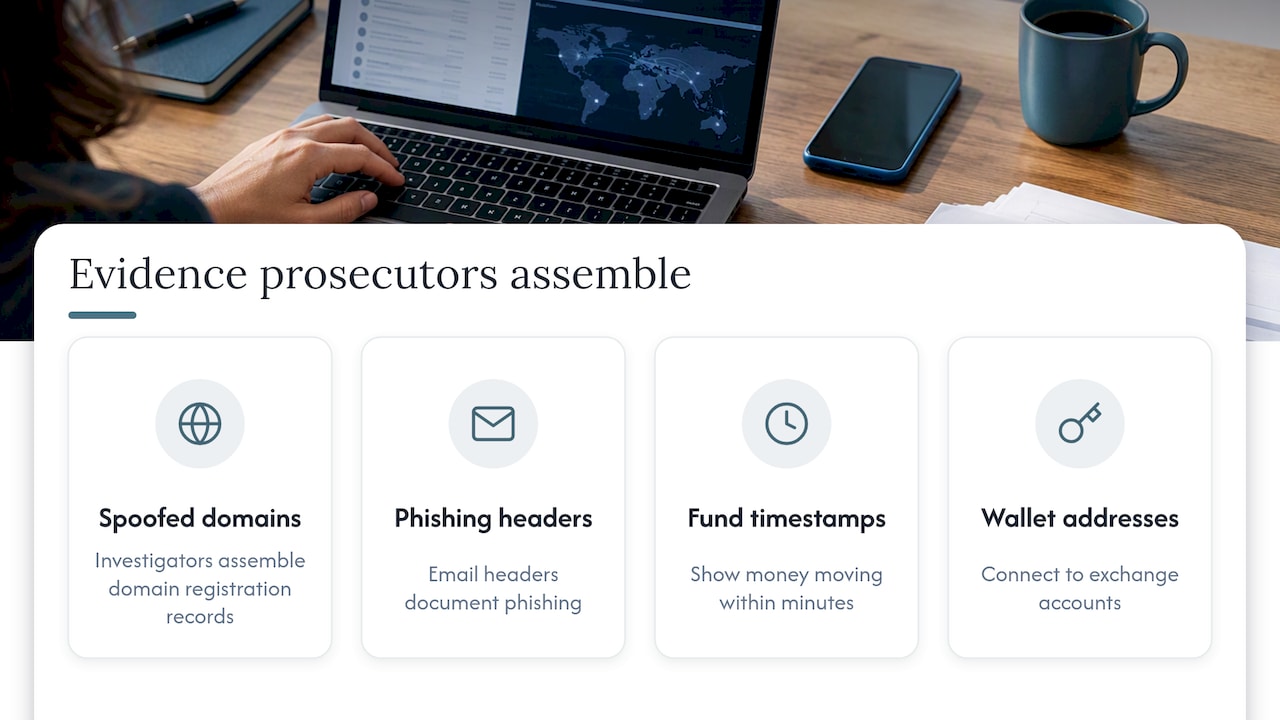
To charge wire fraud, prosecutors must prove a scheme to defraud, intent, and use of interstate wires, three elements that sound simple but take months of document work to establish. Investigators typically assemble spoofed domain registrations, phishing email headers, timestamps that show money moving within minutes of a victim’s “investment,” and wallet addresses that connect back to exchange accounts.
Subpoenas to exchanges play a central role, since regulated platforms hold know-your-customer records that can tie an anonymous wallet to a real identity. Agents often pair that with blockchain tracing to map how stolen funds moved from a victim’s wallet through intermediate addresses before landing somewhere withdrawable. That combination, communications evidence plus a documented transaction trail, is usually what turns a complaint into an indictment.
Related charges and what a conviction can cost you
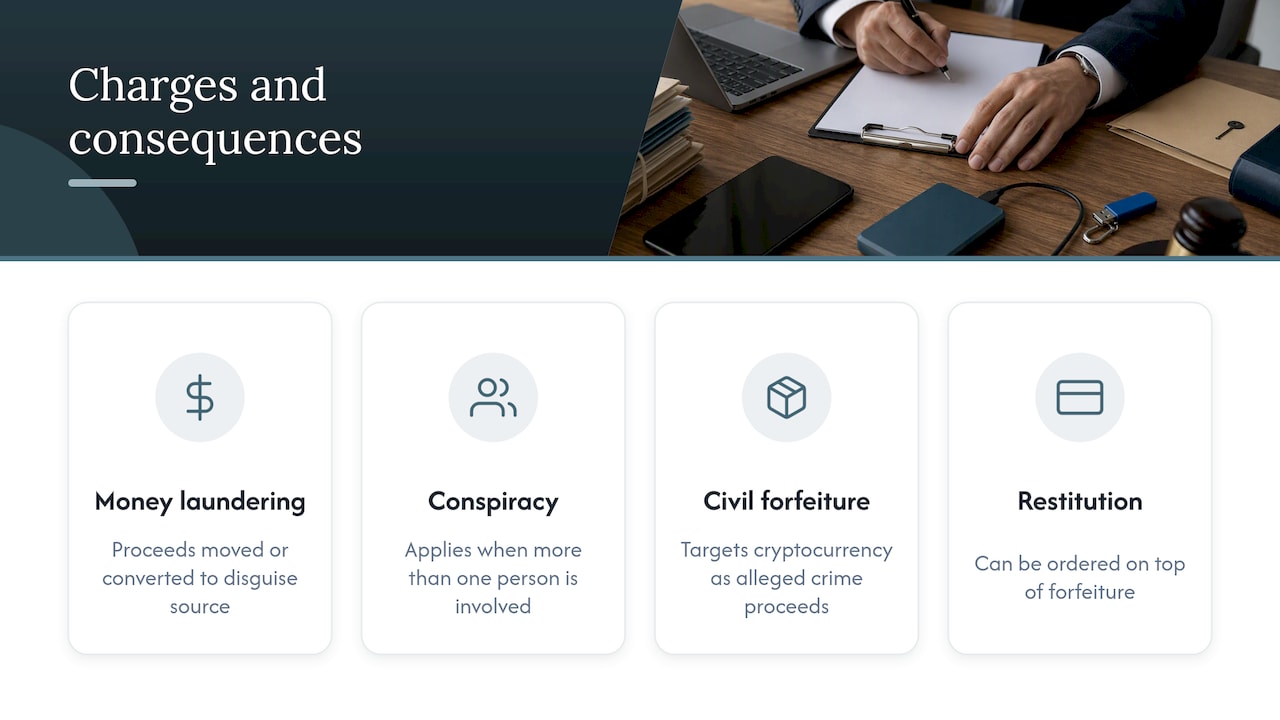
A wire fraud count rarely travels alone. Prosecutors frequently add money laundering charges under 18 U.S.C. § 1956 when proceeds were moved or converted to disguise their source, along with conspiracy counts under §1349 when more than one person was involved.
Civil forfeiture under 18 U.S.C. § 981 lets the government pursue the cryptocurrency itself as proceeds of the alleged crime, filing an in rem action directly against the wallet or asset rather than against a person. A DOJ civil forfeiture complaint out of the Eastern District of New York illustrates this approach, asserting that specific cryptocurrency holdings were traceable proceeds of wire fraud and subject to seizure.
Sentencing exposure stacks with each count: wire fraud alone can mean years of imprisonment per count, and money laundering counts add separate penalties. Courts can also order restitution to victims on top of any forfeiture, so a defendant can face prison time, fines, forfeited assets, and a restitution order simultaneously.
How blockchain tracing turns transactions into evidence
Every blockchain transaction leaves a public record, and forensic investigators use that record to build a transaction graph: a map of addresses, the amounts that moved between them, and clustering techniques that group addresses likely controlled by the same person or operation. That graph is the backbone of both criminal investigations and the forfeiture complaints that follow them.
Fraudsters try to break that trail through several common tactics:
- Spraying stolen funds across dozens of addresses to make manual tracing tedious.
- Routing through mixers or cross-chain bridges to obscure the path between wallets.
- Converting to fiat quickly through complicit or loosely regulated exchanges.
Forensic teams counter these moves with clustering heuristics and exchange subpoena mapping, techniques that reconstruct the flow of funds even after a hop through a mixer or bridge, as reflected in DOJ forfeiture filings that describe exactly this kind of obfuscation. Bitcoin’s simpler transaction model and Ethereum’s smart-contract activity each require different tracing approaches, which is part of why investigators treat chain selection as a factor in how fast a case can move. Our cryptocurrency tracing work follows this same logic to connect wallet activity to identifiable accounts.
Pro Tip: Save every transaction hash the moment you notice a loss. A forensic team can rebuild most of a fund flow from hashes alone, even without your full exchange history.
What to do if you are a victim or under investigation
Whether you lost funds to a scam or you are facing questions about your own crypto activity, the first 24 to 72 hours shape what happens next.
- File a report with IC3.gov and the FTC as soon as you notice unauthorized activity.
- Contact your bank and the receiving exchange immediately to request a hold or freeze on the destination account.
- Preserve transaction hashes, wallet addresses, screenshots of communications, and login logs; avoid posting details publicly, which can tip off the people responsible.
- Engage counsel and consider a forensic investigator within the same window, since tracing gets harder the longer funds sit unaddressed.
A guide on what to report to trigger a police investigation walks through what law enforcement needs to open a case, and a document checklist for a court-ready report covers what to gather before you call anyone.
Prevention, recovery odds, and realistic timelines
Businesses and individuals can cut their exposure with out-of-band verification for any payment request, dual approval requirements for wire transfers, multi-factor authentication on exchange and banking accounts, and tools like Positive Pay for business accounts. AI-assisted phishing has made spoofed messages more convincing, which makes a phone call to a known number before sending funds worth the extra minute.
The FTC notes that crypto transfers are typically irreversible, and recovery odds drop sharply once funds clear an exchange’s hold window, which is why bank and exchange cooperation in the first hours after a loss matters so much. Watch for recovery scams too: the FBI has warned about fraudsters impersonating IC3 itself, so verify any official contact through a .gov address before sharing information or paying anyone claiming they can get your funds back.
What a forensic investigator wants you to know
The pattern we see most often is simple: victims who act within the first day or two, before funds scatter across dozens of addresses, keep more options open. A forensic report only helps in court or with an exchange when it ties specific wallet addresses to specific transactions in a way that holds up to scrutiny, not just a summary of what happened. Hiring a forensic firm tends to matter most when funds are still sitting at an identifiable address rather than already cashed out.
— cristian
Recovera Forensics: forensic support for crypto fraud victims and legal teams
When you are dealing with stolen crypto or a wire fraud allegation, the work that actually moves a case forward is tracing the funds, documenting the chain of custody, and producing a report that a prosecutor, judge, or exchange compliance team will accept. That is the work we do through our cryptocurrency scam investigation and related services, built for individual victims and the attorneys who represent them.
Intake for investigations typically covers transaction hashes, wallet addresses, exchange account details tied to the loss, screenshots of communications or phishing pages, and a timeline of when funds moved and where, to the extent available.
For law firms handling Forex fraud, online trading disputes, or gambling-related claims, our technical analysis and court-ready reporting services are built to support litigation directly. Reach out through our services page to start an intake while your evidence is still fresh.
This article is general information, not a substitute for advice from a qualified lawyer. Consult a qualified legal professional about your own circumstances before acting on anything here.
FAQ
Can you get your money back if you get scammed on crypto?
Recovery is possible but not guaranteed, since crypto transfers are typically irreversible once confirmed. Your odds improve when funds are still sitting at an identifiable exchange address and you act quickly with your bank, the exchange, and a forensic investigator.
Can the FBI trace crypto transactions?
Federal investigators use blockchain forensics to trace transactions across public ledgers, linking wallet addresses into clusters and connecting them to exchange accounts through subpoenas. DOJ forfeiture filings show this tracing work directly supporting seizure actions against crypto tied to wire fraud.
Can you get a wire transfer back if scammed?
A traditional bank wire can sometimes be recalled or frozen if you contact your bank within hours of the transfer, though success depends heavily on the receiving institution’s cooperation. Crypto transfers do not have an equivalent recall mechanism, which is why exchange-side freezes and rapid reporting matter so much more in crypto cases.
What is the most common type of wire fraud?
In the crypto space, phishing scams, fake investment or ICO pitches, and Ponzi-style schemes are among the most frequently charged patterns under federal wire fraud law. Each typically involves a fraudulent communication sent over interstate wires that induces a victim to send funds or credentials.
How quickly should I report a crypto wire fraud loss?
Report to IC3.gov and your bank or exchange as soon as you notice the loss, ideally within the first 24 to 72 hours. Acting in that window gives investigators the best chance of locating funds before they move further through the blockchain.
Sources
- 18 U.S. Code § 1343 – Fraud by wire, radio, or television (Cornell Law)
- What to know about cryptocurrency scams (FTC)
- FBI warns of scammers impersonating IC3 (FBI alert)
- DOJ civil forfeiture complaint and supporting allegations (EDNY)