Cryptocurrency tracing maps the movement of digital funds across public ledgers to identify fund flows, attribute wallet clusters to real-world actors, and produce evidentiary reports used for recovery or prosecution. It works because most blockchains publish every transaction permanently, letting investigators, exchanges, and law enforcement reconstruct where funds went, not just that a theft occurred.
TL;DR:
- Most cryptocurrency is traceable because transactions on public ledgers reveal fund movements, but attribution to individuals depends on off-chain evidence and regulated exchange links.
- Investigators build transaction graphs and use clustering heuristics to follow funds, with cross-chain tracing being the most complex and time-consuming part.
- Legal processes like subpoenas are essential for confirming wallet-to-identity links when funds land in regulated exchanges, with response times varying by jurisdiction.
- Speed of action after theft is critical, as delaying preservation requests allows criminals to layer funds or cash out through privacy methods, significantly reducing traceability.
- Full, court-ready forensic analysis requires documented methodology, chain of custody, and multi-heuristic approaches, not just initial hobbyist checks or dashboard screenshots.
Table of Contents
- What Is Cryptocurrency Tracing, and Why Does It Matter?
- Is Cryptocurrency Traceable, or Just Some of It?
- How Do Investigators Actually Trace Bitcoin Transactions?
- How Do Subpoenas and Chain of Custody Work in Crypto Cases?
- What Limits Crypto Tracing, and What Do Investigators Do About It?
- What Does a Crypto Tracing Investigation Actually Involve?
- What Actually Separates a Solvable Case From a Dead End?
- How Recovera Forensics Turns a Trace Into a Case
- Where to Verify These Cases and Methods
- Sources
- FAQ
What Is Cryptocurrency Tracing, and Why Does It Matter?
Blockchain tracing, sometimes called crypto transaction tracing or digital currency tracking, is the practice of following coins from one address to another using data that’s already public. The industry-standard term is blockchain analysis, and it’s what shows up in academic papers, court filings, and compliance frameworks. “Crypto tracing” is the plain-language version people search for, but they mean the same discipline.
A few terms come up constantly in this field:
- On-chain data: transactions, addresses, and balances recorded directly on the blockchain.
- Off-chain data: information outside the ledger, such as exchange account records, IP logs, or social media posts.
- Attribution: linking a wallet address to a real identity or organization.
- Cluster: a group of addresses controlled by the same entity, inferred through behavioral patterns.
These pieces feed into four main applications: forensic reporting for civil litigation and recovery, anti-money-laundering compliance at exchanges, law enforcement investigations into theft and fraud, and academic research into illicit finance. On-chain data alone rarely closes a case. The transaction graph tells you where funds moved; off-chain evidence, like a KYC record or a login timestamp, tells you who moved them. Crypto tracing succeeds when both layers connect.
Is Cryptocurrency Traceable, or Just Some of It?
Yes, most cryptocurrency is traceable, but “traceable” doesn’t mean “instantly attributable to a named person.” Bitcoin, Ethereum, and similar chains are pseudonymous, not anonymous. Every transaction sits on a public ledger anyone can query through a node or a block explorer, which means the movement of funds is visible even when the owner’s identity isn’t.
Traceability varies sharply by asset design and behavior:
- Bitcoin and account-based chains (Ethereum, most tokens): fully visible transaction history; attribution depends on connecting addresses to identity, usually through an exchange.
- Privacy coins (Monero, Zcash’s shielded pool): transaction graphs are deliberately obscured, making standard clustering methods far less effective.
- Stablecoins on public chains (USDT, USDC): highly traceable, and issuers can sometimes freeze funds at known addresses, which matters a lot for recovery timing.
The strongest predictor of a solvable case is whether the funds touched a regulated exchange. Once coins land in an account tied to a Bank Secrecy Act reporting entity, investigators gain a legal path to a name, an email, an IP address, and a bank account. Funds that stay in self-custodied wallets or move straight into a privacy coin are dramatically harder to attribute, even though the movement itself remains visible.
How Do Investigators Actually Trace Bitcoin Transactions?
Tracing starts with building a transaction graph: nodes represent addresses, edges represent transfers, and the graph grows outward from a known starting point, usually the victim’s last-known wallet or the scam’s deposit address. Analysts traverse this graph forward and backward, following the money until it either stops (dead wallet), splits across many addresses (layering), or lands somewhere identifiable (an exchange, a merchant, a bridge).
The methods investigators lean on most:
- Common-spend heuristic: if multiple inputs fund a single transaction, they’re often controlled by the same wallet software and thus the same owner.
- Change-address detection: identifying which output in a transaction is “change” returning to the sender, versus the actual payment.
- Multi-input clustering: grouping addresses that repeatedly co-spend, building out an entity’s full wallet footprint rather than tracking one address at a time.
- Density-based clustering (DBSCAN-style approaches): academic methods group addresses by behavioral similarity rather than a single rule, useful when heuristics alone produce noisy results.
- Graph centrality and anomaly detection: flagging addresses that act as hubs, mixers, or unusual pass-through points based on transaction volume and timing patterns.
- Cross-chain tracing: following funds through bridges, decentralized exchange swaps, or wrapped-token conversions, since modern theft rarely stays on one chain.
Cross-chain work has become the hardest part of the job. A thief who steals Ethereum, swaps it for a bridged asset, converts that to Bitcoin, and cashes out through a lesser-known exchange has crossed three separate forensic domains, each with its own tooling and data gaps. Investigators have to stitch these domains together manually or with specialized software, since no single explorer covers every chain and bridge combination.
Pro Tip: Treat every clustering result as probabilistic, not certain. A well-documented investigation reports attribution with a confidence level and explains which heuristic produced it, because a court or opposing counsel will ask.
How Do Subpoenas and Chain of Custody Work in Crypto Cases?
On-chain analysis identifies where funds went. Turning that into a name requires legal process, and the sequence matters as much as the technique.
- Subpoena the exchange. Once a cluster analysis shows funds landed in an account at a regulated exchange, counsel can subpoena that exchange’s KYC and transaction records. Domestic exchanges typically respond within a few weeks; the exchange’s own compliance backlog is usually the bottleneck, not the legal process itself.
- Use an MLAT for foreign exchanges. When funds move to an exchange based outside the United States, a Mutual Legal Assistance Treaty request lets U.S. authorities formally ask that country’s government for records. MLAT requests can be slower because they route through diplomatic and judicial channels rather than a direct subpoena.
- Preserve chain of custody. Every export, log, and screenshot needs a timestamp, a hash of the original data, and a documented collection method. Courts weigh a report’s reliability heavily on whether its chain of custody is airtight.
- Build the report around reproducibility. A defensible forensic report includes the transaction graph, the specific heuristics applied, timestamps for every data pull, and an explicit section on limitations, not just a conclusion.
Prosecutors have used exactly this sequence to secure convictions. The Bitfinex hacker money laundering case leaned on blockchain analysis tied to exchange records to build a case involving billions of dollars in stolen funds.
What Limits Crypto Tracing, and What Do Investigators Do About It?
Tracing isn’t magic, and criminals know the weak points as well as investigators do.
- Mixers and tumblers pool funds from many users and redistribute them, breaking the simple one-to-one link between deposit and withdrawal.
- CoinJoin transactions combine multiple users’ payments into one transaction, muddying which input paid which output.
- Privacy coins like Monero use ring signatures and stealth addresses that defeat standard clustering outright.
- Chain-hopping across three or four different blockchains forces investigators to rebuild the graph from scratch at each hop.
The realistic cash-out point for most stolen funds is still a fiat off-ramp, a regulated exchange, a peer-to-peer platform, or occasionally a payment processor, because criminals eventually need spendable money, making understanding trailing stop crypto orders essential in monitoring and managing these transactions. That’s where mitigation efforts concentrate: filing a preservation request with an exchange the moment funds are spotted there, before the account can be emptied, buys investigators time that speed alone can’t.
Pro Tip: Speed is critical in the first days after theft. A basic preservation letter sent promptly often accomplishes more than prolonged analysis, because exchanges can freeze an account quickly, but only if they’re asked before the funds move on.
What Does a Crypto Tracing Investigation Actually Involve?
A real investigation follows a fairly consistent shape, whether it’s run for a victim, a law firm, or a compliance team.
- Intake: gather transaction IDs, wallet addresses, exchange account details, scam communications, and any KYC information already in hand.
- Triage: an analyst runs an initial trace to gauge whether funds are still traceable or have already hit a dead end (a privacy coin swap, a defunct exchange).
- Full forensic analysis: graph construction, clustering, and cross-chain tracing produce a documented fund-flow map.
- Legal escalation: findings support a subpoena, an MLAT request, or a referral to law enforcement, depending on jurisdiction and the exchange involved.
- Deliverables: a forensic report with fund-flow graphs, methodology notes, and chain-of-custody documentation, ready for counsel or investigators to act on.
Timelines vary enormously. Cases where funds sit at a cooperative U.S. exchange sometimes move in weeks. Cases involving multiple chain hops and foreign exchanges can take longer, often several months, largely because of MLAT processing time rather than the analysis itself. Cost tracks complexity: a straightforward single-hop trace costs far less than a multi-chain investigation spanning several exchanges and jurisdictions.
What Actually Separates a Solvable Case From a Dead End?
Speed is the variable people underestimate most. Every day that passes after a theft gives criminals more time to layer funds through mixers, swap into privacy coins, or cash out at an exchange that’s slow to respond to legal process. The technical sophistication of the trace matters far less than how quickly preservation requests go out.
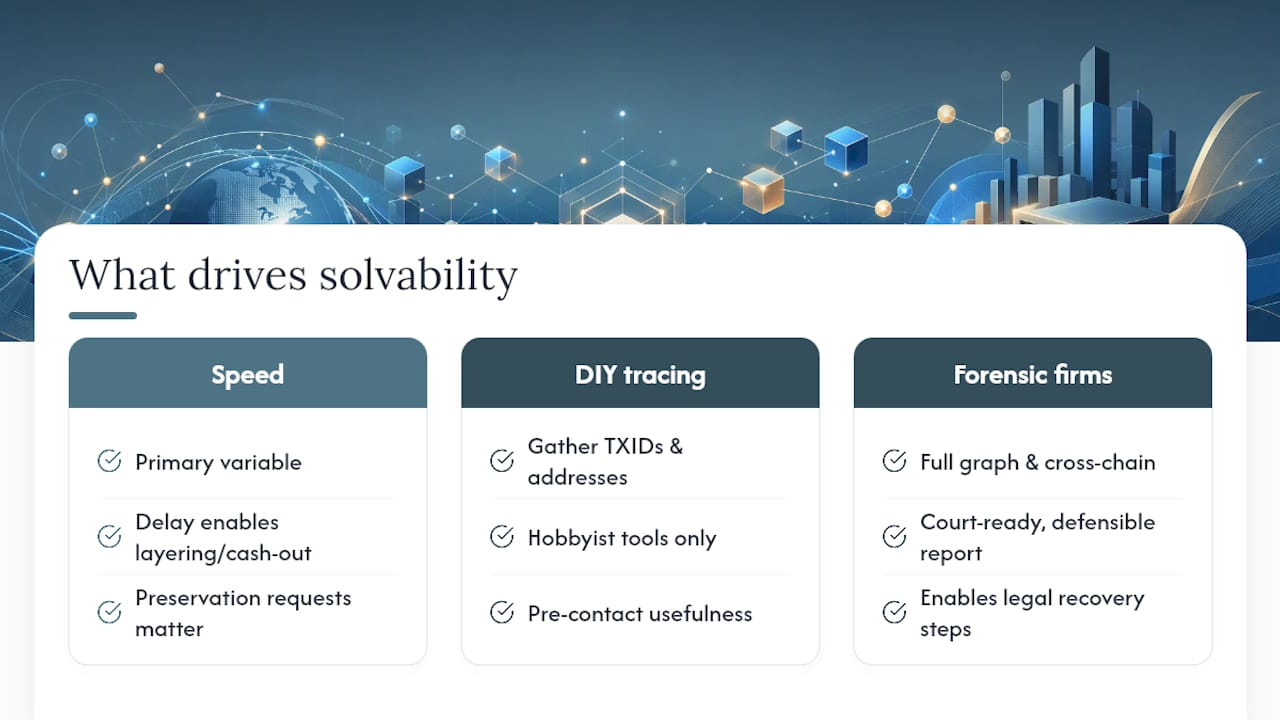
DIY tracing has a place, mainly for gathering the initial transaction IDs and wallet addresses before anything gets contacted. But full graph analysis, cross-chain tracing, and building a report that survives legal scrutiny requires tooling and methodology most victims don’t have access to on their own. The gap between a hobbyist checking a block explorer and a documented, court-ready forensic report is the same gap between a home inspection and a structural engineer’s sealed report.
If there’s one thing worth pushing back on, it’s the assumption that tracing guarantees recovery. It doesn’t. What it guarantees is a documented, defensible account of where the money went, which is the precondition for recovery, not the recovery itself.
— cristian
How Recovera Forensics Turns a Trace Into a Case
Some forensic firms build fund-flow graphs and cluster analysis as described above, then package them into forensic reports designed to hold up with exchanges, counsel, and courts, not just satisfy curiosity about where stolen funds went. These investigations connect wallet activity to broader fraud networks rather than stopping at the first wallet, which matters when the goal is a subpoena or a legal filing, not just a screenshot.

Before engaging, gather your transaction IDs, wallet addresses, exchange account details, and any scam communications. That intake alone often determines whether a case moves in weeks or months. If you’re evaluating whether paid forensic support is worth it for your situation, Recovera Forensics can walk through what a chargeback or recovery filing built on a technical report actually looks like, and what to expect from the process.
Where to Verify These Cases and Methods
- DOJ: $23 million ransomware cryptocurrency seizure
- FBI: cryptocurrency funds stolen by DPRK
- Blockchain analysis overview — Wikipedia
This article is general information, not a substitute for advice from a qualified financial advisor. Consult a qualified financial professional about your own circumstances before acting on anything here.
Sources
Every trace starts with raw chain data, either from running a full node or querying a public block explorer, and scales up from there depending on the case’s complexity.
- Blockchain analysis — Wikipedia
- Department of Justice seizes $23 million in cryptocurrency paid to ransomware extortionists
- FBI identifies cryptocurrency funds stolen by DPRK
- Bitfinex hacker and wife plead guilty to money laundering conspiracy
The trade-offs matter for anyone preparing a case for court. Raw node data is free and complete but painfully slow to query at scale. Indexed commercial datasets are fast and analyst-friendly but cost money and require export formats that hold up under scrutiny, timestamped, methodology-documented, and reproducible by a third party. A report built purely on a screenshot of a dashboard rarely survives cross-examination. One built on exportable raw data with a documented flow-of-funds methodology usually does.
FAQ
Can You Actually Trace Cryptocurrency?
Yes. Most cryptocurrencies run on public ledgers, so every transaction is visible and can be mapped into a transaction graph. Attributing an address to a specific person requires additional evidence, usually exchange KYC records obtained through legal process.
Can Police Trace Cryptocurrency?
Yes, and they routinely do. The FBI has publicly identified stolen crypto funds tied to state-sponsored theft, and DOJ prosecutions have used blockchain analysis to secure guilty pleas in laundering cases involving billions of dollars.
How Do I Find Bitcoin I Bought Years Ago?
Check any old wallet software, hardware wallets, exchange accounts, or paper backups for a seed phrase or private key first. If you know a transaction ID or old address but can’t access the funds, a block explorer can confirm the balance still sits there, though recovering access without the key isn’t a tracing problem, it’s a key-recovery problem.
Can a Crypto Scammer Be Traced?
Often, yes, especially if the stolen funds ever touched a regulated exchange. Investigators build a fund-flow graph from the scam wallet, apply clustering heuristics, and use legal requests like subpoenas to attach an identity once the trail hits an exchange account. Funds that move straight into a privacy coin are considerably harder to attribute.
How Long Does a Cryptocurrency Tracing Investigation Take?
It depends heavily on where the funds ended up. A single-hop case involving one cooperative domestic exchange can resolve in a few weeks, while multi-chain cases involving foreign exchanges and MLAT requests can take several months.