You can usually identify a Telegram scammer through quick checks: an unfamiliar account contacting you first, pressure to act fast, and a request to pay in crypto or gift cards. If you already sent funds, stop replying, screenshot everything, save wallet addresses and transaction IDs, and report the account to Telegram and to the FBI’s IC3 or the FTC right away.
TL;DR:
- Most scammers contact victims through accounts that are newly created, with no mutual contacts, and often demand urgent responses in private chats.
- Cryptocurrency and gift card payments are favored by scammers because they are irreversible, making recovery nearly impossible once funds are sent.
- Verifying accounts by comparing usernames character-by-character, checking for official verification badges, and reverse-image searching profile photos can reveal impostors.
- Reporting promptly to Telegram, federal agencies, and saving chat evidence increases chances of recovery and helps prevent repeat scams.
- Paid forensic tracing can follow stolen crypto through various exchanges and mixers, but only after initial victim reports and evidence gathering.
Table of Contents
- Common Telegram Scams and the Red Flags That Give Them Away
- Practical Verification Checklist You Can Run in the App Right Now
- Tools and Quick Checks: Bots, Image Search, and Link Previews
- If You Already Sent Funds: Preserve Evidence and Report Fast
- When to Bring in Professional Blockchain Forensics
- Why Reporting Fast Protects More Than Just You
- How Recovera Forensics Helps When Telegram Fraud Involves Crypto
- Authoritative Reporting and Help Links
- Sources
- FAQ
Common Telegram Scams and the Red Flags That Give Them Away
Telegram’s mix of anonymous accounts, bots, and massive public groups makes it an easy place to run scams at scale, and cybersecurity researchers have flagged the platform repeatedly as a hotspot for impersonation and automated phishing schemes. Knowing the shape of the con before it reaches you is the fastest way to shut it down.
Impersonation and cloned accounts. Someone copies a real person’s or company’s photo, bio, and name, then reaches out claiming to be that person. Red flags: the account contacted you first, the username differs slightly from the real one, and it avoids video calls or voice notes.
Crypto investment and pump-and-dump schemes. These often show up inside “VIP” trading groups promising guaranteed returns. Watch for screenshots of fake profits, countdown timers pushing you to deposit before a “window closes,” and admins who deflect any question about withdrawing funds.
Phishing bots. A bot messages you claiming your wallet needs “verification” or your account will be suspended, then sends a link to a fake login page. The giveaway is a URL that almost matches a real service but isn’t quite right, and a request for your seed phrase or private key, which no legitimate platform ever needs.
Fake customer support. Scammers monitor public crypto and trading groups, then privately message anyone who posts a complaint, posing as “official support.” Real support teams don’t cold-message you in a group chat.
Job offers, giveaways, and romance scams. A stranger offers easy remote work, a free airdrop, or a fast-moving romantic connection. All three eventually ask for money, personal documents, or a “small fee” to unlock a payout.
Across every category, a few behavioral patterns repeat:
- Unsolicited first contact, especially from an account with no shared groups or contacts.
- Manufactured urgency (“act in the next hour or lose your spot”).
- Secrecy demands, like moving the conversation to a private or “secret” chat immediately.
- Refusal to verify identity through a live video call.
- A push toward crypto, gift cards, or wire transfers instead of traceable, reversible payment methods.
That last point matters more than most people realize. The FTC notes that cryptocurrency payments are generally irreversible, which is exactly why scammers steer victims there. Once crypto leaves your wallet, there’s no bank to call and no chargeback button. Gift cards work the same way: once the code is spent, the money is gone.
Practical Verification Checklist You Can Run in the App Right Now
Before you reply to anything that feels off, run through this sequence. It takes about two minutes and catches the vast majority of impostor accounts.
- Compare the @username character by character. Display names and photos are trivial to clone, but Telegram enforces a unique handle across the whole platform. Pull up the real account (from an official website or verified social link) and check every letter. A single swapped character, like a lowercase “l” for a capital “I,” is one of the oldest tricks in the book.
- Check for a genuine verification badge. Telegram renders verified checkmarks directly in the app for confirmed public figures and organizations. Tap the profile to see if a third party actually backs that badge, rather than trusting a checkmark emoji pasted into a bio.
- Look at account history and shared context. Scroll for mutual contacts, shared groups, and how long the account has existed. A profile created days ago with zero mutual connections and a generic stock photo deserves suspicion.
- Reverse-image search the avatar. Cloned photos frequently turn up on other profiles or stock sites once you search the image, which is one of the fastest ways to expose a fake persona.
- Refuse secret chats and demand outside verification. If someone insists on moving to Telegram’s encrypted “secret chat” mode before you’ve verified who they are, that’s a request to hide the conversation from moderation. Ask them to confirm their identity through an official website, a verified social account, or a company directory instead.
Pro Tip: Save a bookmark of the real organization’s verified Telegram link before you ever need it. When someone messages you claiming to represent that company, you can compare handles in ten seconds instead of scrambling mid-conversation.
Tools and Quick Checks: Bots, Image Search, and Link Previews
A handful of built-in tools handle most of the verification work without exposing you to malware.
- Use Telegram’s official reporting tools. The in-app “Report” button and moderation bots such as @notoscam exist specifically to flag scam accounts, and Telegram’s own spam guidance confirms the platform accepts these reports along with messages to abuse@telegram.org.
- Reverse-image search on any device. On mobile, save the suspicious avatar and search it through a reverse-image search app; on desktop, drag the image into Google Images or TinEye.
- Preview links before tapping them. Telegram shows a link preview automatically in most chats. Expand any shortened URL first, and run unfamiliar links through a link scanner rather than opening them cold, especially anything requesting login credentials, which CISA’s phishing guidance treats as a top red flag regardless of platform.
- Never download unexpected files or install apps a stranger sends you. Fake “verification” tools and trading bots are common malware delivery methods.
- Grab the account’s numerical Telegram ID when possible. Usernames and display names can change overnight, but the numeric ID behind an account stays fixed, which makes it a far more durable identifier for reports and any later forensic work than a handle that could be swapped tomorrow.
If You Already Sent Funds: Preserve Evidence and Report Fast
Speed matters here. Exchanges can sometimes freeze linked accounts if you report quickly, and law enforcement can only act on what you hand them.
- Lock down the evidence first. Screenshot the entire conversation, save every wallet address the scammer gave you, copy the transaction hash for each transfer, note the exact date and time, and record the account’s numerical Telegram ID.
- Contact your exchange or payment provider immediately. If you sent crypto through an exchange, some providers can flag the destination address before it moves further.
- File a complaint with the FBI’s Internet Crime Complaint Center. IC3 guidance recommends including wallet addresses, transaction IDs, and cryptocurrency type, and to file even if some details are missing rather than waiting until you have everything.
- Report at ReportFraud.ftc.gov. This feeds federal fraud databases that investigators and analysts use to spot patterns across victims.
- Report the account inside Telegram. Use the in-app report flow, message @notoscam, and email abuse@telegram.org with the numerical ID attached.
- Do not pay anyone who promises to “recover” your funds for a fee. The FTC specifically warns that recovery-fee requests are usually a second scam layered on top of the first, often run by the same network that stole your money in the first place.
- Preserve everything else. Don’t delete the chat, export it if Telegram’s settings allow, secure the device you used, and gather any KYC or account details from the exchange you transacted through.
One detail victims consistently underestimate: crypto transactions are permanent once confirmed on the blockchain, and there’s no bank or platform that can simply reverse them. That’s precisely why the FTC flags crypto, gift card, and wire transfer requests as fraud hallmarks rather than routine payment options. If your loss involved a trading platform promising unrealistic returns, a strategy-backtesting tool like Backtestify can help you sanity-check whether the returns you were shown were ever mathematically plausible in the first place.
When to Bring in Professional Blockchain Forensics
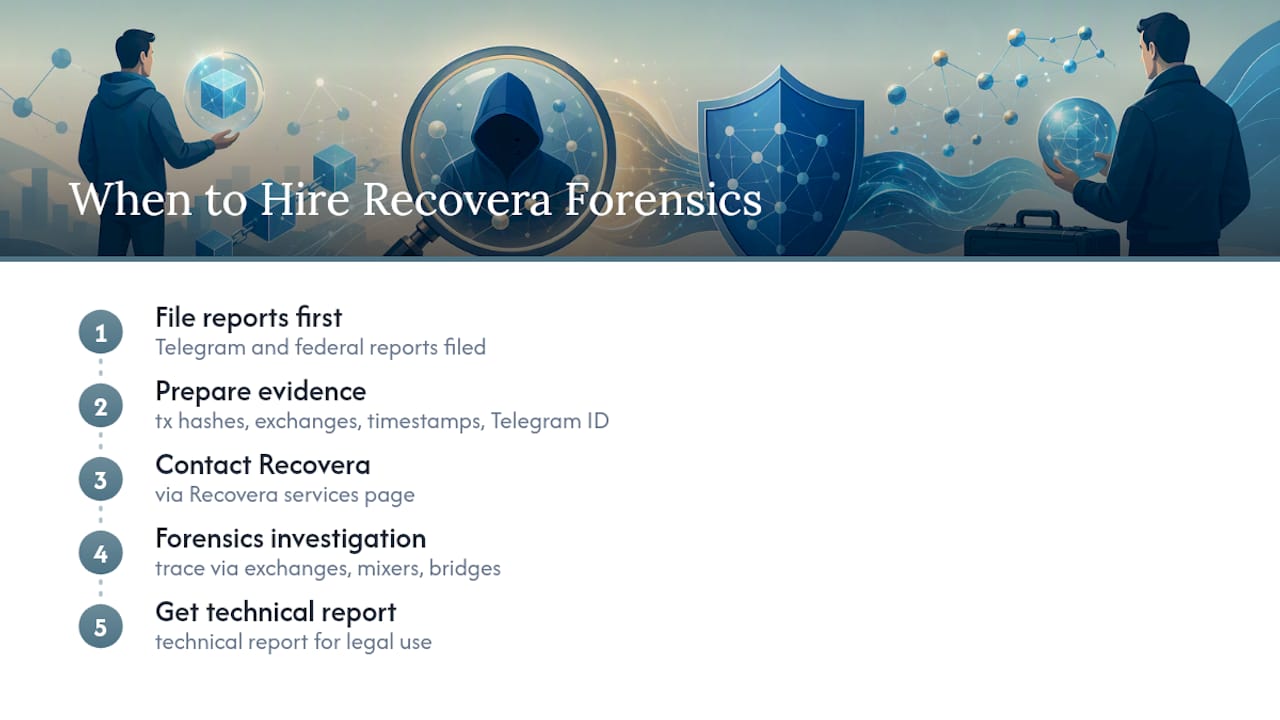
Reporting to Telegram and federal agencies is the right first move, but it doesn’t trace where your crypto actually went. Professional forensics can follow wallet flows across mixers and bridges, flag exchange deposits tied to the destination address, and build the kind of technical report that holds up in legal proceedings.

Before contacting a forensic firm, gather your transaction hashes, exchange account details, timestamps, the scammer’s numerical Telegram ID, and complete chat screenshots. No firm can guarantee recovery, but a documented forensic trail meaningfully raises the odds that an exchange or law enforcement can act on your case. Paid tracing makes sense once you’ve filed your initial reports and the loss is significant enough to justify a formal investigation.
Why Reporting Fast Protects More Than Just You
Every report you file helps Telegram flag repeat offenders faster, which slows the same scam from hitting the next person in line. Don’t waste energy arguing with a suspected scammer. Verify, screenshot, and report systematically, then move on.
— cristian
How Recovera Forensics Helps When Telegram Fraud Involves Crypto
Once you’ve filed your Telegram and federal reports, the next question is whether the stolen funds can actually be traced. That’s where Recovera Forensics comes in: the firm’s Cryptocurrency Scam Investigation, OSINT investigation, and evidence preservation services go beyond basic wallet tracking, reconstructing how funds moved through exchanges, mixers, and bridges to build a technical report suitable for legal proceedings. This route fits victims who’ve already completed the self-reporting steps above and now need someone to follow the money.
Start by pulling together your transaction hashes, exchange details, timestamps, and the scammer’s numerical Telegram ID, then reach out through the recovery scams services page to see whether your case fits a formal investigation. Paid forensics isn’t the first step for every victim, but for losses worth pursuing, it’s the difference between a filed report that sits in a queue and a documented trail an exchange or attorney can actually act on.
Authoritative Reporting and Help Links
File crypto fraud complaints at IC3 and ReportFraud.ftc.gov. Report accounts through Telegram’s spam tools or abuse@telegram.org. Use CISA’s phishing guidance and Identitytheft for identity recovery, and Recovera Forensics for paid tracing help.
This article is general information, not a substitute for advice from a qualified financial advisor. Consult a qualified financial professional about your own circumstances before acting on anything here.
Sources
- FBI: Cryptocurrency investment fraud victim resources
- FTC: Refund and recovery scams
- FTC: What to know about cryptocurrency scams
- Telegram FAQ: spam and reporting
- CyberNews: Telegram scams — basics, red flags, and protection tips
FAQ
How Do You Verify If a Telegram Account Is Real?
Compare the @username character by character against an official source, check account age and mutual contacts, and reverse-image search the profile photo. A genuine account usually has message history, shared groups, and no urgency to move to a secret chat.
Why Would a Scammer Want to Talk on Telegram Instead of Another App?
Telegram allows anonymous account creation, large public groups, and bots, all of which let scammers reach many targets quickly with little accountability, as cybersecurity researchers have documented. The platform’s privacy features that protect legitimate users also make it easier for fraudsters to hide their real identity.
How Do You Find Out If You’re Talking to a Scammer?
Watch for unsolicited contact, pressure to act quickly, requests to move to a secret chat, and any push toward crypto or gift card payments. If the person refuses a live video call or gets defensive when you ask verifying questions, treat that as confirmation, not doubt.
Is Using Telegram a Red Flag?
No, Telegram itself isn’t a red flag; millions of legitimate users and businesses rely on it daily. The red flag is specific behavior within a conversation, such as an unfamiliar account demanding crypto payment or refusing to verify identity, not the app itself.
What Should I Do First If I Already Sent Crypto to a Telegram Scammer?
Stop replying, screenshot the full conversation, and save every wallet address and transaction hash immediately. Then report the loss to your exchange, file with IC3 and ReportFraud.ftc.gov, and consider a firm like Recovera Forensics if the loss is significant enough to warrant a formal tracing investigation.