Wallet tracking shows you where coins moved. Blockchain forensics explains who may have moved them, how the trail connects to a wider scheme, and whether the findings can be documented well enough for a bank, an investigator, or a court. If you lost crypto to a scam, tracking can answer “where did it go?” Forensics is what answers “what can I do with that answer?”
The two are often treated as the same thing, and that confusion costs victims time. This guide explains where tracking ends and forensics begins, what each can and cannot prove, and what to do in the first hours after a theft.
TL;DR
- Wallet tracking follows transfers between addresses on a public blockchain. It is the first step of an investigation, not the whole investigation.
- Blockchain forensics adds clustering, attribution, off-chain records, and documentation, so findings can support a report or legal case.
- Neither method automatically names a wallet owner, and mixers, peel chains, and privacy coins can make trails harder to follow.
- Crypto transfers are generally irreversible, so stop sending funds and preserve evidence right away.
- If you need a report built for legal use, our investigation services are designed for exactly that.
Table of Contents
- The short answer: tracking is a view, forensics is a method
- What wallet tracking actually does
- What blockchain forensics adds
- Where both methods hit limits
- A worked example: the same scam, two approaches
- What to do in the first hours
- How to choose between a quick check and a forensic investigation
- Perspective
- How Recovera can help
- FAQ
- Sources
The short answer: tracking is a view, forensics is a method
Think of wallet tracking as reading a bank statement for one account. You can see money leaving and arriving. You cannot see who sits behind the account, what else they control, or whether the pattern matches a known fraud.
Forensics is the full investigation built on that statement. It groups addresses likely controlled by one party, links addresses to real-world entities such as exchanges, pulls in information from outside the blockchain, and writes everything down in a way another expert can check.
| Wallet tracking | Blockchain forensics | |
|---|---|---|
| Main question | Where did the funds go? | Who is involved, how is it connected, and what can be proven? |
| Data used | Public transaction records | On-chain data plus off-chain information and open-source research |
| Typical output | A list or graph of transfers | A structured report with methods, findings, and a timeline |
| Handles obfuscation | Often stops at the first mixer or bridge | Tries to reconstruct flows across them, with stated confidence |
| Useful for | Quick orientation, curiosity | Reports to authorities, attorneys, legal proceedings |
What wallet tracking actually does
Every transaction on a public blockchain is visible. According to a U.S. government presentation on blockchain analysis, funds can be traced with a public blockchain explorer or by downloading a copy of the blockchain. The same document notes that doing this by hand is cumbersome and time consuming, which is why analysts increasingly rely on software to speed it up.
In practice, tracking looks like this:
- You start with the transaction hash or the receiving address from your payment.
- You open it in a block explorer and see where the coins went next.
- You follow each hop until the funds reach an exchange deposit address, sit still, or get split up.
That is useful. It confirms the transfer happened, gives you timestamps, and may show whether the funds are still in the first wallet. Many victims start here, and it is a sensible first look.
The weakness is that tracking is a snapshot of one path. Scammers rarely leave funds in one place. They split, consolidate, swap tokens, and move across chains. A simple tracker shows each hop but does not tell you which branches matter or whether two addresses belong to the same operator.
What blockchain forensics adds
Forensics keeps the tracing but treats it as evidence-gathering. Four additions matter most.
Clustering: grouping addresses by likely control
Analysts use heuristics to infer that several addresses belong to one user. The U.S. presentation cited above describes “common input” or co-spend analysis: when multiple addresses are inputs to the same transaction, they are inferred to be controlled by the same user. This turns a scattered web of addresses into a smaller number of actors.
Clustering is an inference, not a certainty. A blockchain-investigation overview warns that bad assumptions can group unrelated users together. A careful forensic report states which heuristics were used and how confident the analyst is, rather than presenting every cluster as fact.
Attribution: connecting addresses to real entities
The same government document describes “tagging,” an off-chain technique where analysts label an address with a real-world identity. When a trace passes through one or more tagged addresses, inferences about who took part in the transactions become increasingly possible.
This is the point where forensics separates from tracking. Blockchain transactions are pseudo-anonymous, as Lexology notes: addresses and transactions are visible, but they do not directly reveal the people behind them. The same source says attribution data linking addresses to real-world identities is a key step, and that traditional investigation sources can be adapted to the job. That is the role of OSINT work, which gathers public information such as social profiles, domains, and advertising footprints to connect a wallet to a person or network.
Off-chain records: where identity usually surfaces
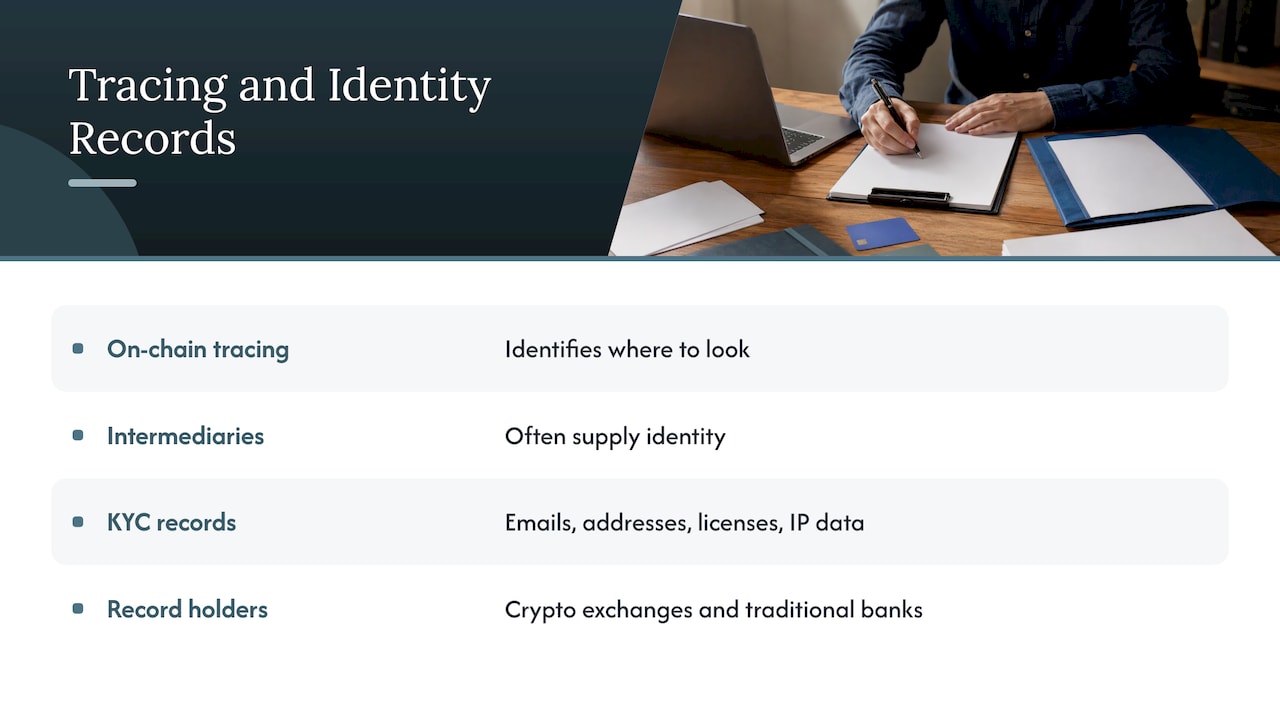
In the Bitfinex case, a professional write-up of the investigation describes prosecutors tracing stolen funds across blockchains, including through a darkweb marketplace. They then obtained disclosure information from intermediaries such as crypto exchanges and traditional banks. That information included KYC records like emails, home addresses, driver’s licenses, account-opening documents, and IP data.
The lesson for a victim is practical. On-chain tracing identifies where to look, and records held by regulated intermediaries often supply the identity. Lawyers can see how this works alongside traditional records in this guide on how to preserve evidence in fraud cases, which fits the way blockchain findings are combined with documents from financial institutions.
Documentation: a report someone else can verify
A forensic report is built to be read by a person who was not there. It records the starting transactions, the methods, each conclusion and the reasoning behind it, and a timeline. That reproducibility is what lets an attorney, bank fraud team, or investigator rely on it. See our guide to admitting blockchain evidence in U.S. court for how that works.
Where both methods hit limits
Honest forensics begins with what is hard.
- Obfuscation. A professional analysis of the Bitfinex case lists darkweb services, mixers, peel chains, and privacy coins as ways bad actors disguise trails. The overview mentioned earlier says mixers can weaken the link between source and destination funds.
- Pseudonymity. An academic paper on tracking stolen cryptocurrency points out that although blockchains are transparent, thieves can hide behind pseudonyms and transaction-obscuring techniques. It describes tainting analysis as one approach to following stolen coins.
- Tool quality. Academic work on forensically sound investigation notes that an untrustworthy or compromised query service can return inaccurate or incomplete results. This is why method and verification matter as much as the software.
- Ownership. The U.S. blockchain analysis presentation states that tracing does not necessarily identify a specific address owner. Off-chain information can identify some owners, and blockchain analysis may support a seizure warrant aimed at recovering fraud proceeds.
These limits apply to anyone doing this work. They are the reason a structured, documented process beats a quick look at an explorer: a trail that reaches an exchange can be acted on, and one that stops at a mixer still leaves useful evidence about what happened.
A worked example: the same scam, two approaches
Imagine a victim sends crypto to an “investment platform” and cannot withdraw. This example is illustrative, not a real case.
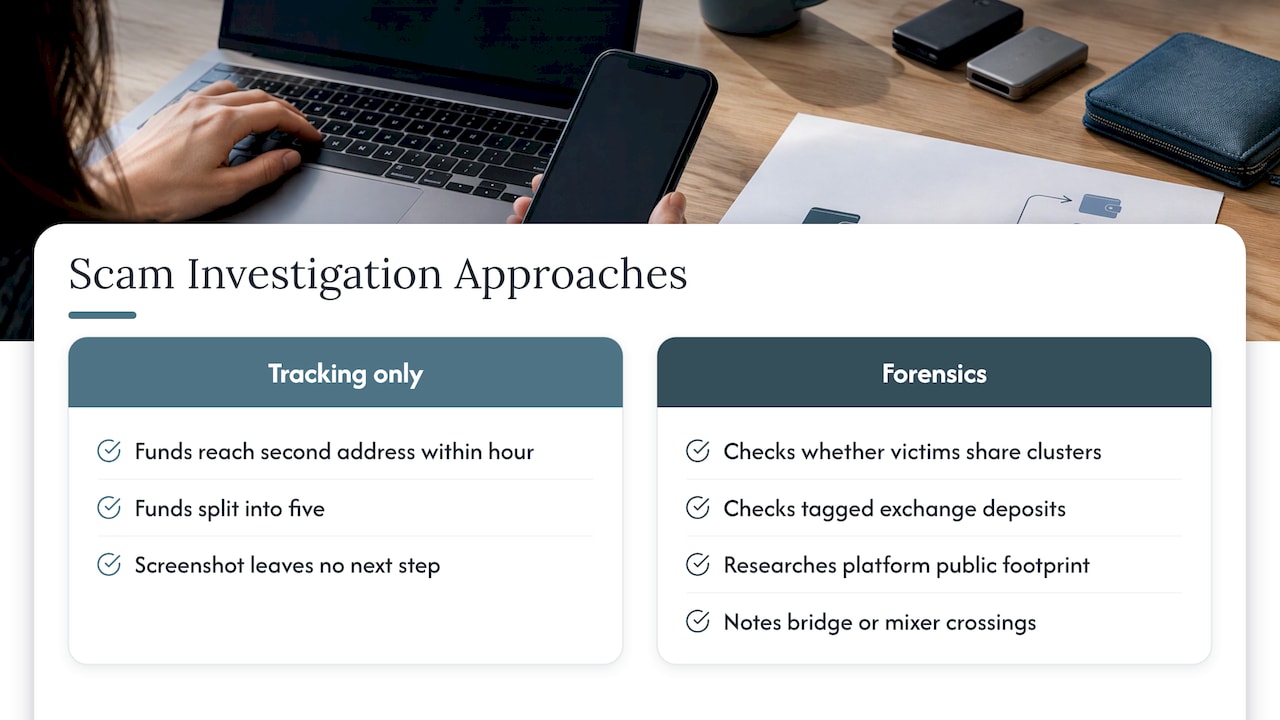
With tracking only. The victim pastes the receiving address into an explorer. They see the funds moved to a second address within an hour, then split into five. They screenshot the page and are left with a diagram and no next step.
With forensics. An analyst starts with the same address and also checks whether other victims’ payments reached the same clusters, which would suggest one operation. They look for tagged exchange deposit addresses along the way, research the platform’s domain and public footprint, and note where funds crossed a bridge or mixer. The result is a report with a timeline, the addresses of interest, the likely destination service, and a clear statement of what is proven and what is inferred. That report can go to a bank, to law enforcement, or to an attorney who can ask the right intermediary for records.
The second path is not a promise of recovery. It is a stronger base for every action that follows.
What to do in the first hours
Crypto transactions are generally irreversible. According to this victim-reporting guide, once funds go to an address you do not control they usually cannot be returned except in rare cases through law-enforcement action. So speed and documentation count.
- Stop sending money. The Ohio Attorney General advises victims to stop sending crypto, gather documentation, and protect their identity and financial accounts.
- Do not keep engaging the scammer. The reporting guide above also says never to share your seed phrase with anyone who claims they can recover your funds.
- Preserve evidence. Save screenshots, messages, transaction IDs, destination wallet addresses, timestamps, and a written timeline. The same guide says this documentation makes reports credible and actionable. The Ohio article adds website addresses, phone numbers, emails, and receipts or statements for the payment method.
- Report the scam to the relevant authorities, and consider your recovery options. Our 24-hour steps for stolen crypto walk through IC3 reporting and evidence preservation.
- Get the trail analyzed properly before it goes cold.
For deeper guidance on wallet-level checks, see our page on wallet activity analysis, and on how monitoring differs from a full case, transaction monitoring vs investigation.
How to choose between a quick check and a forensic investigation
A free explorer check is reasonable if you want to confirm a transaction landed or see whether funds are still sitting in one wallet. A forensic investigation fits when any of these is true:
- You lost a meaningful amount and want to pursue recovery or a formal complaint.
- Funds moved through multiple wallets, a bridge, a swap, or a mixer.
- An attorney, bank, or investigator asks for a written technical report.
- The scam involved a platform, such as Forex, online trading, or gambling, where more than one victim may be involved.
- You need your evidence preserved so it holds up later.
Questions to ask any provider: What data sources do you use beyond the blockchain? How do you document your methods? What will the final report contain? How do you describe confidence levels? Clear answers show a process built for real use.
Perspective
Most people come to us after they have already watched their funds move on an explorer. They know the destination address. What they lack is the next step.
We built our process around that gap. We analyze transaction patterns on public blockchains, connect wallet activity to wider fraud networks, and reconstruct complex flows, including through mixers and bridges. Then we write the findings into forensic reports intended for legal proceedings. We also work directly with law firms, because a report is only as good as its fit with the case it supports.
Our approach is victim-centered and transparent. We explain what we found, how we found it, and what the evidence can and cannot show. We believe that a trail that is properly documented, early, gives you the best base for any action that follows.
cristian
How Recovera can help
If your tracing has reached the point where you need more than an explorer, our team handles cryptocurrency scam investigation, OSINT attribution, and evidence preservation. We also support Forex, online trading, and gambling fraud cases. Law firms can look at our technical analysis and reporting services for professional offices. To see how our process works in more detail, read about blockchain forensics or cryptocurrency tracing.
FAQ
Is wallet tracking the same as blockchain forensics?
No. Wallet tracking follows transfers between addresses. Blockchain forensics includes tracing but adds clustering, attribution, off-chain research, and a documented report. Tracking tells you the path, and forensics tries to explain who is behind it and what can be shown.
Can blockchain forensics identify the owner of a wallet?
Not automatically. A U.S. government presentation says tracing does not necessarily identify an address owner, though off-chain information can identify some. Tagged addresses and records from intermediaries such as exchanges are what usually connect a wallet to a person.
Can I recover stolen crypto after a scam?
Recovery is never guaranteed. Transfers are generally irreversible, and returns usually happen only through law-enforcement action in rare cases, as this reporting guide explains. A forensic report helps you report accurately and gives lawyers and authorities something concrete to act on.
What if the scammer used a mixer?
Mixers weaken the link between source and destination funds, so the trail can become harder to follow. Analysts still examine the flows before and after the mixer, timing, and other connected activity. A good report states clearly which conclusions are firm and which are inferences.
What should I save before contacting an investigator?
Keep screenshots, chat logs, transaction IDs, destination addresses, timestamps, and a written timeline. The Ohio Attorney General also lists website addresses, phone numbers, emails, and payment receipts. Do not delete anything, even if it seems embarrassing.
Sources
- Using Blockchain Analysis From Investigation to Trial
- Leveraging Traditional Investigation Data Sources (Lexology)
- Reverse Engineering the Bitfinex Case
- BlockQuery: Toward forensically sound cryptocurrency investigation
- Cryptocurrency theft tracking paper (arXiv)
- How Law Enforcement Traces Cryptocurrency
- Report Fraud
- Cryptocurrency fraud: What to do after a financial loss (Ohio Attorney General)