Yes, cryptocurrency can be traced in a U.S. divorce, even when a spouse never mentions it. Tracing usually starts with bank and card records that show money moving to an exchange, continues with exchange records obtained through discovery, and ends with an analysis of the public blockchain that follows the coins from wallet to wallet. Done in that order, it produces evidence a family court can use to value and divide the asset.
This guide explains each step, what a tracing expert can and cannot establish, how the same methods apply in bankruptcy and other litigation, and how to choose help early enough to matter.
TL;DR
- Crypto is traceable. Blockchains are public, and the hard part is linking wallets to a person, which depends on exchange and bank records.
- A sound tracing starts with fiat on-ramp records (bank, card, wire), then exchange records, then on-chain analysis, in that sequence.
- Subpoenas to exchanges are often how the full picture is obtained, so your attorney needs to be involved early.
- Tracing results feed valuation, tax reconstruction and division. Each state’s rules decide how the asset is split.
- The same method applies in bankruptcy and other litigation, but the evidence must be assembled so a court will admit it.
Table of Contents
- Why crypto is easier to follow than most people think
- The tracing workflow, step by step
- Records and subpoenas: how identity gets established
- What on-chain tracing covers: mixers, bridges and self-custody
- From trace to division: valuation and state rules
- Crypto tracing in bankruptcy
- Using tracing evidence in litigation, and its limits
- Choosing help and what to bring
- FAQ
- Sources
Why crypto is easier to follow than most people think
A bank account is a closed ledger that only the bank and its customer can see. A public blockchain is the opposite: every transaction is recorded in the open. Greenspoon Marder’s family law group makes the point that blockchain transactions are transparent in their mechanics, but the identities behind them are not always obvious. A forensic professional can follow funds through multiple wallets, exchanges and entities even when ownership is disguised.
That gap between visible transactions and invisible owners is the whole job. Tracing closes it by connecting a wallet address to a real account, a device, or a bank transfer that the spouse made.
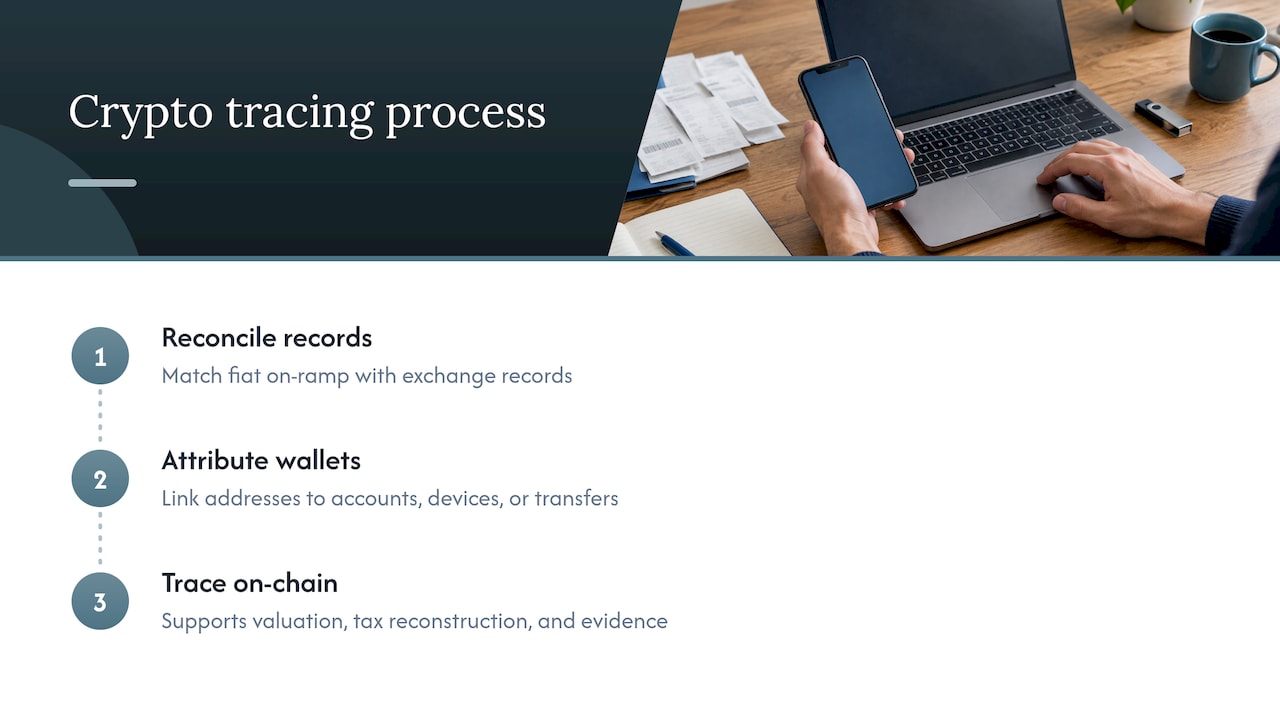
The American Bar Association’s family law materials describe the process as reconciling fiat on-ramp records with exchange records, attributing wallets and addresses, and then tracing activity on-chain. The results can support valuation and tax reconstruction in an admissible evidentiary package.
The tracing workflow, step by step
The ABA describes a defensible analysis as a sequential workflow that starts with fiat on-ramp records such as bank, card and wire activity to identify the first funding sources. Here is how that plays out in practice.
- Collect the fiat trail. Bank statements, credit card statements and wire records over the relevant period. Look for transfers to known exchanges, payment apps and brokers. Recurring round-number transfers, or transfers labeled with an exchange name, are common signs.
- Identify the exchange accounts. Once a transfer points to an exchange, the next target is the account itself: statements, identity (KYC) records, transaction exports and linked account information.
- Attribute wallets and addresses. Withdrawals from an exchange go to addresses. Linking those addresses to devices, IP information or other accounts tells you which wallets the spouse controls.
- Trace on-chain. With wallets identified, the analyst follows movement across self-custody wallets, bridges, decentralized exchanges and mixers where they appear.
- Package the findings. The conclusions become a report with supporting records, ready for valuation, settlement talks or trial.
Each step builds on the one before. If step 2 is weak, step 3 is a guess, and everything after inherits that weakness. This is why the order matters more than the software.
What you can do yourself before hiring anyone
Some of the earliest clues are in documents you already have access to:
- Joint bank and credit card statements showing payments to exchanges or crypto payment services.
- Tax returns and tax software files, which may reference digital asset activity.
- Emails from exchanges, such as account confirmations, withdrawal notices or tax forms.
- Phone apps, browser bookmarks and hardware devices that look like small USB drives.
- Handwritten lists of words, typically 12 or 24, which can be the seed phrase that recreates a wallet.
Block explorers help once you have an address. A practical divorce guide notes that tools such as Etherscan can show a wallet’s holdings and transaction history from its public address. That is useful for a first look. It does not tell you who owns the address, and it does not stop at the first hop where funds start moving through layers.
Do not log into a spouse’s accounts or guess passwords. Unauthorized access can create legal exposure of its own and may taint the evidence. Give what you find to your attorney instead.
Records and subpoenas: how identity gets established
The blockchain shows where the coins went. Exchanges know whose account they went through. That is why discovery matters so much.
Greenspoon Marder states that subpoenas are often the only way to uncover the full scope of cryptocurrency holdings, because exchanges keep records on account ownership, transaction histories and transfer data that can show when an account was opened and how funds moved. Your attorney decides what to request, from whom, and under which state’s procedures.
A few practical points:
- Name the right exchange. Bank and card records are what tell your lawyer which exchanges to subpoena. That is why the fiat trail comes first.
- Ask for the right data. Statements, KYC records, deposit and withdrawal histories, and the destination addresses of withdrawals are what let an analyst continue on-chain.
- Move early. If crypto is known, disclosed or not, the KSTM guide recommends that parties consider appointing a neutral cryptocurrency tracing expert and possibly an e-discovery or computer forensic expert early in the matter.
If your side receives a subpoena instead, deadlines are short. Our guide on what to do in the first 48 hours after a crypto exchange subpoena covers the first steps.
When the trail leaves the country
Sometimes a spouse moves funds to accounts or wallets outside the U.S. Other countries have their own reporting regimes, and those can leave a paper trail. Spain, for example, has its own foreign asset declaration, Model 720, which covers crypto held abroad. If a spouse has ties to Spain, your attorney may ask whether such filings exist. Cross-border questions are for a lawyer in the relevant country to answer.
What on-chain tracing covers: mixers, bridges and self-custody
Once wallets are identified, on-chain tracing can be performed across self-custody wallets, bridges, decentralized exchanges and mixers as applicable. That list matters because these are the usual tools for making a trail harder to read.
| Obstacle | What it does | What a tracing analyst looks at |
|---|---|---|
| Self-custody wallet | Holds coins outside any exchange | Funding source, withdrawal addresses, later movements |
| Bridge | Moves value between blockchains | Matching deposits and withdrawals across chains |
| Decentralized exchange | Swaps one token for another without an account | Swap transactions and the wallets on each side |
| Mixer | Pools funds to break the link between sender and receiver | Timing, amounts and patterns before and after the pool |
Blockchain analysis is a specialist field. The KSTM guide describes tracing as analyzing blockchain transactions, often requiring specialized software and technical understanding. For a closer look at how funds are followed through complex routes, see our walkthrough on tracing the flow of funds in crypto and our overview of blockchain forensics.
From trace to division: valuation and state rules
Finding the asset is the first half. The second half is putting a number on it and deciding who gets what, and that is governed by state law.
A Connecticut family law firm describes a three-stage analysis: decide whether a resource is property, determine its value, and distribute it equitably. It notes that crypto a person actually owns is an existing asset with an ascertainable market value, and that courts need valuation evidence before they divide it. Equitable distribution does not require splitting every asset in half. A court might assign the crypto to the spouse who controls it and award other assets to balance the result.
A Penn State Law Review article on equitable distribution and community property frameworks notes that courts weigh factors such as when the cryptocurrency was acquired, the source of funds, and whether its value grew during the marriage, along with each spouse’s contribution.
This is where tracing earns its cost. The same ABA materials say the results support valuation and tax reconstruction, including transaction date, venue, basis, income and character. Those details answer practical questions:
- Was the crypto bought before the marriage with separate funds, or during it with marital funds?
- Did marital money move into a wallet and later out again?
- What was it worth on the date that matters in your state?
Because prices move while a case sits, ask your attorney which valuation date your state uses and have the tracing report record dates and amounts precisely.
Crypto tracing in bankruptcy
The same toolkit applies when a debtor files for bankruptcy, with a different cast. Instead of a spouse’s lawyer, a trustee asks the questions.
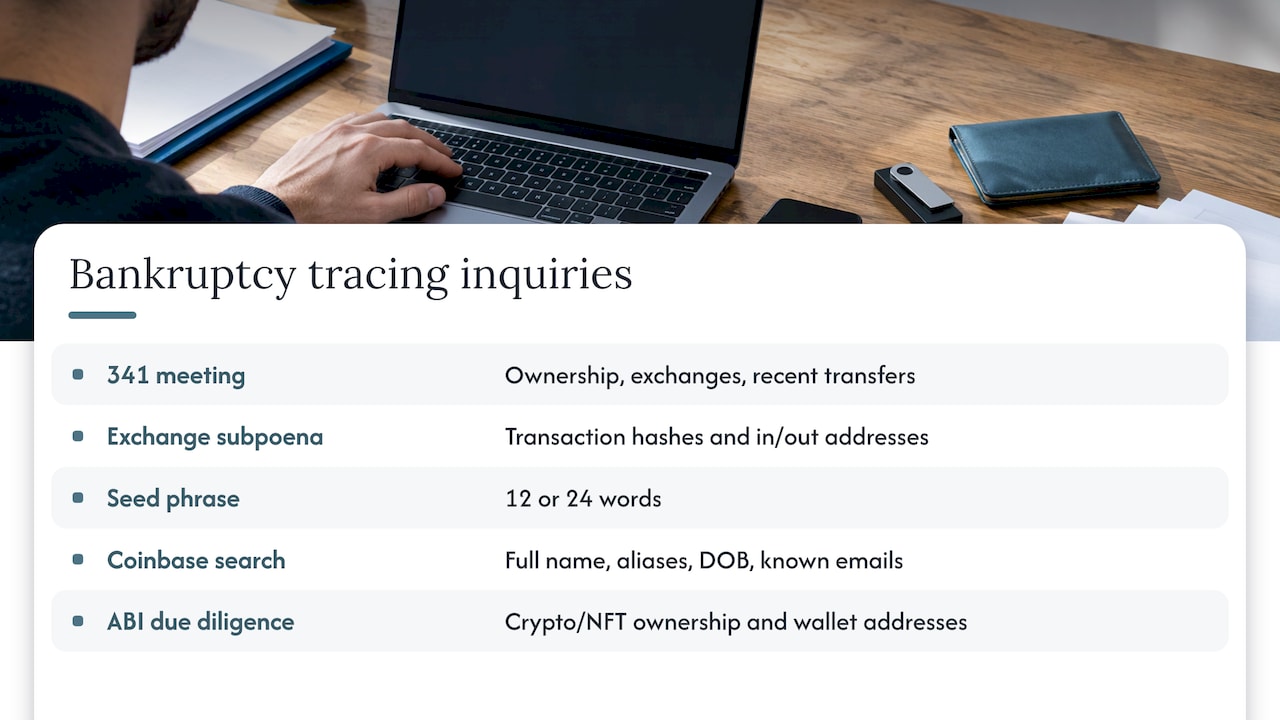
A bankruptcy guide says digital assets belong on the schedules, including Schedule A/B, and that trustees commonly ask at the 341 meeting about cryptocurrency ownership, exchanges used and recent transfers. Trustees may seek turnover of non-exempt assets, use Rule 2004 examinations, subpoena exchanges and use blockchain forensics tools to follow funds.
Official guidance points the same way. A bankruptcy administrator’s letter to trustees says that when material crypto activity may exist, they should consider requesting exchange statements by subpoena to get transaction hashes and the in and out addresses the debtor used. The same letter notes that wallets can be recreated from 12 or 24 word seed phrases, and that trustees should ask about hot and cold wallets and about passphrases that act as a 13th or 25th word.
Exchanges have built intake processes for this. Coinbase’s trustee guide says it can search for customer accounts and requires identifying details such as full legal name, aliases, date of birth and known email addresses.
For due diligence on a distressed company or person, the American Bankruptcy Institute advises asking whether the debtor owns or has owned crypto or NFTs, obtaining wallet and exchange addresses, and tracing across wallets. It adds that identifying all wallets and addresses is critical even if the debtor denies owning cryptocurrency.
If you are a creditor, a former spouse owed support, or counsel for either, the lesson is the same as in divorce: the denial is not the end of the inquiry. Records and the chain can contradict it.
Using tracing evidence in litigation, and its limits
A trace is only as useful as a court will let it be. The ABA says tracing conclusions should be assembled into an admissible package supported by custodian certifications, expert analysis, demonstratives and safeguards for sensitive wallet information, and that reliability depends on the records and attribution behind each step.
Expert testimony is judged under the federal Daubert standard and Rule 702 or the state equivalent. A Norton Rose Fulbright analysis explains that blockchain analytics testimony may be admitted when the proponent shows reliability and a reliable application of reliable methods to the facts. It also says the judge should, where possible, receive an estimate of the methodology’s error rate.
Two cautions follow from court-focused discussions:
- Some tools and techniques are sensitive or proprietary, which can complicate admission at trial. A Justice Department-era court filing on blockchain analysis suggests planning the role of the analysis from the outset.
- Where admissibility risk is high, the same discussion suggests treating analytics as leads and building the case on traditional evidence, such as exchange records and bank statements.
That is why a good report documents method, sources and each attribution link, so another expert can follow it. Our guides on what a usable report contains for law firms, wallet activity analysis for court, chain of custody for crypto evidence and admitting blockchain evidence in U.S. court go deeper on each piece.
Our perspective
Most divorce disputes about crypto are not really about technology. They are about proof. A spouse can say “I never owned any,” and the only answer that moves a judge is a record trail that is documented, dated and explained in plain language.
That is how we approach every engagement. We analyze transaction patterns on public blockchains, connect wallet activity to the accounts and networks behind it, and write the findings as a forensic report built for legal proceedings. We do not stop at basic wallet tracking. We reconstruct how assets moved, including through mixers and bridges, and we work directly with law firms so the report answers the questions the attorney will actually be asked.
We also believe the people on the other side of these cases deserve a process they can follow. You should know what was examined, what was found and how each conclusion was reached. We preserve evidence from the start, because a trace that cannot be defended later is worth very little.
cristian
Choosing help and what to bring
A tracing expert is most useful when engaged early and through counsel. Before you call anyone, gather:
- Bank, card and payment-app statements for the relevant years.
- Any exchange emails, tax forms or screenshots showing account names.
- Wallet addresses, transaction hashes or device descriptions you have found lawfully.
- A short timeline of when you suspect assets moved.
Preserve everything in its original form. Do not edit screenshots or rename files. Our guide on digital evidence preservation explains how to keep material admissible.
If you or your attorney need an independent technical analysis, we offer technical analysis of crypto fraud and court-ready technical reports for law firms and their clients, along with investigation and evidence preservation services for individuals. Pricing is set per engagement, so reach out through our site to discuss your matter.
FAQ
Can a spouse really hide crypto in a divorce?
Spouses can try, by using self-custody wallets, other people’s accounts or mixers. But the blockchain keeps a permanent record, and funding usually comes from a bank or card that leaves its own trail. Combined with subpoenaed exchange records, hidden holdings are often discoverable.
Who finds the crypto, my lawyer or a forensic expert?
Both, in sequence. Your attorney controls discovery and subpoenas. A tracing expert reads the records, attributes wallets and follows the funds on-chain. Guidance for divorce matters recommends considering an expert early, ideally before key depositions.
Is blockchain tracing evidence accepted in court?
It can be, when the expert shows a reliable method applied reliably to the facts of the case and the records behind it are properly certified. Courts have raised issues where tools are proprietary, so the report should rely on documented records at every step.
Does tracing work the same way in bankruptcy?
The method is the same: exchange records, wallet identification and on-chain analysis. The difference is who asks. Trustees use the 341 meeting, Rule 2004 examinations and subpoenas to exchanges, and debtors must list digital assets on their schedules.
What if the crypto was bought before the marriage?
That depends on your state’s rules on separate and marital property. Tracing documents the purchase date, the funding source and any later marital money added, which are the facts a court weighs. Your family law attorney can tell you how your state treats them.
Sources
- Following the Coins: Digital Asset Tracing and Division in Divorce (American Bar Association)
- A Practical Guide to Cryptocurrencies in Divorce Proceedings (KSTM Law)
- Cryptocurrency and Divorce: Why Transparency and Tracing Matter More Than Ever (Greenspoon Marder)
- Cryptocurrency and Other Digital Assets in a Connecticut Divorce (Turco Legal)
- Cryptocurrency, NFTs, and the Metaverse (Penn State Law Review)
- Cryptocurrency and Digital Assets in Bankruptcy (Observed)
- U.S. Bankruptcy Administrator guidance on cryptocurrency investigations, August 25, 2025
- Coinbase bankruptcy trustee guide
- Cryptocurrency, Blockchain and Bankruptcy (American Bankruptcy Institute)
- When blockchain analytics meet the Daubert test (Norton Rose Fulbright)
- Using Blockchain Analysis From Investigation to Trial
- Model 720 Spain foreign asset declaration guide