Wallet activity analysis is the structured review of an address’s balances, transfers, contract interactions, and timing to uncover fund flows, counterparties, and behavior patterns worth acting on. It turns a raw address into actionable intelligence: where money came from, where it went, and whether the pattern looks like normal trading or something that needs deeper scrutiny. The fastest first step is pasting the address into a block explorer or activity API and exporting the transaction hashes for your own record.
TL;DR:
- Record the exact chain and address, snapshot balances, classify transfers, map counterparties, and export hashes, block numbers, and raw data for reproducible records.
- On EVM chains, reexecute suspicious contract calls with a tracer because a successful main transaction can conceal failed internal transfers and nested activity.
- Define active days, profit and loss, and anomaly thresholds before comparing wallets, because providers calculate metrics differently and undocumented estimates cannot be reproduced reliably.
- After theft, preserve timestamped traces and chain snapshots immediately; the first 72 hours matter, and forensic investigators provide documented tracing, not guaranteed fund recovery.
Table of Contents
- Quick analyst checklist: exact fields to inspect first
- Technical methods: EVM tracing, UTXO behavior, clustering basics
- Key metrics and outputs analysts produce from wallet activity
- Use cases: trading signals, flow analysis, scams, and tax or forensic needs
- Applied forensic workflow: turning analysis into court-ready evidence
- Author perspective: DIY analysis limits and when to hire a specialist
- How Recovera Forensics helps: investigation, tracing, and court-ready reports
- FAQ
- Sources
Quick analyst checklist: exact fields to inspect first
Before drawing conclusions, run through a fixed sequence so you capture the same fields every time. Consistency here matters more than speed, especially if the findings might later support a dispute or a filing.
- Confirm the exact chain and public address, copied character for character.
- Snapshot current balances and token holdings at the time of review.
- Record first and last activity dates, active days, and total transaction count.
- Classify each transfer as inflow, outflow, swap, staking or vault action, or contract call.
- Map immediate counterparties and flag any address you can identify as an exchange or bridge.
- Export raw evidence, including transaction hashes, block numbers, and CSV or API dumps.
This mirrors the review sequence used in practical wallet-tracking guides, which emphasize classifying transfers and comparing timing and amounts across related addresses rather than reading balances in isolation.
Pro Tip: Save your export the moment you pull it. A screenshot taken a week later will not match the chain state if funds have already moved.
Technical methods: EVM tracing, UTXO behavior, clustering basics
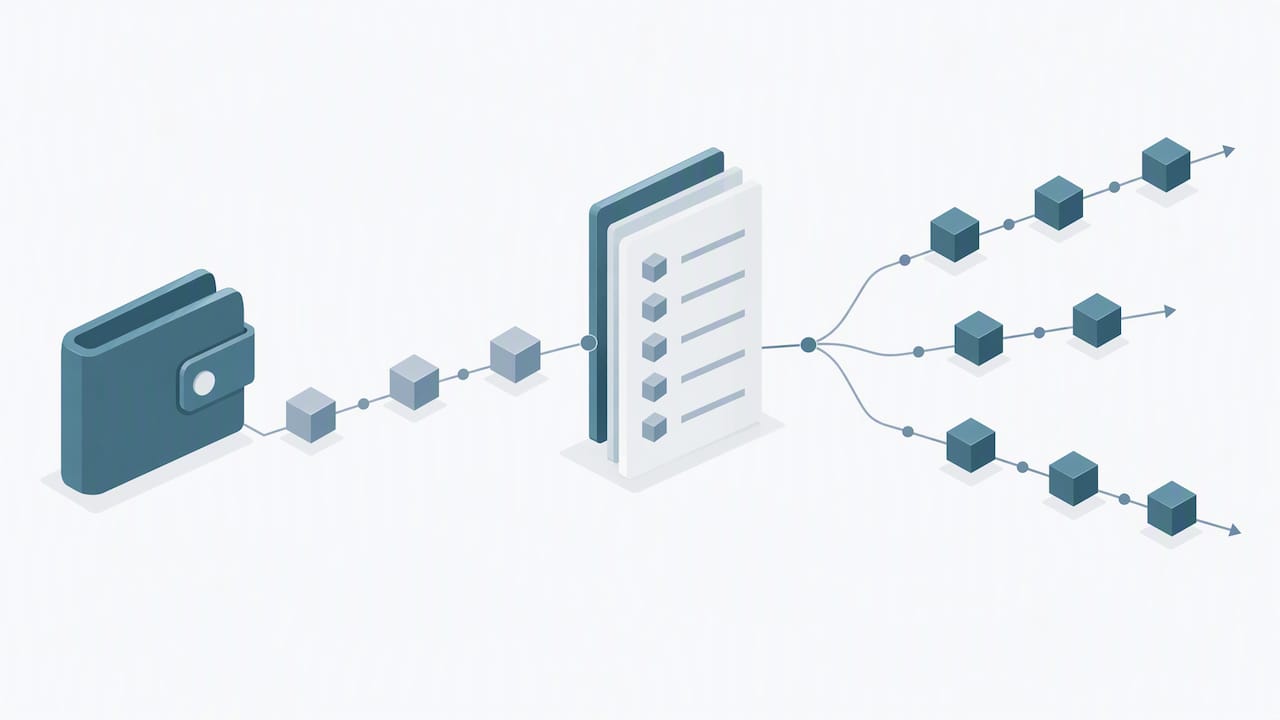
A top-level transaction row often hides more than it shows. On EVM chains, a contract call can trigger nested calls, internal transfers, and emitted events that never appear in a basic explorer listing. Re-executing the transaction with a tracer exposes what actually happened inside it.
- EVM tracing (callTracer, prestate and diff modes) reveals nested calls and state changes, as documented in Geth’s EVM tracing guide.
- UTXO mechanics on Bitcoin track spendable outputs rather than simple balances, and following change outputs gives a more accurate picture of where funds actually moved.
- Wallet clustering combines multiple weak signals, shared funding sources, timing patterns, repeated counterparties, into a confidence level rather than a certainty.
- Operational habit: re-run a trace when something looks off, capture the logs, and save pre and poststate snapshots whenever the node allows it.
A tracing success status alone can mask a failed internal transfer. Geth’s tracing documentation notes that a transaction marked successful can still contain nested effects invisible without re-execution, which is exactly why a single explorer row is never the full story.
Key metrics and outputs analysts produce from wallet activity
Raw transaction lists become useful once they are turned into defined, repeatable metrics.
- Activity summary: first and last activity, active days, transaction and swap counts, inflows and outflows measured over a chosen window.
- Fee and swap breakdowns: gas fees, platform fees, and swap counts, with inferred platform names where the data supports it.
- Holding and profit-or-loss approximations, always documented with the exact method used so the number can be reproduced later.
- Anomaly rules: sudden large outflows, concentration above a set threshold, or a bridge-to-exchange hop worth flagging.
Analyst documentation on wallet metrics warns that providers define terms like “active days” or “realized P&L” differently, which is why a reproducible definition matters more than the number itself when comparing a screenshot to a fresh export.
Use cases: trading signals, flow analysis, scams, and tax or forensic needs
The same checklist serves very different goals depending on what you are trying to accomplish.
- Trading signals: large inflows or outflows and clustered exchange deposits can precede price moves, making flow data a useful early signal.
- Market intelligence: watching concentration, liquidity shifts, and event-driven flows across related wallets.
- Scam investigation: tracing stolen funds through bridges and mixers toward their likely final destination.
- Tax and legal recordkeeping: the IRS requires taxpayers to report digital-asset transactions and retain records of purchases, sales, and fair-market values, which makes wallet-level documentation relevant well beyond the trade itself.
- Decision boundary: once stolen funds, legal exposure, or cross-chain complexity enter the picture, a forensic engagement becomes the more reliable path than a solo review.
Readers who find a suspicious wallet and need faster next steps can see our guidance for identifying scam wallets for a quick-turn approach.
Applied forensic workflow: turning analysis into court-ready evidence
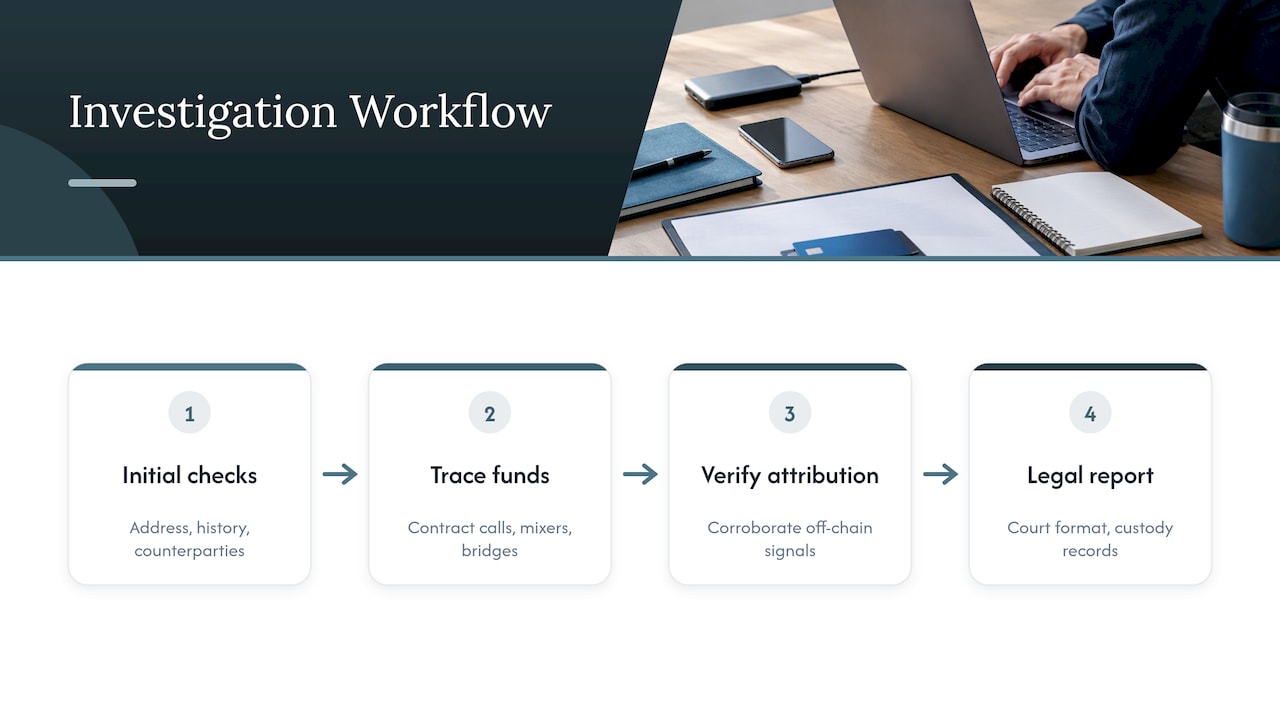
Once a case moves past casual review, we treat every wallet address as a piece of evidence first and a data point second. We preserve raw RPC and trace outputs, transaction hashes, and full chain snapshots before anything else, since a dashboard export loses its evidentiary value the moment the underlying chain state is no longer verifiable.
From there, we trace fund flows through intermediaries and bridges to identify likely exchange deposits, and we build attribution as a confidence-weighted conclusion, combining on-chain signals with off-chain corroboration rather than presenting a guess as certainty.
- Export and timestamp raw trace data, hashes, and block snapshots immediately.
- Trace flows through mixers, bridges, and intermediate wallets to their likely endpoint.
- Document chain-of-custody alongside the technical findings for legal use.
Our process is described in more detail in how we trace and prove crypto fraud.
Pro Tip: A report built for a courtroom needs chain-of-custody notes attached to every export, not just the final summary.
Author perspective: DIY analysis limits and when to hire a specialist
Traders can get real value from a quick wallet review: flow direction, counterparties, and anomaly flags are within reach using free tools. What a weekend review cannot reliably deliver is attribution tied to a real identity or recovery of moved funds, both of which depend on techniques and relationships a solo analyst rarely has. The first 72 hours after a theft matter more than any later step, since evidence and fund trails degrade fast once money crosses into mixers or new exchanges. Hiring a forensic investigator at that point buys documented rigor, not magic: expect a structured trace and a report, not a guaranteed return of funds.
— cristian
How Recovera Forensics helps: investigation, tracing, and court-ready reports
A quick wallet check tells you what happened. Turning that observation into something a court, a bank, or a law firm will act on takes a different kind of work, and that is where our engagements start. We handle cryptocurrency scam investigations, OSINT-based attribution, and preservation of digital evidence, reconstructing fund flows through mixers and bridges and tying them to a structured technical report rather than a loose collection of screenshots.
An engagement typically starts with the same checklist you would run yourself: confirming the address, pulling the transaction history, and flagging obvious counterparties. We take it further by re-tracing contract calls, corroborating attribution with off-chain signals, and formatting findings for legal use alongside chain-of-custody documentation. Law firms and professional offices needing ongoing technical support can review our services for professional offices.
If your review turned up a suspicious flow, a stolen balance, or a counterparty you cannot explain, reach out through our scam investigation services page to start a case review.
This article is general information, not a substitute for advice from a qualified financial advisor. Consult a qualified financial professional about your own circumstances before acting on anything here.
FAQ
Can you trace blockchain transactions?
Yes. Public blockchain transactions are recorded permanently and can be followed from address to address using explorers, tracing tools, or forensic methods. The Bitcoin Core documentation notes that while the chain itself is observable, addresses are pseudonymous, so tracing a flow is different from proving who controls it.
What are the top 3 crypto wallets?
There is no single ranked list we can confirm, since “top” depends on the criteria used (security, supported chains, or user base) and wallet popularity shifts over time. For wallet activity analysis specifically, what matters more than the wallet software is having the exact public address and chain to inspect.
How do I check my wallet funds?
Paste your public address into a block explorer for the relevant chain to see current balances, token holdings, and transaction history. For a fuller picture across multiple wallets, an activity API or portfolio tracker can aggregate balances and recent transfers in one view, as outlined in Mobula’s wallet tracking guide.
What is wallet tracking?
Wallet tracking is the ongoing monitoring of an address’s balances, transfers, and activity over time, often used to spot new transactions, swaps, or counterparties as they happen. It is the lighter, real-time counterpart to a full wallet activity analysis, which digs into historical patterns and relationships in more depth.
Sources
Different tools answer different questions, and picking the wrong one wastes time or produces a false sense of certainty.
Whichever tool you use, verify its claims against the raw transaction hash and contract address before relying on them. Dashboards aggregate data for convenience, but the chain itself is the only source of truth.