Online gambling crypto fraud happens when fake or manipulated betting platforms trick you into depositing cryptocurrency, then block withdrawals, rig outcomes, or disappear with your funds. The moment you suspect fraud, capture your transaction fingerprints: wallet addresses, transaction hashes, timestamps, and exact amounts. Recovery is possible in some cases, but it depends on fast evidence preservation and forensic tracing, not luck.
TL;DR:
- Before depositing, verify the license directly with the regulator, check domain age and complaints, and test a small deposit and withdrawal from a secondary wallet.
- Save addresses, transaction hashes, timestamps, amounts, screenshots, and messages immediately, then ask the sending exchange whether it can flag or freeze the funds.
- Report the case to IC3 and the FTC, then local police; include preserved transaction details and reference your IC3 case number in the police report.
- Recovery is not guaranteed; tracing works best when funds reach a cooperative regulated exchange where investigators can support a freeze request or legal action.
- Reject upfront recovery fees and never share seed phrases or private keys; fraudsters often target victims again after a gambling platform blocks withdrawals.
Table of Contents
- Quick Summary: Risk, Outcomes, and First Moves
- Common Scam Types Targeting Crypto Gamblers
- Why Criminals Favor Crypto and What It Means for Tracing
- How to Verify a Gambling Site Before You Deposit
- What to Do Immediately After You Get Scammed
- How Blockchain Forensic Investigations Actually Work
- What Victims and Investigators Should Prioritize
- How We Help After a Crypto Gambling Scam
- FAQ
- Sources
Quick Summary: Risk, Outcomes, and First Moves
Crypto payments are built to be final. Once a transaction confirms on the blockchain, cryptocurrency transfers cannot be reversed the way a credit card chargeback can undo a purchase. That single fact shapes everything about how you should react to a suspected scam.
Most crypto gambling fraud follows a few repeatable patterns: fake casino sites built to look legitimate, platforms that let you deposit but never withdraw, and phishing attempts aimed at your wallet credentials. The response that gives you the best odds of recovery is the same regardless of which pattern hit you.
- Record every wallet address, transaction hash, timestamp, and amount tied to the incident.
- Contact your exchange or custodial wallet provider immediately if funds passed through it.
- File a report with IC3 and the FTC, including the transaction details.
- Never pay anyone upfront who promises to recover your funds for a fee.
- Consider a professional forensic investigator when the loss is significant and funds moved through multiple wallets or exchanges.
Common Scam Types Targeting Crypto Gamblers
Fraud in online crypto gambling tends to fall into a handful of recognizable categories. Knowing the pattern before you deposit is far more useful than recognizing it after your funds are gone.
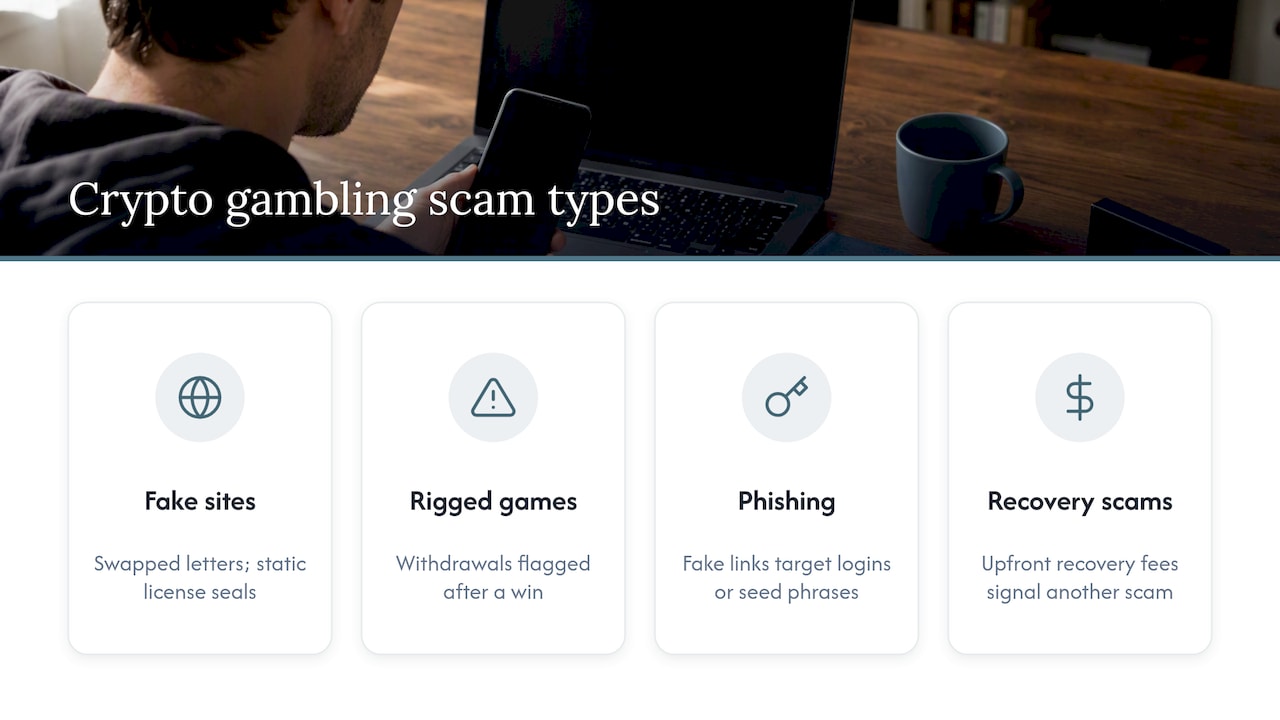
Fake and clone casino websites copy the branding, layout, and even the licensing seals of real platforms. Look closely at the domain: a single swapped letter, an unusual extension, or a URL that redirects through several pages before loading the site are all signs of domain spoofing. Trust badges and regulator logos on these pages are frequently static images with no working link back to an actual license lookup.
Rigged games and staged “provably fair” claims show you a verification algorithm that looks technical but cannot actually be checked independently. Warning signs include games that only turn unfavorable after you deposit larger amounts, withdrawal requests that get “flagged for review” right after a win, and support staff who cannot explain how the fairness algorithm works when asked directly.
Deposit-only casinos and vanish scams accept deposits smoothly but stall every withdrawal attempt. Early signals include a site that was registered only weeks earlier, live chat support that disappears once you request a payout, and sudden “maintenance” messages that coincide exactly with your withdrawal request.
Bonus-abuse rings and collusion involve groups of fraudsters opening multiple accounts to harvest welcome bonuses and promotional offers, often colluding at the same tables to drain promotional funds. This mostly affects operators financially, but it also signals a platform with weak identity controls, which raises your own risk as a depositor.
Phishing and account takeover use credential stuffing, fake SMS or email alerts about your “casino account,” and malware disguised as wallet tools or browser extensions. A message urging you to “verify your account” with a link that does not match the platform’s actual domain is almost always an attempt to steal your login or seed phrase.
Withdrawal traps and recovery scams often target the same victim twice. After a gambling platform blocks your withdrawal, a second party contacts you claiming they can recover your funds for an upfront fee. The FBI and consumer protection agencies warn that recovery services charging fees in advance are themselves a scam, since legitimate investigators and law enforcement do not ask for payment before any work begins.
Why Criminals Favor Crypto and What It Means for Tracing
Criminals gravitate toward crypto gambling fraud because of three properties: speed, pseudonymity, and finality. Once you send funds, there is no bank to call for a reversal, and cryptocurrency payments lack the chargeback protections built into traditional financial systems. Stolen funds often move fast through mixers, privacy pools, and cross-chain bridges designed to break the obvious link between a victim’s wallet and the final destination.
The upside is that public blockchains record every transaction permanently. That transparency is exactly what makes tracing possible, even when it is slow. Jurisdictional gaps and uncooperative exchanges remain the biggest obstacles, but they are not automatic dead ends. Coordinated law enforcement action has shown that tracing and seizure can succeed when investigators identify addresses early and work with exchanges to freeze funds, though the process typically runs through multiple intermediary addresses before reaching a compliant exchange willing to act.
How to Verify a Gambling Site Before You Deposit
A few minutes of checking before you deposit can save you from the entire ordeal. Before you fund any account, run through this sequence.
- Search the operator’s license number directly on the regulator’s own site rather than trusting a badge displayed on the casino’s homepage.
- Look up the site’s domain registration date; platforms registered within the last few months carry higher risk regardless of how polished they look.
- Send a small test deposit from a temporary or secondary wallet rather than your main holdings, and attempt a withdrawal before depositing anything larger.
- Search the platform’s name alongside terms like “withdrawal” or “complaint” to surface recent user reports.
- Check for consistent contact information: a real support email, a physical address, and responsive live chat that stays available after you ask about payouts.
If you ever reach the point of filing a complaint, basic on-chain literacy matters. A blockchain explorer lets you look up any wallet address and see its transaction history, which is how you start noting patterns such as a casino’s deposit wallet funneling funds toward a known exchange cluster.
Pro Tip: Screenshot every deposit confirmation, withdrawal request, and support chat the moment it happens; screenshots taken after an account is suspended are often impossible to recover.
What to Do Immediately After You Get Scammed
Acting in the first hours after a suspected scam matters more than almost anything else you do afterward.
- Preserve your transaction fingerprints: wallet addresses, transaction hashes, timestamps, and exact amounts for every transfer involved.
- Save screenshots of the platform, your account dashboard, withdrawal requests, and any chat or email communication with support.
- Contact the exchange or custodial wallet provider you sent funds from, and ask whether the receiving address can be flagged or frozen.
- File a report with IC3 and the FTC, including every transaction detail you preserved, even if you are unsure whether you qualify as a victim of a crime.
- Contact your local police department and file a report that references your case number from IC3.
A few additional points matter just as much as the sequence itself.
- Never pay an upfront fee to anyone who contacts you promising to recover your funds; this is one of the most common follow-up scams targeting people who already lost money.
- Avoid sharing your seed phrase or private keys with anyone claiming to need them to “trace” or “unlock” your funds.
- If your loss is substantial and the funds moved through several wallets or touched a known exchange, a professional investigator with legal options to recover stolen cryptocurrency and blockchain forensic tools becomes worth considering. Prepare your evidence folder, a clear timeline, and any KYC records tied to your accounts before that conversation.
For a structured checklist built specifically for this situation, our step-by-step evidence preservation guide walks through exactly what to gather in the first 24 hours.
How Blockchain Forensic Investigations Actually Work
A paid forensic investigation starts with intake and triage: investigators ask for your transaction fingerprints, any KYC records from exchanges you used, and a full communication log with the platform or scammer. From there, tracing follows the funds across addresses, flagging where they pass through a mixer or bridge, and identifying the points where they touch a regulated virtual asset service provider (VASP).
That last step matters most, because a VASP is where legal leverage becomes possible. Once funds are linked to an exchange account, investigators can support a freeze request, a civil forfeiture filing, or direct cooperation with law enforcement. Multi-million-dollar seizures by federal agencies show this process can work, though timelines vary widely and cross-jurisdictional movement or a noncooperative VASP remain the most common blockers. Success is never guaranteed, but a documented forensic trail is what turns a vague complaint into something a prosecutor or exchange compliance team can act on. For more on how tracing timelines typically unfold, see our overview of cryptocurrency tracing methods.
What Victims and Investigators Should Prioritize
Speed is the variable most victims underestimate. Waiting a week to report a scam because you are embarrassed or still hoping the platform will respond costs you the window when tracing is most likely to work. Investigators I’d point to care less about how the scam happened and more about whether your evidence is clean and your timeline is honest, gaps and all.
— cristian
How We Help After a Crypto Gambling Scam
We investigate stolen cryptocurrency from online gambling fraud by tracing transaction fingerprints across the blockchain and connecting wallet activity to exchanges that can be approached for freezes or compliance requests. Our reports are built for legal proceedings, so law firms and individual clients get documentation that holds up beyond a simple wallet lookup.
Before reaching out, gather your transaction hashes, wallet addresses, account details from the gambling platform, and any screenshots or chat logs you preserved. Our intake process reviews that evidence first to assess whether tracing is realistic given how far the funds have moved and whether they touched a cooperative exchange.
If you believe you have lost cryptocurrency to a fraudulent gambling platform, our cryptocurrency scam investigation services page outlines what we need from you and how the first triage conversation works.
This article is general information, not a substitute for advice from a qualified financial advisor. Consult a qualified financial professional about your own circumstances before acting on anything here.
FAQ
Can you get your money back if you get scammed on crypto?
Recovery is possible but not guaranteed, and it depends heavily on how quickly you preserve transaction details and whether the funds touched an exchange willing to cooperate. A forensic trace that links stolen funds to a regulated exchange gives you the strongest basis for a freeze request or legal action; our chargeback and recovery options guide covers the realistic paths available.
Can you go to jail for gambling fraud?
Operating a fraudulent gambling platform or knowingly facilitating crypto theft through one can carry criminal penalties, since this falls under fraud and theft statutes rather than simple gambling regulation. Whether charges apply, and to whom, depends on the specific conduct and jurisdiction, so this is a matter for law enforcement and legal counsel to determine case by case.
How can you tell if someone is a crypto scammer?
Common red flags include pressure to deposit more funds before a withdrawal clears, requests to pay fees or taxes in cryptocurrency before you can access your own money, and unwillingness to provide verifiable licensing or contact information. The FTC warns that a demand to pay or receive refunds in cryptocurrency is itself a strong signal of a scam, since legitimate businesses rarely require it.
What should I avoid doing after losing crypto to a gambling scam?
Avoid paying any upfront fee to a person or service that contacts you promising recovery, since legitimate investigators and law enforcement never charge in advance. Also avoid sharing your private keys or seed phrase with anyone, regardless of how convincing their claim to “help” sounds.
What information should I prepare before contacting a forensic investigator?
Bring your transaction fingerprints (wallet addresses, transaction hashes, timestamps, and amounts), any KYC records from exchanges involved, and a complete log of communications with the platform or scammer. Our step-by-step action guide breaks down exactly what documentation supports a stronger case.
Sources
- What to know about cryptocurrency scams | FTC
- Cryptocurrency investment fraud guidance | FBI
- Cryptocurrency guidance | IC3