Recovering funds after a rug pull is possible but uncommon, and your odds depend almost entirely on whether the stolen crypto ever landed on a centralized exchange before being cashed out. The single most urgent move is to stop, document everything (transaction hashes, wallet addresses, timestamps), and report it through official channels. Avoid anyone who asks for money upfront to “guarantee” recovery.
TL;DR:
- The success of recovering stolen funds hinges on whether the crypto landed on a centralized exchange before being laundered or cashed out, making timely reporting crucial.
- Investigators track token movement hop by hop, but funds moved through mixers or into unregulated offshore exchanges greatly diminish recovery chances.
- Reporting to the FBI, FTC, and directly contacting exchanges in the fund’s chain is essential, with detailed transaction data and communications to strengthen your case.
- Paid forensic investigations are recommended only if funds touched an exchange or the laundering trail is complex, and their reports can enhance legal efforts.
- Scammers posing as recovery experts often exploit victims’ desperation by asking for upfront fees or private keys; only law enforcement agencies handle cases without charging victims.
Table of Contents
- Immediate checklist: what to do in the first 24 to 72 hours
- How investigators trace stolen crypto and when recovery is feasible
- Who to notify: FBI, FTC, exchanges, and other agencies
- Exactly what to collect and how to preserve it
- Spotting and avoiding fake crypto recovery services
- Criminal enforcement vs civil suits: options, limits, and timelines
- When to hire paid forensics and what a professional report delivers
- Practical next steps and a short decision checklist
- A note from cristian on facing a rug pull
- Recovera Forensics: services and how to begin an engagement
- Official reporting links and key government guidance
- Sources
- FAQ
Immediate checklist: what to do in the first 24 to 72 hours
The hours right after you realize you’ve been rug pulled matter more than almost anything else you’ll do in this process. Funds move fast, and evidence disappears from your own memory faster than you think. Work through this in order.
- Export every transaction hash, wallet address, timestamp, and amount tied to the scam from your wallet and any block explorer you used.
- Screenshot and save all communications: Telegram or Discord chats, emails, the project’s website, the smart contract page, and any exchange deposit or withdrawal screens.
- Identify every exchange that appears anywhere in the fund’s path and contact their compliance or legal intake teams directly, sending transaction hashes and deposit timestamps so they can check for a hold.
- File a report with the Internet Crime Complaint Center and a complaint with the FTC, keeping the confirmation numbers for both.
- Do not respond to anyone, no matter how convincing, who promises guaranteed recovery or asks for a fee, gas money, or your private keys before doing any work.
A step-by-step action guide can help you keep this process organized if you’re doing it without professional help.
Pro Tip: Create a single folder (cloud and local) the moment you suspect a rug pull, and drop every screenshot, hash, and export into it before you do anything else. Trying to reconstruct this a week later rarely works.
How investigators trace stolen crypto and when recovery is feasible
Tracing stolen crypto is not guesswork. Investigators follow token movement on the blockchain the same way anyone can, using public block explorers, but they cross-reference wallet clusters, timing patterns, and known exchange deposit addresses to figure out where funds actually landed.
- Analysts follow the token’s path hop by hop, flagging any wallet that matches a known exchange’s deposit address pattern.
- Centralized exchanges are the pivot point for legal recovery because they hold identity information and can be compelled by subpoena or court order to freeze an account.
- Mixers, cross-chain bridges, and conversions into native assets without a clear issuer tend to end the trail at the protocol level, since there’s no custodian left to compel.
- Cashing out to fiat through an unregulated or offshore exchange also sharply reduces the odds, since compliance teams outside major regulatory reach may not respond to legal process.
This is why the same rug pull can be recoverable for one victim and a dead end for another: it usually comes down to where the money ended up, not how the theft happened. A subpoena or court order only works if there’s an exchange compliance team on the other end willing and legally required to act. Once funds are laundered through a mixer or swapped into a privacy-focused asset, there’s no compliance department left to serve papers to. Understanding how blockchain forensics traces and proves fraud helps you set realistic expectations before you spend money or time chasing a trail that’s already gone cold.
Who to notify: FBI, FTC, exchanges, and other agencies
Reporting is not just paperwork. It creates a paper trail that can support both freezes at exchanges and eventual restitution if enforcement action ever reaches the people behind the scam.
- File with the FBI Internet Crime Complaint Center, including transaction hashes, wallet addresses, timestamps, and any communications with the scammers.
- Report to the FTC and, if you’re in the United States, your state’s consumer protection office or attorney general, especially if the scam involved a website or entity claiming to operate locally.
- Contact the compliance or legal team at every exchange in the fund’s path directly, attaching hashes and deposit timestamps rather than a general description.
- Contact local police if you want a police report on file, which some exchanges and insurers require before they’ll act, and consider your state attorney general for larger losses or patterns affecting multiple victims.
A detailed walkthrough on filing an IC3 complaint in seven steps covers exactly what to include so investigators aren’t left chasing you for basic details later. None of these agencies charge a fee to take your report or investigate, and response times vary widely depending on case volume and whether funds are still traceable.
Exactly what to collect and how to preserve it
Investigators, exchanges, and courts all work from the same basic evidence set. The more complete and unaltered it is, the more useful it becomes.
- Blockchain data: every transaction hash, the block explorer URL for each transaction, full wallet addresses (not shortened versions), and exact timestamps.
- Communications: direct messages, emails, screenshots of the project’s website and smart contract page, and any purchase or deposit receipts.
- Payment trail: exchange account statements, bank statements, and wire receipts showing how you originally bought the crypto that was later stolen.
- Devices and accounts: preserve the phone or computer you used, export email headers as .eml files rather than just screenshots, and never factory reset a device tied to the case.
The FTC notes that contacting payment providers and financial institutions quickly is still worth doing even though crypto transactions themselves are typically irreversible, since linked bank or card payments may offer a separate avenue.
Pro Tip: Export email headers, not just the message body. A guide on saving .eml files walks through the process, and that header data can be what actually ties a scammer’s account to a real identity.
Spotting and avoiding fake crypto recovery services
Losing crypto once is bad enough. A second wave of scammers specifically targets rug pull victims, posing as recovery experts or law firms.
- Any service that guarantees recovery, asks for an upfront fee, or requests your private keys or seed phrase is not legitimate.
- Pressure tactics, such as claiming a narrow window to act or that a “government fund” will reimburse you for a fee, are common manipulation techniques.
- Ask for verifiable court documents, check for a real professional footprint and references, and never send private keys to anyone under any circumstance.
- Law enforcement agencies never charge victims to investigate or recover stolen funds.
Victims of cryptocurrency recovery scams reported losing over $9.9 million to firms falsely promising to recover stolen crypto between February 2023 and February 2024. (IC3). The pattern is consistent: these firms exploit the panic and urgency victims feel right after a rug pull, offering false hope for a fee they never intended to earn.
Criminal enforcement vs civil suits: options, limits, and timelines
Two separate legal tracks exist after a rug pull, and they move at very different speeds with very different odds.
- Federal enforcement through agencies like the SEC or DOJ may intervene when a rug pull is large enough or fits a pattern of fraud, sometimes resulting in restitution to victims years later through a formal compensation process.
- Civil litigation lets a victim or group of victims subpoena exchanges directly and seek asset restraints, but it typically requires retaining counsel and can take months to years, with costs that scale with case complexity.
- Bankruptcy proceedings or settlement funds tied to enforcement actions sometimes produce partial distributions to victims, though these processes commonly stretch over several years rather than months.
- A court-ready forensic report that maps stolen funds to specific exchange deposits materially strengthens a subpoena or civil filing, giving a judge or exchange compliance team something concrete to act on.
Private recovery firms cannot issue seizure orders on their own. Only a court or a cooperating exchange, acting under legal process, can actually freeze or return funds, which is why IC3’s cryptocurrency reporting frames civil litigation and enforcement action as the realistic paths to partial restitution rather than quick fixes.
When to hire paid forensics and what a professional report delivers
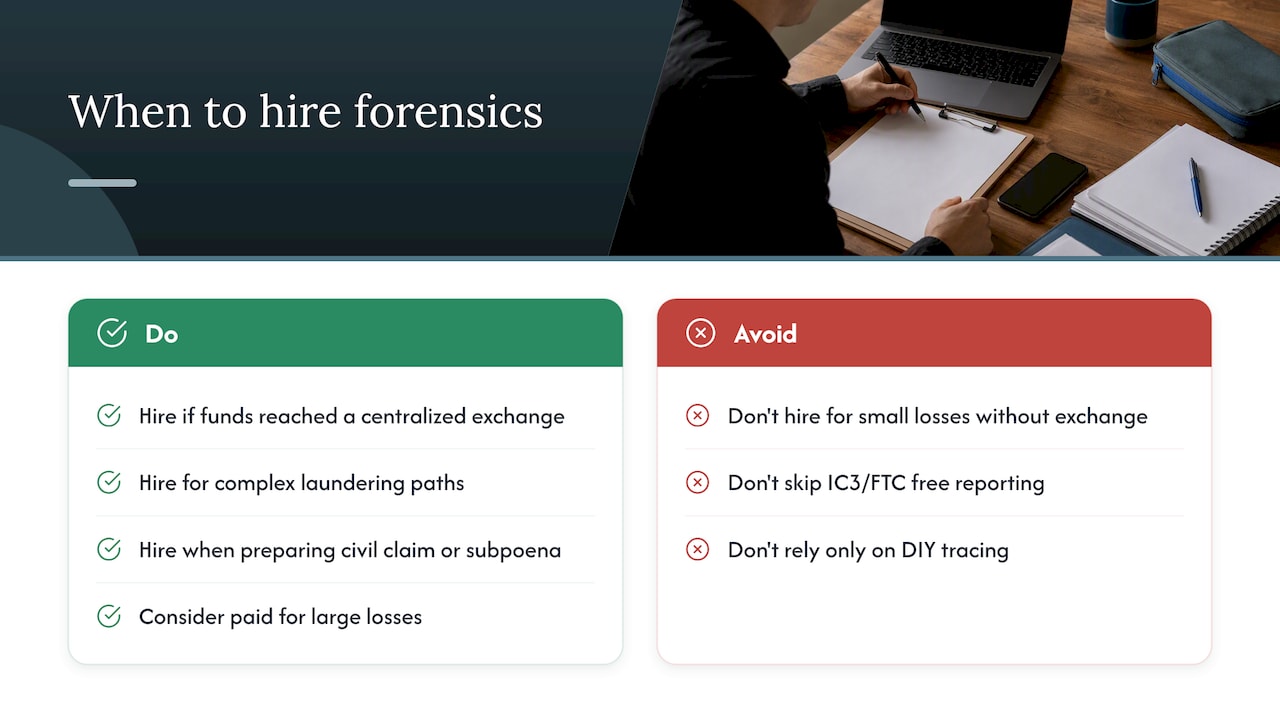
Paid forensic investigation makes the most sense in a specific scenario: you have reason to believe the stolen funds touched a centralized exchange, or the laundering path is complex enough (multiple hops, bridges, mixed with other stolen funds) that tracing it yourself would take specialized tools and time you don’t have.
A specialized forensic investigation service traces stolen cryptocurrency by analyzing transaction patterns on public blockchains and connecting wallet activity to fraud networks, producing forensic reports built to hold up in legal proceedings. A typical engagement produces a transaction map showing the full fund flow, documented exchange deposit evidence, and chain of custody documentation formatted for use in U.S. court filings or subpoena support.
A court-ready forensic report that maps funds to exchange deposits materially increases the chance an exchange will act on legal process and improves civil subpoena outcomes.
Paid forensics tends to justify its cost when self-directed tracing hits a wall, when you’re preparing to work with an attorney on a civil claim, or when the amount lost makes a professional, documented trail worth the investment. For smaller losses with no exchange contact in the trail, free reporting through IC3 and the FTC may be the more proportionate first step before spending on an investigation.
Practical next steps and a short decision checklist
Most victims benefit from a simple three-step decision flow rather than trying to do everything at once.
First, report and preserve: file with IC3 and the FTC, and lock down every hash, address, and communication before memory or access fades. Second, check whether the funds ever touched a centralized exchange; this single fact determines whether legal or forensic action has real teeth. Third, if funds did hit an exchange or the trail is genuinely complex, consider paid forensics rather than trying to reconstruct a multi-hop laundering path on your own.
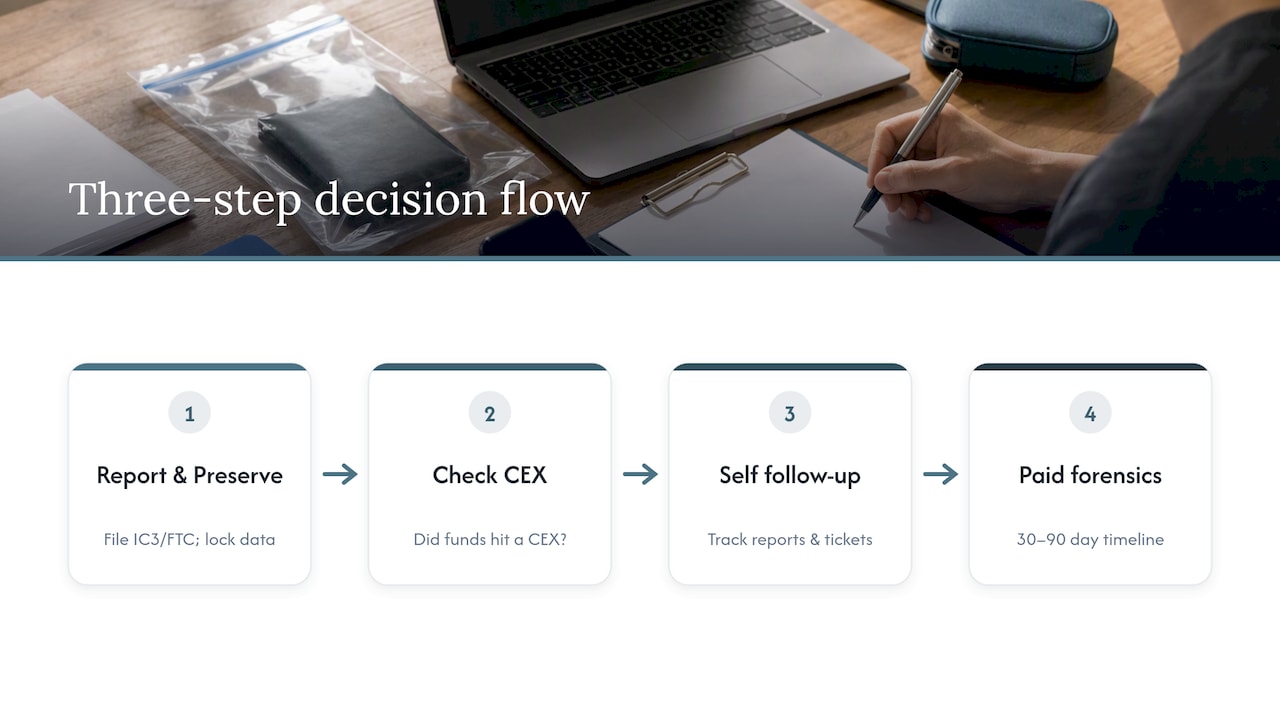
If you engage a forensic investigation, expect the working timeline to run over 30 to 90 days depending on the complexity of the fund flow and how quickly exchanges respond to inquiries. Track every report number, exchange ticket, and email thread in one place so you can follow up without starting from scratch each time.
A note from cristian on facing a rug pull
Losing money to a rug pull is not a failure of judgment you should carry alone. Scammers built these schemes to look convincing, and plenty of careful people have fallen for one. What matters now is speed: preserve your evidence today, file your reports this week, and treat any unsolicited offer of guaranteed recovery for a fee as a second scam in progress, not a lifeline.
— cristian
Recovera Forensics: services and how to begin an engagement
If your case looks like it involves an exchange somewhere in the fund’s path, or a laundering trail too tangled to trace on your own, a documented forensic investigation turns a frustrating guessing game into a paper trail someone can actually act on. They build transaction maps and evidence reports designed to hold up with exchange compliance teams, attorneys, and courts, rather than a basic wallet lookup that stops at the first hop.
Before reaching out, it helps to gather your documents using the checklist for a court-ready crypto report, which covers exactly what investigators need to start work without back-and-forth delays. Intake typically starts with a review of your transaction history and communications to assess whether the funds are traceable to an exchange or another accountable party.
You can start that process on the cryptocurrency scam investigation services page, where you can outline your case and find out what a forensic engagement would involve for your situation.
Official reporting links and key government guidance
Two reports form the backbone of any recovery effort, and both are free to file.
- The FBI’s Internet Crime Complaint Center is the primary channel for reporting crypto theft, and complete transaction details make your report far more useful to investigators aggregating cases against the same scam network.
- The FTC’s consumer guidance on what to do after being scammed outlines steps for contacting payment providers and preserving your consumer rights.
- IC3’s public service announcements repeatedly warn about fake recovery firms, so checking recent PSAs on recovery scams before hiring anyone is a smart habit.
This article is general information, not a substitute for advice from a qualified financial advisor. Consult a qualified financial professional about your own circumstances before acting on anything here.
Sources
- Internet Crime Complaint Center (IC3) | Fictitious Law Firms Targeting Cryptocurrency Scam Victims Offering to Recover Funds
- FBI Guidance for Cryptocurrency Scam Victims
- FTC: What to do if you were scammed
FAQ
Can you recover from a rug pull?
Recovery is possible but not guaranteed, and it depends heavily on whether the stolen funds reached a centralized exchange before being cashed out or laundered through a mixer. Reporting quickly to IC3 and preserving your transaction data gives you the best realistic chance.
Is rug pulling illegal in the United States?
Rug pulls typically involve fraud, and depending on the facts, they can trigger securities law violations or wire fraud charges that federal agencies like the SEC or DOJ can pursue. Whether a specific case is prosecuted depends on jurisdiction, the amount involved, and whether the perpetrators can be identified, so victims should still file a report regardless of the legal outcome.
How do people get away with rug pulling?
Scammers typically move stolen funds through mixers, cross-chain bridges, or convert them into assets with no clear issuer, which breaks the chain that would otherwise let investigators or exchanges freeze the funds. Anonymous wallet creation and operating from jurisdictions with limited enforcement cooperation also make attribution difficult.
What are the consequences of rug pulling?
When identified and prosecuted, people behind rug pulls can face criminal charges including fraud and, in some cases, securities violations, along with civil suits from victims seeking restitution. In practice, consequences depend on whether law enforcement can identify the individuals and whether enough evidence exists to support charges or a civil claim.
How can I avoid falling for a rug pull again?
Research a project’s team, smart contract audit history, and liquidity lock terms before investing, and treat anonymous teams or unaudited contracts as a serious warning sign. Diversifying across established platforms and avoiding projects that pressure quick investment decisions also reduces your exposure to future scams.