A paid blockchain forensic investigation traces stolen funds, preserves legal evidence, and produces a court ready report that makes seizure, forfeiture, remission, or civil recovery feasible when centralized cash out points exist. Immutable blockchain records alone rarely reverse a theft. Recovery usually depends on finding an exchange, custodial wallet, or other identifiable endpoint where the thief converted crypto to cash.
TL;DR:
- Blockchain forensic investigations produce detailed transaction maps and cluster analyses that link stolen funds to identifiable endpoints like exchanges or custodial wallets.
- Ensuring evidence preservation follows strict technical standards, such as hashing and custody logs, is crucial for admissibility in legal proceedings.
- Tracing tactics include following mixers, chain hopping, and micro transactions, but funds moving entirely through offshore services may leave no recoverable trail.
- Legal recovery depends on connecting thefts to known cash-out points, with public cases showing seizure success when links are established through subpoenas or warrants.
- Most investigation costs reflect complexity, with faster results possible if victims act within the first 72 hours and gather comprehensive documentation beforehand.
Table of Contents
- What a paid blockchain forensic investigation actually delivers
- Preserving crypto evidence so it holds up in court
- How investigators actually trace stolen crypto
- Turning a forensic report into a legal recovery path
- What timelines and costs actually look like
- Choosing a blockchain forensic provider without getting burned twice
- When forensic tracing led to real recovery
- Why rigor matters more than speed in this work
- Get a paid forensic investigation started with Recovera Forensics
- Where to verify the legal and technical standards
- Sources
- FAQ
What a paid blockchain forensic investigation actually delivers
Clients pay for a defined set of outputs, not a vague promise of recovered money. A competent engagement produces a transaction flow map, cluster analysis that groups related addresses, a timeline reconstruction of when funds moved, and preserved evidence exports paired with hashes that prove nothing was altered after collection. Most engagements end with an expert affidavit or technical report written for legal professionals such as judges, prosecutors, or opposing counsel rather than for a general audience.
That report usually lands in one of two categories. “Traceable” findings show exactly where funds went, including a named exchange or custodial wallet subject to know your customer rules. “Attributable only” findings show a pattern or cluster of likely control by one actor but stop short of a named endpoint. The difference matters enormously to a prosecutor deciding whether a subpoena is worth issuing.
- Transaction flow maps show every hop the stolen funds took across wallets and services.
- Cluster analysis groups addresses likely controlled by the same actor using shared spending patterns.
- Preserved exports and hashes protect the evidence chain so a court can trust the report later.
- Expert reports or affidavits translate the technical findings into a form usable in litigation or law enforcement referrals.
A federal forfeiture opinion out of the D.D.C. shows how this works in practice: analysts linked on chain flows to custodial exchange accounts, which led to subpoenas that identified the users behind the wallets. That link between blockchain data and a real identity is what turns a theft report into a prosecutable case.
Preserving crypto evidence so it holds up in court
Evidence collected casually rarely survives a challenge to its admissibility. The moment a theft is discovered, every wallet address, transaction ID, and screenshot needs to be captured in a way that can be defended later, not just described in an email.
NIST IR 8387 lays out the baseline: hash evidence at the moment of collection using an approved algorithm, store those hashes separately from the evidence itself, and log every person who touches the file afterward. That guidance treats digital evidence preservation as a discipline with specific, checkable steps rather than a best effort exercise.
- Hash every exported file at collection using a current NIST approved algorithm, and store the hash value in a separate record from the file itself.
- Log every transfer of custody, including who handled the file, when, and where it was stored.
- When funds sit in an exchange account or a seized wallet, use formal legal process such as a subpoena or warrant rather than informal requests, and ask for certified export formats or custodial certifications that satisfy Federal Rules of Evidence 901 or 902 where possible.
- Keep a record for each piece of evidence that includes a unique ID, a timestamp, the handler’s name, the storage location, and a tamper log.
Pro Tip: Never move or “test” suspicious funds yourself. Any transaction you initiate becomes part of the chain investigators have to explain later.
How investigators actually trace stolen crypto
Tracing follows a workflow, not a single lookup. Investigators triage the case first, checking wallet addresses and transaction hashes to confirm the theft pattern. From there they map the flow of funds across wallets, cluster addresses likely under common control, and reconstruct a timeline that shows how quickly the thief moved assets. The goal at every stage is to find a point where the trail touches a know your customer exchange or another identifiable service, then layer in open source intelligence to connect that account to a real person before writing the report.
- Mixers and tumblers blend stolen funds with other users’ coins to break the direct link between sender and receiver.
- Privacy coins obscure transaction details at the protocol level, which limits what public blockchain analysis alone can show.
- Chain hopping moves value across different blockchains through swaps or bridges, forcing investigators to follow the trail across separate ledgers.
- Rapid micro transactions split large sums into many small transfers to complicate clustering and slow manual review.
Each tactic raises cost and time rather than making tracing impossible outright. Investigators mitigate mixer use by watching for known mixer addresses and timing correlations, and they handle chain hopping by tracking bridge contracts and swap records across chains. The hard limit shows up when funds move entirely through noncooperative offshore services or cash out through peer to peer channels that never touch a regulated exchange. In those cases, the trail can go cold even with sound methodology, because there is no custodial record left to subpoena.
Turning a forensic report into a legal recovery path
A technical report only matters if it plugs into an actual legal mechanism. In the U.S., that usually means one of three routes: a criminal referral that leads to government seizure and forfeiture, a civil suit against the identified actor, or discovery requests to exchanges holding relevant account records.
Remission is the path many victims overlook. Under 28 C.F.R. Part 9, the Department of Justice can compensate victims from assets the government has already forfeited, but the process is discretionary and requires proof of direct pecuniary loss along with a showing that the victim has no other recourse and did not knowingly contribute to the offense.
- A forensic report identifies specific property and cash out points, which supports the seizure warrants that make forfeiture possible in the first place.
- The same report becomes an exhibit in civil litigation and can support discovery requests aimed at exchanges that hold identifying account data.
- Without a documented chain of conduct connecting the theft to a specific wallet or account, remission and civil claims both become far harder to support.
What timelines and costs actually look like
Expect triage within days once a provider has wallet addresses and transaction hashes. A shallow trace to a first identifiable endpoint typically takes one to three weeks. A deep investigation involving mixers, multiple chains, or dozens of hops can run weeks to months, and cost scales with that complexity.
Cost depends on factors such as transaction volume, the complexity of wallet transfers, use of mixers or cross chain bridges, the extent of open source intelligence needed to identify individuals, and whether expert affidavit or litigation support is included.
- Preserve every scam related email in its original .eml format rather than a screenshot or forwarded copy.
- Save all exchange correspondence, including support tickets and any KYC confirmations you received.
- Record every wallet address involved, including your own, before you interact with them again.
- Do not move, spend, or “test” any suspicious funds still in your control.
- Contact counsel early about preservation subpoenas, since exchanges can purge account data on standard retention schedules.
Pro Tip: Speed matters most in the first 72 hours. Exchange logs and IP records tied to a cash out account are far more likely to still exist if you act before that window closes.
Choosing a blockchain forensic provider without getting burned twice
Ask any provider to show a sample report excerpt and a plain language description of their methodology before you sign anything. A firm that cannot explain how it clusters addresses or handles mixer activity is not going to hold up well under cross examination later.
Require specific deliverables in writing: preserved export files, hash logs stored separately from those files, a written methodology section, and a willingness to testify or produce an affidavit that can survive a Rule 702 admissibility challenge, since courts weigh whether an expert’s methods are documented and reproducible rather than whether the expert holds a particular degree.
- Red flag: raw CSV exports with no clustering, attribution, or methodology write up attached.
- Red flag: refusal to explain how mixer transactions or chain hopping were handled in the analysis.
- Red flag: no documented chain of custody procedure for evidence handling.
- Red flag: vague engagement terms with no defined deliverables or timeline.
A forensic report that lists transactions without attribution or a documented methodology is often insufficient for legal recovery, since attribution and a defensible conduct chain are what persuade judges and prosecutors to act on the findings.
When forensic tracing led to real recovery
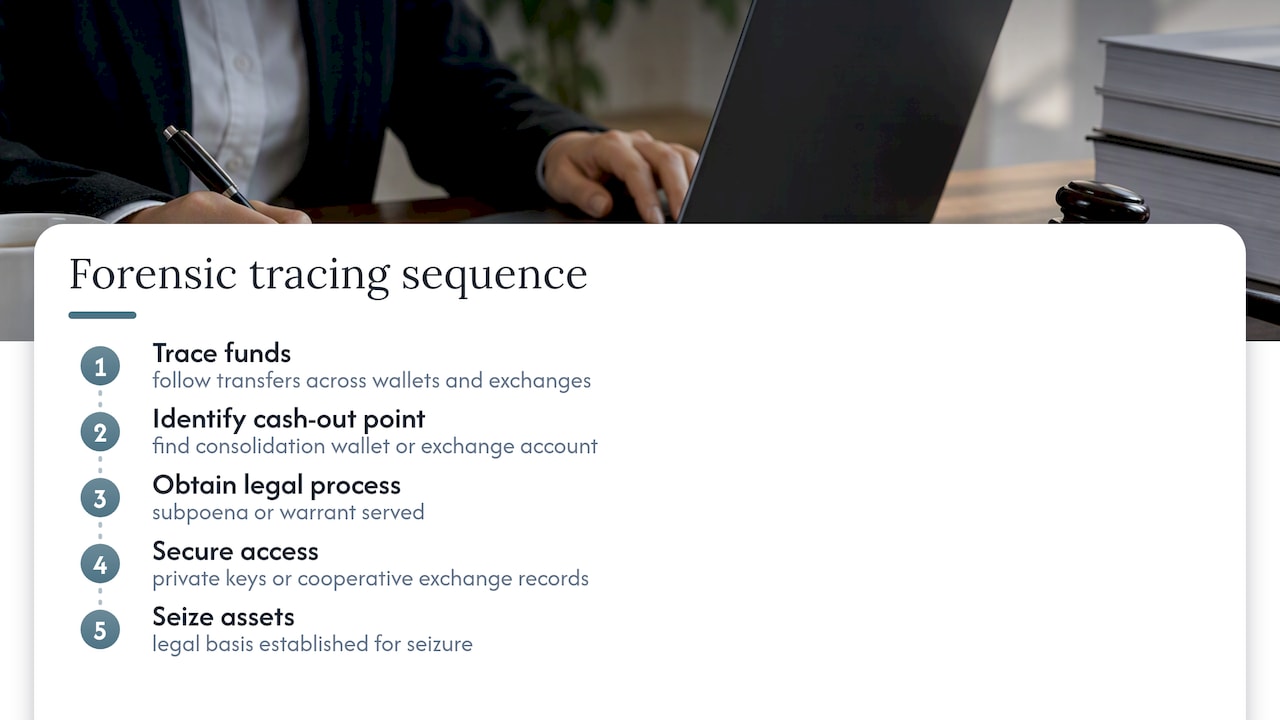
The clearest public examples of forensic tracing paying off come from federal cases rather than individual bank refunds. DOJ case materials describe stolen funds traced through multiple wallets and exchanges, with law enforcement obtaining seizure once they secured private keys or cooperative exchange records. The pattern in these cases is consistent: tracing identified a consolidation wallet or exchange account, a subpoena or warrant followed, and the government then had a legal basis to seize the assets.
A larger scale example comes from the Helix mixer case, where IRS Criminal Investigation and the Department of Justice obtained legal title to roughly $400 million in assets tied to the platform in early 2026, after tracing work connected mixed funds back to identifiable accounts. These outcomes did not happen because a bank issued a refund. They happened because tracing produced a defensible link between stolen funds and a seizable asset, which is the same mechanism an individual victim’s forensic report is built to support on a smaller scale. The lesson for an individual case is the same: recovery follows identification of a cash out point, not the mere existence of a blockchain record.
Why rigor matters more than speed in this work
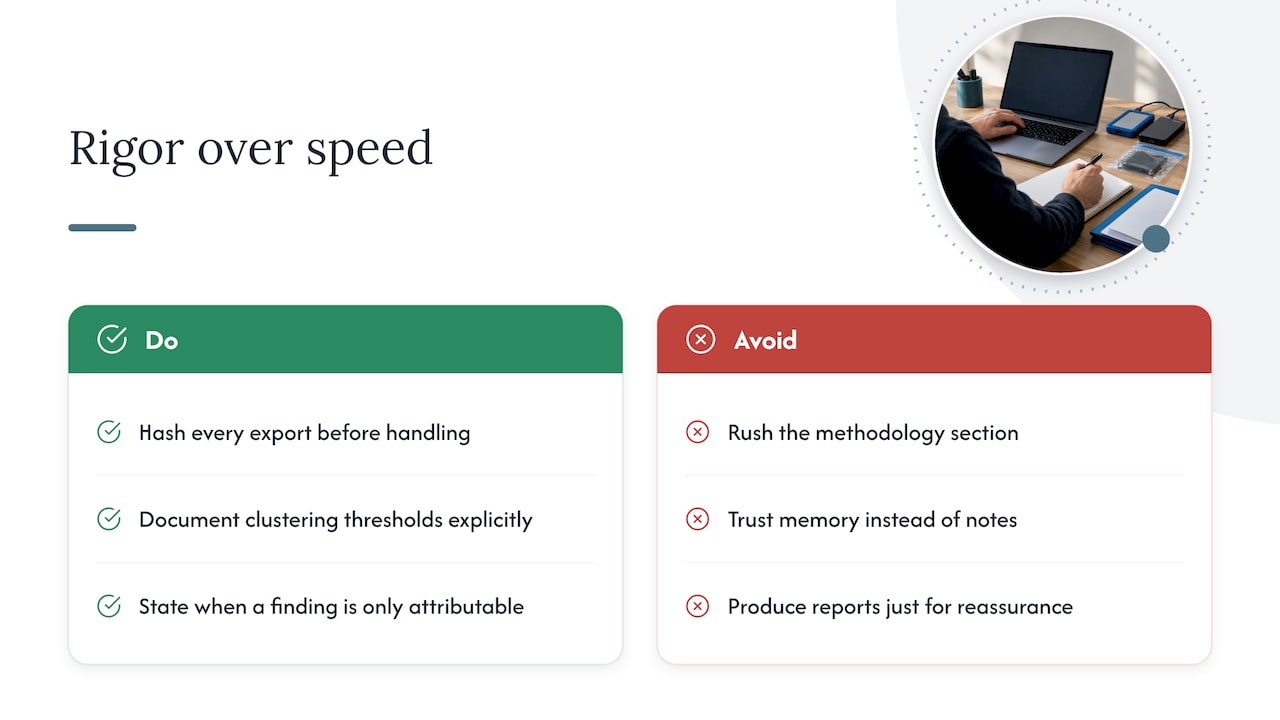
Victims want their case moved fast, and that instinct is reasonable given how quickly exchanges purge logs. But a report rushed past its methodology section is a report a defense attorney will dismantle in an afternoon. The work that actually holds up in front of a judge is slow in the right places: hashing every export before anyone touches it, writing down the clustering thresholds instead of trusting memory, and being honest when a finding is attributable only rather than fully traceable.
Recovera Forensics builds its process around that discipline, using detailed transaction pattern analysis to trace lost assets and produce reports built for legal proceedings rather than for reassurance alone. That distinction between a persuasive narrative and a defensible record is where most recovery attempts succeed or fail.
— cristian
Get a paid forensic investigation started with Recovera Forensics
Recovera Forensics runs paid blockchain forensic investigations built around tracing, attribution, evidence preservation, and court ready reporting, with services covering cryptocurrency scam investigation, OSINT work, and evidence preservation for individual victims, plus technical analysis and litigation support for law firms handling client cases.
Before reaching out, gather your original scam emails in .eml format, any exchange correspondence, every wallet address involved, and your bank records covering the transaction dates. That documentation lets a first triage call move quickly instead of starting from scratch. Start that process on the recovery services page to see what a paid engagement covers for your situation.
Where to verify the legal and technical standards
For readers who want the primary documents rather than a summary: the DOJ remission FAQ explains eligibility under 28 C.F.R. Part 9, the D.D.C. forfeiture opinion shows how courts treat blockchain traceability, and NIST IR 8387 sets the technical bar for evidence hashing and custody. Complex loss cases may also warrant a forensic accounting partner for quantifying pecuniary loss.
This article is general information, not a substitute for advice from a qualified lawyer. Consult a qualified legal professional about your own circumstances before acting on anything here.
Sources
- Frequently asked questions: Compensating victims for forfeited assets — U.S. Department of Justice
- Forfeiture opinion discussing blockchain traceability (D.D.C.)
- Digital Evidence Preservation: Considerations for Evidence Handlers — NIST IR 8387
FAQ
What does a paid blockchain forensic investigation cost?
Recovera Forensics does not publish flat pricing since cost depends on transaction volume, hop count, and whether mixers or cross chain bridges are involved. Contact the services page directly for a quote based on your case details.
Can a forensic report guarantee my money back?
No report can guarantee recovery, since outcomes depend on whether the stolen funds ever touch a centralized, know your customer exchange or other identifiable endpoint. A strong report improves your odds by giving prosecutors, courts, or civil counsel a defensible basis to act.
How long does tracing stolen crypto usually take?
Initial triage often happens within days, a shallow trace to a first identifiable endpoint typically takes one to three weeks, and deep investigations involving mixers or multiple chains can run weeks to months.
What is remission and how is it different from a bank refund?
Remission is a discretionary Department of Justice process under 28 C.F.R. Part 9 that can compensate victims from assets the government has already seized and forfeited. It is not a bank refund, and it requires proof of direct pecuniary loss along with a showing that no other recourse exists.
What should I do in the first 72 hours after discovering a crypto theft?
Preserve every scam related email in its original .eml format, save exchange correspondence, and record all wallet addresses without moving any remaining funds. Contact counsel about preservation subpoenas quickly, since exchange logs are often purged on standard retention schedules.