If you have lost cryptocurrency to a scam, you need transaction tracing first to see where the funds went, but tracing alone will not get your money back. A full forensic investigation, forensic investigations performed by specialized firms, builds on that tracing with off-chain evidence and a legal-grade report that courts and exchanges can act on. Preserve every record now and report the theft immediately: those two moves protect your options no matter which path you take next.
TL;DR:
- Transaction tracing only reveals potential leads, such as wallet addresses and exchanges, but no funds are recovered without legal or custodial intervention.
- A forensic investigation extends tracing with off-chain data, device analysis, and a legal-grade report to support court actions or exchange freezes.
- Immediate evidence preservation procedures, like saving transaction details and screenshots, are crucial within the first 72 hours to ensure investigation success.
- Conducting thorough, well-documented investigations with preserved records increases the likelihood of actual fund recovery through law enforcement, exchanges, or civil courts.
- Be cautious of recovery services demanding upfront fees or guarantees, as legitimate forensic firms bill by engagement and rely on solid evidence to facilitate recovery.
Table of Contents
- What separates transaction tracing from a forensic investigation
- What to do in the first 72 hours after a crypto theft
- Inside a forensic investigation: methods and court-ready reporting
- How tracing results turn into actual recovered funds
- Why evidence discipline matters more than speed
- How Recovera Forensics turns a trace into a recovery case
- Sources
- FAQ
What separates transaction tracing from a forensic investigation
Transaction tracing is the technical first step: mapping where stolen crypto went using public blockchain data. An investigator pulls transaction hashes, wallet addresses, and timestamps, then follows the money through wallet clusters until it lands somewhere identifiable, often an exchange. Bitcoin and Ethereum transaction hashes run 64 hexadecimal characters, and Ethereum addresses are 42 characters starting with “0x,” details that matter because filing an IC3 complaint requires exactly these identifiers.
A forensic investigation is broader. It takes the tracing output and adds the layers that make the result usable in a legal setting:
- On-chain data showing the flow of funds between addresses and clusters.
- Off-chain records such as exchange KYC information, bank transfers, and communications with the scammer.
- Device and cloud artifacts that connect a person to a wallet or account.
- A written report with documented methods, assumptions, and a chain of custody.
The FBI and IC3 warn that victims should distrust recovery services that guarantee returns or demand large up-front fees, a pattern that shows up often in this space and one reason the distinction between tracing and investigation matters so much.
Tracing by itself rarely returns stolen assets. It produces leads: an address, a cluster, maybe an exchange account. Converting that lead into recovered funds requires a custodian to freeze an account, a court to issue an order, or a prosecutor to pursue forfeiture. Without that second stage, a trace is just a map with no destination.
What to do in the first 72 hours after a crypto theft
The hours right after you discover a theft decide how much evidence survives and how fast anyone, investigator or law enforcement, can act on it. Work through this in order:
- Stop touching the compromised wallet or exchange account: do not log back in, move remaining funds, or attempt your own transactions, since this can overwrite data or tip off the scammer.
- Save the transaction hash, sender and receiver addresses, exact amounts, and timestamps for every relevant transfer.
- Export wallet data, take screenshots of balances and transaction history, and save every email, chat log, and message exchanged with the scammer.
- Image affected devices if possible, or at minimum avoid factory resets or app deletions that could destroy local evidence.
- File a complaint with IC3, including addresses, hashes, dates, amounts, asset types, and the names of any platforms involved.
- Notify the exchange where funds landed, if known, and screenshot your report and their response for your records.
- Gather off-chain records: bank statements, exchange account statements, KYC confirmations, and any contracts or promotional material from the scammer.
Pro Tip: Keep every piece of evidence in its original format and make a copy before you touch anything; a screenshot with a visible timestamp is more useful later than a cropped or edited image.
Watch for a specific red flag during this window: anyone who contacts you promising guaranteed recovery for an upfront fee is very likely running a second scam. Legitimate forensic work is billed per engagement, not sold as a guarantee.
Inside a forensic investigation: methods and court-ready reporting
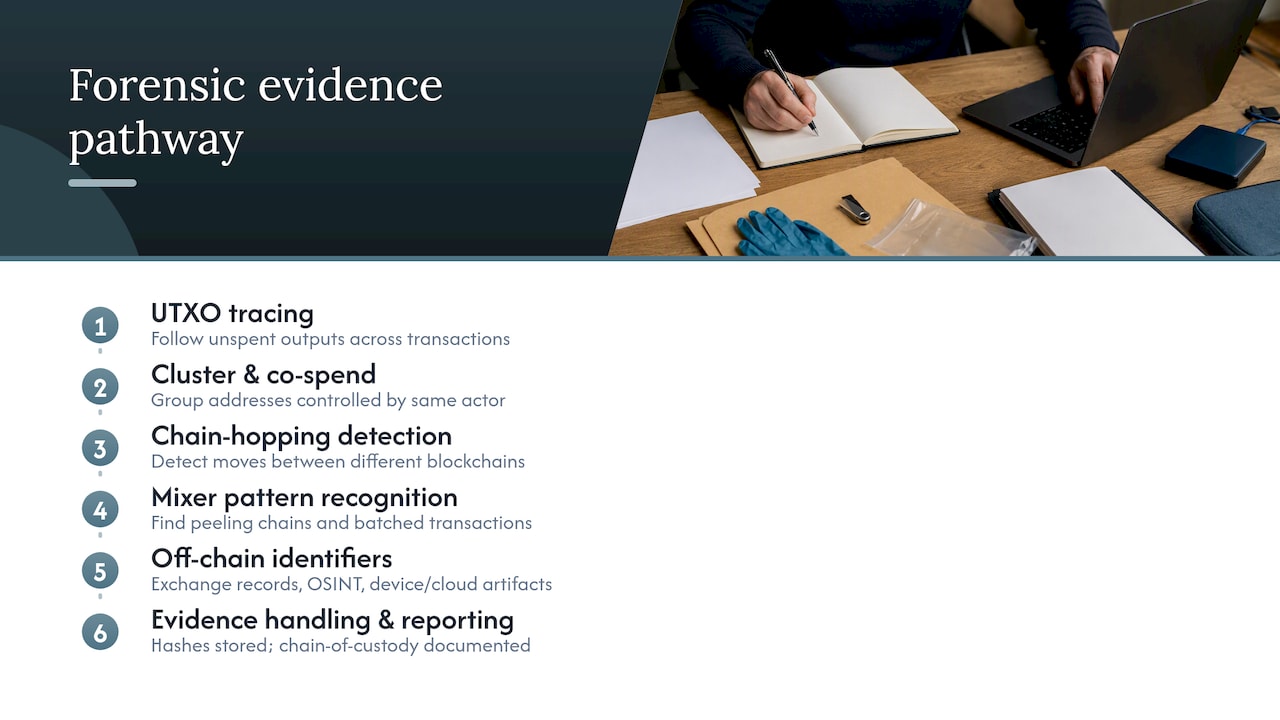
A forensic investigation layers several techniques on top of basic tracing. On the blockchain side, investigators use UTXO tracing to follow unspent outputs across transactions, cluster and co-spend analysis to group addresses likely controlled by the same party, and chain-hopping detection to track funds moved between different blockchains. Mixer pattern recognition looks for peeling chains and batched transactions that signal an attempt to obscure the trail. Research into Bitcoin mixer investigations shows that these patterns, combined with off-chain identifiers, often narrow an investigation even when funds pass through a mixing service.
Off-chain work is where attribution happens. Investigators pursue exchange records through legal process, run open-source intelligence to connect wallet addresses to real accounts or identities, and collect device or cloud artifacts that place a specific person behind a specific transaction. A federal complaint involving seized USDT shows this combination at work: blockchain tracing linked stolen funds to a Binance account, which was voluntarily frozen at investigators’ request before legal process moved forward. You can walk through a similar case in this example of tracing Ethereum to an exchange.
Evidence handling is what separates a usable report from an interesting one. NIST’s guidance on digital evidence preservation states that changing a single bit changes a hash, so investigators store hashes separately from working copies and document exactly how and when each piece of evidence was collected. A guide to chain of custody for crypto cases breaks down what that documentation needs to include.
Mixers, chain-hopping, and asset conversions add complexity to an investigation, but they rarely make tracing impossible. Pattern recognition and off-chain data together usually produce a workable lead.
None of this is unlimited. Privacy coins, well-run mixing services, and cross-border jurisdictional gaps can stall even a well-documented trace, and research on the evidentiary limits of blockchain analysis notes that tools alone rarely identify an operator without off-chain records or a mistake on the operator’s part.
How tracing results turn into actual recovered funds
A completed trace is a starting point, not an ending. Turning it into recovered money generally runs through one or more of these routes:
- Custodial action: exchanges sometimes freeze an account voluntarily when presented with a clear trace and a law-enforcement request, and sometimes only after a court order compels it.
- Law enforcement and forfeiture: investigators obtain warrants and seizures, and DOJ forfeiture and remission processes can return forfeited assets to victims, as seen in a significant amount of OneCoin assets DOJ made available for victim compensation in April 2026.
- Civil litigation: a civil suit can secure injunctions or preliminary asset-restraint orders, though these require solid tracing evidence and often cooperation from a custodian.
Expect these processes to take months, sometimes longer, and plan for partial rather than full recovery. Jurisdictional boundaries, especially when funds cross into exchanges or wallets outside reach of U.S. courts, are the most common reason a well-documented case still stalls.
Why evidence discipline matters more than speed
Victims often want a fast answer about whether their money is gone for good, but the honest answer depends on evidence quality more than urgency. A trace built on preserved, hashed, well-documented records gives counsel and law enforcement something they can act on; a trace built on secondhand screenshots and a fading memory of what happened does not. Be skeptical of anyone who promises a guaranteed outcome, since no legitimate investigator can make that promise. When a case needs off-chain attribution, a legal-grade report, or coordination with an exchange, that is the point to bring in a forensic investigator rather than continuing to trace it alone.
— cristian
How Recovera Forensics turns a trace into a recovery case
Some firms handle the full path from tracing to a report usable by attorneys. Such services may cover cryptocurrency scam investigation, OSINT investigations and digital attribution, evidence preservation, and technical reports built for legal proceedings, along with support for Forex, online trading, and gambling fraud cases.
Before reaching out, gather what you can:
- Transaction hashes, wallet addresses, and timestamps for every transfer involved.
- Screenshots, emails, and chat logs with the scammer or platform.
- Exchange account statements and any KYC confirmations you have access to.
From there, a typical engagement moves from tracing and attribution through evidence preservation to a court-ready report, with direct liaison to exchanges and coordination with your legal counsel where relevant. If you are weighing whether tracing alone is enough for your case, Recovera’s services page lays out what a full investigation adds, and law firms handling fraud cases can review services built for professional offices. Start by checking which evidence you already have against this action guide before your first call.
Sources
- Internet Crime Complaint Center (IC3) PSA and guidance
- NIST: Digital Evidence Preservation: Considerations for Evidence Handlers
- USA v. Approximately 110,270 USDT seized from Binance Account – complaint
This article is general information, not a substitute for advice from a qualified financial advisor. Consult a qualified financial professional about your own circumstances before acting on anything here.
FAQ
What is the difference between transaction tracing and a forensic investigation?
Transaction tracing follows blockchain data such as hashes and addresses to map where stolen funds went. A forensic investigation adds off-chain records, attribution work, and a legal-grade report, which is what actually supports a freeze, seizure, or court action.
Can transaction tracing alone get my stolen crypto back?
No. Tracing identifies where funds are, but recovery requires a custodian, court order, or law-enforcement action such as a freeze, seizure, or DOJ forfeiture process to actually move the money back.
What should I report to IC3 after a crypto scam?
Include every transaction hash, wallet address, amount, asset type, and timestamp you have, along with platform names and any identifying details about the scammer. The IC3 cryptocurrency reporting page lists the exact fields investigators need.
How do I know a crypto recovery service is not a scam?
Be wary of any provider demanding a large upfront fee or guaranteeing a specific recovery outcome, since the FBI and IC3 specifically warn about fraudulent recovery services. Ask for a clear scope of work and documented methodology before paying anything, and check the provider’s process for preparing court-ready reports.
Does Recovera Forensics offer both tracing and full investigations?
Yes. Recovera Forensics provides cryptocurrency scam investigation, OSINT and digital attribution work, evidence preservation, and technical reports for legal proceedings, covering both the tracing stage and the fuller investigation that follows it.