A paid blockchain-forensics investigation can produce a court-ready technical report that satisfies FRE 702 and Daubert scrutiny, tracing stolen funds from your wallet to their current location. Whether you recover anything depends less on the report itself than on whether the trail crosses a regulated exchange willing, or legally compelled, to freeze it. Certain firms build these reports for exactly that reason: to give victims and their counsel something a court will actually accept.
TL;DR:
- A court-ready forensic report requires detailed documentation of methodology, including tool versions, query parameters, and chain-of-custody practices, to withstand legal scrutiny.
- Investigators map the full transaction graph, follow cross-chain swaps, and corroborate off-chain data to trace stolen funds, though the trail often ends at mixers or uncooperative exchanges.
- Recovery depends heavily on whether funds reach regulated custodians; if funds remain in unhosted wallets or are mixed, chances of recovery diminish significantly.
- Prioritize immediate actions like recording all transaction IDs, exporting wallet histories, and securing communications to preserve critical evidence before engaging an investigator.
- For best results, engage firms that provide transparent sample reports, clarify scope and costs upfront, and confirm analysts can testify if the case proceeds to litigation.
Table of Contents
- What Goes Into a Court-Ready Crypto Scam Report
- How Do Investigators Actually Trace Stolen Funds?
- What Makes a Forensic Report Admissible in U.S. Court?
- When Should You Hire a Paid Investigator?
- What Should You Gather Before Contacting an Investigator?
- What Can You Realistically Expect After the Report Is Done?
- What Rights and Protections Do Crypto Scam Victims Have?
- Where Should You Officially Report a Crypto Scam?
- How Should You Secure Your Remaining Assets After Reporting?
- What Are the Most Common Crypto Scam Patterns to Watch For?
- How Do You Avoid a Secondary Recovery Scam?
- A Note From Cristian at Recovera Forensics
- Get a Forensic Case Assessment From Recovera Forensics
- Sources
- FAQ
What Goes Into a Court-Ready Crypto Scam Report
If you’re planning to report a crypto scam through a forensic investigation rather than a simple complaint filing, the deliverable needs to do more than list wallet addresses. Courts, compliance teams, and opposing counsel all look for the same structural markers before they’ll treat a blockchain report as anything more than an educated guess.
A properly built report opens with an executive summary that ties directly to your specific claims and the legal action you’re pursuing, whether that’s a civil suit, a freeze request, or a law enforcement referral. From there it moves into a transaction-level narrative built around TXIDs, block heights, and timestamps, usually with annotated flow diagrams showing where funds split, merged, or passed through an exchange.
The exhibits matter as much as the narrative. A defensible report includes raw data exports, timestamped screenshots, cryptographic hashes of every file pulled, and appendices documenting each step. TRM Labs’ guidance on court-ready reporting emphasizes that provenance and reproducibility separate an admissible report from a marketing document.
A report typically includes:
-
An executive summary connecting the facts to the relief requested
-
A transaction narrative with TXIDs, block heights, and UTC timestamps
-
Raw exports, hashed files, and screenshot exhibits
-
A methodology section naming the tools, versions, and query parameters used
-
A confidence assessment distinguishing strong attribution from probable leads
Statistic Callout: Reports that fail to preserve tool versions and query parameters are the ones most often challenged in cross-examination, since opposing counsel can’t test what wasn’t documented in the first place, per TRM Labs.
How Do Investigators Actually Trace Stolen Funds?
Tracing starts on-chain and finishes off-chain. Investigators pull raw data from node exports, block explorers, and internal transaction logs, then run it through analytics platforms built for clustering and graphing wallet activity.
- Build the transaction graph. Analysts map every hop the stolen funds take, applying clustering heuristics to group addresses likely controlled by the same actor.
- Handle swaps and bridges. Token conversions and cross-chain bridge transfers get flagged and followed separately, since a straight value transfer trace breaks the moment funds swap chains.
- Corroborate off-chain. Exchange KYC records, subpoenas, and open-source intelligence connect a wallet cluster to a real identity or account.
- Document the chokepoints. Every touchpoint with a regulated custodian gets logged, because that’s where legal process can actually bite.
Cross-border exchanges with weak compliance, privacy coins, and mixing services remain the biggest blockers. [Blockchain Council’s overview of forensic tracing] notes that once funds hit a mixer or move through a non-cooperative VASP, the trail often goes cold regardless of tool sophistication.
Pro Tip: Investigators frequently overlook internal transaction calls and smart contract event logs on Ethereum-based chains. A Fordham Law practitioner note found these sit in separate explorer tabs and get missed constantly, which can leave gaps in an otherwise solid trace.
What Makes a Forensic Report Admissible in U.S. Court?
Federal courts don’t accept a blockchain report just because it looks technical. Under FRE 702 and the Daubert standard, a judge acts as gatekeeper, testing whether the methodology is reliable, whether it’s been tested or peer-reviewed, and whether it has a known error rate. Reports also need to satisfy FRCP 26(a)(2)(B) disclosure requirements if the analyst will testify as an expert.
Chain-of-custody discipline is what turns a technical write-up into evidence. That means hashing every export at the moment it’s pulled, logging who handled each file and when, and preserving native files so another analyst could rebuild the same result a year later.
Reconstruction is the real test. If a second analyst can’t take your preserved exports, tool versions, and query parameters and land on the same conclusion months later, the report won’t hold up under cross-examination.
That standard comes directly from TRM Labs’ framework for investigators, which treats reproducibility as non-negotiable for court use.
-
Separate automated tool output from the analyst’s expert opinion, and label each clearly
-
Version-stamp every tool and log every query parameter used to generate a result
-
Preserve subpoenaed exchange records under FRE 803(6) as business records, which supports authentication without live testimony from every custodian
When Should You Hire a Paid Investigator?
Not every case is worth a paid engagement, and a competent investigator will tell you that during intake rather than after billing you. The strongest signal is whether funds touched an exchange at any point. Recent movement, available TXIDs, and any device or communication logs from the scam contact all raise the odds of a usable trace.
- Check for viability signals first. If your funds sat in a single unhosted wallet for months with no exchange activity, a full investigation may cost more than it can realistically recover.
- Request a sample report. A legitimate firm will show you redacted examples of past deliverables, including how they document methodology and chain-of-custody.
- Ask about testimony availability. If your case might go to litigation, confirm the analyst can serve as a testifying expert, not just a report author.
- Get a scope-based estimate. Pricing and timeline usually track the number of addresses involved, whether cross-chain tracing is needed, and whether legal process like subpoenas is part of the engagement.
Walk away from anyone who guarantees recovery, hints at unlawful methods to “hack back” funds, or refuses to explain how they’ll preserve evidence. Guidance on vetting recovery services consistently flags guaranteed-return promises as the clearest red flag in this space.
What Should You Gather Before Contacting an Investigator?
The first hours after discovering a scam matter more than almost anything that follows. Stop moving any remaining funds immediately, since additional transactions can complicate the trace and, in some cases, look like you’re trying to hide activity.
Record every TXID connected to the theft, export your full wallet transaction history, and screenshot every communication with the scammer, including timestamps. If you used an exchange to buy or transfer the crypto, pull your receipts and transfer confirmations now, since some platforms purge older records.
- Export wallet history in native format plus CSV or JSON for easy review
- Screenshot chat logs, emails, and social media messages with visible timestamps
- Save device logs if you suspect malware or remote access was involved
- Write a plain-language timeline of what happened and when, in your own words
Pro Tip: Share files through encrypted transfer rather than plain email attachments. A serious investigator will give you a secure upload link rather than asking you to send wallet exports over unencrypted channels.
What Can You Realistically Expect After the Report Is Done?
A finished forensic report is a tool, not a guarantee. What it enables depends entirely on where the funds ended up. If the trail leads to a domestic, cooperative exchange, the report can support a freeze request or preservation letter within hours. Subpoenas to compel account disclosure typically take weeks to move through the process, and international requests routed through mutual legal assistance treaties can stretch into months.
- Hours: Urgent notices to cooperative U.S. exchanges when funds are actively sitting in an identifiable account
- Weeks: Subpoenas compelling exchange disclosure of account holder information
- Months: Cross-border requests, MLATs, or civil recovery litigation
The single biggest factor in success is whether stolen funds touch a regulated custodian at all. Chainalysis’s forensics glossary points to federal seizure cases where funds reaching an exchange allowed agencies to freeze or forfeit assets through legal process, something that’s simply not possible when funds stay in unhosted wallets or move through mixers.
Statistic Callout: Recovery outcomes typically fall into a few categories: frozen exchange accounts with identified parties, civil recovery suits when parties are known, or dead ends with no actionable custodian contact. Rapid notification and clean chain-of-custody documentation push cases toward the first two.
What Rights and Protections Do Crypto Scam Victims Have?
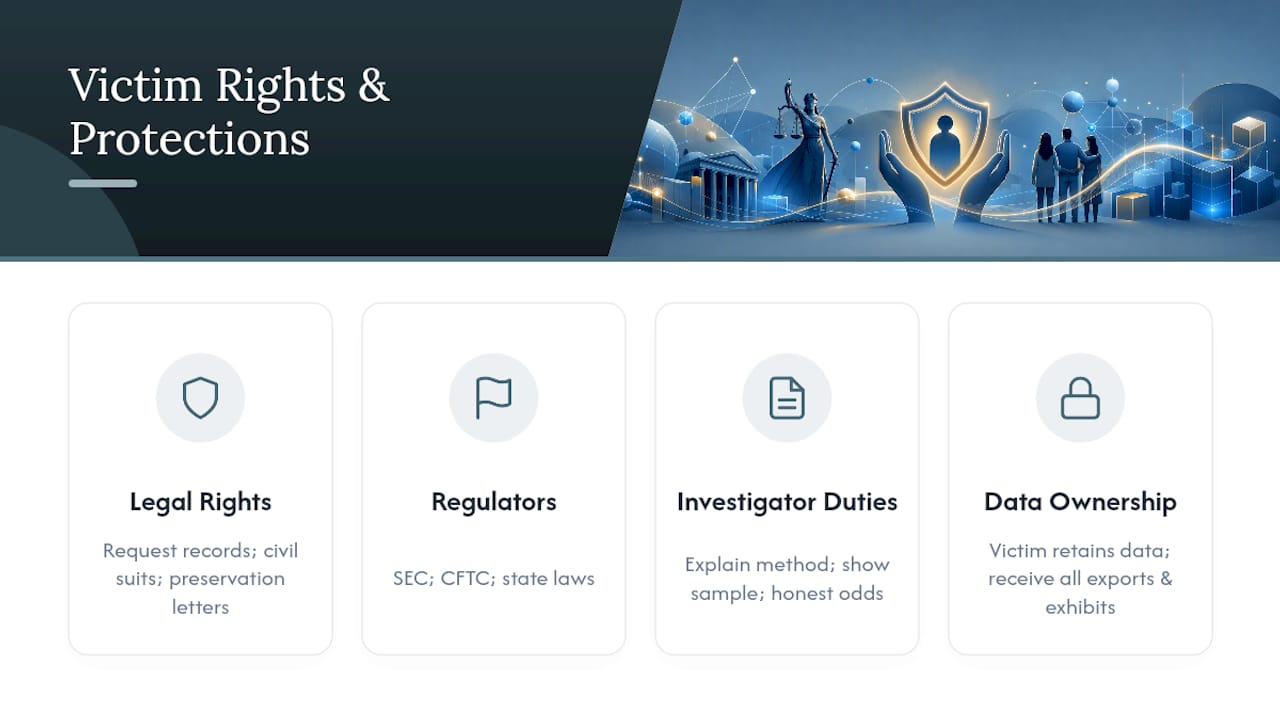
Victims of cryptocurrency fraud aren’t without leverage, even though crypto’s decentralized design makes recovery harder than a stolen credit card charge. You have the right to request records from exchanges through legal process, the right to pursue civil claims against identified parties, and in many cases the right to have counsel issue preservation letters that legally obligate a platform to hold data before it’s purged.
Federal and state consumer protection frameworks also apply to crypto fraud, even though enforcement varies by state and by the specific fraud type. If your case involves securities fraud, such as a fake investment platform, the SEC’s jurisdiction may apply. If it involves commodity-related fraud or manipulation, the CFTC may have standing. Working with an investigator who understands which regulatory body actually governs your fact pattern saves time that victims often waste filing with the wrong agency first.
You also have a right to expect transparency from anyone you pay to investigate your case. That includes a clear explanation of methodology, a sample of what the final deliverable looks like, and an honest assessment of your odds before you sign an engagement. No legitimate investigator can promise a specific recovery outcome, and any protection framework you’re relying on works better with a documented, hashed evidentiary trail behind it rather than a verbal account of what happened.
Victims retain ownership of their own case data throughout the engagement, and a properly run investigation should give you copies of every export and exhibit generated, not just the final polished report.
Where Should You Officially Report a Crypto Scam?
Filing an official complaint and commissioning a forensic investigation are two different tracks, and pursuing both gives you the strongest position. Reporting to the right agency creates a public record and can trigger law enforcement attention even when your individual case is too small for an FBI field office to prioritize on its own.
The FBI’s Internet Crime Complaint Center (IC3) is the standard first stop for federal reporting on cryptocurrency fraud in the United States. The Federal Trade Commission also collects fraud reports through its ReportFraud.ftc.gov portal, which feeds into broader pattern analysis used by multiple agencies. If your case involves a fraudulent investment platform or fake trading scheme, the SEC’s tip and complaint system applies, and commodity-related scams belong with the CFTC.
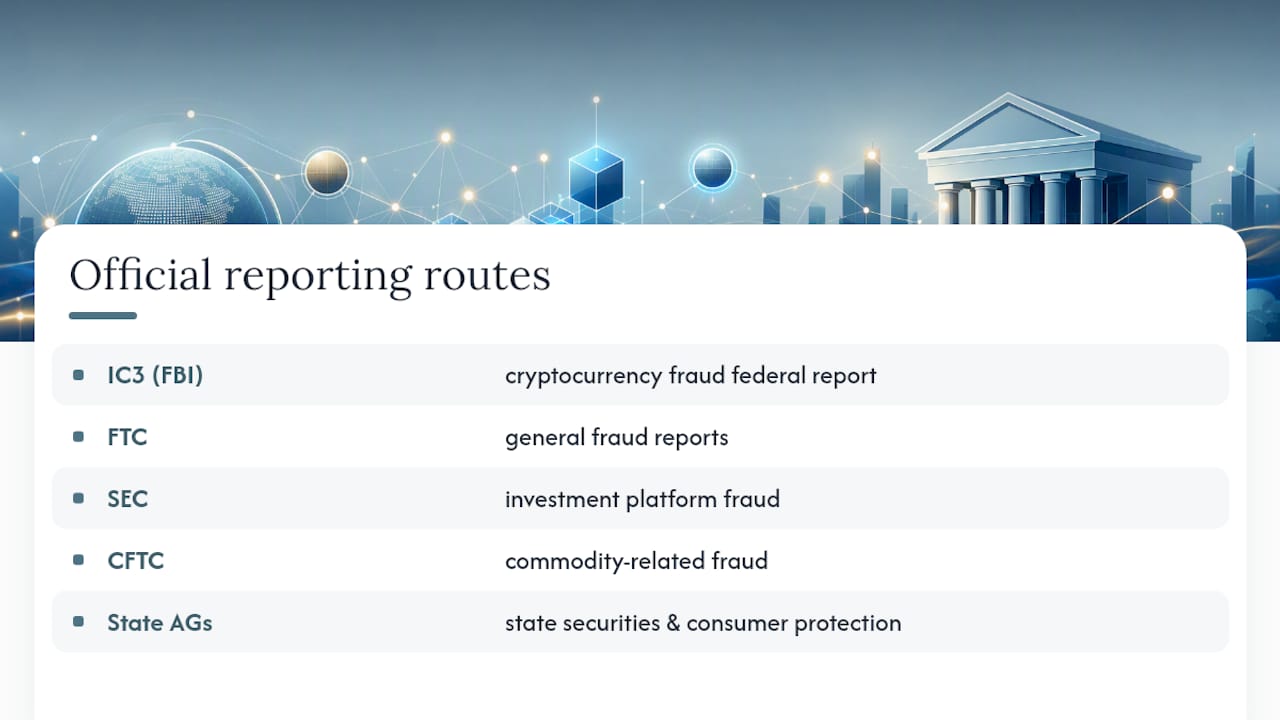
State securities regulators and your state attorney general’s consumer protection division are worth contacting too, particularly if the scam originated from a domestic actor or a company registered in your state. Many exchanges also maintain internal fraud reporting channels, and notifying the platform directly, alongside law enforcement, can trigger an internal freeze faster than waiting on a subpoena.
None of these filings substitute for a forensic report. They document the crime and may prompt an investigation, but they generally won’t trace your specific funds. A forensic report gives your complaint teeth by attaching the technical evidence that turns a generic fraud report into an actionable case file.
How Should You Secure Your Remaining Assets After Reporting?
The scam that already happened is rarely the only risk. Victims frequently get targeted a second time, often by someone posing as a recovery expert who claims to have already located the stolen funds.
Move any remaining crypto holdings to a new wallet with a freshly generated seed phrase, especially if the compromised wallet’s private key may have been exposed through a phishing link or malicious app. Enable hardware wallet storage for anything you’re not actively trading, and turn on withdrawal whitelisting on any exchange account you still use.
Change passwords on every account connected to your crypto activity, including email, since scammers frequently pivot from a compromised wallet to a compromised inbox to intercept password resets. Enable multi-factor authentication using an authenticator app rather than SMS, since SIM-swapping remains a common secondary attack vector against crypto holders who’ve already been flagged as targets once.
Review your device for malware if you suspect the original compromise involved a downloaded app or a malicious browser extension, and consider a clean reinstall if you’re not confident it’s clear. Finally, be selective about who you tell about the loss. Scammers monitor crypto fraud complaint forums and social media specifically to identify fresh victims for follow-up recovery scams.
What Are the Most Common Crypto Scam Patterns to Watch For?
Recognizing the pattern before you send funds is always cheaper than tracing them afterward. Romance-based investment scams, often called “pig butchering,” build a relationship over weeks before introducing a fake trading platform that shows fabricated gains until you try to withdraw. Fake exchange or wallet apps mimic real platforms closely enough to pass a casual glance, harvesting private keys the moment you import a wallet.
Rug pulls hit newer token launches, where developers drain liquidity pools shortly after a coordinated marketing push inflates the price. Impersonation scams involving fake customer support, often reached through a sponsored search ad or a fake help-desk number, trick victims into sharing seed phrases directly. Phishing remains constant, arriving through fake airdrop claims, wallet security alerts, or NFT minting links that request wallet connections to malicious contracts.
Red flags worth memorizing: any platform that guarantees fixed daily returns, any contact who pressures you to act within a narrow time window, and any request to share your seed phrase or private key under any pretense at all. Legitimate platforms never need your seed phrase to fix an account issue. A support agent who says otherwise is the scam, not the fix.
How Do You Avoid a Secondary Recovery Scam?
Fake recovery services target people who’ve already lost money once, which makes this the single highest-risk moment in the entire process. Anyone who contacts you unprompted after a public complaint filing, claiming they’ve already found your funds, should be treated as a scammer until proven otherwise.
Verify a firm’s legitimacy by asking for a redacted sample report before you pay anything, and check whether the methodology section names actual tools, versions, and query parameters rather than vague references to “advanced software.” A legitimate investigator explains their transaction graph analysis approach in plain terms and will not promise a guaranteed outcome, since no one controls whether a scammer’s funds will reach a cooperative custodian.
Check for an upfront fee structure tied to the scope of investigation rather than a percentage cut of “recovered” funds paid before any recovery has actually occurred, a common structure in secondary scams. Search the firm’s name alongside terms like “complaint” or “review” on independent forums, not just testimonials on their own site. Confirm they can point to real case experience with U.S. legal processes, such as subpoenas or exchange preservation requests, rather than vague claims about “government connections” that supposedly speed up recovery. If a firm pressures you to wire funds quickly or asks for your private keys or seed phrase at any point, that’s the same red flag as the original scam, just wearing a different costume.
A Note From Cristian at Recovera Forensics
I built Recovera Forensics around one belief: victims deserve a process they can actually verify, not just a promise. Every engagement starts with documentation, not assumptions, because a report that can’t survive scrutiny helps no one in court.
We’re upfront about what tracing can and can’t do. No investigator can guarantee a specific outcome once funds leave your control, and we’ll tell you early if your case has weak recovery odds rather than stringing out an engagement. What you get instead is transparency: a clear timeline, defined deliverables, and a report built to the same standard opposing counsel will try to pick apart.
— cristian
Get a Forensic Case Assessment From Recovera Forensics
Recovera Forensics builds the documentation layer that turns a stolen-crypto complaint into something a court, an exchange compliance team, or opposing counsel has to take seriously. Our engagements produce a full court-ready forensic report, transaction exhibits tied to TXIDs and block heights, hashed raw data exports, a methodology appendix documenting tool versions and query parameters, and analyst availability for expert testimony if your case moves to litigation.
Intake starts with what you’ve already gathered: TXIDs, wallet addresses, exchange records, scammer communications, and any device logs tied to the incident. From there we run a case assessment to determine whether your funds show viable chain-of-custody and chokepoint exposure before committing to a full engagement, so you’re not paying for an investigation with low odds of producing an actionable lead.
If you’re ready to find out what a forensic trace can actually show in your case, start a case assessment with Recovera Forensics today. Fees and timelines vary by scope, and we’ll walk you through both honestly before any engagement begins.
Sources
For readers or attorneys who want to go deeper: the CUNY academic analysis of expert evidence standards covers FRE 702 and Daubert in detail. TRM Labs’ court-ready reporting framework breaks down reproducibility standards practitioners actually use. Blockchain Council’s forensics overview explains tracing methodology in accessible terms for non-technical readers.
- Academic discussion of expert evidence standards and admissibility (CUNY)
- Building strong cases with blockchain evidence (TRM Labs)
FAQ
Can a forensic report guarantee I get my crypto back?
No. A forensic report proves where funds went and can enable legal action, but recovery depends on whether the funds reach a regulated custodian that can be compelled to freeze or disclose them.
How long does a court-ready crypto forensic investigation take?
It varies with complexity, but urgent exchange notices can happen within hours, subpoenas typically take weeks, and cross-border cases involving MLATs can stretch into months.
What’s the difference between reporting a crypto scam and hiring a forensic investigator?
Reporting to agencies like the FBI’s IC3 or the FTC creates an official record and may trigger law enforcement attention, while a forensic investigation from a firm like Recovera Forensics produces the technical evidence and court-ready report needed to actually trace and act on stolen funds.
Does a blockchain forensic report meet U.S. court evidence standards?
A properly built report is designed to satisfy FRE 702 and Daubert by documenting methodology, tool versions, error rates, and chain-of-custody so it can withstand cross-examination.
What should I do immediately after discovering a crypto scam?
Stop moving any remaining funds, record every TXID, export your wallet transaction history, and screenshot all communications with the scammer before contacting an investigator.