A crypto dusting attack is when someone sends tiny, near-worthless amounts of cryptocurrency to hundreds or thousands of wallet addresses to unmask the people behind them. The single best response is to leave that dust alone: don’t spend it, don’t consolidate it with your other funds, and don’t interact with any token or link that arrives with it. Getting dusted does not mean your keys are compromised. It’s a privacy probe, not a theft.
TL;DR:
- Dusting campaigns increasingly target high-value wallets by pairing tiny deposits with social engineering, such as phishing links or malicious approvals, to maximize damage.
- Regularly reviewing unfamiliar incoming transactions, separating active funds from cold storage, and avoiding consolidating dust drastically reduce deanonymization risks.
- Improvements in wallet security, like coin control and address rotation, are effective defenses against dusting, but users must maintain disciplined habits and revoke unnecessary token approvals.
- Exchange-based dust poses less privacy risk because of internal pooling, making conversion using platform tools a safer option than external links or third-party services.
- Escalated dusting incidents involving malicious contract approvals or phishing require forensic investigation, evidence preservation, and possibly professional help for recovery and legal action.
Table of Contents
- What “Dust” Actually Is (and How Dusting Differs From Address Poisoning)
- The Mechanics: How Attackers Trace Dust Back to You
- Who Sends Dust, and Why It Matters Who’s Watching
- Signs You’ve Probably Been Dusted
- How to Protect Your Wallet and Privacy From Dusting
- How Exchanges Handle Dust Differently Than Your Own Wallet
- When Dusting Becomes a Real Problem, Not Just an Annoyance
- What Forensic Help Looks Like When Dusting Turns Into Something Worse
- Real-World Dusting Campaigns and What They Revealed
- Legal and Regulatory Perspectives on Dusting Attacks
- Recommendations for Monitoring Dusting Attempts Over Time
- Where Dusting Tactics Are Headed Next
- Get Help If Dusting Turned Into Real Financial Loss
- Our Take: Dusting Deserves Less Panic and More Habit
- Sources
- FAQ
What “Dust” Actually Is (and How Dusting Differs From Address Poisoning)
Dust is a transaction so small it’s barely worth acknowledging. On Bitcoin, that might be a few hundred satoshis. On Ethereum or other token networks, it could be a fraction of a cent worth of an obscure token. Dust shows up naturally, too. Exchanges round off withdrawals, mining pools distribute tiny leftovers, and smart contracts sometimes emit residual balances after a swap. Most of what lands in your wallet is background noise.
A crypto dusting attack is different because it’s deliberate: someone sends dust specifically to track how you move funds afterward. That’s distinct from address poisoning, where scammers generate a lookalike address (matching your usual first and last few characters) and send a fake transaction hoping you’ll copy the wrong address from your history for a future payment. Malicious airdrops are a third category entirely, dropping tokens loaded with phishing links or contract approval traps. All three exploit the same habit: glancing at a transaction list without reading it carefully.
The Mechanics: How Attackers Trace Dust Back to You
Dusting works because of how the UTXO (Unspent Transaction Output) model handles Bitcoin and similar chains. Every coin you hold is really a collection of separate “outputs” from past transactions, not one fungible balance. When you spend, your wallet often bundles multiple UTXOs together as inputs, including that dust, to cover the amount.
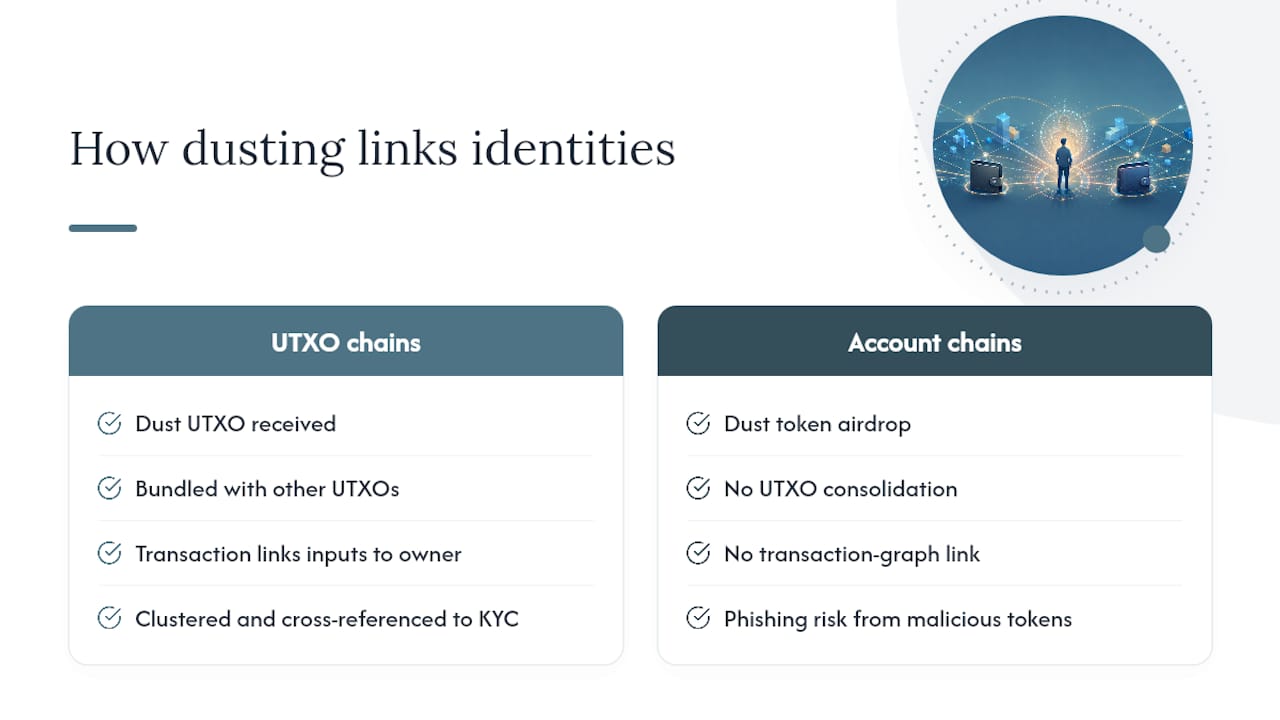
That bundling is the trap. Chainlink’s breakdown of dusting attacks explains that the attacker’s real goal isn’t recovering the dust. It’s forcing a link: once dust gets consolidated with your other coins in a single transaction, blockchain analytics tools can infer that all the inputs belong to the same wallet owner. Chain-surveillance firms then cluster these addresses into a single profile and cross-reference the cluster against known KYC touchpoints, like the deposit address you used at an exchange, to attach a real identity to what was previously anonymous.
Account-based chains like Ethereum work differently. There’s no UTXO consolidation step, so dusting there leans more on unsolicited token airdrops and malicious contract approvals than transaction-graph clustering. The privacy risk is smaller on Ethereum, but the phishing risk from dust tokens carrying malicious links is arguably higher.
Who Sends Dust, and Why It Matters Who’s Watching
Not everyone dusting your wallet wants to steal from you. Criminal actors use dusting to build target lists for phishing campaigns, extortion attempts, or, in rare and extreme cases, physical targeting of individuals known to hold large balances. Deanonymizing a whale’s wallet turns an anonymous address into a name and, potentially, a location.
But dusting shows up in noncriminal contexts too. Blockchain analytics firms, academic researchers, and law enforcement agencies use similar techniques for legitimate forensic mapping and investigations. Receiving dust isn’t proof of malicious intent on its own.
High-value wallets attract disproportionate attention because the payoff for successfully identifying the owner is bigger. A dusted wallet holding $40 isn’t worth the analytics effort; one holding several million dollars in Bitcoin is.
Signs You’ve Probably Been Dusted
A few patterns show up consistently across dusting incidents. Watch for:
- Tiny, unexplained deposits (fractions of a cent to a few dollars) from addresses you’ve never transacted with.
- Unfamiliar tokens appearing in your wallet, especially ones with a memo, note, or embedded URL in the transaction data.
- The same small amount, or a similar one, arriving from multiple different source addresses across different chains.
- A prompt to “claim,” “verify,” or approve a smart contract shortly after one of these deposits appears.
That last one is the real danger. CoinGecko’s research on dusting notes that some airdropped tokens are designed specifically to lure recipients into approving malicious permissions, which can open the door to actual fund loss, not just deanonymization.
How to Protect Your Wallet and Privacy From Dusting
Defense against dusting is mostly about discipline, not software you have to buy. Here’s the order that matters most:
- Never spend or consolidate dust. If your wallet supports a “do not spend” or “freeze UTXO” feature, use it on any suspicious small deposit immediately.
- Use an HD (hierarchical deterministic) wallet with address rotation. Generating a new receiving address for each transaction limits how much any single dusting campaign can learn about your activity.
- Turn on coin control. Most serious wallets, including hardware wallets like Ledger, let you manually select which UTXOs go into a transaction. This is the direct countermeasure to the consolidation trick.
- Route transactions through a VPN or Tor when broadcasting, so your IP address doesn’t become another data point tied to the transaction.
- Revoke unused token approvals on Etherscan’s token approval checker or a similar tool, and keep hot wallets (for daily use) separate from cold storage (for savings).
- Split custody by hardware wallet for anything you’re not actively trading.
Coinbase’s dusting guide backs the core of this: HD wallets, do-not-spend flags, and avoiding consolidation are the three pillars that actually neutralize the attack.
Pro Tip: Before you dismiss a dust deposit as harmless, check the sending address on a block explorer. If it’s flagged by the community or shows a pattern of sending identical tiny amounts to hundreds of wallets, that confirms it’s a dusting campaign rather than a stray rounding error.
One caution worth stating plainly: privacy mixers or tumblers might sound like a tempting fix for tainted coins, but their legal status is murky and several have drawn sanctions or law enforcement action in the United States. Coin control and address hygiene get you most of the same privacy benefit without that exposure.
How Exchanges Handle Dust Differently Than Your Own Wallet
Dust sitting in an exchange account carries far less privacy risk than dust sitting in a self-custodied wallet. Exchanges typically pool customer balances into large omnibus wallets on the back end, so the public blockchain never sees your individual transaction history the way it would with a personal wallet. CoinGecko notes that this internal pooling makes converting small balances through the exchange’s own “convert dust” tool a safe, low-risk action.
That’s a meaningful distinction: self-custody gives you control, but it also means every UTXO you touch is publicly traceable. Custodial accounts trade some of that control for a layer of obfuscation.
If dust shows up in an exchange account, use the platform’s built-in conversion or small-balance tool. Never click an external link claiming to help you “clean” or “claim” dust from an exchange. Legitimate platforms don’t email you links for that.
When Dusting Becomes a Real Problem, Not Just an Annoyance
For most retail holders, a dusting attack is a privacy nuisance, not a theft event. The math backs that up: dust amounts are typically smaller than the transaction fee needed to move them, which is exactly why leaving them untouched costs you nothing.
Escalate your response if you notice repeated targeting over weeks, dust tied to addresses linked to a KYC exchange you use, or any follow-up contact, such as an email or social media message referencing your holdings. That pattern suggests someone successfully deanonymized you and is moving to the next stage.
If that happens:
- Stop transacting from the affected address immediately.
- Revoke any approvals granted to unfamiliar contracts.
- Preserve evidence: transaction hashes, timestamps, screenshots of the suspicious deposits, wallet addresses involved, and any dApp URLs you interacted with.
- Move unaffected funds to a newly generated wallet only after you’re confident you’re not exposing the new seed to the same risk.
Incident response differs depending on what actually happened: a dusted wallet with no approvals granted is a very different situation from one where you clicked a malicious airdrop link. If you suspect the second scenario, that’s when a step-by-step forensic action plan and outside expertise become worth the cost.
What Forensic Help Looks Like When Dusting Turns Into Something Worse
When dusting escalates into targeted phishing, wallet compromise, or extortion, Recoveraforensics builds transaction graph analyses and wallet-linking reports designed to hold up in legal proceedings, not just satisfy curiosity. Victims should preserve transaction hashes, exact timestamps, wallet addresses, and a timeline of what happened before reaching out.
Recovery outcomes vary by case, jurisdiction, and how quickly evidence gets locked down after an incident. No forensic investigator can promise a specific dollar figure back. What a proper investigation can do is connect wallet activity to real-world entities and produce documentation that law enforcement, attorneys, or exchanges can act on.
Real-World Dusting Campaigns and What They Revealed
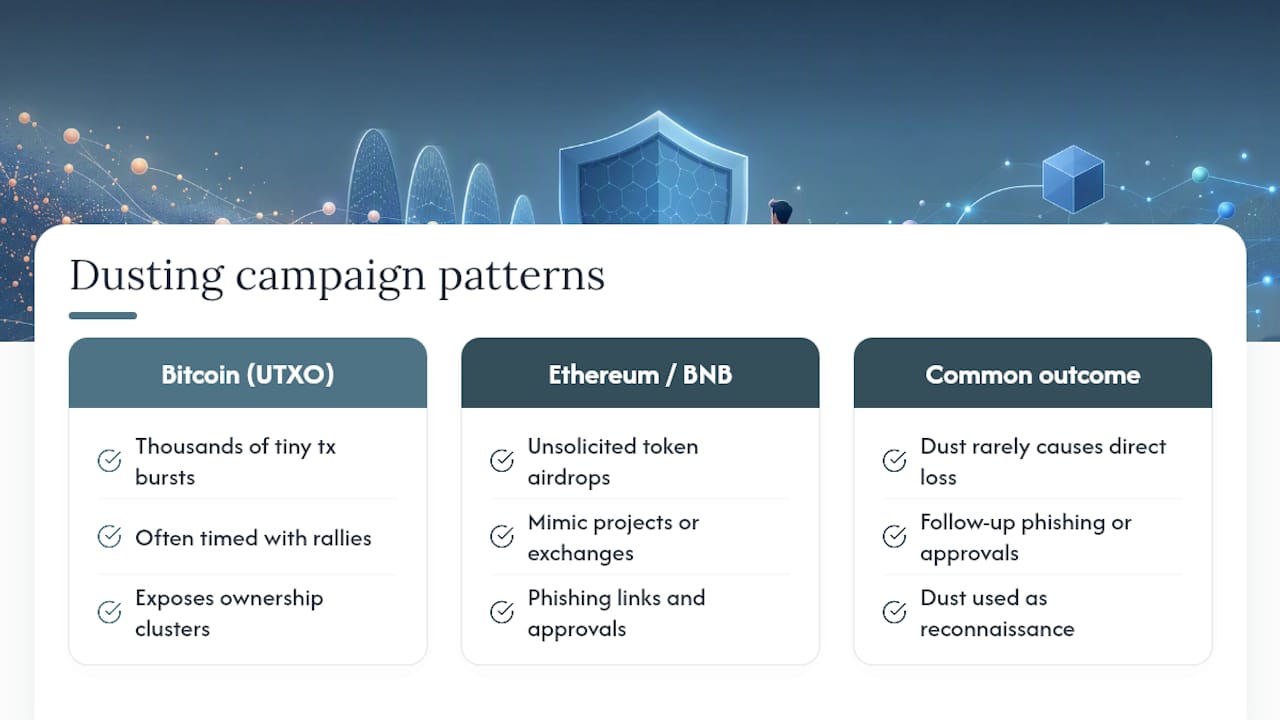
Dusting isn’t theoretical. Bitcoin’s network has seen multiple large-scale dusting waves over the years, where researchers and analytics firms observed thousands of tiny transactions broadcast to wallets in short bursts, often timed to coincide with price rallies when more wallets are actively moving funds. One well-documented pattern involved dust distributed across addresses tied to a specific mining pool’s payout structure, which analysts used to demonstrate how easily consolidation habits expose ownership clusters even without any malicious follow-up.
On the account-based side, Ethereum and BNB Chain have both experienced waves of unsolicited token airdrops carrying names designed to look official, sometimes mimicking real projects or exchanges, with embedded links that redirect to phishing sites mimicking wallet-connect interfaces. Security researchers have flagged these campaigns repeatedly, noting that the tokens themselves are often worthless, but the approval prompt they trigger is where real losses happen.
The pattern across nearly every documented case is the same: the dust itself rarely causes direct financial harm. The damage, when it happens, comes from what follows: a phishing message referencing a wallet’s real balance, a fake support agent who “already knows” the victim’s holdings, or a malicious contract approval buried in fine print. That’s the actual lesson from these incidents. Dusting is reconnaissance. The attack, if there is one, comes later and through a different door.
Legal and Regulatory Perspectives on Dusting Attacks
No U.S. federal statute names “dusting” specifically, which puts it in a gray zone that regulators and courts are still working through case by case. Sending a small amount of cryptocurrency to a public address isn’t illegal by itself. Anyone can broadcast a transaction to any address on a public blockchain, and there’s no ownership right that prevents someone from doing so.
Where it gets legally serious is what follows the dust: unauthorized access attempts, phishing, extortion, or fraud tied to information gathered through dusting-based deanonymization. Those actions fall squarely under existing computer fraud, wire fraud, and identity theft statutes, and federal agencies including the FBI and the Secret Service have pursued cases built on blockchain analytics evidence.
Regulatory attention has also grown around the analytics side of the equation. Chain-surveillance firms that supply deanonymization tools to both legitimate investigators and, occasionally, less scrupulous actors, operate largely without dedicated crypto-specific oversight in the United States, which is part of why privacy advocates keep pushing for clearer rules around how transaction-graph data gets collected, sold, and used. For now, if dusting escalates into contact, threats, or financial loss, the legal path runs through existing fraud and harassment law, not a dusting-specific statute. Document everything and treat it as evidence for whichever statute ultimately applies.
Recommendations for Monitoring Dusting Attempts Over Time
Treat dust monitoring the way you’d treat checking your credit report: not urgent, but worth a regular habit rather than a one-time check. A few practices make this manageable without turning into an obsession.
Set a monthly cadence to review your wallet’s transaction history for unfamiliar incoming amounts, particularly if you hold balances you consider worth protecting long-term. Most block explorers let you label or tag addresses, which makes repeat dusting from the same source easier to spot at a glance instead of getting lost among legitimate transactions.
Consider a dedicated “public” address that you use for anything involving exposure, such as posting a donation address publicly, and keep your primary holdings on addresses you never disclose. This isolates the dust exposure to a wallet that doesn’t matter if it gets deanonymized.
Some wallet software and browser extensions now flag known dusting-source addresses automatically, cross-referencing against community-reported lists. That’s a useful second layer, but it shouldn’t replace manually glancing at what’s actually landing in your wallet. Automated flags miss new campaigns until enough people report them.
If you notice a pattern rather than a one-off, several dust deposits over a few weeks, or dust followed by an airdrop with a link, that’s the signal to move from casual monitoring to active defense: revisit your coin control settings, confirm no approvals were granted, and consider whether it’s time to rotate to a new receiving address for future transactions.
Where Dusting Tactics Are Headed Next
Dusting campaigns have gotten more targeted, not just more frequent. Early dusting waves broadcast to huge, indiscriminate batches of addresses. Newer campaigns increasingly pair dust with social engineering, timing airdrops to follow news events or price spikes when wallet owners are more likely to be actively checking balances and more likely to click something unfamiliar.
Cross-chain dusting is also expanding as bridges and multi-chain wallets become standard. An attacker can now dust the same target across several networks simultaneously, increasing the odds that at least one deposit triggers a consolidation mistake or a careless approval. Expect this to keep growing as wallets add more built-in multi-chain support, since convenience features often work against the coin-control habits that prevent dusting from succeeding.
On the defensive side, wallet developers are building smarter automatic dust detection directly into interfaces, flagging suspicious deposits before a user ever sees them mixed in with legitimate transactions. Some hardware wallet firmware updates now include dust-specific warnings triggered by transaction size and sender reputation scoring. That arms race, better detection on one side, more convincing social engineering on the other, is likely to define how dusting evolves through the rest of the decade. The technical mechanics probably won’t change much. The delivery and follow-up phishing almost certainly will get more sophisticated.
Get Help If Dusting Turned Into Real Financial Loss
If a dusting incident led somewhere worse, an approved token drained your wallet, a phishing message referenced your actual holdings, or you suspect a targeted extortion attempt, the priority shifts from privacy hygiene to evidence and recovery. Recoveraforensics builds transaction-graph analyses and forensic reports designed for legal proceedings, tracing how funds moved and connecting wallet activity to the parties responsible. If you’re already working with an attorney or considering a formal complaint, a documented chain of custody for the digital evidence matters as much as the analysis itself. Reach out before you consolidate anything further or send funds to a new wallet on your own.
Our Take: Dusting Deserves Less Panic and More Habit
Most of what gets written about dusting overstates the danger and understates the fix. Receiving dust isn’t a five-alarm event, and treating every tiny deposit like an active hack leads people either to freeze up or, worse, to consolidate funds in a panic, which is the exact mistake that hands attackers what they wanted.
The conventional advice, “just ignore it,” is half right and half lazy. Ignoring dust is correct. But ignoring the underlying habit that made the attack possible, consolidating UTXOs without thinking, reusing addresses, skipping coin control, is how the next campaign succeeds where this one didn’t. The fix isn’t vigilance during a dusting event. It’s a permanent, boring habit of address rotation and manual UTXO selection that makes the attack technically pointless before it even starts.
Where this actually gets serious is the follow-through: a phishing message, a fake support contact, an approval prompt disguised as a routine transaction. That’s where the real financial risk lives, and it’s also where DIY research stops being enough. If dusting escalates past a nuisance into contact or loss, the evidence you preserve in the first 48 hours matters more than almost anything else you’ll do afterward.
— cristian
Sources
For deeper technical detail, see Coinbase’s dusting guide, Ledger’s protection walkthrough, and Coin Bureau’s 2026 safety guide. For investigation support, review Recoveraforensics’ service overview.
- What is a crypto dusting attack, and how to avoid it? | Coinbase
- Crypto dusting attack | Chainlink Blog
- What Dusting Attacks Are and Why You Shouldn’t Worry About It | CoinGecko
- How to Protect Your Crypto in 2026: Safety Guide – Coin Bureau
FAQ
How do I get rid of crypto dust?
You generally don’t need to. Leave it in your wallet, mark it “do not spend” if your wallet supports that feature, and avoid including it in future transactions to prevent accidental consolidation.
Can the IRS see your crypto wallet?
The IRS can trace blockchain transactions through subpoenas to exchanges and blockchain analytics tools, especially once a wallet has been linked to a real identity through KYC records. Dusting itself doesn’t give the IRS direct access to your wallet, but it can contribute to the same clustering techniques analytics firms use.
What happens to crypto dust?
Dust simply sits in your wallet as an unspent output until you either mark it as unusable or accidentally include it in a future transaction. It doesn’t disappear or expire, and it carries no inherent value or danger on its own.
How do I get rid of dust in Coinbase?
Use Coinbase’s built-in small-balance conversion tool rather than any external link or third-party service. Because Coinbase pools customer balances internally, converting dust through official platform tools carries minimal privacy risk.
What’s the difference between dusting and address poisoning?
Dusting sends small amounts to track and deanonymize you over time, while address poisoning sends a fake transaction from a lookalike address hoping you’ll copy the wrong address later. Both exploit careless transaction history review, but they aim for different outcomes.