A pig butchering crypto scam is a long-term confidence fraud where a stranger builds a fake relationship with you, then convinces you to move money into a fraudulent crypto investment platform. If you’re mid-scam right now, stop sending money immediately and save every wallet address, transaction ID, and message. Report it to the FBI’s IC3, the FTC, and FinCEN, and consider a forensic investigator to trace where the funds went.
TL;DR:
- Nearly all pig butchering scammers start with a seemingly innocent relationship on social media or messaging apps before transitioning to crypto investment pitches.
- Immediate cessation of all payments and prompt reporting to authorities within hours greatly improves chances of tracing and possibly recovering stolen funds.
- Cryptocurrency transactions’ public nature allows forensic analysts to track funds, but mixers, cross-chain transfers, and jurisdictional limits complicate recovery efforts.
- Law enforcement efforts have identified and froze billions in assets, but success relies heavily on victims providing detailed on-chain data quickly after loss.
- Recognizing red flags such as instant intimacy, crypto-only payments, and withdrawal restrictions can help prevent falling victim to these elaborate scams.
Table of Contents
- How pig butchering scams actually operate
- Red flags and warning signs to watch for
- What to do the moment you suspect a scam
- How investigators trace stolen crypto and what recovery really looks like
- Law enforcement is catching up, and reporting fast helps
- An investigator’s note to victims
- Where Recovera Forensics fits if you decide to pursue recovery
- Official reporting and guidance you’ll need
- Sources
- FAQ
How pig butchering scams actually operate
The scheme gets its name from farmers fattening livestock before slaughter, and the analogy holds. Scammers “fatten” a target emotionally and financially before taking everything.
Contact usually starts somewhere ordinary: a dating app match, a LinkedIn message, a wrong-number text, or a comment on social media. The scammer invests weeks building rapport, often claiming to live overseas or work in finance or tech. Once trust forms, the conversation moves to WhatsApp, Telegram, or Signal, away from the platform’s moderation and away from any paper trail a dating app might keep.
Then comes the pitch. The scammer mentions a “guaranteed” trading platform or a relative who works at a crypto exchange with insider access. They walk you through downloading an app or visiting a site that looks legitimate, often a domain just one letter off from a real exchange. Early deposits are small, and the fake dashboard shows impressive gains almost immediately. Some platforms even let you make a small withdrawal early on, just enough to prove the “returns” are real.

That first success is the hook. The FBI describes this as a confidence-enabled model, where trust replaces due diligence. As deposits grow, so does the pressure. Scammers suggest taking out loans, borrowing from family, or liquidating retirement accounts to “maximize” the opportunity. When you try to withdraw a larger sum, the platform suddenly demands a tax payment or unlocking fee. There is no real trading happening. The money went straight into the scammer’s wallet the moment you sent it.
Red flags and warning signs to watch for
Pig butchering schemes follow recognizable patterns once you know what to look for. The relationship and the “investment opportunity” almost always arrive together, and both escalate faster than a normal financial decision should.
- Rapid intimacy: someone you’ve never met in person expresses strong affection or friendship within days or weeks.
- Investment pressure: the same person introduces a trading platform or crypto opportunity early in the relationship.
- Isolation tactics: they discourage you from discussing the “opportunity” with a financial advisor, bank, or family member.
- Crypto-only payments: the platform accepts deposits only in cryptocurrency and resists any other payment method.
- Unofficial apps: you’re asked to download an app outside the Apple App Store or Google Play, or visit a domain with a slightly misspelled name.
- Withdrawal failures: the account suddenly can’t process a withdrawal without a new “tax,” “fee,” or “compliance” payment first.
Pro Tip: If anyone you haven’t met in person asks you to move money into a crypto platform they recommend, treat that as the scam, not the opportunity.
What to do the moment you suspect a scam
Acting fast changes outcomes. Every hour that funds sit in a scammer’s wallet before moving further makes tracing harder, and every additional payment increases your loss.
- Stop all payments immediately. Do not send another transaction, even if the scammer claims one more deposit will unlock a withdrawal.
- Cut off communication. Stop responding on the app or chat platform where contact happened; continued conversation is often used to extract more money or evidence-destroying excuses.
- Contact your bank and any exchange used. Ask about freezing transfers, reversing wire payments, or flagging the receiving account; exchanges can sometimes halt outgoing transfers if you act within hours.
- Preserve every piece of evidence. Save wallet addresses, transaction IDs, timestamps, screenshots of chats and the fake dashboard, and the exact domain name of the platform.
- File official reports. Submit a complaint to the FBI’s IC3, notify local police, and file with the FTC.
A few things matter beyond that sequence:
- Investigators rely on granular on-chain data, so exact wallet addresses and transaction IDs matter more than a general description of what happened.
- Never pay anyone who contacts you promising guaranteed recovery for an upfront fee. The FBI warns this is a common second-stage scam that targets people who already lost money once.
For a fuller walkthrough of what to gather and how to file, our step-by-step action guide covers the technical fields investigators ask for.
How investigators trace stolen crypto and what recovery really looks like
Blockchain transactions are public, which is both the scammer’s weakness and the investigator’s starting point. Forensic analysts use address clustering to group wallets likely controlled by the same operation, and transaction graph analysis to map how funds move from your wallet to intermediate addresses and eventually to an exchange where the scammer tries to cash out. Once funds land on a regulated exchange, subpoenas can sometimes identify the account holder and freeze the balance before it’s withdrawn.
The obstacles are real. Scammers frequently chain-hop across different cryptocurrencies, route funds through mixers designed to obscure trails, use cross-chain bridges, or convert to privacy coins that resist tracing. Jurisdictional issues compound this: an exchange in one country may not respond to a request from law enforcement in another.
- A forensic report can show a full transaction timeline and identify which exchange received the funds, which is often what turns a request into an actual freeze.
- Cases reported within days of the loss, where the funds haven’t yet passed through a mixer, have meaningfully better odds of a traceable trail.
- Exchange cooperation and clear on-chain identifiers, meaning exact addresses and TXIDs, are the two factors that most often separate a stalled case from a working one.
Pro Tip: Screenshot the exact deposit address before the platform disappears. Scammers often take fake sites offline within days, and that address may be your only starting point for tracing.
Law enforcement is catching up, and reporting fast helps
The scale of this fraud has drawn a coordinated federal response. The FBI’s Operation Level Up proactively identified and notified over 4,300 potential victims, helping prevent an estimated $285 million in additional losses as of January 2025, often reaching people who had no idea they were being scammed.
The numbers behind that effort are stark. Cryptocurrency investment fraud caused $7.2 billion in reported losses in 2025, according to the 2025 IC3 Annual Report, and the FTC reported more than $7.9 billion in investment-scam losses with a median individual loss above $10,000 in 2025. Law enforcement has used domain seizures and wallet restraints to recover funds when victims report quickly.
An investigator’s note to victims
Losing money to someone you trusted, sometimes someone you believed loved you, carries a weight that’s different from an ordinary theft. Both the financial hole and the sense of betrayal are real, and neither one is your fault for having trusted another person.
Being honest matters more than being comforting: not every case ends in a full recovery, and tracing takes time, sometimes weeks, sometimes longer, depending on how far the funds traveled before you reported it. What I can tell you is that acting now, preserving what you have, and reporting through the right channels gives you the best realistic shot at whatever recovery is possible. Waiting doesn’t.
— cristian
Where Recovera Forensics fits if you decide to pursue recovery
Once you’ve reported the scam through official channels, tracing where the funds actually went is a technical job. Forensic investigators build reports that follow the money across wallets and exchanges, working from the same on-chain data investigators use, and prepare documentation suitable for legal proceedings when a case moves toward litigation or exchange freezes.
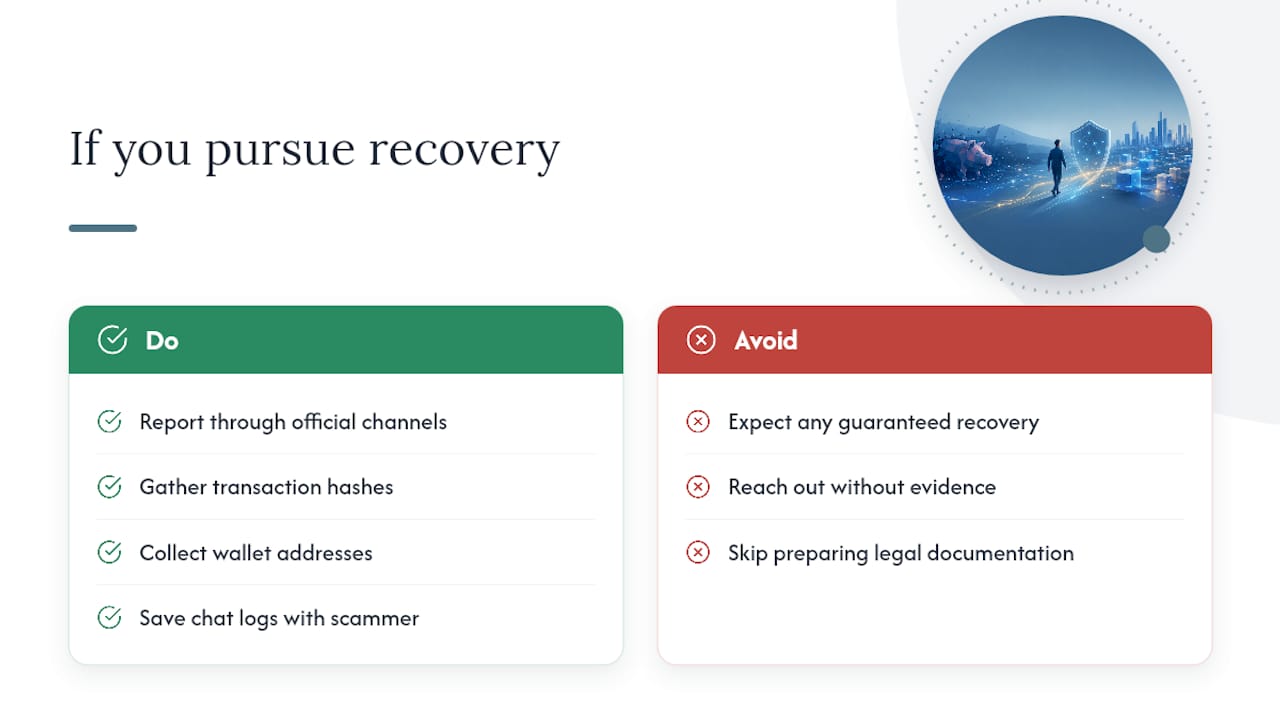
Before reaching out, gather your transaction hashes, wallet addresses, and any chat logs with the scammer. A forensic investigation can clarify where funds moved and support a freeze request, but no investigator can promise recovery given how mixers and jurisdictional gaps affect outcomes. You can review the investigation and recovery services Recovera Forensics offers to see how the process starts.
Official reporting and guidance you’ll need
- File a complaint with the FBI’s IC3, including exact wallet addresses, transaction IDs, and timestamps.
- Review FTC guidance on spotting and avoiding investment scams.
- Read the FinCEN alert describing pig butchering red flags used by financial institutions.
- See our IC3 filing walkthrough for the exact fields to include.
- For broader evidence-handling steps, this corporate fraud investigation guide covers practices that translate well to individual cases.
This article is general information, not a substitute for advice from a qualified financial advisor. Consult a qualified financial professional about your own circumstances before acting on anything here.
Sources
- Operation Level-Up: How the FBI Is Saving Victims from Cryptocurrency Investment Fraud — FBI
- 2025 IC3 Annual Report — Cryptocurrency Investment Fraud
- People losing big to investment scams, learn how to spot and avoid them — FTC
- FinCEN alert: Pig butchering (virtual currency investment scams)
FAQ
Why am I getting packages that I didn’t order?
Unexpected packages are usually a sign of a “brushing scam,” where a seller ships cheap goods to real addresses to post fake verified reviews, and are typically unrelated to a pig butchering crypto scam. If your address was compromised alongside financial accounts, check your bank and crypto exchange statements for unfamiliar activity as a precaution.
Can you get your money back if you get scammed on crypto?
Recovery is possible in some cases but never guaranteed, and it depends heavily on how quickly you report and whether funds reached a cooperative exchange before moving further. The FBI’s Operation Level Up has helped prevent losses by intervening early, which is why immediate reporting matters more than almost anything else.
I lost $16,000 to a cryptocurrency scam. How can I recover it?
Start by filing a report with the FBI’s IC3 and the FTC, including every wallet address, transaction ID, and timestamp you have. From there, a forensic investigator can attempt to trace the funds to an exchange, though recovery isn’t guaranteed and depends on how far the money has moved.
How can you tell a crypto scam?
Common signs include being pressured to invest by someone you’ve never met in person, a platform that only accepts crypto payments, and sudden fees required to “unlock” a withdrawal. The FTC also flags unsolicited investment advice from online contacts as a major red flag tied to billions in reported losses.