A crypto money mule is someone who receives or forwards illicit crypto or cash on behalf of someone else, and even unwitting participation can carry real legal risk. If you’ve already moved funds for a stranger or an online “employer,” stop transferring immediately and preserve every message, wallet address, and transaction hash. The steps below explain what to do next and how to tell if you’re being groomed for this right now.
TL;DR:
- Moving funds into personal accounts or wallets for unknown sources is a major red flag, especially if asked to convert cash quickly through crypto ATMs.
- Criminal schemes often recruit through casual job ads, social media, or dating apps, gradually building trust before escalating to large, urgent transfers.
- Immediate action such as stopping transfers, freezing accounts, and preserving evidence greatly improves chances of recovery and investigation success.
- Blockchain’s permanent transaction records allow investigators to trace related wallets across multiple exchanges, though privacy tools can slow this process.
- Professionals can provide forensic reports for legal cases but cannot guarantee fund recovery, especially if involved with mixers or cross-chain laundering.
Table of Contents
- What a Crypto Money Mule Actually Does
- How Scammers Recruit and Run Crypto Money Mules
- Warning Signs You’re Being Groomed as a Mule
- Legal Risk and How Investigators Trace Crypto Money Mules
- What to Do If You’ve Already Moved Funds
- How to Avoid Becoming a Crypto Money Mule
- When Blockchain Forensics Is Worth Paying For
- Cristian’s Take: Why the First Hour Matters More Than the Investigation
- How Recoveraforensics Can Help Once You’ve Stopped the Bleeding
- Where to Report and Get Official Guidance
- Sources
- FAQ
What a Crypto Money Mule Actually Does
Two things get conflated constantly here: the mule account and the mule actor. The account is the vehicle, a bank account or crypto wallet that funds pass through. The actor is the person controlling it, who may or may not understand what’s happening. That distinction matters in court. A “witting” mule knowingly moves stolen funds for a cut. An “unwitting” mule believes they’re doing a legitimate job, and prosecutors weigh that difference, though ignoring obvious warning signs can still expose an unwitting participant to liability.
Recognizable typologies include:
- Job-ad mules: recruited as “payment processors” or “financial agents” for a remote employer
- Romance and pig-butchering mules: manipulated by someone they believe is a romantic partner
- ATM and kiosk mules: instructed to deposit cash into crypto ATMs and send the coins elsewhere
- BEC cash-out mules: used to receive business email compromise proceeds before quick forwarding
How Scammers Recruit and Run Crypto Money Mules
Recruitment rarely looks sinister at first. Criminals run these schemes like a hiring funnel, working through job boards, social media direct messages, dating apps, and unsolicited emails offering “remote financial assistant” work. The pitch usually promises easy pay for minimal effort: receive funds, convert them, forward them along.
The operational sequence tends to follow a pattern:
- Initial contact through a job posting, dating profile, or cold message that feels ordinary
- Trust building, often over days or weeks, with a scripted, professional-sounding pitch
- A small test transaction to prove the “system works” and build your confidence
- Instructions to convert cash into crypto, frequently via a QR code or a nearby crypto ATM
- Escalating amounts, with urgency added (“the client needs this today”) to discourage questions
The scripts sound legitimate because they borrow real corporate language: onboarding paperwork, “compliance holds,” even fake employee IDs. Regulators have tracked this evolution toward Bitcoin ATMs and decentralized finance rails precisely because these tools let criminals convert and move value fast, with far less friction than a wire transfer.
Warning Signs You’re Being Groomed as a Mule
Certain requests should stop you cold, no matter how the job or the relationship is framed.
- Someone asks to route “business” or “client” funds through your personal bank account or wallet
- You’re pressured to convert money into crypto quickly, especially through a Bitcoin ATM
- Small deposits arrive from unfamiliar sources, followed by urgent instructions to forward them
- The pay is unusually high for minimal work, or structured as a percentage of what you move
- You’re told to keep the arrangement secret from your bank, family, or anyone else
No legitimate employer, romantic partner, or government agency will ever ask you to deposit cash into a personal account or send crypto to “verify” or “protect” funds. That single request is one of the most reliable scam indicators the FTC tracks.
Pro Tip: If anyone asks you to “test” the process with a small transaction before larger ones follow, treat that as the scheme revealing itself, not as proof it’s safe.
Legal Risk and How Investigators Trace Crypto Money Mules
Moving illicit proceeds, even once, can trigger frozen accounts, terminated banking relationships, and criminal exposure depending on intent and jurisdiction. Banks and exchanges routinely shut down accounts tied to fraud reports without warning, leaving mules unable to access their own remaining funds.
Blockchain records help investigators more than most people expect. Every transaction leaves a permanent, traceable hash between wallet addresses, and transaction-graph analysis lets investigators cluster related wallets across multiple exchanges, even when funds hop between blockchains. The limits show up at jurisdictional borders and with mixers or privacy coins, where tracing gets slower but rarely impossible.
Treasury’s own risk assessment treats mule networks as a structural weak point in laundering chains rather than a minor nuisance, since these networks now operate as coordinated, repeatedly deployed infrastructure rather than one-off arrangements.
Investigators and the IC3 typically request:
- Transaction hashes and wallet addresses involved
- Exact dates, amounts, and currency types
- Screenshots of chat logs, emails, or job offers
What to Do If You’ve Already Moved Funds
Acting fast changes outcomes. Follow this order:
- Stop all transfers immediately and cut off communication with the recruiter or contact
- Call your bank and the exchange or platform used, and request a hold or freeze on the account
- Preserve every piece of evidence: screenshots, transaction IDs, emails, chat logs, and any QR codes you were sent
- File a complaint with the FBI’s Internet Crime Complaint Center, which accepts reports even when no financial loss occurred yet
- Talk to a lawyer before responding to any bank or law enforcement inquiry, especially if you’re unsure whether your involvement looks witting
Voluntary disclosure, done early and with documentation in hand, generally reads far better to investigators than staying silent and hoping the account activity goes unnoticed.
How to Avoid Becoming a Crypto Money Mule
A few habits close off most recruitment attempts before they start.
- Never accept business or client funds into a personal bank account or personal wallet, period
- Insist on formal, corporate payment channels for any legitimate job; a real employer has one
- Research any employer’s registration or regulatory standing before agreeing to handle funds
- Never buy crypto or visit an ATM on someone else’s instructions, no matter how the request is framed
- Keep personal and any freelance finances in separate accounts, and use strong authentication everywhere
Government advisories aimed at students and jobseekers specifically flag “set up an account and move funds” offers as a mule recruitment pattern, not a real job. If you want a deeper look at how one common variant works, Recoveraforensics’ breakdown of romance crypto scams walks through the grooming timeline in detail. For readers still fuzzy on how wallets and addresses function at a technical level, this beginner’s guide to Bitcoin fills that gap.
When Blockchain Forensics Is Worth Paying For
Self-reporting to the FBI and your bank covers the first, urgent steps. Professional forensics becomes worth the cost once the case outgrows what a consumer complaint can accomplish.
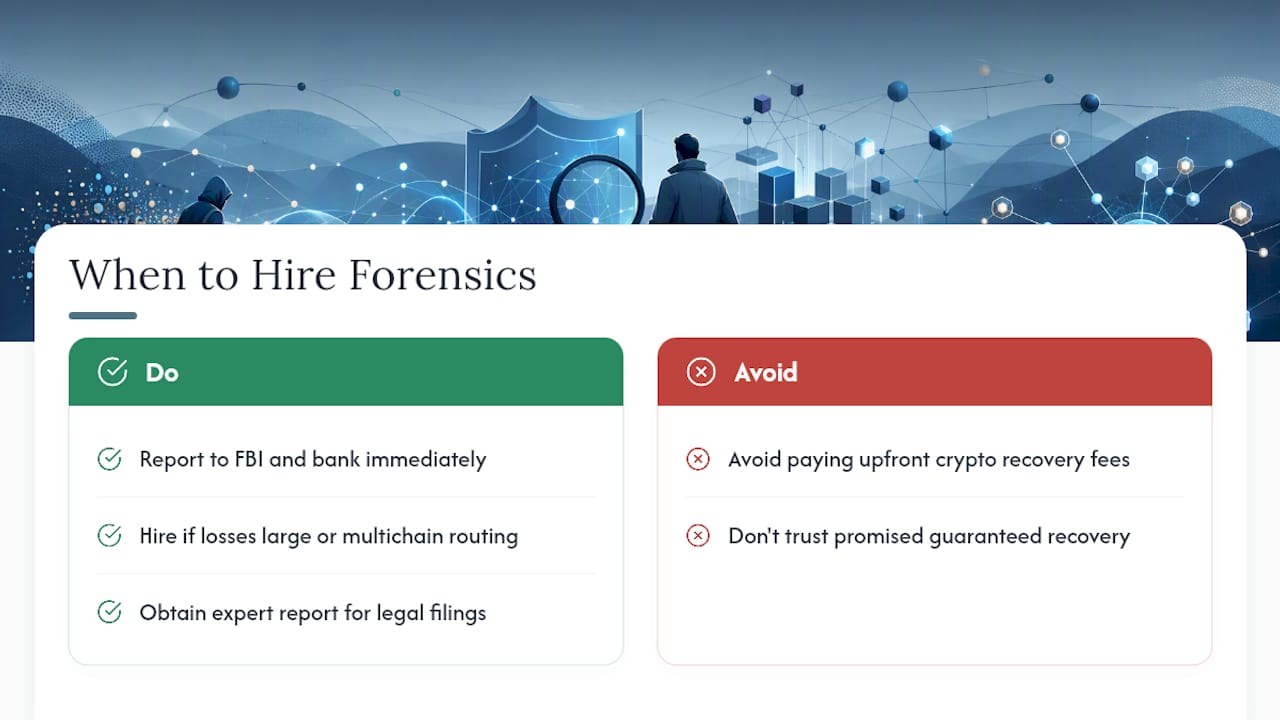
A legitimate forensic investigation can trace transaction graphs across wallets and exchanges, cluster addresses tied to a single fraud network, and produce a report formatted for legal proceedings. It cannot guarantee stolen funds come back. No credible firm will promise that, because recovery ultimately depends on cooperation from exchanges, freezing windows, and whether the funds have already been laundered through mixers.
Consider hiring an investigator when losses are large, the routing crosses multiple chains or exchanges, or your attorney needs an expert report to support a legal filing or law enforcement referral.
Be wary of anyone who asks for an upfront crypto payment to “unlock” or “recover” your stolen funds. That pattern describes a second scam layered on top of the first, not a real recovery service.
Cristian’s Take: Why the First Hour Matters More Than the Investigation
Victims usually spend the first hours after realizing what happened trying to fix it themselves, sending more messages, asking the “employer” for explanations. That delay costs more than people realize. The single most useful thing anyone can do is stop moving money and start documenting everything, immediately. Investigations can rebuild a lot from blockchain records, but they can’t undo a transfer you kept making while hoping it would resolve itself. Be equally skeptical of anyone who demands a crypto payment upfront to “recover” what you lost. That’s rarely a rescue.
— cristian
How Recoveraforensics Can Help Once You’ve Stopped the Bleeding
If you’ve already stopped transfers and filed your reports, professional tracing services can build full transaction graph analysis, cluster related wallets across exchanges, and produce forensic reports formatted for legal proceedings and law enforcement referrals, not just a screenshot of a blockchain explorer. That distinction matters when a case moves toward litigation or a formal complaint.
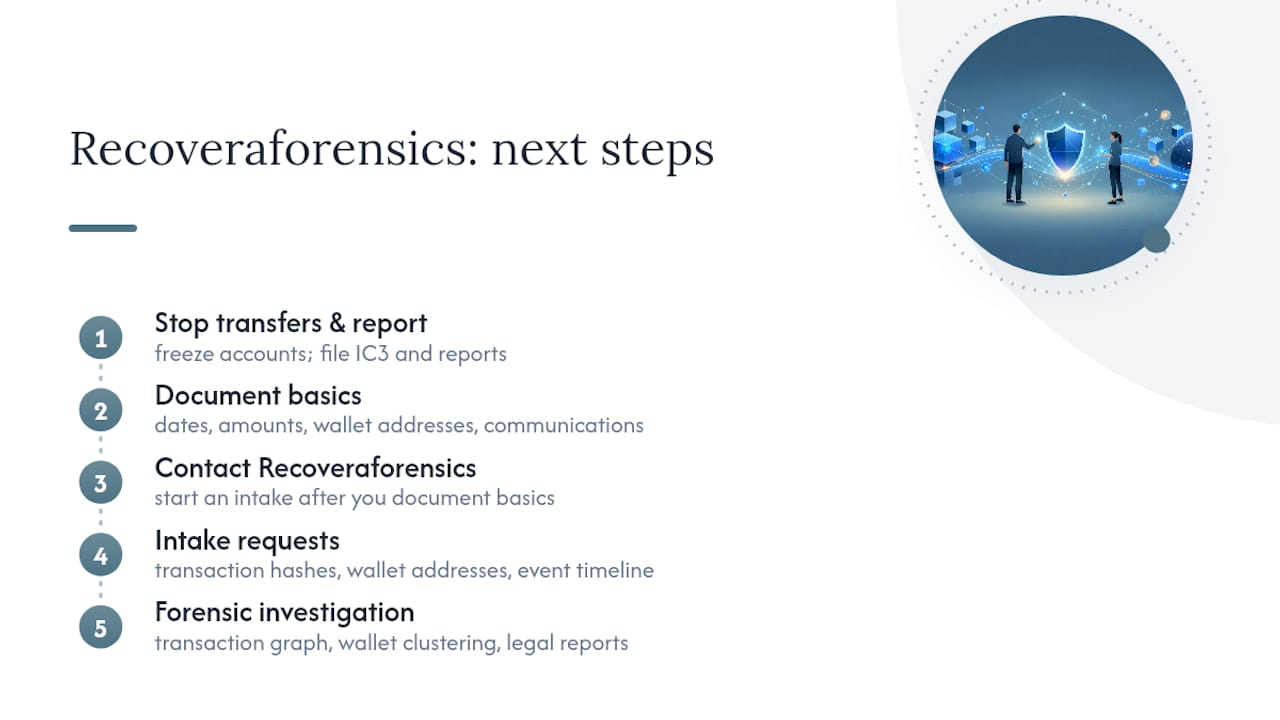
Reach out once you’ve documented the basics: dates, amounts, wallet addresses, and any communication with the recruiter or scammer. Self-help steps like freezing accounts and filing with IC3 come first; a forensic investigation makes sense once you need an expert-grade trace or a report your attorney can use. Visit Recoveraforensics to start an intake, which typically asks for transaction hashes, wallet addresses, and a timeline of events.
Where to Report and Get Official Guidance
- FBI / IC3: file a complaint for criminal investigation, even without a confirmed loss
- IC3 cryptocurrency reporting guidance: details exactly what transaction data to submit
- CFTC advisory: consumer-facing warning on becoming an unwitting mule
- FTC crypto scam guidance: consumer protection alerts and prevention tips
- Treasury’s National Money Laundering Risk Assessment: policy-level context on mule networks
This article is general information, not a substitute for advice from a qualified lawyer. Consult a qualified legal professional about your own circumstances before acting on anything here.
Sources
- Money Mules
- What To Know About Cryptocurrency and Scams | Consumer Advice
- 2026 National Money Laundering Risk Assessment
FAQ
How Can I Protect Myself From Becoming a Money Mule?
Never accept business funds into a personal account, verify any employer’s legitimacy before handling money for them, and refuse any request to convert cash to crypto on someone else’s behalf.
How Can You Tell If Someone Is a Crypto Scammer?
Look for pressure to act fast, requests for crypto payments to “verify” or “protect” funds, and refusal to use traceable, corporate payment channels; legitimate contacts don’t need secrecy or urgency.
How Do You Identify a Money Mule Account?
Mule accounts typically show a pattern of small, unrelated inbound deposits followed quickly by outbound transfers to unfamiliar wallets or accounts, often within hours.
Can the FBI Track Cryptocurrency Transactions?
Yes. Blockchain transactions are permanently recorded, and investigators use transaction hashes and wallet addresses to trace fund flow across exchanges, though cross-border and mixer-obscured funds take longer to unwind.