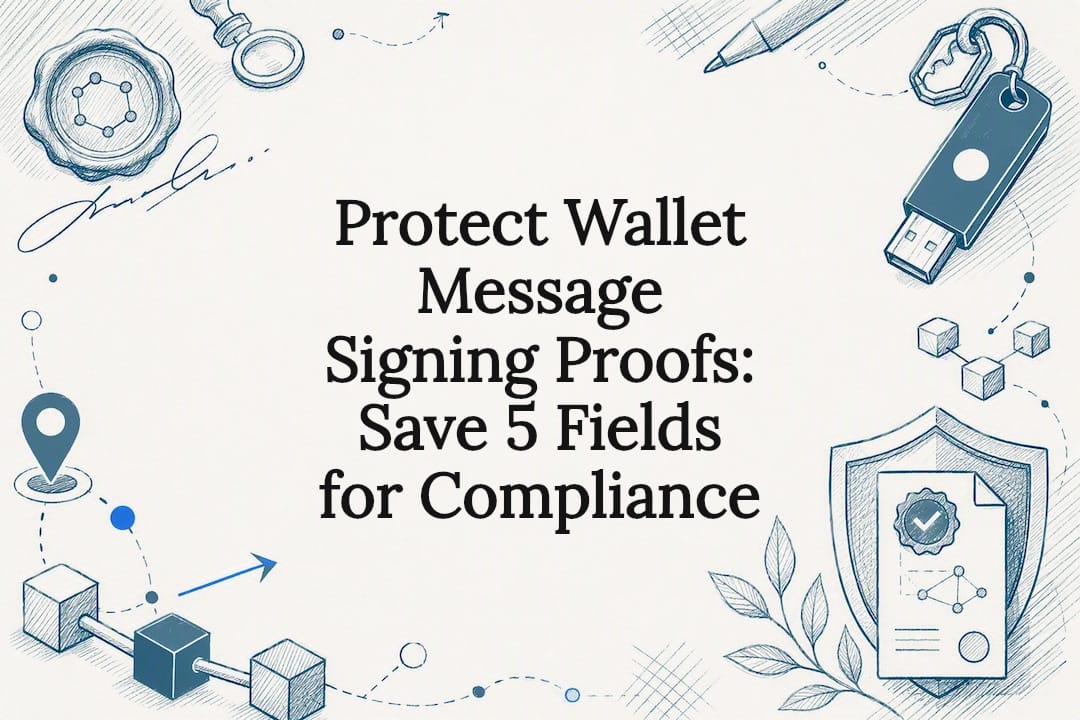
Yes, signing a specific message with your wallet produces verifiable proof that you control that address. The signature, message, and address together let anyone recover the same public key and confirm a match, no funds move. To make that proof usable later, record the signed message hash, the exact message text, the address, and a timestamp at the moment of signing, and lean on a hardware wallet with a nonce or timestamp baked into the message to block replay attempts.
TL;DR:
- Recording the signed message hash, exact message, address, timestamp, and verification result immediately after signing is essential for a reliable audit trail.
- Always verify signatures offline or through a trusted verifier before accepting proof, especially since some services do not retain the signed message hash once the event is fired.
- Use hardware wallets and confirm that the full message appears on the device screen to prevent phishing or truncated message attacks.
- Standard protocols like CAIP-375, EIP-191, EIP-712, and ERC-1271 govern wallet message signing across different chains and wallet types.
- Signed proofs alone cannot establish intent or address control history; forensic analysis of transaction graphs and activity logs may be necessary in disputes or suspected fraud cases.
Table of Contents
- Quick Checklist for Creating and Verifying a Wallet Message Signing Proof
- How to Sign a Message With Different Wallet Types
- How Do You Verify a Signed Message?
- What Are the Security Risks of Signing a Message?
- What Should You Record for an Audit Trail?
- Which Standards Govern Wallet Message Signing?
- When Do Signed Proofs Need Forensic Investigation?
- The Signature Is Only as Strong as What You Do With It
- When a Signature Isn’t Enough, Recovera Forensics Steps In
- Sources
- FAQ
Quick Checklist for Creating and Verifying a Wallet Message Signing Proof
Before you sign anything, run through these steps in order:
- Confirm you’re connected to a trusted site or app, and read the message text before approving anything.
- Use a hardware wallet when possible, and confirm the address and message shown on the device screen match what you expect.
- Capture five fields the moment you sign: the signed message hash, the exact message, the address, the timestamp, and whether verification passed (
isVerified). - Verify the signature offline, or through a verifier you trust, before treating the proof as accepted.
Skipping step 3 is the most common mistake. Some verification services, including Mesh’s wallet verification flow, don’t retain the signed message hash after the event fires, so if you don’t grab it then, it’s gone.
How to Sign a Message With Different Wallet Types
The mechanics change depending on whether you’re holding a hardware device, a mobile app, or a smart contract wallet, but the core idea stays the same: you’re asking the wallet to cryptographically stamp a specific piece of text without moving any funds.
Ledger with Electrum (Bitcoin). Unlock the device, open the Bitcoin app, and in Electrum use the Sign/Verify Message tool. Enter the address and the exact message text, then confirm the request on the device screen itself, not just in the desktop app. Ledger walks through this exact flow for proving Bitcoin account ownership through Electrum, and it’s gasless since no transaction ever broadcasts.
Trezor. Trezor Connect exposes a getOwnershipProof method that returns a structured SLIP-0019 ownership proof bundle, useful when you need proofs across several addresses at once rather than signing one at a time. You can also use the standard Sign/Verify Message flow for a single address.
Mobile wallets (MetaMask, Trust Wallet, BlueWallet). Connect to the requesting site, check that the domain in the signing prompt matches where you actually are, read the message word for word, then sign. Copy the resulting signature exactly, whitespace and all.
Smart or contract wallets. These verify differently: they use ERC-1271 for on-chain signature checks, and undeployed counterfactual addresses may need ERC-6492 wrapping so a verifier can still validate the signature before the contract exists on-chain.
- Never import a seed phrase into a random app just to sign a message. If your wallet doesn’t support signing natively, that’s a sign to switch tools, not to expose your keys.
Pro Tip: If your hardware wallet’s screen doesn’t show the full message text before you approve, stop. A truncated or blank confirmation screen is exactly the gap phishing attacks exploit.
How Do You Verify a Signed Message?
Verification is really just running the math in reverse and checking the result against what you expected.
- Recover the address from the signature. On Ethereum and other EVM chains, this means running
ecrecoveragainst the message hash and signature to get back a public address. - Compare that recovered address to the address the signer claims to control. A mismatch means the proof fails, full stop.
- Confirm the message text matches the exact string that was requested, with no edits, and check that any nonce or timestamp inside it is still fresh.
- For contract wallets, run an ERC-1271 check instead of a plain
ecrecover, since these wallets validate signatures through their own on-chain logic. - Store the signed message hash and the
isVerifiedresult. Mesh’s verify-wallets flow emits exactly this structure in itswalletMessageSignedevent, pairingsignedMessageHash,message,address,timeStamp, andisVerifiedin one payload.
Some teams offload verification to a server using JWT-based flows through providers like Web3Auth. That works fine for login sessions, but it shifts trust to the server, so it’s not a substitute for an independent, client-side check when the stakes are a dispute or a legal claim.
What Are the Security Risks of Signing a Message?
The biggest risk isn’t cryptographic. It’s what the message actually says and where the request came from.
- Phishing. Fake sites mimic real dApps and ask you to sign something that looks routine. Always check the URL and confirm the wallet connection before approving anything.
- Replay attacks. A signature without a nonce or timestamp can be reused later in a different context. The CAIP-375 standard recommends baking a nonce or timestamp directly into the signing request for exactly this reason.
- Ambiguous wording. Never sign a message that could be reinterpreted as a transaction approval or a permission grant. If the text is vague, don’t approve it.
- Seed-import risk. Moving a seed phrase into an unfamiliar app to force a signature defeats the purpose of hardware security, and support teams like Coinbase warn against this pattern.
Pro Tip: If a counterparty insists you sign something you can’t fully verify, ask for a micro-deposit or an escrowed alternative instead. A legitimate party will accommodate that.
What Should You Record for an Audit Trail?
Compliance and dispute cases hinge on five fields captured at the moment of signing, not reconstructed after the fact:
- The signed message hash
- The exact message text
- The wallet address
- The timestamp
- The verification result (
isVerified)
Grab the hash immediately. Mesh’s documentation is explicit that it doesn’t retain the signed message hash once the event has fired, so late retrieval isn’t an option. Once you have the payload, store it in an immutable log with access controls and hashed backups. That level of chain-of-custody discipline is what separates a proof that holds up in a dispute from one that just sounds convincing. Teams handling especially sensitive financial records may also want encrypted, access-controlled storage as a baseline. If you’re feeding this into a VASP compliance workflow, double check that the network ID and address format match what the counterparty system expects.
Which Standards Govern Wallet Message Signing?
A handful of specs cover almost every signing scenario you’ll run into:
- CAIP-375 defines
wallet_signMessage, a chain-agnostic RPC that supports multiple accounts and signature schemes and can link sessions for better UX and security. - EIP-191 (personal_sign) and EIP-712 are the two common EVM signing formats. Use the matching verifier for each, since they hash differently.
- EIP-1271 lets contract wallets verify signatures on-chain, which matters because a plain
ecrecovercheck won’t work for smart wallets. - SLIP-0019 structures Bitcoin ownership proofs for UTXO wallets and PSBT contexts, with a nonce field to guard against replay.
- Veriscope and GTR are VASP-focused protocols. GTR’s wallet verification flow uses a QR code the wallet owner scans and signs, letting non-custodial wallets satisfy Travel Rule checks without exposing more than necessary.
When Do Signed Proofs Need Forensic Investigation?
A clean signature doesn’t always end the story. Watch for conflicting signature provenance (two parties claiming the same address), a missing signed message hash that can’t be reconstructed, or fast, layered fund movement right after a suspected theft. Any of those is a reason to escalate past a self-service check.
A signature can prove control of a key. It cannot, on its own, prove intent, consent, or the full history of how that key came to be controlled. That gap is exactly where forensic work earns its place.
What a forensic engagement typically produces is a transaction graph connecting the disputed address to related wallets, a legal-grade report suitable for litigation or law enforcement, and documented chain-of-custody for every piece of evidence. Before reaching out, gather your signed payloads, exact timestamps, any exchange correspondence, and wallet activity logs. Recovera Forensics’ step-by-step fraud investigation guide covers what to assemble first.
The Signature Is Only as Strong as What You Do With It
Most guides on this topic stop at “sign the message, check the address, done.” That’s technically correct and practically incomplete. A verified signature tells you the private key holder approved a specific string of text at a specific moment. It says nothing about whether that person was coerced, whether the message was misleading, or whether the address has any connection to a fraud network moving funds through it right now.
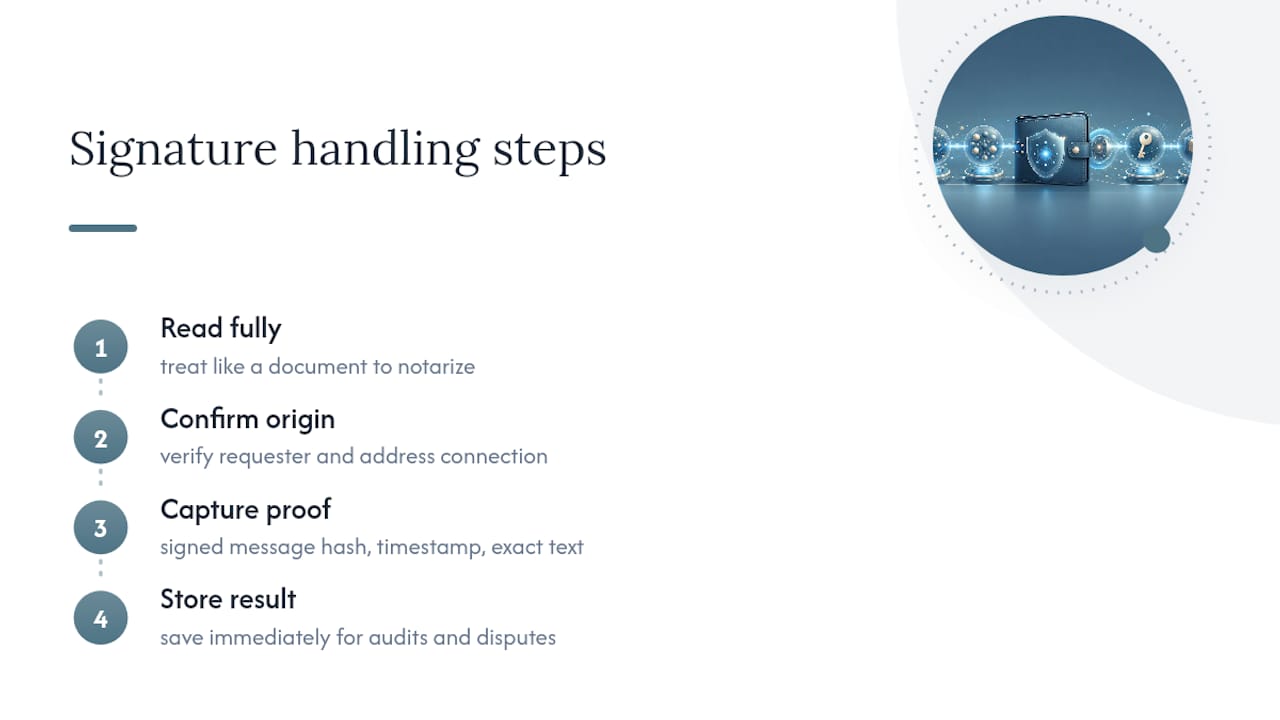
The conventional advice also underweights the audit trail. Plenty of tutorials walk through signing and verifying, then leave storage as an afterthought. In a dispute or compliance review, the proof you didn’t save is the proof that didn’t happen. Capture the signed message hash, the timestamp, and the exact text the instant you sign, not when someone asks for it later.
If there’s one habit worth building, it’s treating every signature request with the same skepticism you’d apply to a document you’re about to notarize. Read it fully. Confirm the origin. Store the result properly. The math behind message signing is solid. The failures almost always happen around it, not inside it.
— cristian
When a Signature Isn’t Enough, Recovera Forensics Steps In
A signed message proves control of an address at a moment in time. It can’t tell you whether that address sits inside a fraud network, whether funds were moved under duress, or where stolen assets ended up after the fact. That’s a different problem, and it needs a different toolkit.
Recovera Forensics builds transaction graph analysis and legal-grade forensic reports that trace fund flow across wallets, exchanges, and mixers, connecting activity that a signature alone can’t explain. Before reaching out, collect your signed-message payloads, transaction logs, and any exchange correspondence. That paperwork shortens the investigation and strengthens the eventual report.
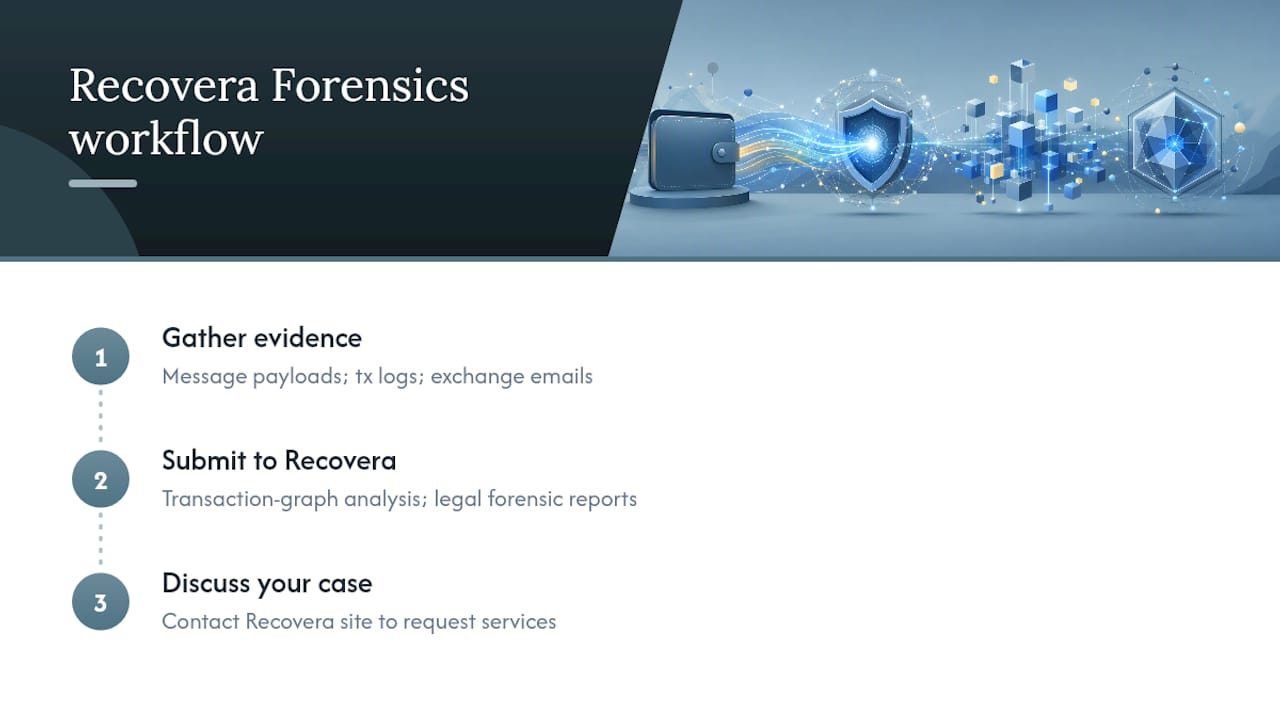
If you suspect the wallet activity behind a disputed proof involves fraud, start with Recovera Forensics’ blockchain forensics services, or reach out directly through the main Recovera Forensics site to discuss your case.
Sources
- Verify self-hosted wallets — Mesh docs
- Proving ownership of your Ledger Bitcoin account using Electrum — Ledger support
FAQ
How Do You Prove Wallet Ownership?
Sign a specific message with your wallet’s private key and share the resulting signature. Anyone can recover your address from that signature and message to confirm you control the key, no funds need to move.
What Is the 12-Word Phrase Used for in Bitcoin Wallets?
A seed phrase is a mnemonic that generates your wallet’s private keys. It should never be entered into an app or website solely to produce a signature, since that exposes full control of your funds.
Can a Trust Wallet Transaction Be Traced?
Yes. Blockchain transactions, including those from Trust Wallet, are recorded on a public ledger, and forensic tools can trace fund flow across addresses and exchanges even when the wallet itself is non-custodial.
How Do You Generate a Signature on Trust Wallet?
Connect Trust Wallet to the requesting app, review the exact message text and requesting domain, then approve the signing prompt. The app returns a signature you can share for verification without exposing your seed phrase.
What’s the Difference Between Message Signing and Transaction Signing?
Message signing produces a cryptographic proof of control without moving funds or touching the blockchain. Transaction signing authorizes an actual transfer or contract call that gets broadcast and recorded on-chain.