Crypto tracing gives a law firm a documented, repeatable account of where a client’s digital assets went, address by address, on a public ledger. It does not, by itself, tell you who was behind the wallets. A good tracing engagement pairs the on-chain trail with exchange records and other documents, and it is written so that a court can test the method. This guide explains what tracing can and cannot establish, how investigators work, what a report should contain, and how to get it ready for U.S. litigation.
TL;DR
- Tracing follows funds between addresses on a public blockchain. It shows flow and links addresses into clusters; identity usually needs off-chain evidence.
- Mixers and cross-chain bridges make tracing harder, so the method must be documented step by step, including where confidence drops.
- In U.S. federal court, tracing testimony is judged under Rule 702 and the Daubert factors: sufficient data, reliable methods, reliable application.
- Clients should preserve addresses, transaction IDs, messages and exchange details immediately, before anything is lost or edited.
- Ask the forensic team for a report built for your use: demand letter, exchange subpoena, civil filing or expert testimony.
Table of Contents
- What crypto tracing establishes in a fraud case
- How investigators follow stolen funds
- What a tracing report should contain
- Where tracing gets difficult
- Making tracing evidence hold up in U.S. court
- How a firm uses a tracing report across a matter
- What clients should preserve right away
- Our perspective
- Working with Recovera on a law firm matter
- Choosing a tracing provider: criteria that matter
- FAQ
- Sources
What crypto tracing establishes in a fraud case
Tracing is the technical process of following cryptocurrency between wallet addresses on a public ledger. In a fraud matter it can establish the path stolen assets took, group addresses that appear to be controlled together, and show where funds landed. A U.S. court filing on blockchain analysis describes it this way: the trail yields evidence that can lead to identifying perpetrators when combined with information from outside the chain.
That last clause matters for lawyers. Public blockchains are immutable, so transactions can be traced retrospectively and the record persists. But an address is not a name. The same filing treats blockchain analysis as both a source of investigative leads and, when reliable, evidence that can support search warrants or testimony.
The practical split looks like this:
| Question | On-chain tracing alone | Needs off-chain evidence |
|---|---|---|
| Where did the funds go after leaving the victim’s wallet? | Yes | No |
| Which addresses appear linked? | Often, through clustering | Corroboration helps |
| Which exchange received the funds? | Often | Account records come from the exchange |
| Who controls the receiving account? | No | Yes: KYC records, IP logs, communications |
| What did the person know or intend? | No | Yes |
A review in the Global Investigations Review practitioner’s guide makes the same point from a UK perspective: blockchain analytics is largely a tracing exercise, not a mechanism for establishing identity, attribution, knowledge or intent. U.S. litigators will recognize the lesson. Plead tracing for what it proves, and build attribution from other sources.
How investigators follow stolen funds
A tracing analyst starts from what the victim can supply: a destination address, a transaction hash, a platform name. From there the work is a disciplined walk through the ledger.
- Anchor the first hop. Confirm the victim’s outgoing transaction on the chain itself, not from a screenshot. Copying the address electronically, rather than retyping it, is a best practice noted in an OSCE guide to crypto crime investigation.
- Follow each hop. Record every transfer: time, amount, sending and receiving address, transaction ID.
- Apply clustering heuristics. Co-spend analysis (inputs spent together are likely controlled together) and change-address analysis help group addresses, as described in the same court filing on blockchain analysis.
- Choose and state an accounting method. When stolen and clean funds mix in one address, the analyst must say how the money is attributed. A U.S. Attorney’s filing in the District of Columbia describes a last-in-first-out approach used to follow funds through the intermediary addresses scammers use to obscure the trail.
- Flag endpoints. Identify where funds reach services that hold customer records, such as exchanges, because those are where legal process can reach.
- Document everything. Every conclusion should be reproducible by a second analyst working from the same public data.
On a simple theft, this can move quickly. On a layered scheme with dozens of hops, the report is as much about the quality of the method as the destination it reaches. For a deeper walk through the mechanics, see our guide to tracing the flow of funds in crypto for legal recovery and our overview of blockchain forensics.
What a tracing report should contain
A report meant for counsel is not a chart exported from software. It is a document an opposing expert can read and a judge can follow. At minimum we would expect:
- Scope and instructions. Who engaged the analyst, what question was asked, what materials were provided.
- Source data. The addresses, transaction IDs, timestamps and amounts that begin the trace, with how they were obtained and preserved.
- Methodology. The tools used, the heuristics applied, the accounting method for commingled funds, and the assumptions behind each.
- Findings by hop. A transaction-level schedule plus a readable diagram of the flow.
- Confidence levels. Where a link is firm, where it is probable, and where the trail is inferred, for example across a mixer or a bridge.
- Endpoints and next steps. The exchanges or services where funds arrived, and what records counsel could seek from them.
- Analyst qualifications and limits. What the analyst is, and is not, opining on.
The last two items protect your client. A report that overreaches on identity invites a successful challenge. One that states its limits plainly tends to survive cross-examination better. Our page for firms that need SEC-ready reports for Rule 702 and 901 goes further on report structure.
Where tracing gets difficult
Honest planning means knowing the obstacles before a deadline arrives.
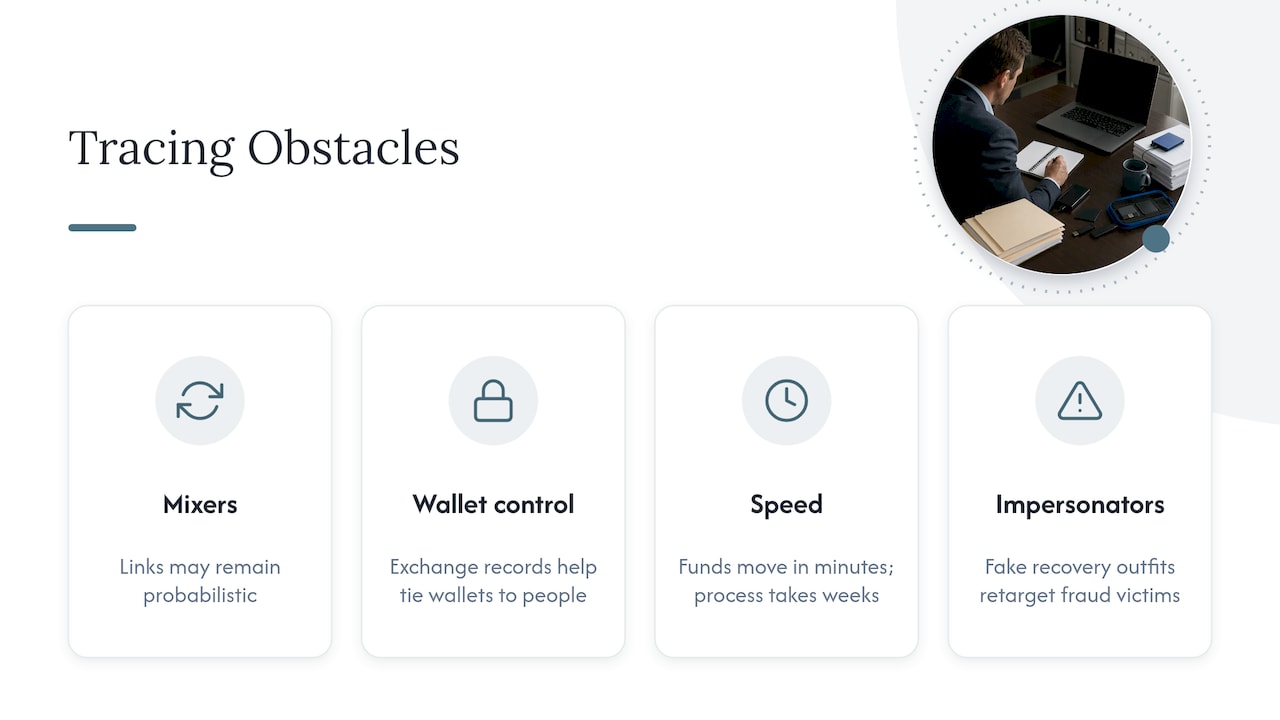
Mixers and bridges. The GIR guide notes that privacy-enhancing technologies such as mixers and cross-chain bridges make it harder to link an address definitively to an actor. Experienced analysts can often reconstruct flows through them using timing, amounts and behavior patterns, and a transparent report will state which links are probabilistic. Firms should not expect certainty in every hop.
Wallet control. Showing that a specific person controlled a specific wallet remains a hard evidentiary problem. The same guide indicates that forensic reports should integrate exchange records and other documents to tie on-chain activity to a real-world entity. In practice that means subpoenas, discovery requests and, where appropriate, referrals to law enforcement.
Speed. Funds move in minutes, while legal process moves in weeks. Early tracing identifies where assets sit so counsel can decide whether to seek preservation requests or emergency relief. Our guide on 72 hours to save stolen crypto covers why the first days matter.
Impersonators. Victims of one fraud are often targeted again by fake recovery outfits, including fictitious law firms. Counsel should warn clients about this when taking the matter.
Making tracing evidence hold up in U.S. court
In federal court, expert testimony about blockchain forensics is governed by Federal Rule of Evidence 702. The Southern District of New York’s opinion in SEC v. Terraform Labs restates the requirements: the expert’s knowledge must help the trier of fact, rest on sufficient data, and use reliable principles. In that case the court allowed expert testimony about the blockchain and related software where it would help the jury understand the evidence.
The leading criminal example on tracing software is United States v. Sterlingov (2024). The court applied Daubert, asking whether the software, principles and methods are scientifically valid and reliably applied to the facts. The Daubert factors it considered include testing, peer review, error rate and general acceptance.
Separately, a 2023 filing from the U.S. Attorney’s Office for the District of New Jersey states that law enforcement has found commercial blockchain analysis tools reliable for criminal investigations across numerous cases. That is a party’s position, not a ruling, but it shows how the government frames the tools.
What this means for a civil firm engaging a tracer:
- Choose an analyst who can explain the method in plain language. Rule 702 is about helpfulness and reliability, not jargon.
- Keep a clean evidence trail. Authentication and chain of custody for the underlying data matter. See our guides on blockchain evidence admissibility, crypto chain of custody and digital evidence preservation.
- Separate tracing from attribution. Offer the tracing as expert opinion and attribution as the product of corroborating records.
- Plan for challenge. Ask the analyst what an opposing expert would attack, and have an answer ready.
If you want a refresher on how courts weigh proof generally, this overview of the role of evidence in trials is a plain-language starting point, though crypto-specific admissibility turns on the Rule 702 analysis above. Our step-by-step piece on admitting blockchain evidence in U.S. court is more specific.
How a firm uses a tracing report across a matter
A report is rarely a single-use document. A well-built one supports several stages.
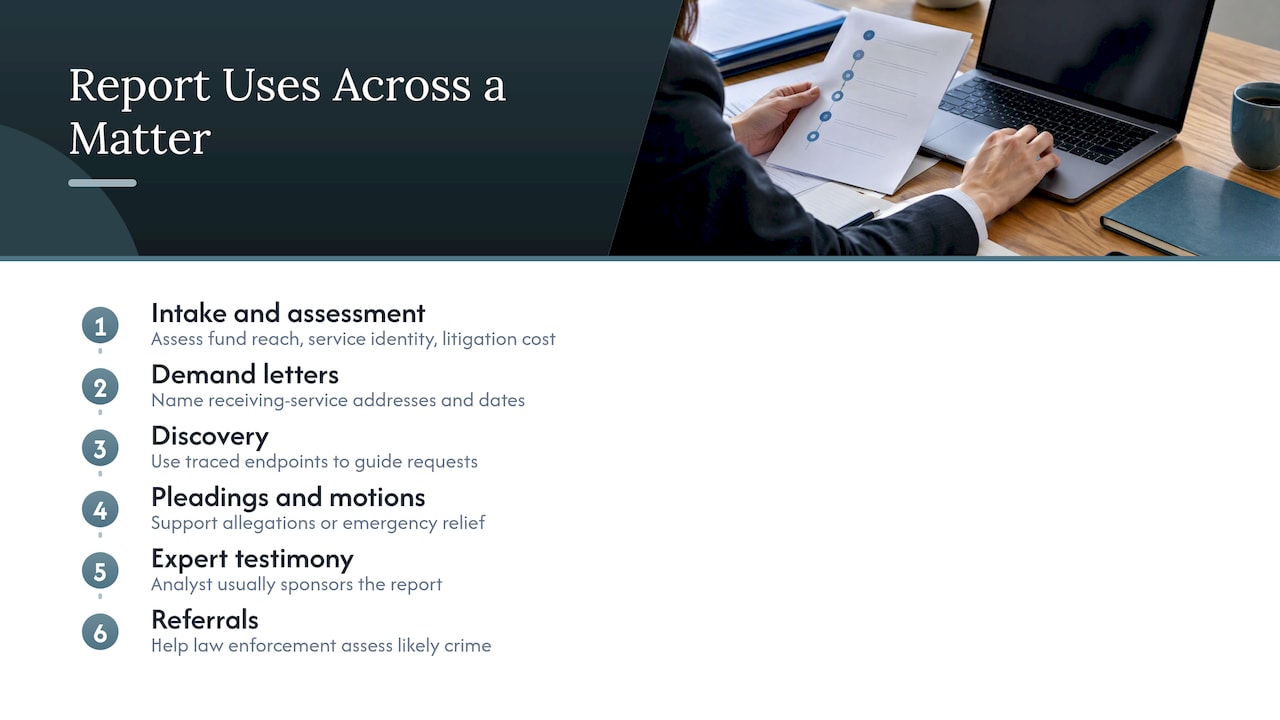
Intake and case assessment. A preliminary trace tells you whether funds are still in reach, whether they reached an identifiable service, and whether the matter justifies the cost of litigation.
Demand and preservation letters. Transaction-level findings let you send a precise letter to a service that received funds, naming addresses and dates instead of generalities.
Discovery and subpoenas. Endpoints identified by tracing guide what to request, from whom. Records tying an exchange account to a person are what convert a flow chart into attribution.
Pleadings and motions. Findings can support allegations in a complaint, or the factual showing needed for emergency relief. Counsel should confirm with their own research what the court expects for the claims at issue.
Expert testimony. The analyst who prepared the report is usually the one who sponsors it, so the report should be written with that testimony in mind.
Referrals. Where criminal conduct is likely, a clear report helps law enforcement assess the case. Our guide on whether police investigate crypto scams explains what agencies tend to need, and the page on wire fraud in crypto cases covers the federal angle.
When the matter involves exchange-to-exchange transfers, the crypto Travel Rule can also inform what information receiving services should hold about senders and recipients.
What clients should preserve right away
The quality of a trace depends heavily on what the client keeps. Tell clients, in writing, to preserve:
- Wallet addresses involved, copied electronically rather than retyped
- Transaction IDs and the exchange or platform used for each transfer
- Messages, emails, call logs and social media conversations with the other party
- Promotional material, websites and advertisements that induced the investment, captured with dates
- Account statements, deposit receipts and bank records for any fiat leg
The OSCE guide cited above lists these items as what victims should document promptly. Tell clients not to delete chats, close accounts or move remaining funds without advice. For a client-facing checklist, point them to our 24 to 72 hour investigator checklist, and for the wider picture our crypto fraud investigation action guide.
Our perspective
Most weak tracing reports fail for the same reason: they were written as a picture, not as testimony. A diagram that shows funds moving from A to B is easy to produce. A document that tells a court how each link was found, what could be wrong, and what it does not prove is harder, and that is the one a lawyer can use.
We build our work around that difference. We analyze transaction patterns on public blockchains, connect wallet activity to wider fraud networks, and write forensic reports for legal proceedings. We reconstruct complex flows, including through mixers and bridges, and we say plainly where confidence changes. We collaborate directly with law firms so the report answers the question counsel actually has, whether that is a demand letter, discovery plan or filing.
We also think victims deserve a transparent process. Clients should know what we are examining, what we expect to find, and what further evidence a case will need. That honesty is part of why a report holds up.
cristian
Working with Recovera on a law firm matter
We provide technical analysis of crypto fraud, technical reports and documentation, and support for Forex and online trading fraud cases for firms that need forensic backing. Details are on our professional offices page. If your client is an individual who has just been defrauded, our digital fraud investigation and crypto recovery services cover scam investigation, OSINT and digital attribution, and evidence preservation. Fees are set per engagement, so contact us through our site with a short description of the matter.
Choosing a tracing provider: criteria that matter
You will meet several types of provider: in-house analytics teams at large advisory firms, software vendors who sell tools to agencies, solo consultants, and specialist forensic firms. Compare them on the points that decide whether the work survives scrutiny:
- Testimony readiness. Will the person who did the analysis explain it under oath, and have they done so under Rule 702 standards?
- Method transparency. Can they describe heuristics, accounting method and error handling without hiding behind software?
- Handling of obfuscation. Do they have a documented approach to mixers and bridges, and do they grade confidence?
- Evidence discipline. Do they preserve source data and keep custody records?
- Honest scoping. Do they separate tracing from attribution and decline to promise recovery?
- Communication. Will they work with your timeline and your client’s circumstances?
Be cautious of anyone who guarantees recovery or asks for an upfront fee while claiming legal authority. Fake law firms and recovery services target fraud victims specifically.
FAQ
Can a tracing report identify the person behind a wallet?
Not by itself. Tracing shows flow between addresses and can cluster them, but identity generally depends on exchange records, account data or other documents. A strong report integrates those sources when counsel obtains them.
Will a court accept crypto tracing evidence?
Courts have accepted blockchain analysis testimony when the method meets Rule 702 and Daubert reliability standards, as in the Sterlingov and Terraform decisions discussed above. Admission is decided case by case, so the report should document data, method and application clearly.
How should a firm explain tracing limits to a client?
Say that tracing can show where funds went and where records may exist, but cannot promise recovery. Mixers, bridges and difficulty proving wallet control can slow or limit the outcome. Setting those expectations early protects the relationship.
What should a client send before the first call?
Send wallet addresses, transaction IDs, the platform or exchange used, and all communications and promotional material from the scammer. Also include bank records for any fiat transfers. Ask the client to keep originals untouched.
Sources
- Using Blockchain Analysis From Investigation to Trial (U.S. court filing)
- U.S. Attorney’s Office, District of Columbia filing on LIFO tracing
- Global Investigations Review: Cryptocurrency and Blockchain, the UK Perspective
- United States v. Sterlingov (2024)
- U.S. Attorney’s Office, District of New Jersey filing (2023)
- SEC v. Terraform Labs, Opinion and Order (December 2023)
- OSCE: Decoding Crypto Crime