You can trace a Cardano transaction with nothing more than its transaction hash and a public blockchain explorer. Paste the hash into the explorer’s search bar, read the inputs and outputs, then repeat the process for every address that received the funds. The first hop takes minutes. Following stolen funds through dozens of later hops, and turning that trail into evidence a court or investigator can use, is where the real work starts.
This guide walks through both parts: the do-it-yourself reading of a Cardano transaction, and what changes when the money was stolen and the results need to hold up.
TL;DR
- A Cardano transaction hash is a 64-character hexadecimal ID. Search it in an explorer to see senders, receivers, amounts, fees and metadata.
- Cardano uses a UTXO model, so one transaction can have many inputs and outputs, and a wallet can use many addresses. Tracing means following outputs, not account balances.
- An address does not name a person. Linking it to one usually requires off-chain data, such as exchange records obtained through legal process.
- If you lost ADA to a scam, preserve your records first and report to the FBI’s IC3 with hashes, addresses, amounts and timestamps.
- No tracing method can promise identification or recovery. A good trace gives you facts and a documented trail to act on.
Table of Contents
- What a Cardano transaction hash tells you
- How to trace a transaction in a Cardano explorer
- Following funds across several hops
- Can a Cardano address be linked to a real person?
- If your ADA was stolen: what to do with the trace
- Turning a trace into evidence
- Perspective: why a hand-made trace is only the beginning
- Can tracing guarantee identification or recovery?
- How professional tracing differs from checking an explorer
- Get a Cardano trace you can use
- Common mistakes when tracing Cardano transactions
- FAQ
- Sources
What a Cardano transaction hash tells you
Every Cardano transaction has a unique identifier, the transaction hash, also called the txhash or transaction ID. It is a 64-character hexadecimal string you can look up on chain. Your wallet’s activity list shows it, and so does the confirmation screen of most exchanges after a withdrawal.
If you were scammed, the hash is the most valuable single item you have. It is the anchor of the whole investigation. Copy it from your wallet or exchange history rather than retyping it, and keep a screenshot of where you found it.
How to trace a transaction in a Cardano explorer
A blockchain explorer is a public website that reads the chain and displays it in a human-readable way. Cardanoscan, Cexplorer and AdaStat are common choices. The Cardano Developer Portal describes the basic method: copy the transaction hash from your wallet activity and paste it into the explorer’s search bar to see the full details, including sender and receiver addresses.
Step 1: Start from the hash you have
Search the hash. The page that opens is the transaction record. It exists permanently and cannot be edited by the recipient.
Step 2: Read what the page shows
A typical transaction page lists the hash, block number, epoch, timestamp and confirmations, plus the input addresses (where the ADA came from) and output addresses (where it went) with amounts. It also shows the fee, any minted or burned tokens, and attached metadata or certificates.
Two details trip up beginners:
- Change outputs. Cardano follows the UTXO model. If the inputs do not exactly cover the outputs plus the fee, one output returns the remainder to a change address controlled by the sender. So a transaction with two outputs often means one payment and one change, not two payments.
- Metadata. Transactions can carry numbered metadata labels. Label 674 holds a plain-text message and label 721 holds token metadata. A message attached to a scam payment can be useful context, so capture it.
Step 3: Identify the destination output
Find the output that matches the amount and address you sent to. Ignore the change output for now. Click that destination address.
Step 4: Open the address and look for what happened next
The address page lists every transaction the address has taken part in. Look at what happened after your funds arrived. Did they sit there? Were they split into several smaller outputs? Did they move within minutes? Rapid splitting across many addresses is a common pattern when someone is trying to make the trail harder to follow.
Step 5: Check the stake key
A Cardano wallet is not a single address. Wallets can generate many, and explorers can decode the stake key attached to an address, which shows other addresses that belong to the same stake key and likely the same wallet. This helps you see that five addresses may be one person’s single wallet. It also has limits, covered below.
Following funds across several hops
One hop is easy to read by eye. Ten hops is not. Each hop produces a new transaction with new inputs and outputs, and a single payment can fan out into many branches.
Two approaches exist.
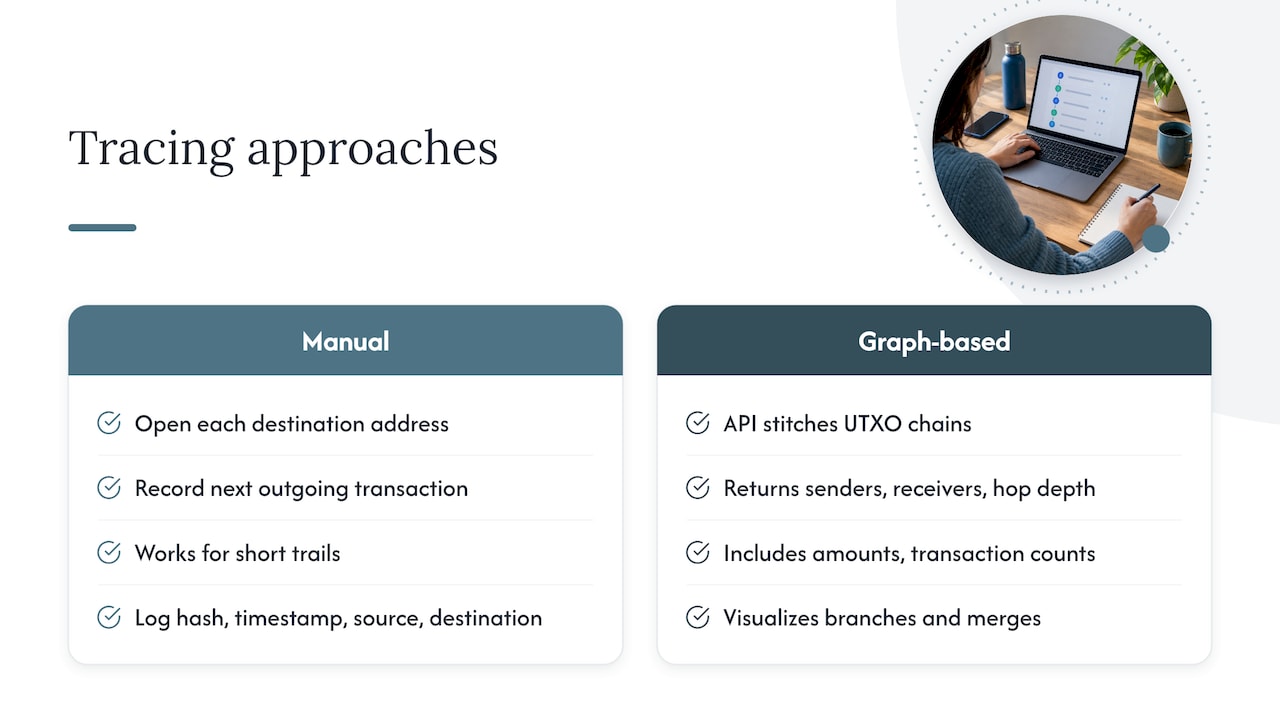
Manual tracing. You open each destination address, note the next outgoing transaction, and record it in a spreadsheet. This works for short trails. Log the hash, timestamp, source, destination, amount and your observation for every hop.
Graph-based tracing. Data providers expose APIs that stitch UTXO chains together. For example, Coinpath for Cardano returns senders, receivers, hop depth, amounts and transaction counts across multiple hops. Investigators combine such outputs into a visual graph so that branches, merges and consolidation points are visible at once. Our own write-up on transaction graph analysis explains the methods and models behind this, and our guide to the flow of funds in crypto shows how that trail is presented for legal recovery.
The point where a trail ends in a way you can act on is usually a deposit into an exchange or other service that holds customer identity records. That is the moment a trace stops being a curiosity and becomes a lead.
Can a Cardano address be linked to a real person?
Not from the chain alone. A cryptocurrency address does not contain personal identifiers. Linking one to a person typically needs off-chain data such as exchange KYC records, subpoenas or open-source intelligence, and obfuscation methods can complicate the picture.
The same principle applies to your own addresses. If you hold ADA, the history of your own wallets is part of your financial record, and keeping it organized matters for reporting too. The practical side of tying wallet activity to a named taxpayer is covered in this piece on audit-ready crypto records, which shows how the link between an address and an identity is established from the owner’s side.
Why clustering is not proof
Investigators group addresses into clusters that probably share a controller. That is useful, but it is a heuristic. Research on Cardano specifically finds that clustering can produce false positives: transactions with several users may group unrelated addresses, and so-called Franken addresses can connect addresses belonging to different people.
The practical lesson: treat a cluster as a lead and not a conclusion. A report that states the confidence level of each link, and explains why, is far more credible than one that asserts ownership.
If your ADA was stolen: what to do with the trace
Speed and documentation matter more than cleverness. Here is a sensible order.
- Stop interacting. Do not send more funds to anyone offering to “release” or “recover” your assets. Follow-up demands are a common second wave of the same scam.
- Save the raw material. Keep the transaction hashes, the addresses involved, screenshots of chats, emails, websites and wallet screens. Do not edit or rename originals. Our guide to digital evidence preservation covers what makes this material usable later, and chain of custody for crypto explains why who handled it and when matters.
- Capture the scammer’s emails. Headers carry information that screenshots do not. See how to trace a scam email.
- Report to the FBI. U.S. victims should file a complaint with the Internet Crime Complaint Center (IC3) and include cryptocurrency addresses, amounts and types, transaction hashes, and dates and times. The tracing steps above produce exactly those details.
- Record your trace. Document each hop with the hash, time and amount, so another person can repeat your steps and reach the same result.
- Consider professional help early. Funds that reach an exchange can sit there only for a limited time. Our 24 to 72 hour investigator checklist lays out what to do first.
If you are wondering what police will do with your report, see what to report to trigger police crypto investigations.
Turning a trace into evidence
A trace you made by clicking through an explorer is an excellent starting point, but a court or a law firm will ask how it was produced, whether it can be reproduced, and who is vouching for it.
U.S. courts have shown they will engage with this kind of analysis. A 2022 law firm review of Bitcoin cases notes that courts recognized blockchain analysis software as reliable enough to support probable cause for search warrants, by tracing funds and linking addresses through pattern recognition. That discussion concerned Bitcoin, but the reasoning about method and reliability is what matters for any chain.
What a defensible report generally contains:
- A clear statement of the question asked and the data used.
- Every hop, with hash, timestamp, amount and source of the data.
- The reasoning behind each address link, with a confidence level.
- Screenshots and exports with capture dates, handled under a documented chain of custody.
- A plain statement of what the analysis cannot show.
For the legal side, see our guides on admitting blockchain evidence in U.S. court, blockchain evidence admissibility and forensic affidavits.
Perspective: why a hand-made trace is only the beginning
In our work, the first trace a victim brings us is usually correct as far as it goes. The explorer shows the chain faithfully. What it cannot do is tell you which of the next ten branches matters, whether a cluster of addresses is one actor or a coincidence, or how to present all of it so a lawyer can rely on it.
That is why we build the investigation around the report. We analyze transaction patterns on public blockchains, follow funds through splits, bridges and mixers, and connect wallet activity to wider fraud networks where the evidence supports it. We designed our approach to go deeper than basic wallet tracking, because a list of addresses is not the same as an explanation.
We also work directly with law firms, so our reports are prepared with legal proceedings in mind: documented methods, preserved evidence, and clear language about what is established and what is inferred. We treat victims with respect. You did not do something foolish by being targeted by a professional fraud, and a transparent process is the least you are owed.
cristian
Can tracing guarantee identification or recovery?
No, and any provider that promises otherwise should make you cautious. Tracing establishes where funds went. Whether they can be frozen, returned or attributed depends on where they ended up, how fast action was taken, whether a regulated service holds identity data, and whether a court or agency acts on the findings.
What a trace does reliably is turn a loss into a documented case. It gives you hashes and timelines for IC3, for your attorney, and for any exchange compliance team that receives a legitimate request. Our page on the lack of a universal crypto recovery success rate explains this plainly, and our guide on whether a crypto recovery offer is a scam risk helps you screen out the fake recovery services that target victims a second time.
How professional tracing differs from checking an explorer
| Aspect | Doing it yourself in an explorer | Forensic investigation |
|---|---|---|
| Starting point | One hash or address | Full case file: hashes, communications, emails, wallet history |
| Depth | A handful of hops by hand | Complex flows, splits, bridges and mixers |
| Address links | Observed on screen | Reasoned, with confidence levels and false-positive checks |
| Output | Notes and screenshots | A technical report built for legal proceedings |
| Evidence handling | Informal | Preservation and documented chain of custody |
| Best for | Understanding what happened | Supporting a report, a lawyer or a claim |
For a wider view of the discipline, see our overview of blockchain forensics, and for the difference between automated alerts and a real case, transaction monitoring versus investigation.
Get a Cardano trace you can use
If you lost ADA or other crypto to fraud and want the trail documented properly, our cryptocurrency scam investigation services cover stolen-asset tracing, wallet activity analysis, OSINT and attribution, and preservation of evidence and digital footprint. Law firms can work with us through our services for professional offices, including technical reports and documentation. We do not publish prices, since each engagement depends on the case. Start by sending the hashes and a short timeline.
Common mistakes when tracing Cardano transactions
- Treating change as a payment. The smaller output going back to the sender’s own wallet is not a second recipient.
- Trusting a cluster as identity. Grouped addresses are a hypothesis until corroborated.
- Stopping at the first address. The first address often just forwards funds. The interesting point is later.
- Losing the original context. Without the chat logs, emails and site captures, the hashes lose their story.
- Paying for a rescue. Unsolicited recovery offers after a scam are a known follow-on tactic. Verify before you pay anyone.
FAQ
How do I find a Cardano transaction if I only have a wallet address?
Open a Cardano explorer and search the address. Its page lists every transaction it took part in, with hashes and timestamps. Click the transaction that matches your payment and follow its outputs from there.
Can I see who owns a Cardano wallet?
Not directly. Addresses carry no personal identifiers. Ownership generally comes from off-chain records, such as exchange account data obtained through legal process, which is why reporting and legal channels matter.
Is Cardano harder to trace than Bitcoin?
Both are public ledgers built on the UTXO model, so the basic method is similar: follow outputs from one transaction to the next. Cardano wallets use many addresses and stake keys, so the work lies in grouping addresses correctly without creating false links.
Where should I report a Cardano scam in the United States?
File a complaint with the FBI’s IC3 at ic3.gov. Include addresses, amounts, asset types, transaction hashes and dates and times. Keep copies of everything you submit.
Sources
- Cardano Setup, Cardano Developer Portal
- How to Read a Cardano Transaction on Cardanoscan
- Understanding Cardano transactions and the Cardano Explorer
- My ADA are gone! First Aid Collection, Cardano Forum
- Cardano Coinpath API, Bitquery documentation
- What Is Crypto Tracing?
- Heuristic-Based Address Clustering in Cardano Blockchain
- Cryptocurrency, Internet Crime Complaint Center (IC3)
- Blockchain analytics in the courts, Norton Rose Fulbright