Telegram crypto scams are real, well organized, and capable of draining a wallet in minutes. If you suspect you’re mid-scam right now, stop responding immediately, screenshot every message, and record any transaction hashes before you do anything else. Then revoke wallet approvals through a block explorer and move remaining funds to a fresh wallet if it’s still safe to do so.

The scale of this problem is not abstract. Multi-asset scams, including crypto and tokenized assets, drove more than $442 billion in global financial losses through 2025. A meaningful share of that traces back to messaging-app fraud, and Telegram’s open structure makes it a favorite staging ground.
If you think you’re being scammed right now, do this immediately:
- Stop replying and mute or leave the chat, but don’t delete it yet.
- Screenshot usernames, messages, group names, and any shared links.
- Save every transaction hash and wallet address involved.
- Revoke token approvals on a block explorer and disconnect any connected dApp.
- Move uncompromised funds to a new wallet with a fresh seed phrase.
Key Takeaways
Telegram crypto scams succeed by combining manufactured urgency with private, unverifiable conversations, and the single most effective countermeasure is independent verification before any wallet action.
| Point | Details |
|---|---|
| Scale of the threat | Multi-asset scams caused over $442 billion in global losses in 2025, with Telegram a major vector. |
| Recognize the funnel | Ads and bridge sites push victims into Telegram DMs where voice notes and PDFs build false trust. |
| Apply the checklist fast | Never share seed phrases or sign unlimited approvals; treat urgency and guaranteed returns as automatic red flags. |
| Harden accounts and wallets | Use two-step verification, hardware wallets, burner wallets, and periodic approval audits. |
| Preserve evidence immediately | Screenshots, transaction hashes, and chat exports are what make tracing and legal action possible. |
Table of Contents
- What Are the Most Common Telegram Crypto Scams?
- How Does the Telegram Investment Scam Funnel Actually Work?
- What Red Flags Signal a Telegram Crypto Scam?
- How Do You Protect Your Telegram Account and Crypto Wallet?
- What Should You Do Immediately After Getting Scammed?
- What Does a Blockchain Forensics Investigation Involve?
- Sources
- FAQ
What Are the Most Common Telegram Crypto Scams?
Most Telegram crypto scams follow a handful of well-worn scripts. Recognizing the pattern matters more than memorizing every variation, because scammers rotate names and coins constantly while the mechanics stay nearly identical.
- Fake admin or support impersonation. Someone claiming to be a group moderator or exchange “support agent” DMs you about a wallet issue and asks you to “verify” by sharing a seed phrase or clicking a login link.
- Giveaway and airdrop scams. A channel announces a free token drop but requires you to connect your wallet or pay a small “gas fee” first, which is really a wallet-drain trigger.
- Fake trading or prop-firm services. These groups sell signals or managed accounts and quietly harvest login credentials through a linked platform. F‑Secure documented one such operation that began as an Instagram ad and ended with victims typing passwords into a fake broker portal inside Telegram.
- Wallet-draining Mini Apps. Fraudulent Telegram Mini Apps present themselves as legitimate dApps, then request broad token-transfer permissions the moment you connect your wallet.
- Pump-and-dump channels and fake presales. Paid “signal groups” hype a low-cap token, insiders sell into the pump, and latecomers are left holding a worthless bag.
Pro Tip: If a group pushes you to act within minutes, that urgency is the scam, not the opportunity. Legitimate projects don’t need you to decide before your coffee gets cold.
How Does the Telegram Investment Scam Funnel Actually Work?
The path into a Telegram investment scam rarely starts on Telegram. It usually begins with a paid ad on Instagram or TikTok promoting a trading mentor or “AI-powered” investment tool. Clicking through lands you on a slick bridge site, a landing page built just to collect your contact details and funnel you into a Telegram chat with a “personal advisor.”
Once inside Telegram, the manipulation gets patient. Investigators at F‑Secure found operators using voice notes, PDF performance reports, and staged screen recordings to simulate a real advisory relationship before ever asking for money or credentials.
The trust-building phase can stretch over days. By the time a victim is asked to enter login details into a “verification portal,” the request feels routine rather than alarming, because dozens of earlier messages already established a false rapport.
Because the entire relationship happens in private DMs, there’s no public trail for other users or platforms to flag. That privacy is exactly what suppresses detection and reporting.
- Bridge sites collect leads and route them into Telegram, often through affiliate links.
- Voice notes and PDFs manufacture the appearance of institutional legitimacy.
- Private one-on-one contact removes any bystander who might warn the victim.
- Operators monetize through direct “fees” and through affiliate commissions paid for each recruited victim.
What Red Flags Signal a Telegram Crypto Scam?
Run through this checklist the moment something feels off. Most Telegram crypto scams fail this test within the first two items.
- Any request for your seed phrase, private key, API key, or 2FA code. No legitimate exchange, wallet provider, or admin will ever ask for these. Full stop.
- A wallet connection request tied to an “approval” you don’t fully understand. Check what the contract actually asks for before signing, and never grant unlimited token approvals to an unfamiliar address.
- Guaranteed returns, doubling promises, or pressure to act “before the window closes.” Real markets don’t guarantee anything, and urgency is a manipulation tactic, not a market condition.
- Requests to pay off-platform through gift cards, wire transfers, or a “trusted” third-party escrow account.
- Lookalike usernames, brand-new accounts, or unsolicited DMs from “support.” Verify independently through the project’s official website, never through a link someone sent you in chat.
Kaspersky recorded a 53% jump in Telegram scam discussion in a single year, a sign that these tactics are scaling faster than most users’ awareness of them.
How Do You Protect Your Telegram Account and Crypto Wallet?
Securing yourself against a Telegram cryptocurrency fraud attempt takes two separate tracks: locking down the app itself and hardening how you interact with wallets and smart contracts.
- Turn on two-step verification in Telegram settings and review your active sessions regularly to catch any device you don’t recognize.
- Restrict who can message you. Telegram lets you limit DMs to contacts only, which cuts off a large share of cold-outreach scam attempts before they start.
- Use a hardware wallet for long-term holdings and keep a separate burner wallet, funded lightly, for testing new dApps or Mini Apps.
- Never reuse a seed phrase across wallets. One compromised app should never mean every holding is exposed.
- Audit and revoke old approvals periodically using an on-chain explorer’s token approval checker, and be cautious with “permit” style signatures under EIP-2612, since a signed unlimited approval can let an attacker move funds without a second confirmation.
- Bookmark official project links directly rather than clicking anything forwarded in a group, and avoid Telegram-based escrow or peer-to-peer deals that skip a regulated third party entirely.
Pro Tip: Set your burner wallet up with just enough crypto to cover a handful of transactions, nothing more. If it drains, the loss is a lesson, not a disaster.
What Should You Do Immediately After Getting Scammed?
The first 48 to 72 hours determine whether an investigation has anything to work with. Treat this like a small crime scene: preserve first, react second.
- Export or screenshot the full conversation before the scammer deletes the account, capturing usernames, timestamps, group names, and any bridge-site URLs.
- Record every transaction hash and wallet address tied to the loss, since these become the backbone of any later tracing effort.
- Revoke any wallet approvals immediately and move remaining, uncompromised funds to a brand-new wallet with a new seed phrase.
- Report the account to Telegram directly, and if fiat currency touched the transaction at any point, contact your bank or payment provider the same day. Early reporting sometimes still allows a chargeback or faster tracing window.
- File reports with law enforcement, including the FTC and the FBI’s IC3, attaching every piece of evidence you gathered in step one.
Pro Tip: Don’t wait for a “big enough” loss to report. Small early reports build the pattern data that eventually catches repeat operators.
Once you’ve documented everything, an important question follows: does this need professional tracing? If the scam involved multiple wallet hops, a bridge site with an affiliate code, or a sum large enough to justify legal action, that’s the signal to bring in a forensics specialist rather than trying to trace it yourself.
What Does a Blockchain Forensics Investigation Involve?
A proper investigation traces stolen funds through wallet clustering, transaction mapping, and OSINT research linking wallet activity to real infrastructure, exchange accounts, affiliate codes, or hosting records tied to the scam.
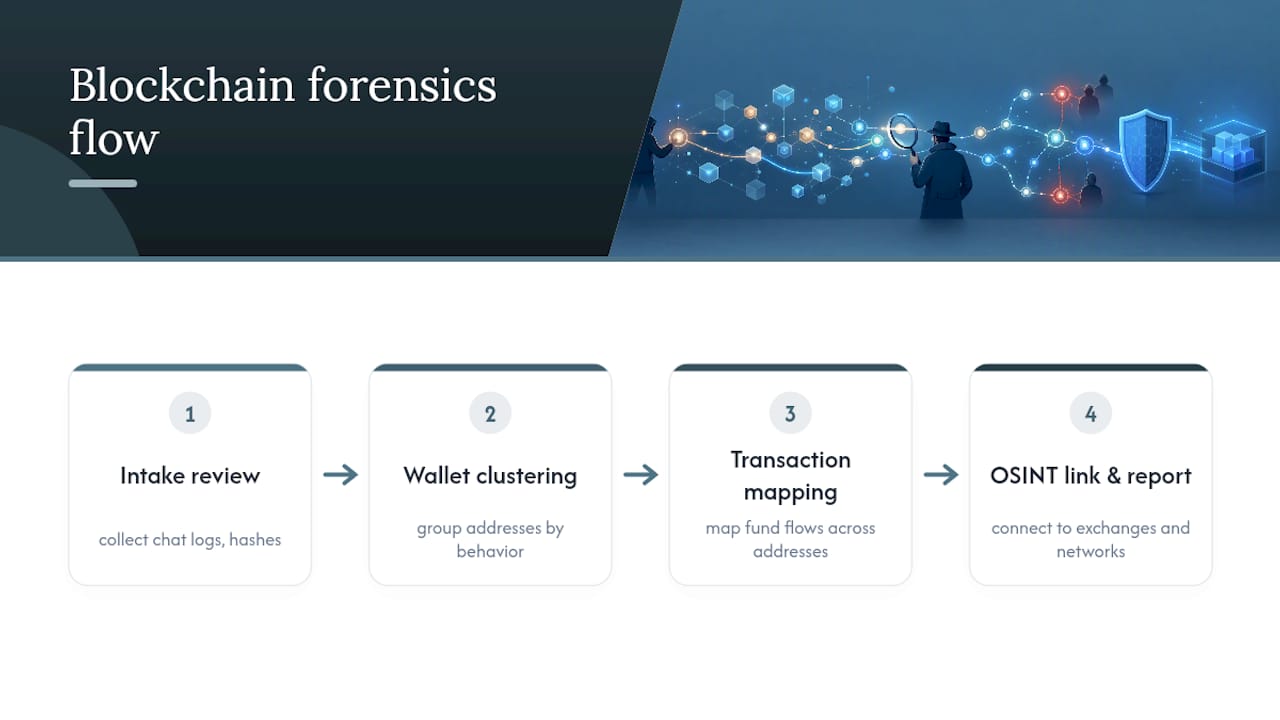
Evidence that speeds this process along includes chat logs, transaction hashes, screenshots of the bridge site, and any affiliate or referral codes visible in the original message thread. Recovera Forensics builds this material into a technical forensic report suitable for legal proceedings, connecting wallet movement to broader fraud networks rather than stopping at a single address.
Tracing funds is not the same as guaranteeing their return; recovery depends on where the funds moved and whether they touched a regulated exchange. Timelines and costs vary case by case, but victims with organized evidence and larger losses generally get the clearest answers fastest. Recovera Forensics begins with an intake review of your case documentation before scoping the investigation.
Author note: the one habit that stops most of these scams
Verify through the official channel, always, before you act on anything urgent in a DM. I’ve seen victims lose funds not because they were careless, but because a convincing voice note replaced five seconds of independent checking. That pause is the whole defense.
Sources
- Multi-billion-dollar guarantee marketplaces exploit stablecoins and scams (RUSI)
- Investigating a Telegram Trading Scam: How Instagram Ads Can Lead to Credential Theft | F‑Secure
- Top 10 Telegram scams to watch out for (Kaspersky)
- Telegram Mini Apps abused for crypto scams and Android malware delivery (Security Boulevard)
This article is general information, not a substitute for advice from a qualified financial advisor. Consult a qualified financial professional about your own circumstances before acting on anything here.
FAQ
How do I know if someone on Telegram is a scammer?
Watch for unsolicited DMs from “support” accounts, brand-new profiles, requests for your seed phrase or 2FA code, and pressure to act within a tight deadline. Any combination of these is a strong signal to stop and verify independently.

How can you tell if someone is a crypto scammer?
They’ll typically promise guaranteed or unusually high returns, push you toward off-platform payments, and avoid any request for third-party verification. Genuine investment opportunities never require secrecy or urgency to close.
Why would a scammer use Telegram instead of other platforms?
Telegram allows anonymous account creation, unlimited group sizes, and bot automation, which lets one operator run dozens of scam funnels simultaneously. Kaspersky’s data shows Telegram-related scam discussion surged 53% in a single year as scammers shifted operations there.
Why is Telegram considered a red flag in crypto communities?
Telegram itself isn’t inherently unsafe. It’s a red flag when it’s used as a substitute for verified, official communication channels, since scammers exploit its private DMs and easy anonymity to avoid the scrutiny public platforms provide.
How do I report a Telegram crypto scam?
Report the account or group directly within Telegram, then file documentation with your bank or payment provider if fiat was involved, and submit a report to the FTC or the FBI’s IC3 with your saved evidence.