A Twitter crypto scam works by tricking you into sending crypto directly to a scammer or connecting your wallet to a malicious contract that drains it the moment you sign. Both paths usually end the same way: your funds move to an address you never approved, and once that transaction confirms, it is irreversible on the blockchain
The danger is speed. A fake giveaway tweet, a “support” DM, or a cloned mint site can empty a wallet before you realize what happened. There is no undo button in crypto, no bank to call for a chargeback. What happens in the next hour matters more than almost anything else.
If you think you’ve been targeted right now, here’s the immediate checklist:
- Stop. Don’t click another link, sign another transaction, or reply to the account.
- Screenshot everything. Capture the tweet or DM, the sender’s handle, and the timestamp before it can be deleted.
- Copy the transaction ID and wallet addresses involved. You’ll need these for every report you file.
- Disconnect your wallet from any site you interacted with, using your wallet’s connected-sites settings.
- Start reporting to the platform, exchanges, and law enforcement (covered in detail below).
Everything past this point explains how these scams work, how to spot one before it costs you, and what realistic recovery looks like once funds are gone.
Key Takeaways
Twitter crypto scams succeed by combining borrowed trust, engineered urgency, and irreversible blockchain transactions, so recognizing the pattern before you click matters more than any recovery step after the fact.
| Point | Details |
|---|---|
| Speed defines outcomes | Screenshot, copy transaction IDs, and report within hours, not days, before funds move further. |
| Drainers exploit approvals | Wallet drainers rely on you signing a permission, not on traditional malware, so check every approval request. |
| Funds follow a pattern | Stolen crypto typically consolidates, swaps on a DEX, then deposits to an exchange where identity data may exist. |
| Tracing isn’t recovery | Blockchain transparency allows tracing, but mixers and weak exchange cooperation can stop actual reclamation. |
| Prevention is mostly free | Hardware wallets, authenticator-based 2FA, and a separate web3 browser profile block most attack paths. |
Table of Contents
- How Twitter Crypto Scam Tactics Actually Work
- Red Flags That Signal a Twitter Fraud Scheme
- Case Studies: What Real Twitter Crypto Scam Incidents Teach Us
- What To Do in the First Hours After a Twitter Crypto Scam
- How Blockchain Forensics Traces Stolen Crypto (and Where It Hits a Wall)
- Prevention Steps to Avoid Twitter Scams Before They Happen
- Why Forensic Literacy Beats Fear After a Scam
- Sources
- FAQ
How Twitter Crypto Scam Tactics Actually Work
Twitter fraud schemes aren’t one trick repeated endlessly. They’re a toolkit, and scammers pick the tool that fits the target. Understanding each method is the fastest way to recognize one before it costs you money.
1. Giveaway and “double your crypto” scams
The oldest trick in the book is still the most profitable. A tweet, often from a hacked or cloned account impersonating a celebrity, exchange, or crypto figure, promises to double any crypto sent to a specific address within minutes. There is no verification process, no real giveaway, and no reason a legitimate company would ever ask you to send funds first to receive more back. The scam depends entirely on borrowed trust: an account that looks real enough that a wave of replies from bot accounts (“I got paid, thank you!”) pushes hesitant users over the edge.
2. Account hijacking through social engineering
Sometimes scammers don’t bother impersonating an account. They take over a real one. The most infamous example targeted employees rather than users directly, using phone-based social engineering to gain access to internal admin tools. Once inside, attackers posted from dozens of verified, high-follower accounts simultaneously, a scale of trust exploitation individual phishing attempts can’t match.
3. DM credential baiting
Direct messages offering “help withdrawing stuck funds,” free credentials for a trading platform, or personal investment advice from a supposed insider are a distinct category from public giveaway scams. These conversations move slowly and feel personal, which is exactly the point. Kaspersky has documented DM-based campaigns where victims were directed to fake platforms and asked to make a small deposit or pay a “withdrawal fee” before losing everything they sent, with red flags including subtly altered domain names and accounts with almost no posting history.
4. Impersonation and URL redirect tricks
This one is technically clever and catches even careful users. Researchers have documented scammers abusing a Twitter URL structure that lets a link display as though it originates from a trusted, verified account while actually redirecting to a completely different post. The visible handle and the actual destination don’t match, and most people never notice because the link preview looks legitimate at a glance.
5. Wallet drainers and malicious smart contracts
This is the mechanism causing the most damage right now. A drainer isn’t malware in the traditional sense. It’s a smart contract designed to request a token approval or signature that, once granted, lets the attacker move assets out of your wallet automatically. Technical analysis from Talos Intelligence shows drainer contracts exploit the same approval flow legitimate decentralized apps use, which is exactly what makes them so effective. You think you’re minting an NFT or claiming an airdrop. You’re actually authorizing a stranger to empty your holdings.

Pro Tip: Before connecting any wallet to a new site, check what permissions you’re being asked to grant. A “mint” button that requests unlimited token approval, rather than a specific, capped amount, is one of the clearest signs of a drainer contract.
Red Flags That Signal a Twitter Fraud Scheme
Most scams share the same tells once you know where to look. A few seconds of checking can save you from a mistake that no forensic team can fully undo afterward.
Account-level anomalies are usually the first giveaway:
- A brand-new account, or one with almost no followers, messaging large numbers of people simultaneously.
- Display names that don’t match the handle, or handles with subtle character swaps (a lowercase “l” instead of an uppercase “I”, extra numbers).
- Verified-looking checkmarks paired with an account creation date from days or weeks ago.
- Reply threads full of bot-like engagement that all reads suspiciously similar.
URL and redirect checks matter just as much as account signals. Kaspersky’s research into these campaigns highlights something easy to miss: scammers sometimes insert spaces or invisible characters into domain names so the link visually resembles a trusted brand while pointing somewhere else entirely. Always look at the actual address bar after a page loads, not just the link text in the tweet.
Urgency and payment requests are a psychological tactic, not a technical one, but they work because panic short-circuits careful thinking. Phrases like “limited time,” “first 100 wallets only,” or “small fee required to release your funds” exist to stop you from pausing to verify anything.
On the blockchain itself, there are patterns forensic investigators look for that mirror what a careful victim might notice too: a giveaway address receiving dozens of small, similarly sized deposits in a short window, followed by consolidation into a single wallet, then a swap and a deposit into an exchange. Academic research on the “From Tweet to Theft” case study documented exactly this sequence during a fake UNI token giveaway, and it’s a pattern that shows up again and again across unrelated incidents.
Before sending anything or connecting a wallet, run a quick three-part check: search the domain name independently rather than trusting the link, cross-check the offer against the organization’s verified website or official Discord, and if a DM claims to be from someone you know, contact that person through a separate channel to confirm.
Case Studies: What Real Twitter Crypto Scam Incidents Teach Us
Three documented incidents show how these attacks scale, how funds move once stolen, and why speed after the fact matters so much.
The 2020 mass hijack remains the clearest example of what happens when attackers bypass the user entirely and go after the platform’s own infrastructure. On July 15, 2020, attackers used phone-based social engineering against Twitter employees to gain access to internal administrative tools, then used that access to post bitcoin giveaway scams from roughly 130 verified accounts, including major public figures and companies. The tweets collected about $110,000 in bitcoin in a matter of hours, a number that seems almost quaint given today’s asset values, but the mechanism, hijacking trust at the account level rather than tricking each victim individually, is still the playbook behind coordinated attacks today.
The UNI giveaway study offers something rarer: a documented forensic trace of exactly where stolen funds went. Researchers followed a fake Uniswap (UNI) token giveaway promoted through compromised or impersonated social accounts, and the on-chain data showed a consistent laundering pattern: victim deposits into giveaway addresses, consolidation of those funds into a smaller number of wallets, a swap through a decentralized exchange, and finally deposits into centralized exchange addresses, with one deposit address alone linked to over $3.5 million in aggregate activity.
Recent drainer and fake-mint incidents follow a faster, more automated version of the same idea. A hijacked or cloned account promotes a fake NFT mint or token claim, drives traffic to a cloned site, and the moment a visitor connects their wallet and signs the transaction, a drainer contract sweeps NFTs and tokens out immediately, no waiting, no multi-step deposit process.
| Incident | Attack vector | Approximate scale | On-chain pattern |
|---|---|---|---|
| 2020 Twitter hijack | Employee social engineering | ~$110,000 in BTC | Direct transfers to attacker wallets |
| UNI giveaway study | Impersonation/giveaway tweets | $3.5M+ through one deposit address | Consolidation, DEX swap, exchange deposit |
| Fake mint drainers | Malicious smart contract approval | Varies by incident | Immediate sweep on wallet connection |
The lesson across all three: scammers engineer urgency to beat your judgment, and they engineer obfuscation, consolidation, swaps, cross-chain moves, to beat forensic tracing. Funds that eventually land on a centralized exchange create a real opportunity for follow-up, since exchanges may hold know-your-customer data tied to that deposit address. Funds that get bridged, mixed, or swapped repeatedly before that point become much harder to connect to a real identity.
What To Do in the First Hours After a Twitter Crypto Scam
If you’ve already lost funds, or suspect you have, the sequence of your response over the next 24 to 48 hours has a real effect on what happens next. Move through this in order.
-
In the first hour: stop and document. Stop interacting with the account or site immediately. Screenshot the tweet or DM, including the handle, display name, and timestamp, before the scammer deletes it. Copy the exact wallet addresses involved and the transaction ID (hash) from your wallet or a block explorer.
-
Same day: report through every available channel. Report the account directly to Twitter/X using its built-in reporting tool, flagged as fraud or a scam. File a report with your local police department, and if you’re in the United States, submit a complaint to the FBI’s Internet Crime Complaint Center (IC3) and the Federal Trade Commission. These reports create an official paper trail that exchanges and courts often expect to see later.
-
If funds reach an exchange: file immediately. When on-chain tracing shows stolen funds landing in a deposit address tied to a centralized exchange, file a fraud report with that exchange directly, attaching your transaction evidence and any law enforcement case number you’ve already received. Exchanges are far more responsive when a report arrives with organized proof rather than a vague description.
-
Preserve everything, and stop trying to fix it yourself. Export relevant browser history, save any emails from the scammer, and hold onto cookies or session data if an investigator asks for them later. Do not send more crypto to “unlock” or “verify” your account, that request is itself always part of the scam.
-
Bring in a forensic firm when the case needs a formal trail. If the amount lost justifies a formal investigation, or you need a report suitable for law enforcement or civil litigation, this is where a firm like Recovera Forensics steps in, handling evidence preservation, chain-of-custody documentation, and transaction graphing that turns scattered screenshots into a coherent legal-ready case file.
Pro Tip: Save your wallet’s transaction hash and the destination address as plain text, not just a screenshot. Investigators and exchanges both need the raw string to search block explorers, and a screenshot can crop or blur the exact characters that matter.
How Blockchain Forensics Traces Stolen Crypto (and Where It Hits a Wall)
Every transaction on a public blockchain is permanently visible, which is both the reason forensic tracing works at all and the reason it has real limits. Here’s what the process actually looks like.
Investigators start by identifying the malicious addresses involved in the scam, then use clustering techniques and transaction graphing to map where funds moved next. This isn’t guesswork. Academic tracing of the UNI giveaway scam showed a textbook laundering sequence: consolidation of many small deposits, a swap through a decentralized exchange, and a deposit to a centralized exchange address, a pattern investigators now recognize almost on sight. The goal of this mapping is to identify likely on-ramps and off-ramps: points where stolen crypto touches a regulated exchange, since that’s usually the only place a real identity can be attached to a wallet address.
Tracing is possible precisely because blockchains are transparent ledgers. Every hop a stolen coin makes is recorded forever, and that transparency is what lets investigators reconstruct a flow months after the theft. What tracing cannot always do is force recovery. Cross-chain bridges, mixing services, and exchanges with weak compliance cooperation can all slow or block a case even when the money trail itself is perfectly clear on paper.
Forensic work exists specifically to bridge that gap between “we can see where it went” and “we can do something about it.” A proper engagement produces wallet-clustering evidence, a documented flow map, and coordination support for subpoenas or preservation letters sent to exchanges holding relevant deposit records.
One structural challenge investigators face is that an exchange deposit address often holds commingled funds from many different users, not just the scammer, which means direct attribution of stolen funds to a specific later withdrawal usually requires the exchange’s own internal cooperation, not just external chain analysis.
That’s why the firm’s methodology leans heavily on producing documentation that exchanges and courts can actually act on, rather than a spreadsheet of addresses with no legal weight behind it. Realistic timelines vary widely depending on how quickly a victim reported the incident, whether the funds landed on a cooperative exchange, and whether KYC data exists that ties an account to a real person. Quick reporting consistently correlates with better outcomes, a finding echoed in reporting guidance from academic analysis of platform-based scam incidents.
Prevention Steps to Avoid Twitter Scams Before They Happen
Every defense below is something you can set up today, and none of it requires giving up using Twitter for crypto discussion or research.
-
Harden your account access first. Turn on strong two-factor authentication using an authenticator app or a physical security key, not SMS, which is vulnerable to SIM-swapping. Use a unique password managed through a password manager, and lock down the recovery email tied to your Twitter account with its own 2FA.
-
Treat your wallet like cash, not a login. Keep significant holdings in a hardware wallet that never touches your browser directly. Never connect your primary wallet to an unfamiliar site, use a secondary “burn” wallet with minimal funds for testing new mints or dApps, and rely on a read-only address viewer when you just need to verify a balance publicly.
-
Build simple interaction rules and stick to them. Never click links sent through unsolicited DMs, regardless of how official the sender looks. Verify any giveaway or promotion against the organization’s official website or verified Discord before doing anything. Never post your seed phrase or private key anywhere, no legitimate support request will ever ask for it.
-
Keep your browser environment clean. Install a phishing-blocking browser extension, keep your operating system and browser updated, and consider a separate browser profile dedicated only to web3 activity so a compromised extension can’t touch your main accounts.
-
Report fast and share what you learn. Flag suspicious tweets the moment you spot them rather than scrolling past, and tell people in your network about new scam patterns as you notice them. Community reporting speeds up platform takedowns for everyone else.
Pro Tip: Keep a simple text file with dates, wallet addresses, and transaction hashes for anything unusual you encounter, even scams you avoided. If you’re ever targeted successfully later, that habit means you already know how to produce clean evidence fast.
Why Forensic Literacy Beats Fear After a Scam
Most advice on this topic stops at “don’t click suspicious links,” which is true but useless the moment someone already has. What the research on incidents like the UNI giveaway actually shows is that stolen funds leave a trail, a messy one, but a real one. That should change how victims think about the hours right after a loss.
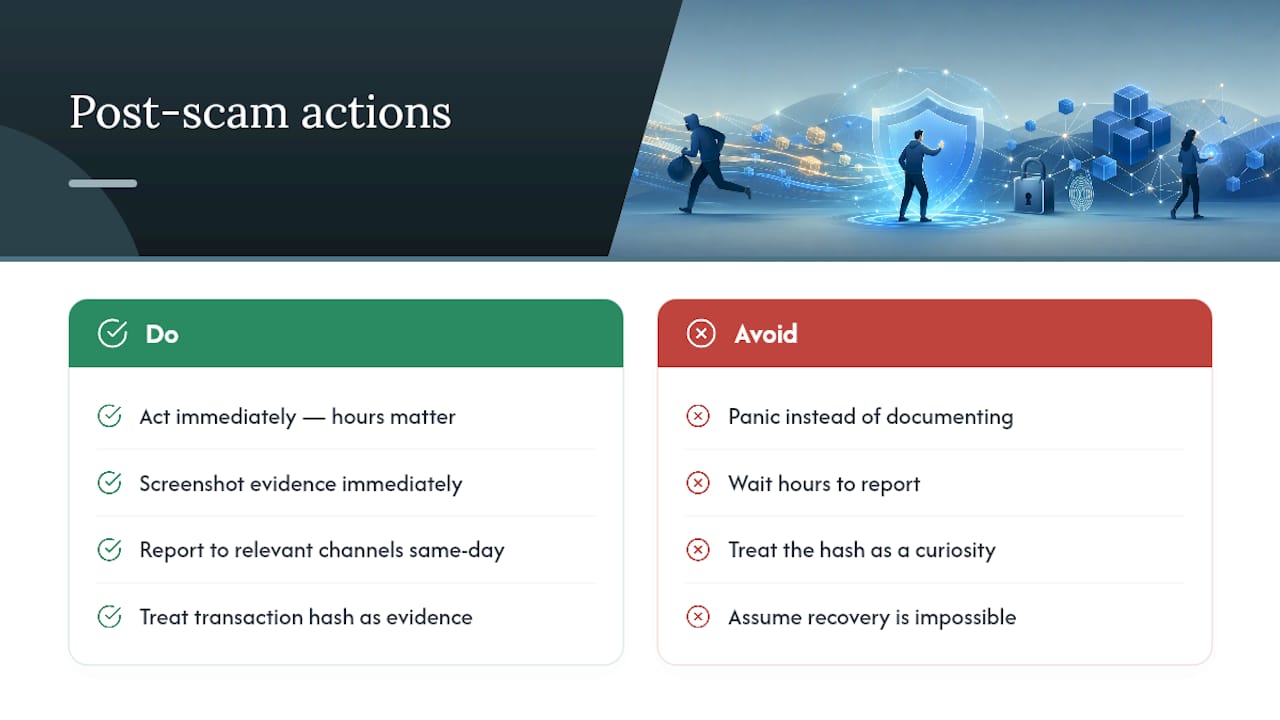
The conventional advice treats a scam as a dead end. It isn’t, not immediately. It’s a forensic problem with a shrinking window. Every hour spent panicking instead of documenting is an hour funds have to consolidate, swap, and cross into territory that’s harder to follow. The victims who fare best aren’t the ones who feel worst about what happened. They’re the ones who screenshot fast, report to every relevant channel same-day, and treat the transaction hash as evidence rather than a curiosity.
Prevention still matters more than any recovery effort ever will. But underestimating what forensic tracing can accomplish, even without a guaranteed happy ending, means giving up ground you didn’t have to give up.
This article is general information, not a substitute for advice from a qualified financial advisor. Consult a qualified financial professional about your own circumstances before acting on anything here.
Sources
- 2020 Twitter account hijacking — Wikipedia
- How scammers steal cryptocurrency from Twitter users | Kaspersky official blog
- From Tweet to Theft (case study) — academic preprint
FAQ
Is there a specific cryptocurrency scam going around on Twitter right now?
Twitter/X continues to see rotating waves of fake giveaways, hijacked-account promotions, and wallet drainer campaigns tied to trending tokens or NFT mints, rather than one single ongoing scam. The mechanics stay consistent even as the specific accounts and coins change.
Are Twitter crypto giveaways ever real?
Legitimate organizations essentially never ask you to send crypto first to receive more back. Any tweet promising to “double” or “match” your crypto after a deposit is a scam, regardless of how official the account appears.
How can you tell if someone is a crypto scammer on Twitter?
Look for a mismatch between the account’s age or follower count and its claimed authority, urgency-driven language pushing you to act immediately, and requests to send funds or connect a wallet before receiving anything. Verify any claim through the organization’s official website rather than the tweet itself.
How do you know if someone is scamming you in a Twitter DM?
Unsolicited DMs offering investment help, stuck-fund recovery, or free credentials are a near-universal red flag, especially when they eventually ask for a deposit or “small fee.” Kaspersky’s research on these campaigns found scammers often use domains with subtle alterations designed to look legitimate at a glance.