A court-ready blockchain forensic report documents the tools, data sources, and analytical steps behind a cryptocurrency tracing investigation in enough detail for another analyst to replicate the findings under Federal Rule of Evidence 702. If you suspect stolen crypto, the immediate priority is preserving wallet records and exchange exports, then engaging a qualified blockchain forensic investigator before transaction trails go cold.
TL;DR:
- Tracing stolen crypto quickly is critical, as funds move through mixers and bridges within hours, reducing the chances of successful recovery.
- A court-ready forensic report must include raw data exports, detailed methodology, and reproducible scripts to withstand legal scrutiny in court.
- Investigators rely on semantic analysis, timing correlation, and cross-chain parsing to reconstruct illicit fund flows, with effectiveness decreasing over multiple hops.
- File and preserve all transaction records, exchange exports, and communication evidence within hours of discovery to maintain traceability and chain of custody.
- Filing a regulatory complaint with the SEC supports enforcement actions, but a separate forensic investigation is necessary for asset recovery and litigation purposes.
Table of Contents
- What goes into a court-ready blockchain forensic report
- How investigators trace stolen crypto and where tracing hits limits
- Meeting Rule 702 and authenticating evidence under Rule 901
- Preserve evidence now: a checklist before you call an investigator
- Hiring a blockchain-forensic investigator: scope, timeline, and cost
- Filing a crypto fraud complaint directly with the SEC
- Other agencies that handle crypto fraud reports
- Protecting yourself the moment you notice fraud
- Scam typologies the SEC watches for
- What happens after you file a report
- Your rights and confidentiality when reporting to the SEC
- How we build reports that hold up in U.S. courts
- Start a forensic investigation with Recovera Forensics
- FAQ
- Sources
What goes into a court-ready blockchain forensic report
Counsel receiving a forensic report for the first time often cannot tell a thorough document from a thin one until it fails under cross-examination. A report built for litigation needs specific components, not a narrative summary with screenshots attached.
The structure that holds up under scrutiny includes:
- An executive summary stating the claim, the assets traced, and the bottom-line finding in plain language.
- A scope and limitations section naming what was and was not investigated, and why.
- An itemized list of evidence, each piece labeled with its source and collection date.
- A methodology section describing tool classes, data sources, processing steps, and assumptions.
- Findings that tie directly back to specific evidence items, not general conclusions.
- Exhibits containing raw exports, transaction ID lists, and visual transaction graphs.
- Recommendations for next steps, whether that is further tracing, asset freezing requests, or litigation support.
The methodology section carries the most weight in a Daubert-style challenge, as explained in detail in How to Scrape SEC Disclosures into Structured Data. It should name the categories of tools used (blockchain explorers, clustering software, cross-chain tracers), describe how data moved from raw export to finished graph, and spell out every assumption an opposing expert could contest. Courts want to see that someone else, given the same raw data, could reach the same conclusions.
Insist on exhibits that go beyond polished diagrams: raw CSV or JSON exports, complete transaction ID lists, cryptographic checksums for every file, and, where possible, a script or notebook that reproduces the analysis step by step. A report without these backup materials is an opinion. A report with them is evidence.
Pro Tip: Ask your investigator for the raw transaction export and hash values before the final report is finalized, so your own technical consultant can verify the numbers independently.
How investigators trace stolen crypto and where tracing hits limits
Tracing stolen cryptocurrency starts with on-chain graphing: mapping every transaction from the victim’s wallet forward, hop by hop, across the public ledger. Investigators layer clustering heuristics on top of that graph to group addresses likely controlled by the same actor, then enrich the results with tags from exchange deposit addresses, sanctioned entities, or known scam clusters.
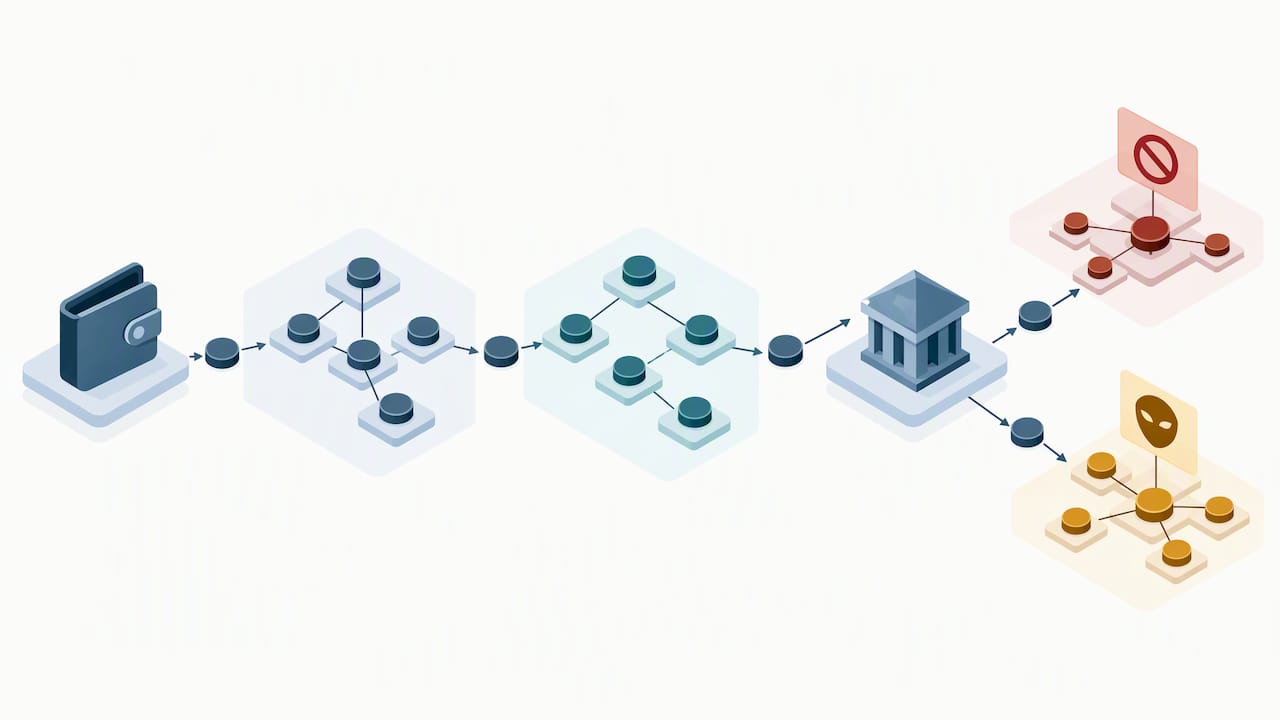
The harder work begins when funds hit a mixer or cross a bridge to another chain. These services are designed to obscure the link between source and destination, so investigators rely on semantic analysis, timing correlation, and protocol-specific parsing to reconnect the trail on the other side.
Common tool classes include:
- Chain scanners and block explorers for raw transaction lookup.
- Indexers that pre-process blockchain data for faster querying across millions of transactions.
- Semantic parsers that interpret DeFi and bridge protocol logic to recover transaction intent.
A peer-reviewed semantic-tracing framework reported high destination precision and address recall across evaluated datasets, demonstrating that modern cross-chain tracing can reconstruct illicit fund-flow paths with meaningful accuracy, though results vary by dataset and chain complexity. Destination recall tends to drop as the number of hops increases, since each mixer pass or bridge crossing adds uncertainty that compounds across the chain. This is also why speed matters: the sooner an investigation starts, the fresher the trail and the more hops remain traceable before funds are cashed out or re-mixed.
Meeting Rule 702 and authenticating evidence under Rule 901
Admissibility hinges on two separate legal tests, and a report that nails one while ignoring the other still gets excluded. Rule 702 requires that expert testimony rest on sufficient facts and reliable, replicable methods. Courts scrutinize whether the methodology could be tested, whether it has a known or potential error rate, and whether the expert applied it consistently to the facts of the case.
Separately, FRE 901 governs authentication: proving that a piece of electronic evidence is what it claims to be. Certified records under Rule 902 can streamline this for exchange-provided data, removing the need for a live witness to authenticate every export.
A report built to survive both tests should include:
- A clear statement of assumptions made during analysis, flagged as assumptions rather than facts.
- Known error rates or confidence levels for the tracing methods used, where the underlying research supports a figure.
- Raw data retained and available for opposing counsel’s expert to review.
- Documentation showing the same inputs, run through the same steps, produce the same outputs.
Pro Tip: Ask your investigator whether their report has survived a Daubert-style challenge in a U.S. court before you retain them, and ask to see how they responded to the objection.
Preserve evidence now: a checklist before you call an investigator
Delay is the single biggest threat to a traceable crypto theft. Attackers move stolen funds through mixers and bridges within hours, so the value of your evidence starts degrading the moment you discover the theft.
- Collect every wallet address and transaction ID connected to the loss, including the victim’s own addresses.
- Export exchange account records in CSV or JSON format rather than relying on screenshots.
- Save API logs, KYC correspondence, and any communication with the scammer, with metadata intact.
- Compute cryptographic hashes for every file before anyone touches the data again.
- Log who collected each item, when, and how, in a signed chain-of-custody record.
- Store everything in a secure, access-controlled location, separate from your working copies.
Acting within the first days after discovery meaningfully improves the odds that tracing produces a usable, admissible result rather than a dead end at the first mixer.
Hiring a blockchain-forensic investigator: scope, timeline, and cost
A well-scoped engagement letter should specify every deliverable: raw exports, the analytic scripts or notebooks behind the findings, a final written report, replication materials, and availability for deposition or trial testimony if the case proceeds.
Before you sign, ask whether the investigator’s work has been reproducible in past cases, whether they have U.S. court experience, and whether they will hand over raw data and custody logs rather than treating the methodology as proprietary.
- Data volume and the number of chains involved drive both timeline and cost.
- Cross-chain tracing through multiple bridges takes longer than single-chain analysis.
- Litigation support (deposition prep, trial testimony) is typically scoped and billed separately from the investigation itself.
Pro Tip: Budget a retainer for urgent preservation work separately from the full investigation, so evidence collection does not wait on a final scope agreement.
Filing a crypto fraud complaint directly with the SEC
Alongside any forensic investigation, victims of securities-related crypto fraud, such as fraudulent token offerings or investment schemes marketed as securities, can file a tip or complaint directly with the SEC. The agency maintains an online complaint portal where individuals submit detailed accounts of the suspected fraud, including dates, amounts, wallet addresses, and communications with the parties involved.
The complaint process does not require an attorney, though legal counsel can help frame the submission to highlight the elements the SEC’s Enforcement Division looks for, such as misrepresentation, unregistered securities offerings, or Ponzi-like structures. Supporting documentation strengthens a complaint considerably: wallet statements, marketing materials from the scheme, screenshots of promises made, and any prospectus or whitepaper distributed to investors.
Because the SEC’s jurisdiction covers securities fraud specifically, a complaint about a scheme that does not involve an investment contract or securities offering may be redirected or simply not acted upon. This is a separate track from the technical tracing work a forensic investigator performs. A forensic report documents where the money went and who controlled it; an SEC complaint asks a federal regulator to investigate and potentially pursue enforcement action against the parties responsible. The two efforts are complementary. A well-documented forensic report, built with the chain-of-custody rigor described above, can also serve as supporting material if you choose to file with the SEC or another regulator.
Other agencies that handle crypto fraud reports
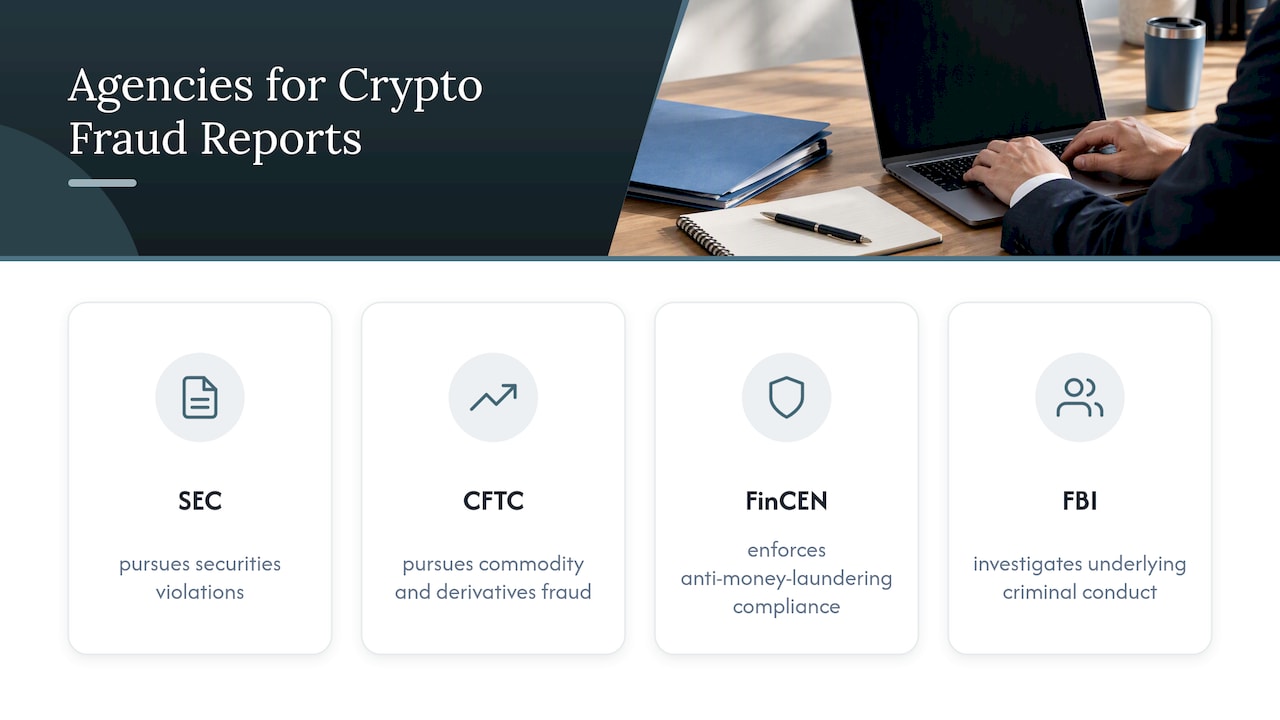
The SEC is not the only federal body with jurisdiction over crypto fraud, and knowing which agency to approach can save weeks of redirected complaints. The Commodity Futures Trading Commission (CFTC) handles fraud involving crypto derivatives, commodity-like tokens, and certain trading platforms, overlapping with the SEC in cases where it is unclear whether an asset is a security or a commodity.
The Financial Crimes Enforcement Network (FinCEN) focuses on anti-money-laundering violations, including unregistered money transmitters and businesses that fail to meet reporting obligations tied to large or suspicious crypto transactions. Victims do not typically file individual fraud complaints with FinCEN, but FinCEN data and reporting requirements often surface in forensic investigations when tracing funds through regulated exchanges.
The FBI’s Internet Crime Complaint Center accepts reports of crypto theft and scams as a form of cybercrime, and its data feeds broader law enforcement investigations into organized fraud networks. State securities regulators and state attorneys general also accept complaints, particularly for schemes that targeted residents of a specific state.
Filing with multiple agencies is not duplicative. Each one has a different mandate: the SEC pursues securities violations, the CFTC pursues commodity and derivatives fraud, FinCEN enforces anti-money-laundering compliance, and the FBI investigates the underlying criminal conduct. A forensic report prepared for litigation can be shared across these channels, since the underlying transaction analysis supports a securities complaint, a criminal referral, and a civil recovery action simultaneously.
Protecting yourself the moment you notice fraud
The hours immediately after discovering a crypto theft matter as much as the weeks that follow. Securing what remains of your holdings comes first: move any uncompromised funds to a new wallet with a freshly generated seed phrase, and assume any device or browser extension involved in the original transaction may be compromised.
Contact your exchange immediately if the fraud involved a platform account, since some exchanges can flag or temporarily freeze linked accounts if the stolen funds pass through their systems before cashing out. Change passwords on every account connected to your crypto activity, including email, since email compromise is a common entry point for wallet theft. Enable two-factor authentication using an authenticator app rather than SMS, which is vulnerable to SIM-swapping attacks.
Document everything before you start cleanup. Screenshot wallet balances, transaction histories, and any communication with the scammer before changing settings or moving funds, since forensic investigators rely on this evidence to reconstruct the timeline. Revoke any token approvals or smart contract permissions you granted during the scam interaction, since many theft schemes rely on lingering approvals to drain additional funds later. These steps protect what remains while a forensic investigation works to trace what was already taken.
Scam typologies the SEC watches for
Recognizing the shape of a scheme helps you describe it accurately when reporting it, whether to the SEC, another agency, or your forensic investigator. Fraudulent token offerings dressed up as investment opportunities, often promising fixed or guaranteed returns, fall squarely within the SEC’s focus on unregistered securities sold through misrepresentation.
Ponzi and pyramid structures built around crypto, where early investors are paid with funds from later investors rather than real returns, represent another recurring pattern the SEC pursues. Pump-and-dump schemes, where organizers coordinate to inflate a token’s price before selling off their holdings, fall under both securities fraud and market manipulation theories.
Fake or cloned investment platforms that mimic legitimate exchanges or trading apps, often discovered through social media or romance-based approaches, frequently appear in SEC enforcement actions once losses are reported at scale. Initial coin offerings and token sales that misrepresent the underlying technology, team credentials, or use of funds also draw SEC scrutiny, since these pitches often meet the legal definition of a securities offering regardless of how the token is labeled.
Identifying which typology matches your situation helps frame a complaint in terms regulators recognize, and it helps a forensic investigator anticipate where stolen funds are likely to move based on patterns seen in similar schemes.
What happens after you file a report
Filing a complaint with the SEC does not produce an immediate response or a case number you can track in real time. The agency reviews submissions as part of a broader intake process, and most complaints do not receive individual follow-up unless investigators need additional information or the matter becomes part of a larger enforcement action.
This is a meaningful distinction for victims expecting updates: the SEC’s enforcement process is confidential by design, and the agency generally does not confirm or deny whether a specific complaint triggered an investigation. Victims seeking recovery of their own funds, rather than regulatory enforcement against the wrongdoer, typically need a separate track, which is where a forensic investigation and potential civil litigation come in.
A forensic report that traces stolen funds to specific wallets or identifiable exchange accounts gives counsel something concrete to act on regardless of what the SEC ultimately decides to pursue. While a regulatory complaint works through its own timeline, a parallel forensic investigation keeps the asset-recovery track moving and preserves evidence that would otherwise degrade while waiting on a regulatory response.
Your rights and confidentiality when reporting to the SEC
Individuals who submit a complaint to the SEC are generally protected from retaliation if they are also company insiders reporting securities violations under the agency’s whistleblower provisions, though most individual crypto fraud victims filing as members of the public fall outside that specific framework. The SEC treats complaint submissions as part of its confidential enforcement process, meaning the agency does not typically disclose who filed a complaint or the details of an ongoing review.
This confidentiality cuts both ways for victims: it protects you from exposure, but it also means you may never learn the outcome of your submission. Consulting an attorney before filing is worthwhile if your situation involves potential personal liability, such as questions about how you acquired or held the assets in question, or if you are weighing whether to pursue a parallel civil claim.
Nothing about filing an SEC complaint prevents you from also pursuing a private forensic investigation or civil recovery action. The two processes operate independently, and documentation gathered for one often strengthens the other.
How we build reports that hold up in U.S. courts
We specialize in recovering stolen cryptocurrencies through blockchain forensics, analyzing transaction patterns on public ledgers to trace lost assets and connect wallet activity to broader fraud networks. Our reports document methodology, preserve raw exhibits, and follow the step-by-step action framework victims and counsel need to move from discovery to litigation-ready evidence.
— cristian
Start a forensic investigation with Recovera Forensics
If you are preparing a case that needs a report capable of surviving a Daubert challenge, waiting costs you traceable hops. We offer cryptocurrency scam investigation, OSINT and digital attribution work, and evidence preservation services built around the replication and chain-of-custody standards this article describes, alongside dedicated support for law firms needing technical reports and litigation backup.
Before reaching out, gather what you can: wallet addresses, transaction IDs, exchange exports, and any communication with the suspected fraud. Then start the conversation through our investigation and recovery services page, where our team can scope the engagement and outline what a report would look like for your specific case.
- Cryptocurrency scam investigation and OSINT-based digital attribution.
- Preservation of evidence with documented chain of custody.
- Court-ready technical reports built for litigation and expert testimony.
This article is general information, not a substitute for advice from a qualified lawyer. Consult a qualified legal professional about your own circumstances before acting on anything here.
FAQ
What makes a blockchain forensic report admissible in court?
A report becomes admissible when it meets Rule 702’s requirements for reliable, replicable methodology and satisfies FRE 901 authentication for the underlying electronic evidence. Courts look for documented tools, stated assumptions, and raw data that another analyst could use to reproduce the findings.
How quickly should I preserve evidence after discovering crypto theft?
Preserve wallet addresses, transaction records, and exchange exports immediately, ideally within hours of discovery, since stolen funds often move through mixers or bridges quickly. Acting fast preserves more traceable hops and strengthens the chain-of-custody record an investigator will need later.
Should I report crypto fraud to the SEC or hire a forensic investigator?
These serve different purposes: an SEC complaint asks a federal regulator to review potential securities violations, while a forensic investigation traces where your specific funds went and builds evidence for recovery or litigation. Many victims pursue both, since a forensic report can also support a regulatory complaint.
What does Recovera Forensics charge for a forensic investigation?
Pricing depends on case scope, data volume, and whether litigation support is needed, and is quoted per engagement rather than published as a flat fee; current service details are listed on our service pages. You can request a scope and estimate directly through that page.
Will I get updates after filing a complaint with the SEC?
The SEC’s enforcement process is confidential, and most individual complaints do not receive case-specific follow-up or status updates. Victims seeking asset recovery typically need a separate forensic investigation track, since it does not depend on the SEC’s internal review timeline.
Sources
- Tracing the Shadows: Automatic Tracking and Analysis of Crypto Money Laundering via Transaction Semantic Analysis | Proceedings of the ACM on Software Engineering
- Rule 702. Testimony by Expert Witnesses | Federal Rules of Evidence | LII / Legal Information Institute