A P2P crypto scam happens when someone poses as a legitimate buyer, seller, or trading partner on a peer-to-peer platform to trick you into sending cryptocurrency or fiat payment, then disappears with your funds. If this happened to you, stop every transfer and conversation with the other party right now, and save every transaction hash, wallet address, and timestamp before anything disappears.
TL;DR:
- Most P2P scam patterns rely on impersonation, overpayment, triangulation, romance schemes, or fake listings to deceive victims.
- Trading off-platform, hurried exchanges, or refusing escrow protections are key red flags indicating potential scam activity.
- Immediate steps after a scam include stopping transfers, recording all transaction evidence, and reporting to authorities within 48 hours.
- Law enforcement and exchange cooperation depend on early, detailed evidence collection, but recovery is not guaranteed.
- Social media scams now account for nearly 30% of reported crypto losses, often initiating scams before any crypto transfer occurs.
Table of Contents
- Common P2P scam types and what they look like
- Red flags to watch for on and off the platform
- If you were scammed: what to do in the first hours and days
- How reporting, exchange action, and forensic recovery actually work
- Watch for recovery scams targeting you after the fact
- Scams differ on decentralized versus centralized P2P platforms
- How to check a P2P platform’s legitimacy before you trade
- Legal recourse options and their limits depending on where you are
- Preventive steps that actually reduce your risk
- The psychological tactics scammers rely on
- What I’ve seen go wrong after the loss itself
- How we help once the evidence is preserved
- FAQ
- Sources
Common P2P scam types and what they look like
Most P2P scams follow a handful of recognizable scripts. Learning the pattern matters more than memorizing every variation, because scammers adjust details constantly while reusing the same mechanics.
Impersonation scams involve someone posing as platform customer support or a verified trader, often reaching out first to “help” with a stuck transaction. Overpayment scams work in reverse: the buyer sends more than agreed, then asks for a refund of the difference, hoping you will release crypto before noticing the original payment was reversed or fake. Triangulation and escrow scams introduce a fake middleman who promises to hold funds safely, then vanishes with both sides’ money. Romance and investment scams, often called pig butchering, build weeks of personal rapport before steering the target toward a fraudulent trading platform. Fake listings, job offers, and giveaway scams lure victims with underpriced crypto, paid “testing” jobs, or promises of free tokens in exchange for a small deposit.
- Impersonation: fake support agents who contact you first, claiming your account or trade needs urgent verification.
- Overpayment: a buyer sends extra funds, then pressures you to refund before the original payment clears.
- Triangulation: a supposed trusted escrow agent collects funds from both parties and disappears.
- Romance and pig butchering: a new online relationship gradually pushes you toward a fraudulent investment app.
- Fake listings and giveaways: underpriced crypto or “double your coins” offers that require an upfront deposit.
The CFPB’s complaint analysis found that romance and pig-butchering schemes show up repeatedly in crypto-related complaints, often made worse by platforms that offer little customer support when something goes wrong.
Red flags to watch for on and off the platform
Scammers tend to rush you, isolate you from platform protections, or ask for something a legitimate counterparty never would. Spotting these signals early can stop a loss before it happens.
- The other party pushes you to move the conversation or trade off-platform, away from escrow and dispute protections.
- You feel sudden urgency: countdown timers, threats to cancel the deal, or claims that “the price will change in minutes.”
- Payment is demanded exclusively in crypto, or you’re sent a QR code or wallet address that doesn’t match the platform’s listed details.
- The account is new, has little or no trade history, or its profile photo and bio look copied from somewhere else.
- Someone asks for a one-time passcode, remote access to your device, or to “verify” your identity by reading back a code.
- A payment screenshot looks slightly off: mismatched fonts, inconsistent timestamps, or amounts that don’t match your own records.
Pro Tip: If anyone asks you to leave the platform’s chat or escrow “to make things faster,” treat that as the scam itself, not a shortcut.
If you were scammed: what to do in the first hours and days
What you do in the first 24 to 48 hours shapes how much can realistically be traced or recovered later. Move through these steps in order, and resist any urge to keep negotiating with the scammer.
- Stop all transfers immediately and cut off further communication with the other party.
- Save transaction hashes, wallet addresses, amounts, and timestamps exactly as they appear, before any chat history gets deleted.
- Screenshot every message, profile link, phone number, email address, and payment receipt tied to the interaction.
- Open a support ticket with the P2P platform and attach your preserved evidence.
- File a report with the FBI’s Internet Crime Complaint Center, including transaction hashes and communication logs.
- Submit a complaint at ReportFraud.ftc.gov, and file a CFPB complaint if a bank or payment app was involved.
- Contact your bank or payment provider about any related fiat transfers and request they preserve their own records.
- Avoid anyone who promises guaranteed recovery for a fee, and check the recovery-scam warnings covered later in this guide.
IC3’s guidance specifically recommends including cryptocurrency addresses, transaction IDs, dates, times, amounts, and communication logs in your report, since that detail is what lets investigators connect your case to related ones. New FTC data from April 2026 show social media started nearly 30% of reported scams in 2025, with social-media-originated investment scams driving $2.1 billion in reported losses that year, a reminder that many P2P scams begin with a message on a social app long before any crypto changes hands. For a full walkthrough of the filing process, see our guide on filing an IC3 complaint.
How reporting, exchange action, and forensic recovery actually work
Exchanges freeze funds only when their own security systems flag suspicious activity or when they receive a formal legal process such as a subpoena or court order. A private request from a victim, without legal backing, rarely triggers an immediate freeze.
Blockchain forensics can trace the flow of stolen funds across wallets, identify clustering patterns that link addresses to known fraud networks, and produce a report suitable for legal proceedings. Tracing funds is not the same as recovering them: a forensic report shows where the money went and builds the documentation needed for the next step, but it does not by itself force anyone to return anything.
- Exchange cooperation typically follows a subpoena, court order, or active law enforcement request, not a direct victim email.
- Civil litigation can compel disclosure or asset freezes when the counterparty or receiving exchange is identifiable.
- Coordinated law enforcement investigations, especially when multiple victims report the same pattern, carry more weight than an isolated complaint.
- Evidence preserved within the first hours (hashes, addresses, timestamps, chat logs) materially improves what any of these routes can accomplish later.
Our guide on how stolen crypto recovery actually works walks through these paths in more detail, including what realistic timelines tend to look like.
Watch for recovery scams targeting you after the fact
A second wave of fraud often follows the first: people who find victims through comments on scam-awareness posts or direct messages, then promise to recover stolen crypto for an upfront fee. The FBI’s IC3 warned in August 2023 that victims further defrauded by fictitious law firms claiming recovery services reported significant losses between February 2023 and February 2024.
- Red flags: demands for an upfront “release fee,” guaranteed results, or claims of an exclusive relationship with an exchange.
- Fake law firm fronts and impersonation of law enforcement are common tactics in these follow-on scams.
- Legitimate investigators never promise a guaranteed outcome and never ask for secret upfront payments before any work scope exists.
- Check for verifiable public contact information, a written contract defining scope, and independent reviews before engaging anyone.
Pro Tip: Before paying anyone for recovery help, file your IC3 and FTC reports first. A legitimate forensic intake will explain realistic options without asking you to pay just to “start the process.” Our breakdown of recovery scam warning signs covers more tactics to watch for.
Scams differ on decentralized versus centralized P2P platforms
Centralized P2P platforms, where a company runs the marketplace and manages escrow, limit some scam types because the platform holds funds until both sides confirm the trade. Scammers on these platforms instead focus on social engineering: pushing you off-platform, impersonating support, or tricking you into releasing escrow early with fake payment proof.
Decentralized P2P trading, where no central operator holds funds in escrow, removes that safety net entirely. Once you send crypto to a wallet address, there is no dispute process and no customer support ticket to open. Scammers on decentralized platforms rely more heavily on fake smart contracts, lookalike token addresses, and wallet-draining links disguised as trade confirmations. The lack of identity verification common to many decentralized setups also makes impersonation easier, since there’s no account history to check against.
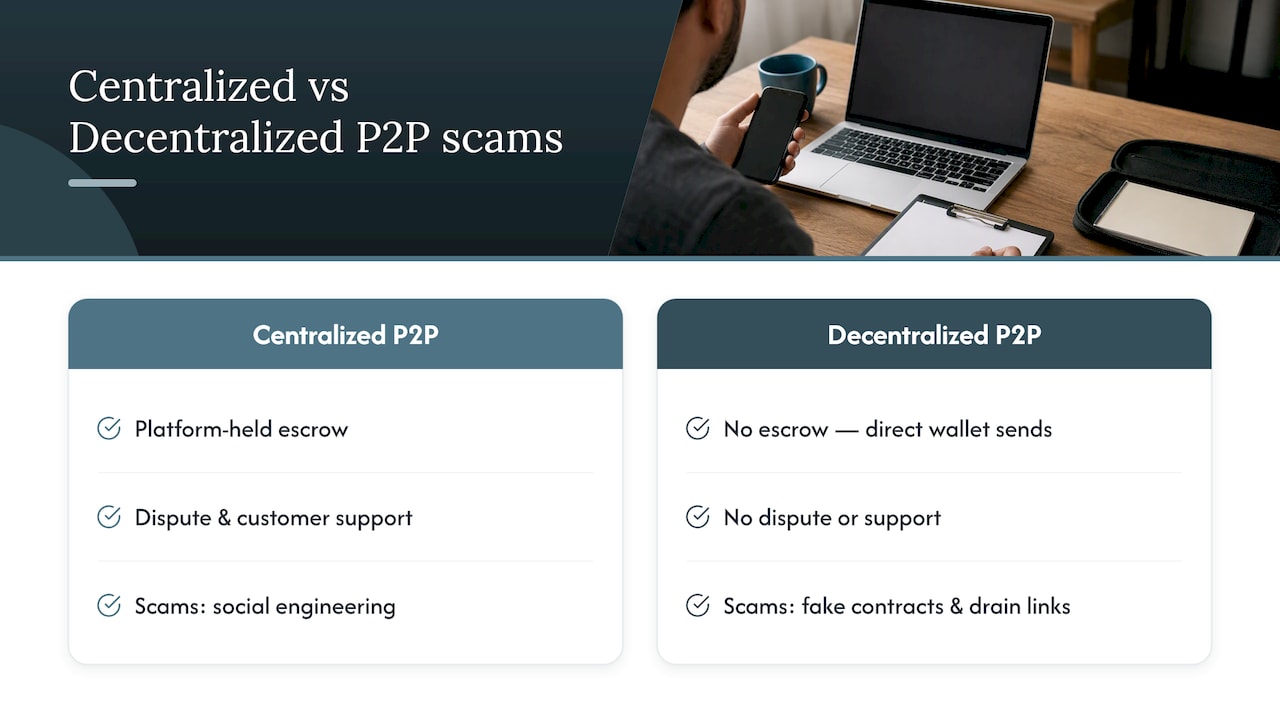
Both environments share one consistent weakness: platforms that verify only an email address or phone number, rather than full identity, make it easy for scammers to create convincing accounts or take over existing ones. Treat any account verified by token alone, regardless of which model the platform uses, with extra caution before trading anything of value.
How to check a P2P platform’s legitimacy before you trade
A few checks before your first trade can filter out a large share of risk. Start with how the platform handles disputes: legitimate P2P marketplaces publish clear escrow terms and a support process for contested trades, not just a chat window.
Look for a verifiable company behind the platform: a registered business name, a physical or legal address, and terms of service that explain what happens when a trade goes wrong. Search the platform’s name alongside words like “scam” or “complaint” and read what comes up on independent forums, not just the reviews the platform features itself. Check whether the platform requires identity verification beyond an email or phone number, since token-only verification makes account takeover and impersonation easier for scammers. Confirm that escrow is handled by the platform itself, not by a third party the other trader suggests, and never trade on a platform that pressures you to move funds before escrow releases.
If a platform has no clear ownership information, no dispute process, and reviews that read like templates, treat that as reason enough to walk away before sending anything.
Legal recourse options and their limits depending on where you are
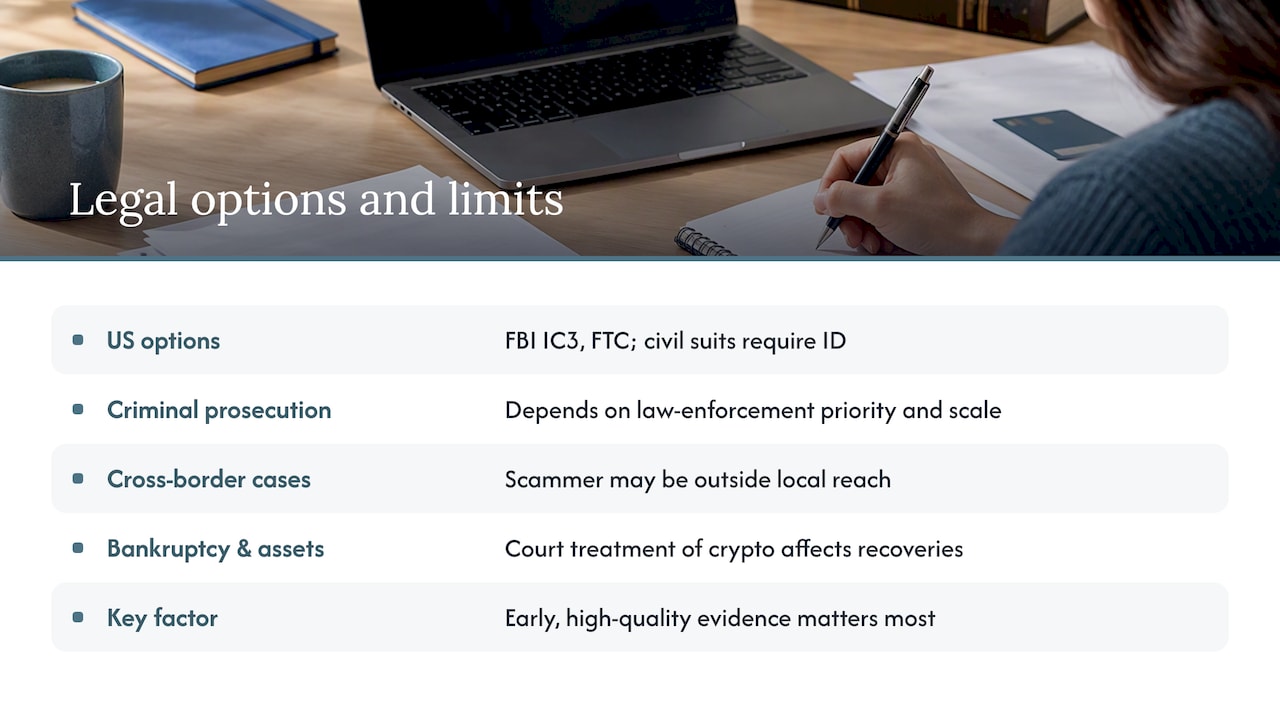
Options for pursuing a P2P crypto scam vary by jurisdiction, and what counts as a viable legal path in one country may not exist in another. In the United States, victims can file a report with the FBI’s Internet Crime Complaint Center and separately with the FTC, and in some cases pursue civil litigation if the scammer or a receiving exchange can be identified. Civil suits require knowing who to sue, which is often the hardest part in a crypto case where wallet addresses don’t come with names attached.
Criminal prosecution depends on law enforcement prioritizing the case, which tends to happen more readily when multiple victims report the same scam pattern or when losses are large enough to justify resources. Cross-border cases add another layer of difficulty: a scammer operating from outside your country may be functionally outside the reach of your local law enforcement, even with a strong forensic trail.
Where crypto losses intersect with other legal matters, such as a scammer declaring bankruptcy or hiding assets through shell structures, how courts treat digital assets in bankruptcy proceedings becomes relevant to what a victim can actually recover through the courts. None of these routes guarantee an outcome, which is why evidence quality, reported early, matters more than any single legal mechanism.
Preventive steps that actually reduce your risk
Most P2P losses trace back to a handful of avoidable moments: trading with an unverified counterparty, skipping escrow, or leaving an account without basic security. A short list of habits closes most of that gap.
Verify your counterparty’s trade history and account age before agreeing to terms, and be skeptical of accounts with high ratings but very few completed trades. Use the platform’s own official escrow feature for every trade, even one that seems small or low-risk, since escrow is the main protection a legitimate P2P marketplace offers. Enable two-factor authentication on your exchange and wallet accounts, and never share a one-time code with anyone, including someone claiming to be platform support. Avoid borrowing against your crypto holdings to fund a trade or investment you’re unsure about, since liquidation risk on leveraged crypto positions can compound a scam loss with a second, unrelated financial hit. Keep your own transaction records (hashes, amounts, counterparties) as a habit, not just after something goes wrong, since that history makes any future dispute or report far easier to support.
The psychological tactics scammers rely on
Scammers succeed by engineering trust and urgency faster than a normal interaction would allow. Pig-butchering schemes, as documented in the CFPB’s review of crypto-asset complaints, often start with weeks of ordinary conversation before any mention of crypto, building a relationship that makes the later investment pitch feel like a favor rather than a pitch.
Urgency is the second lever: a countdown on a “limited time” deal, a claim that your account will be locked, or a warning that prices will change in minutes. Scarcity and authority often combine, with a scammer posing as platform staff who can “fix” a problem only if you act immediately. Reciprocity shows up in overpayment scams, where the scammer’s initial generosity (sending more than agreed) creates pressure to return the favor quickly, before you’ve had time to check whether the original payment actually cleared. Each tactic is designed to shorten the window between first contact and final transfer, since a scam that survives a day of reflection usually falls apart.
What I’ve seen go wrong after the loss itself
The most common mistake isn’t falling for the scam. It’s what happens after: deleting angry messages instead of saving them, paying a stranger’s “recovery fee” out of panic, or waiting weeks to file a report while hoping the platform fixes it quietly. A proper forensic intake looks at wallet clustering, transaction timing, and any off-chain evidence you still have, and that review only works if the early evidence survived.
— cristian
How we help once the evidence is preserved
We focus on the part victims usually get wrong: documenting the trail before it goes cold. Our services include cryptocurrency scam investigation, OSINT investigations and digital attribution, preservation of evidence and digital footprint, technical analysis, and court-ready reporting for legal proceedings.
- Before reaching out, gather your transaction hashes, wallet addresses, chat logs, and any payment receipts tied to the trade.
- Our intake reviews what you’ve preserved and explains realistic tracing and reporting options for your case.
- We do not promise guaranteed recovery. Our reports are built to support legal action, exchange escalation, and law enforcement cooperation, not to shortcut them.
If you’re ready to start, visit our scam investigation services page to see what a forensic intake covers and how to submit your case details.
This article is general information, not a substitute for advice from a qualified financial advisor. Consult a qualified financial professional about your own circumstances before acting on anything here.
FAQ
Is P2P crypto trading safe?
P2P trading carries real risk because it relies on another person following through, not a centralized guarantee. Using a platform’s built-in escrow, verifying your counterparty’s trade history, and never moving a trade off-platform substantially reduce that risk.
What’s the latest crypto scam?
Scam tactics shift constantly, but FTC data from April 2026 show social media is now a major starting point, with social-media-originated scams producing $2.1 billion in reported losses in 2025. Romance and pig-butchering schemes that build trust before introducing a fraudulent investment app remain among the most damaging current patterns.
Does P2P freeze a bank account?
A P2P platform itself cannot freeze your bank account, but your bank may flag or temporarily hold a related transfer if it detects suspicious activity. If you reported fraud to your bank, ask them directly what review or hold process applies to your specific transaction.
How can you tell if someone is a crypto scammer?
Common signs include pressure to move the conversation off-platform, demands for crypto-only payment, a new or thin trade history, and requests for one-time codes or remote device access. Any combination of urgency and a request to bypass the platform’s own protections is reason enough to stop the trade.
Sources
- IC3 | Cryptocurrency-related reporting guidance
- FTC | New data show people have lost billions to social media scams (2026)
- CFPB complaint bulletin: analysis of consumer complaints related to crypto-assets