
Stolen cryptocurrency can sometimes be recovered, but the odds depend almost entirely on how fast you move and what evidence you preserve. If funds are still sitting in a wallet you can identify, or if they’ve landed on a KYC exchange like Coinbase or Binance, there’s a real window to act. If they’ve been run through a mixer or converted to a privacy coin like Monero, that window closes fast.
The single most important thing you can do right now: do not touch the compromised wallet and start collecting every transaction ID (TXID), wallet address, and screenshot you can find.
Immediate must-do items:
- Copy every TXID and wallet address involved in the theft
- Screenshot your exchange account history, chat logs, and any communications with the attacker
- Move any remaining funds to a clean, freshly generated wallet on a device you trust
- File a complaint at IC3 (the FBI’s Internet Crime Complaint Center) — include addresses, TXIDs, amounts, and timestamps
- Contact any centralized exchange where the attacker’s address received funds and request an emergency freeze
Pro Tip: Save your IC3 complaint number. Every subsequent report you file, whether with local police, your state Attorney General, or a forensic firm like Recoveraforensics, should reference that number. It signals you’ve already entered the federal system.
Recovery is sometimes possible but rarely guaranteed. The evidence you collect is the gateway to any freeze or seizure, not the tracing itself.
Key Takeaways
Recovering stolen crypto is possible in specific circumstances, but success depends on acting within hours, preserving high-quality evidence, and getting funds frozen at a KYC exchange before they’re laundered further.
| Point | Details |
|---|---|
| Speed is the critical variable | Attackers launder funds within hours; immediate exchange contact and IC3 filing maximize your chances. |
| Evidence is the gateway | TXIDs, wallet addresses, timestamps, and communication logs are what law enforcement and exchanges need to act. |
| KYC exchange = best recovery path | Funds landing at a KYC exchange before withdrawal is the single most promising scenario for a freeze. |
| Seed phrase determines wallet recovery | If you have your BIP-39 seed phrase, wallet access is usually fully recoverable; without it, noncustodial recovery is nearly impossible. |
| Recoveraforensics for complex cases | For large or fast-laundered losses, Recoveraforensics provides forensic tracing, exchange liaison, and legal-grade reports. |
Table of Contents
- What should you do in the first 24–72 hours after crypto theft?
- Is this theft or lost access? How to diagnose your situation
- How does blockchain tracing actually work, and what can’t it do?
- Who should you report crypto theft to in the United States?
- How to restore a wallet or recover a locked custodial account
- When should you hire a forensic firm or cryptocurrency attorney?
- What do crypto recovery typically cost, and how long does it take?
- How to secure your remaining assets and prevent future theft
- Legal options for crypto theft victims outside the United States
- How to request a freeze or rollback on a centralized exchange
- Community resources and forums that can help during recovery
- What victims of crypto theft need to hear honestly
- Recoveraforensics: professional forensic help when the stakes are high
- Sources
- FAQ
What should you do in the first 24–72 hours after crypto theft?
Speed is the single biggest variable in whether you get anything back. Attackers often move funds through bridges and mixers within hours of a theft. Every hour you wait is an hour they use to obscure the trail.
Step-by-step priority list:
- Secure remaining assets first. Generate a fresh wallet on a clean device, write down the BIP-39 seed phrase on paper, and transfer any funds that weren’t stolen. Do not reuse the compromised wallet for anything.
- Verify your device is clean. Run a reputable antivirus scan (Malwarebytes or similar) before doing anything sensitive on the same machine. If you suspect a keylogger or remote access tool, use a different device entirely.
- Do not respond to the attacker. Any contact with the person who stole your funds can compromise your legal case and may expose you to further manipulation.
- Collect and preserve evidence. Export transaction CSVs from your exchange, capture full-page screenshots with timestamps visible, save email headers (not just the body), and document your browser history around the time of the theft.
- Contact centralized exchanges. If you can identify the wallet address where funds landed, look up which exchange controls it (blockchain explorers like Etherscan or Blockchain.com often tag known exchange addresses). Email that exchange’s compliance or law enforcement liaison team directly, not general support.
- File official reports. Start with IC3 at ic3.gov, then file with the FTC at reportfraud.ftc.gov, and file a report with your local police department. Save every case number.
- Revoke token approvals. If the theft involved ERC-20 tokens, use a tool like Revoke.cash to check and remove any outstanding smart contract approvals on your address.
Evidence to collect:
- Transaction hashes (TXIDs) for every relevant transfer
- Sending and receiving wallet addresses
- Timestamps for all transactions (UTC preferred)
- Platform account logs and trade history exports
- All communications: emails, texts, app messages, social media DMs
- Screenshots of any fraudulent websites or investment platforms
Pro Tip: When capturing screenshots for law enforcement, use your operating system’s built-in screenshot tool rather than a browser extension. Native screenshots embed metadata that investigators can verify. Crop nothing.
The fastest and most common laundering approach moves funds through bridges and mixers within hours, which is why immediate exchange contact is the single most effective action when funds are heading toward a KYC platform.
Is this theft or lost access? How to diagnose your situation
Before you spend time filing reports or hiring help, figure out which problem you actually have. The recovery path for stolen funds is completely different from the path for a wallet you’ve locked yourself out of.
Theft (funds transferred out without your authorization):
- You see outgoing TXIDs you didn’t initiate
- Your exchange account shows logins from unfamiliar IPs or devices
- Token approvals were granted to unknown contracts
- KYC or contact details on a custodial account were changed without your action
Lost access (funds still in the wallet, but you can’t get in):
- You deleted the app or lost the device
- You forgot your PIN, password, or passphrase
- You have a hardware wallet but lost the device (not the seed phrase)
- You have a partial seed phrase or suspect a word error
Wallet access is often recoverable when the seed phrase, private key, or wallet file exists. Without those, noncustodial recovery is usually impossible, and no legitimate service can change that.
Quick diagnostic checklist:
- Check all known backup locations: cloud notes, email drafts, physical notebooks, USB drives
- Look for wallet files (.dat files for Bitcoin Core, keystore files for Ethereum)
- Confirm the last known state of your device (factory reset? lost? stolen?)
- Review your exchange account for unauthorized changes to 2FA or email
How does blockchain tracing actually work, and what can’t it do?
Blockchain forensics maps the movement of funds by following TXIDs across the public ledger. Every transaction on Bitcoin, Ethereum, and most major chains is permanently recorded and publicly visible. A forensic analyst traces from the theft address outward, identifying intermediate wallets, exchange deposit addresses, and patterns that suggest the same actor controls multiple wallets (a technique called address clustering).
What tracing can do:
- Link the attacker’s wallet to known exchange deposit addresses
- Build a timeline of fund movements across chains and tokens
- Identify when funds were converted (e.g., ETH swapped to BTC or USDT)
- Produce a chain-of-custody evidence package suitable for law enforcement and civil proceedings
What tracing can’t do:
- Recover funds directly (tracing is evidence-building, not retrieval)
- Reliably follow funds through mixers like Tornado Cash or through privacy coins like Monero
- Force an exchange to act without a formal legal request or law enforcement involvement
- Guarantee that identified wallets belong to a specific person
The laundering chain matters enormously. A direct transfer to a Coinbase deposit address is a very different situation from funds that passed through three cross-chain bridges and a mixer. Global financial-crime watchdogs have flagged cross-border laundering via mixers and bridges as among the hardest patterns to unwind, precisely because each hop degrades the evidentiary chain.
The most realistic recovery path is when stolen funds reach a KYC exchange that can be asked to freeze accounts. Tracing alone helps evidence-building but rarely returns funds by itself.
When funds do land at a KYC exchange, a forensic report showing the address linkage and transaction timeline gives the exchange’s compliance team what they need to freeze the account and hold funds pending law enforcement instruction. That’s the moment tracing converts from documentation into action.
Who should you report crypto theft to in the United States?
Filing reports in the right places, with the right documentation, is what turns your evidence into a case. Each channel serves a different function.
Official U.S. reporting channels:
- IC3 (FBI Internet Crime Complaint Center): The primary federal channel for crypto theft. File at ic3.gov. IC3 guidance specifies that reports should include cryptocurrency addresses, transaction hashes, amounts, and timestamps. IC3 complaints feed into federal investigations and can trigger DOJ action.
- FTC (Federal Trade Commission): File at reportfraud.ftc.gov. The FTC aggregates fraud data and can refer cases to law enforcement. Less direct than IC3 for crypto-specific cases, but still worth filing.
- Local police department: File a report even if local police have limited crypto expertise. The report number is often required by exchanges before they’ll act on a freeze request.
- State Attorney General: Many state AGs have consumer fraud or cybercrime units. Find yours at naag.org.
- Your exchange’s compliance team: This is separate from customer support. Most major exchanges publish a law enforcement request portal or compliance email. Contact them directly with your evidence package.
| Authority / Platform | Key documents required | Expected response |
|---|---|---|
| IC3 / FBI | TXIDs, wallet addresses, timestamps, amounts, communication logs | Complaint logged; may trigger federal investigation |
| FTC | Transaction details, platform name, contact records | Data aggregated; referrals to law enforcement |
| Local police | Police report form, TXIDs, screenshots, ID | Case number issued; limited direct action on crypto |
| State Attorney General | Written complaint, evidence package, police report number | Referral or investigation depending on state resources |
| Centralized exchange | TXIDs, attacker wallet address, police report number, account logs | Account review; possible freeze pending legal process |
Pro Tip: When contacting an exchange’s compliance team, send a structured evidence memo, not a narrative email. List the attacker’s wallet address, the TXID of each transfer, the amount and timestamp, and your police report number. Compliance teams process dozens of requests; a clean, structured submission gets faster attention.
For pig-butchering scams and similar confidence fraud, the FDIC OIG publishes advisories that describe the scam mechanics in terms law enforcement recognizes. Referencing the relevant advisory in your IC3 report can help investigators categorize and prioritize your case.
How to restore a wallet or recover a locked custodial account
If your problem is lost access rather than theft, the recovery path is technical and usually solvable when you have the right backup materials.
BIP-39 seed phrase restores
A BIP-39 seed phrase (12 or 24 words) is a universal backup standard. Any compatible wallet software can restore your accounts from it. The most common mistakes that block successful restores are word errors, wrong derivation paths, and forgotten passphrases.
Restore steps:
- Download the wallet app fresh on a clean device (never restore on a potentially compromised machine)
- Choose “Restore from seed phrase” or equivalent
- Enter your words in exact order, checking each against the BIP-39 word list
- If accounts don’t appear, check the derivation path (m/44’/0’/0’ for Bitcoin, m/44’/60’/0’ for Ethereum are the most common)
- If you used an optional passphrase (sometimes called a “25th word”), try with and without it
- Once restored, immediately move funds to a freshly generated wallet
Pro Tip: Use BTCRecover for Bitcoin wallet and seed phrase recovery when you have a partial phrase or suspect a word error. It’s an open-source tool that can systematically test variations without exposing your seed to a third party.
Hardware wallet replacement
If your Ledger or Trezor device is lost or damaged but you have the seed phrase, recovery is straightforward: order a new device from the manufacturer directly (never from third-party marketplaces), restore using the seed phrase, and verify that the addresses match your records before moving any funds. If the device was stolen and you’re not certain the seed phrase is secure, move funds to a new wallet immediately after restoring.
Custodial exchange account recovery
Exchanges use KYC to verify identity. If you’re locked out, contact support and expect to provide:
- Government-issued photo ID
- A selfie matching your ID photo
- Proof of the email or phone number on the account
- Answers to security questions or access to backup codes
If standard support can’t help (for example, if a scammer changed your email and 2FA), escalate to the exchange’s compliance or fraud team in writing, with a police report number attached.
Lightning and multisig wallets
Lightning wallets require channel state backups (Static Channel Backups, or SCBs) in addition to the seed phrase. Check your wallet’s cloud backup settings (Phoenix, Breez, and Muun all handle this differently). For multisig setups, you need the seed phrase plus the extended public keys (xpubs) of all co-signers. Contact your wallet provider’s support if you’re missing either.
After regaining access to any wallet, immediately move funds to a fresh address, rotate all keys, and document the restoration with screenshots and timestamps.
When should you hire a forensic firm or cryptocurrency attorney?
Professional help is worth the cost in specific situations: the amount lost is substantial, funds moved quickly through multiple chains, or you have evidence that funds reached a KYC exchange. For small losses or funds already deep in a mixer, the math often doesn’t work.
Decision criteria for hiring forensics:
- Loss exceeds a threshold where professional fees are proportionate (many firms set minimums)
- You have TXIDs and can see funds moved to exchange deposit addresses
- The theft involved sophisticated patterns: multiple wallets, cross-chain bridges, or coordinated account takeovers
- You’re pursuing civil litigation or a DOJ remission claim and need court-grade evidence
What a forensic firm delivers:
- Full chain tracing with address clustering and timeline reconstruction
- Exchange liaison: structured freeze requests with the evidence packages compliance teams require
- Legal-grade forensic reports with chain-of-custody documentation
- Expert testimony readiness for civil or criminal proceedings
What a cryptocurrency attorney adds:
- Criminal referrals and coordination with federal prosecutors
- Civil recovery actions against identifiable defendants
- Restitution and remission petitions when DOJ seizes scam-controlled wallets as part of criminal cases
A realistic path to partial recovery: A victim loses $180,000 to a pig-butchering scam. A forensic firm traces the funds through three intermediate wallets to a deposit address at a major exchange. The firm submits a structured evidence package to the exchange’s compliance team, referencing the IC3 complaint number and a police report. The exchange freezes the account. Law enforcement subpoenas the account records. Months later, partial funds are held pending forfeiture proceedings. This is the best-case scenario, and it depends entirely on the funds reaching that KYC exchange before being withdrawn.
Vetting a recovery firm: what to check
- No legitimate firm guarantees recovery or demands large upfront fees before any work begins
- Ask for a sample forensic report or methodology overview before engaging
- Confirm the firm produces reports in formats accepted by U.S. law enforcement (chain-of-custody documentation, address attribution methodology)
- Check whether they have experience liaising directly with exchange compliance teams
Red flags:
- Upfront fees with no deliverable milestone
- Promises of guaranteed recovery or specific percentages returned
- Requests to send crypto to a “recovery wallet”
- No verifiable business address or professional credentials
Pro Tip: Ask any forensic firm whether they work on a contingency basis for large cases. Some do, which aligns their incentive with yours. For smaller cases, a fixed-fee forensic report is often the more realistic option.
Recoveraforensics produces forensic investigation reports built for legal proceedings, including address attribution, transaction timelines, and exchange-ready evidence packages.
What do crypto recovery typically cost, and how long does it take?
Costs and timelines vary by case complexity, how far funds traveled, and whether law enforcement gets involved.
Pricing models:
- Fixed-fee forensic report: A defined deliverable for a set price, regardless of outcome. Common for cases where the primary goal is documentation for legal proceedings.
- Hourly: Used by forensic consultants and attorneys for open-ended investigations.
- Contingency: Some firms take a percentage of recovered funds for large cases. Requires the firm to believe recovery is genuinely possible.
Many professional forensic firms set minimum case values, often in the six-figure range, before taking contingency engagements. Below that threshold, fixed-fee reports are the standard model.
| Case size | Typical cost range | Timeline | Recovery probability |
|---|---|---|---|
| Small amounts | Fixed report fee | Weeks for tracing; months for any legal action | Low without exchange cooperation |
| Medium amounts | Fixed or hourly | Weeks to months for tracing; months to years for legal | Moderate if funds hit KYC exchange |
| Large amounts | Contingency or hourly | Months for tracing; years for federal forfeiture/remission | Higher with law enforcement involvement |
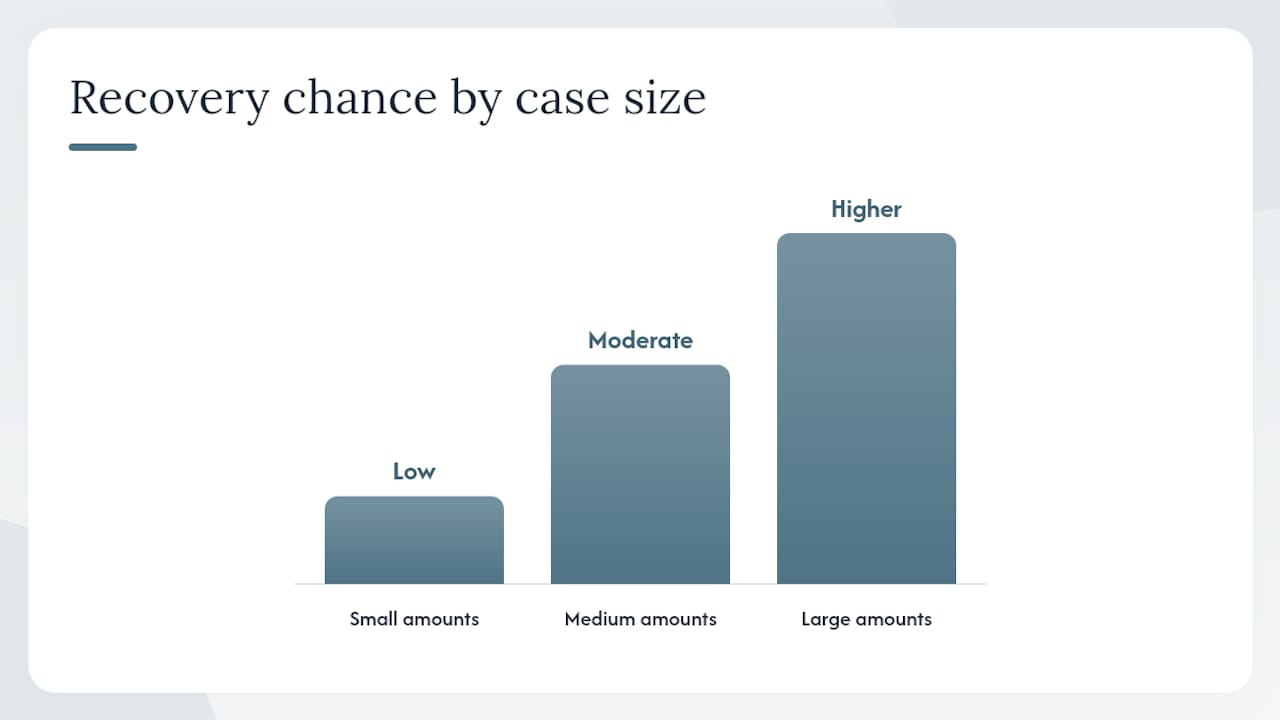
Exchange freeze attempts can happen within hours to days of filing a structured request with the right evidence. Full federal investigations and forfeiture or remission processes typically take months to years. Recovery without exchange cooperation or law enforcement seizure is rare. The documentation is what makes either of those outcomes possible.
How to secure your remaining assets and prevent future theft
After an incident, the priority is making sure it doesn’t happen again. Most repeat losses happen because victims don’t change their security posture after the first theft.
Immediate steps:
- Move all remaining funds to a hardware wallet (Ledger or Trezor) on a clean device
- Revoke all ERC-20 token approvals using Revoke.cash or a similar tool
- Change passwords on all exchange accounts and use a password manager (Bitwarden or 1Password)
- Replace SMS-based 2FA with a FIDO2 hardware key (YubiKey) or an authenticator app (Authy or Google Authenticator)
- Set up a separate, dedicated email address for exchange accounts only
Seed phrase and backup best practices:
- Write your seed phrase on paper immediately after generating a new wallet
- Transfer the paper copy to a metal backup (Cryptosteel or similar) for fire and water resistance
- Store copies in at least two geographically separate locations
- Never photograph your seed phrase, store it in a cloud service, or type it into any website
- Test your backup by restoring a small test wallet before trusting it with significant funds
For large balances:
- Use a multisig setup (2-of-3 or 3-of-5) with keys held on separate hardware devices
- Consider a geographically distributed key arrangement where no single location holds enough keys to sign a transaction alone
- Review and remove exchange API keys that are no longer in use
Account hygiene checklist:
- Audit all active exchange sessions and revoke unfamiliar ones
- Verify the recovery email on each exchange account is a dedicated, secure address
- Check 2FA backup codes are stored securely offline
- Set withdrawal address whitelists on exchanges that support them
Legal options for crypto theft victims outside the United States
If you’re based outside the U.S., or if the theft crossed borders, the reporting and recovery paths differ by jurisdiction.
European Union: The EU’s Markets in Crypto-Assets (MiCA) regulation, which came into full effect in 2024, requires crypto asset service providers operating in the EU to maintain compliance programs and respond to law enforcement requests. Victims in EU member states should report to their national financial regulator (e.g., BaFin in Germany, AMF in France) and to Europol’s European Cybercrime Centre (EC3), which coordinates cross-border crypto crime investigations.
United Kingdom: The Financial Conduct Authority (FCA) oversees registered crypto firms in the UK. Victims should report to Action Fraud (actionfraud.police.uk), the UK’s national fraud reporting center, and to the FCA if the firm involved was FCA-registered. The National Crime Agency (NCA) handles large-scale crypto crime. UK courts have shown willingness to grant freezing injunctions against crypto wallets when applicants can identify the wallet and demonstrate a proprietary claim.
Asia: Regulatory frameworks vary significantly. In Singapore, the Monetary Authority of Singapore (MAS) oversees licensed digital payment token service providers; victims report to the Singapore Police Force’s Anti-Scam Centre. In Japan, the Financial Services Agency (FSA) regulates exchanges; victims report to local police and the FSA. In South Korea, the Financial Intelligence Unit (FIU) handles crypto compliance; report to the Cyber Investigation Division of the National Police Agency.
Across all jurisdictions, the evidence requirements are similar: TXIDs, wallet addresses, timestamps, and communication records. A forensic report produced to international standards (chain-of-custody documentation, address attribution methodology) is useful regardless of which country’s legal system you’re working within.
How to request a freeze or rollback on a centralized exchange
A freeze request is the most direct lever you have, and it only works on centralized platforms where the exchange controls the funds. Decentralized protocols have no equivalent mechanism.
Step-by-step freeze request process:
- Identify the exchange. Use a blockchain explorer (Etherscan for Ethereum, Blockchain.com for Bitcoin) to look up the attacker’s receiving address. Many exchange deposit addresses are tagged in these explorers. If not, a forensic firm can identify the controlling exchange.
- Find the compliance contact. Most major exchanges publish a law enforcement request portal or a compliance email address. Search “[exchange name] law enforcement request” or “[exchange name] compliance contact.” Do not use general customer support for this.
- Prepare your evidence package. Include: the attacker’s wallet address, every TXID linking your funds to that address, amounts and timestamps in UTC, your IC3 complaint number, your local police report number, and a brief factual summary (one page maximum).
- Send the request. Use a professional, structured format. State clearly that you are requesting an emergency account review and freeze pending law enforcement action. Attach your evidence as PDFs or CSVs, not screenshots embedded in email.
- Follow up in writing. If you don’t receive a response within 48 hours, follow up once. Keep a record of all correspondence.
- Coordinate with law enforcement. Exchanges are more likely to act when a law enforcement agency has also contacted them. Share your IC3 complaint number and ask your local detective to send a formal request to the exchange’s law enforcement portal.
Rollbacks are not possible on public blockchains. Once a transaction is confirmed, it cannot be reversed by the exchange or anyone else. What exchanges can do is freeze the account that received the funds, preventing withdrawal while an investigation proceeds.
Community resources and forums that can help during recovery
You don’t have to navigate this alone. Several communities and resources offer practical guidance, moral support, and sometimes direct help identifying scam patterns.
Reddit communities: r/CryptoCurrency, r/Bitcoin, and r/ethfinance all have active members who can help identify scam wallet addresses, suggest reporting steps, and share experiences with specific exchanges’ compliance teams. The r/Scams subreddit is specifically focused on fraud patterns and often has threads from victims of the same scam operation.
Crypto-specific support: The Global Anti-Scam Organization (GASO) at globalantiscam.org maintains a database of scam operations and offers victim support resources. Their site includes documented case patterns that can help you identify whether your theft matches a known operation, which strengthens your IC3 report.
Practical cautions for forums:
- Never share your seed phrase, private keys, or wallet file in any forum, even in a “support” thread
- Be skeptical of anyone who contacts you privately after you post about a theft, offering to help recover your funds for a fee
- Verify any tool or service recommended in a forum before using it; fake recovery tools are a common secondary scam targeting theft victims
Emotional and psychological support: Losing a significant amount of money to fraud is genuinely traumatic. The FBI’s National Elder Fraud Hotline (1-833-FRAUD-11) serves older victims, and the Identity Theft Resource Center (idtheftcenter.org) offers free support for fraud victims of all ages. Avoid making major financial decisions, including paying any recovery service, while in acute distress. Give yourself 24–48 hours before committing to any paid engagement.
What victims of crypto theft need to hear honestly
The hardest part of this work isn’t the forensics. It’s telling someone who lost their savings that the trail went cold at a mixer, or that the funds moved too fast for any exchange to act. Crypto theft is genuinely devastating, and the people who commit it count on victims being too embarrassed or too desperate to report it properly.
What I’ve seen consistently: the victims who get the best outcomes are the ones who act fast, document everything, and resist the urge to pay a second scammer promising to undo the first theft. That second scammer is almost always waiting. The moment you post about a loss in a public forum or contact a recovery service that found you first, the risk of a follow-on scam spikes sharply.
Recoveraforensics approaches every case with the same methodology regardless of case size: trace the funds, document the chain of custody, and produce a report that law enforcement and exchanges can actually use. We don’t promise outcomes we can’t deliver. What we can promise is rigorous, documented forensic work that gives you the strongest possible position for whatever legal or regulatory path you pursue.
If you’re feeling pressure to act immediately, that pressure is real but the decision about who to hire is not one to make in the first hour. Secure your evidence, file your IC3 report, and then evaluate your options with a clear head.
Recoveraforensics: professional forensic help when the stakes are high
When stolen funds are substantial, moved quickly through multiple wallets, or show signs of reaching a KYC exchange, a professional forensic investigation changes what’s possible. Recoveraforensics specializes in exactly this: full blockchain tracing, address clustering, exchange liaison, and forensic reports built for legal proceedings.
What clients receive: a documented chain-of-custody forensic report, structured evidence packages formatted for exchange compliance teams and law enforcement, and expert support for civil claims or DOJ remission petitions. Every engagement is handled with strict confidentiality, and evidence is preserved in formats that courts and federal agencies recognize.
Before contacting Recoveraforensics, have ready: your TXIDs, attacker wallet addresses, timestamps, your IC3 complaint number, and any communication records. Engagements are available on a fixed-fee or contingency basis depending on case size and evidence quality.
Start your case review to discuss your situation and find out whether professional forensics is likely to change your outcome.
Sources
These are the official pages and forensic resources to bookmark when filing reports or working with investigators.
- Cryptocurrency – Internet Crime Complaint Center (IC3)
- How To Recover Stolen Crypto 2026 Guide | TorHoerman Law
- Recover Stolen Crypto: Realistic Options and What Actually Works | Crypto Grows News
- Justice
- Crypto wallet recovery guide – Blockchain Council
This article is general information, not a substitute for advice from a qualified financial advisor. Consult a qualified financial professional about your own circumstances before acting on anything here.
FAQ
Can stolen crypto be traced?
Yes, most stolen crypto can be traced on public blockchains using TXIDs and address clustering. Tracing becomes significantly harder when funds pass through mixers, privacy coins, or multiple cross-chain bridges.
Can the police do anything about stolen crypto?
Local police can file a report and issue a case number, which exchanges often require before acting on a freeze request. Federal agencies, particularly the FBI through IC3, have more direct tools for crypto crime, including coordination with exchanges and DOJ forfeiture proceedings.
Who can help me recover my crypto?
The FBI’s IC3, your exchange’s compliance team, and professional forensic firms like Recoveraforensics are the legitimate options. Avoid any service that contacts you unsolicited or demands upfront fees before delivering any work.
How much does crypto recovery cost?
Fixed-fee forensic reports vary by case complexity; contingency arrangements are available for large cases where recovery is plausible. Many professional firms set minimum case thresholds, often in the six-figure range, for contingency engagements.
What if my funds went through a mixer?
Mixer-laundered funds are significantly harder to trace and rarely recovered without a law enforcement seizure of the mixer operation itself. Filing with IC3 is still worthwhile, as federal agencies have successfully seized mixer infrastructure in past operations.