Binary options scams are real, widespread, and financially devastating. If you’ve already sent money, stop all further transfers right now and call your bank or credit card issuer before you do anything else.
First steps you can take in the next 10 minutes:
- Stop transfers. Do not send any additional funds, regardless of what the platform tells you.
- Preserve evidence. Screenshot your account dashboard, chat logs, emails, and any transaction confirmations before they disappear.
- Call your bank or card issuer. Ask specifically about a chargeback or dispute. Time windows are short.
- Change your passwords. If you shared login credentials or identity documents, change passwords on your email, bank, and any linked accounts immediately.
- Do not pay anyone who contacts you promising to recover your money. That is almost certainly a second scam.
Recovery is possible for some victims, especially those who act within days. Your first calls should go to your financial institution and, in parallel, to law enforcement via the FBI’s Internet Crime Complaint Center (IC3).
Key Takeaways
Most binary options scams follow an identifiable playbook, and acting within days of a loss — not weeks — is the single factor that most consistently determines what’s recoverable.
| Point | Details |
|---|---|
| Scams are real and documented | Federal courts have ordered substantial penalties in a single global binary options fraud case. |
| Check registration first | Verify any platform on CFTC, SEC/Investor.gov, and FINRA BrokerCheck before depositing anything. |
| Act immediately after a loss | Contact your bank for a chargeback and file with FBI/IC3, CFTC, and FTC within days, not weeks. |
| Crypto losses need forensic tracing | Funds moved through crypto require blockchain forensics before obfuscation steps make tracing impossible. |
| Recoveraforensics for crypto victims | Recoveraforensics produces forensic reports suitable for legal proceedings, exchange cooperation, and chargeback support. |
Table of Contents
- What binary options are — and why most online platforms are a problem
- How binary options scams typically operate
- Red flags: how to spot a binary options scam before you lose money
- Are any binary options legal in the U.S.? How to verify registration
- Immediate, time-sensitive steps if you suspect you’ve been scammed
- Recovery options: chargebacks, bank disputes, law enforcement, civil suits, and crypto recovery
- When crypto is involved: what forensic recovery looks like
- Exactly how and where to report a binary options scam in the U.S.
- How to avoid binary options scams going forward
- Why evidence-first action is the approach that actually works
- Lost crypto to a binary options platform? Here’s what Recoveraforensics can do
- Official resources and links for reporting and verification
- Sources
- FAQ
What binary options are — and why most online platforms are a problem
A binary option is a yes/no financial contract: you bet on whether a price will be above or below a specific level at a set expiration time. If you’re right, you collect a fixed payout. If you’re wrong, you lose your entire stake. The “binary” refers to those two outcomes, nothing in between.
That structure is legal in the United States, but only on registered exchanges. Three U.S. exchanges are authorized to list binary options: the Cantor Exchange, the Chicago Mercantile Exchange (CME), and the North American Derivatives Exchange (Nadex). These platforms operate under Commodity Futures Trading Commission (CFTC) oversight, with transparent pricing, regulated counterparties, and real withdrawal processes.
The problem is the internet. Hundreds of offshore websites market binary options directly to U.S. retail customers while operating completely outside that regulatory framework. As the CFTC documents, many of these platforms are unregistered, and some have refused to credit customer accounts, denied withdrawals, committed identity theft, or manipulated software to produce losing trades. The product name sounds familiar; the platform behind it is often a fraud operation.
How binary options scams typically operate
The playbook is consistent enough that regulators have mapped it in detail. Understanding the phases helps you recognize where you are in the cycle.
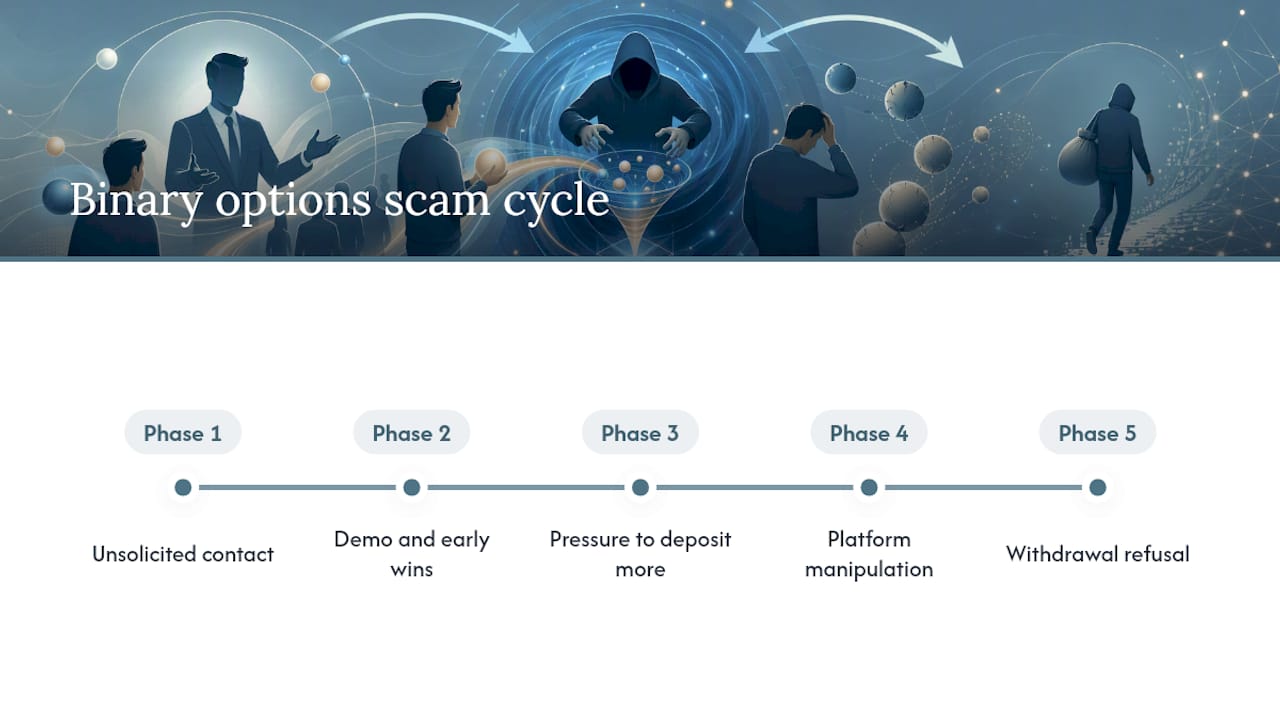
Phase 1: Unsolicited contact. A message arrives via social media, WhatsApp, email, or a dating app. The person is friendly, sometimes romantic, and eventually steers the conversation toward a “can’t-miss” trading opportunity.

Phase 2: The demo and early wins. The platform shows you impressive returns on a demo account, or your first small deposit appears to grow quickly. This is manufactured. The numbers on the screen are not connected to real markets.
Phase 3: Pressure to deposit more. Once you’re engaged, the pressure intensifies. Bonuses are offered — but buried in the terms is a trading-volume requirement so large that withdrawals become mathematically impossible until you’ve lost everything.
Phase 4: Platform manipulation. Investor that fraudulent platforms manipulate trading software to distort prices and payouts, extend expiration times when trades are winning, and generate artificial losing trades. Your account balance is a fiction.

Phase 5: Withdrawal refusal. When you try to cash out, the platform invents reasons to block it: unmet bonus conditions, “verification” requirements, or sudden account freezes. Some demand additional payments framed as “taxes” or “insurance” before releasing funds.
That case also revealed how platforms fabricate staff identities and fake corporate addresses to appear legitimate — a reminder that a professional-looking website proves nothing about a company’s actual registration or intentions.
State-level agencies have documented similar patterns. The Missouri Secretary of State’s office warns that binary options schemes frequently impersonate government agencies and demand fees to release funds, a tactic that compounds losses for victims who are already desperate.
Red flags: how to spot a binary options scam before you lose money
Most victims describe seeing at least two or three of these warning signs before they lost significant money. The problem is that scammers are skilled at explaining them away.
Warning signs to watch for:
- You were contacted first — you did not seek out this platform.
- The platform promises guaranteed returns or “risk-free” profits.
- You’re pressured to deposit quickly, often with a countdown or a “limited offer.”
- The platform requests copies of your passport, driver’s license, or credit card photos. Investor.gov flags this as a direct identity-theft tactic.
- Withdrawals are blocked, delayed, or subject to new conditions every time you request one.
- Payment is accepted only via cryptocurrency, wire transfer, or gift cards.
- The platform cannot be verified on CFTC, SEC, or FINRA databases (more on that below).
- “Insurance” is offered on your trades, but collecting it requires an additional deposit.
Pro Tip: Ask the platform for an independent trade confirmation — a third-party record showing your trade executed on a real market at the stated price and time. Legitimate regulated exchanges produce these automatically. A platform that cannot or will not provide one is not trading on any real market.
The SEC and CFTC have jointly warned investors that online platforms may operate without required registration and systematically manipulate payouts. That joint alert is worth reading before you engage with any platform you didn’t independently discover through a regulated exchange.
Are any binary options legal in the U.S.? How to verify registration
The short answer: yes, but narrowly. Binary options traded on Cantor Exchange, CME, or Nadex are legal and regulated. Nearly every other platform soliciting U.S. customers online is operating outside the law.
How to check whether a platform is registered:
- CFTC: Search the CFTC’s registration database for the firm’s name and any associated individuals.
- SEC / Investor.gov: Use the SEC’s EDGAR system and the Investor.gov resources to check broker-dealer registration.
- FINRA BrokerCheck: At brokercheck.finra.org, search the broker’s name and CRD number. This shows registration status, licenses held, and any disciplinary history.
- NFA BASIC: The National Futures Association’s Background Affiliation Status Information Center covers futures and derivatives registrants — relevant for any platform claiming to offer binary options.
If a platform isn’t in any of those databases, stop. No registration means no regulatory oversight, no investor protections, and no recourse through U.S. agencies if something goes wrong.
Immediate, time-sensitive steps if you suspect you’ve been scammed
Speed matters more here than in almost any other financial fraud scenario. Chargeback and dispute windows at most U.S. banks and card networks close within 60–120 days of a transaction, and some are shorter. Every day you wait narrows your options.
- Stop all transfers immediately. Do not send more money, even if the platform threatens to freeze your account or forfeit your balance.
- Document everything now. Screenshot your account balance, trade history, chat logs, emails, and any payment confirmations. Save them to a device the platform cannot access and back them up offline.
- Contact your bank or credit card issuer. Ask for a chargeback (credit card) or ACH dispute (bank transfer). Provide your documentation. Be explicit that you believe you’re a fraud victim.
- Contact your crypto exchange if crypto was used. If you sent cryptocurrency, notify the exchange where you purchased it. Some exchanges can flag destination wallets and cooperate with law enforcement.
- File complaints with federal agencies (detailed in the reporting section below).
- Change all passwords on email, banking, and any account that shares credentials with the fraudulent platform.
One point that surprises many victims: preserving evidence in a documented, organized format — with timestamps and chain-of-custody notes — materially strengthens both chargeback claims and law enforcement referrals. Don’t just take screenshots; note the date, time, and URL for each one.
Recovery options: chargebacks, bank disputes, law enforcement, civil suits, and crypto recovery
No single recovery path works for everyone. The right approach depends on how you paid, how much time has passed, and where the funds went.
- Credit card chargeback: The fastest and most accessible option for many victims. Card networks like Visa and Mastercard have fraud dispute processes, and issuers often side with cardholders when documentation is strong. Success rates drop sharply after 60–120 days.
- Bank ACH or wire dispute: Wire transfers are harder to reverse than card payments. ACH disputes have some consumer protections, but wires sent internationally are often unrecoverable through the bank alone.
- Law enforcement investigation: Filing with the FBI/IC3, CFTC, and FTC creates an official record and can trigger investigations, especially when multiple victims report the same platform. Individual recoveries through this channel are rare and slow, but enforcement actions can result in court-ordered restitution.
- Civil litigation: Suing a fraudulent operator is possible but expensive and jurisdictionally complex when the defendants are offshore. It’s most viable when a U.S.-based individual or entity is identifiable.
- Crypto forensic recovery: When funds moved as cryptocurrency, blockchain forensics can trace wallet flows, identify exchange accounts that received funds, and produce reports suitable for legal proceedings or exchange cooperation requests. This is the most technical path, and it requires acting before funds are mixed or moved through obfuscation layers.
Realistic expectations: partial recovery is more common than full recovery. Jurisdiction and payment method are the two biggest variables. A victim who paid by credit card to a U.S.-accessible platform has meaningfully better odds than one who wired funds to an offshore account or sent crypto to an anonymous wallet.
When crypto is involved: what forensic recovery looks like
Cryptocurrency losses from binary options fraud are recoverable in some cases, but the window closes fast. Once funds pass through a mixing service or move across multiple exchanges, tracing becomes exponentially harder. The CFTC’s enforcement findings confirm that fraudulent operations running offshore with deceptive interfaces typically require specialist forensic tools and cross-jurisdictional coordination to trace.
Here’s what a professional forensic engagement typically looks like:
- Initial intake. The victim provides transaction IDs, wallet addresses, platform communications, and any account records. The forensic team establishes a timeline.
- On-chain tracing. Analysts map the flow of funds across public blockchains, identifying intermediate wallets, cluster attributions, and any exchange deposit addresses where funds landed.
- Cluster analysis and attribution. Using OSINT and blockchain analytics, the team assigns confidence levels to wallet attributions — connecting addresses to known entities, exchanges, or fraud networks.
- Report compilation. A professional forensic report includes transaction linkage maps, cluster attributions with confidence levels, chain-of-custody documentation, and recommended next steps for banks, law enforcement, or civil counsel. Recoveraforensics’s forensic investigation service produces exactly this type of report, structured for use in legal proceedings.
- Legal and exchange referrals. The report is submitted to the relevant exchange’s compliance team or law enforcement to support account freezes or asset recovery.
Pro Tip: Ask any forensic firm you consider for a sample report structure before engaging. A legitimate firm will show you what deliverables look like. If they promise guaranteed recovery or ask for a large upfront fee before doing any work, treat that as a red flag — the CFTC specifically warns that advance-fee recovery offers are a common secondary scam.
Cost and timeline depend on transaction volume, whether funds passed through mixing services, and how many exchanges are involved. A straightforward single-exchange trace may take days; a multi-hop cross-chain investigation can take weeks. Acting early, before obfuscation steps occur, is the single biggest factor in what’s recoverable.
Exactly how and where to report a binary options scam in the U.S.
File with every relevant agency. Reports are not mutually exclusive, and cross-agency filings increase the chance that a pattern is recognized and acted on.
Agencies and their roles:
- CFTC: Primary regulator for commodity derivatives, including binary options. File at cftc.gov/complaint.
- SEC / Investor.gov: Covers securities fraud and unregistered broker-dealers. File at sec.gov/tcr.
- FBI / IC3: Handles internet crime complaints. File at Ic3. The FBI has published advisories specifically about binary options fraud and actively investigates cases.
- FTC: Handles consumer fraud broadly. File at Reportfraud.
- State attorney general: Your state AG’s consumer protection division can pursue local enforcement and may have jurisdiction over U.S.-based operators.
What to include in every complaint:
- Dates and amounts of every transaction
- Payment method (credit card, wire, crypto, gift card)
- Platform name, URL, and any associated phone numbers or email addresses
- Names or aliases of individuals you communicated with
- Screenshots of your account, trade history, and all communications
- Transaction IDs or confirmation numbers
- Any identity documents you were asked to provide
| Agency | Role | Where to file |
|---|---|---|
| CFTC | Commodity/derivatives regulator | cftc.gov/complaint |
| SEC | Securities fraud, unregistered brokers | sec.gov/tcr |
| FBI / IC3 | Internet crime investigations | ic3.gov |
| FTC | Consumer fraud | reportfraud.ftc.gov |
| State AG | Local enforcement, consumer protection | Your state’s official .gov site |
How to avoid binary options scams going forward
The most effective protection is a short due-diligence habit applied before you send a single dollar.
Do:
- Verify any platform’s registration on CFTC, SEC, FINRA BrokerCheck, and NFA BASIC before depositing.
- Search the platform’s name plus “complaint,” “fraud,” or “scam” before engaging.
- Test small withdrawals early. A legitimate platform processes them without conditions.
- Confirm that any trading bot or automated system has independently verifiable performance records. Understanding how to verify a trading bot through third-party tools like Myfxbook is a practical skill that applies to any automated trading claim.
- Read risk disclosures carefully. Platforms that bury or misrepresent risk language are signaling something about how they operate.
Don’t:
- Send money to any platform that contacted you first.
- Accept “guaranteed returns” at face value. No regulated investment product guarantees profits.
- Provide copies of your passport, credit card, or driver’s license to an unverified platform.
- Pay any “tax,” “insurance,” or “release fee” to unlock a withdrawal.
- Engage with anyone who contacts you after a loss, promising to recover your funds for an upfront fee. The CFTC warns explicitly that unsolicited recovery offers are a common indicator of a secondary scam.
Why evidence-first action is the approach that actually works
Most victims who contact Recoveraforensics after a binary options fraud loss share a common pattern: they waited weeks or months before acting, often because the platform kept stringing them along with promises. By the time they sought help, funds had moved through multiple wallets, and the chargeback window had closed.
The agency guidance in this article points to the same conclusion from a different angle. CFTC enforcement, FBI advisories, and SEC investor alerts all emphasize early reporting and evidence preservation. That’s not bureaucratic advice. It’s a practical reality: the earlier a forensic trace begins, the more of the transaction chain is still visible on-chain and the more exchange cooperation is possible before funds are withdrawn to cold storage or converted.
Realistic expectations matter too. Not every case ends in full recovery. But a well-documented complaint filed quickly, supported by a professional forensic report, gives victims the strongest possible position across every recovery channel simultaneously.
Lost crypto to a binary options platform? Here’s what Recoveraforensics can do
If cryptocurrency was part of your loss, the recovery path requires more than a police report. Recoveraforensics conducts blockchain forensic investigations specifically for victims of binary options fraud and related trading scams, producing technical reports that banks, law enforcement agencies, and civil attorneys can actually use.
A first consultation covers your transaction history, the platforms involved, and whether on-chain tracing is viable given how funds moved. Bring your transaction IDs, wallet addresses, platform communications, and any screenshots of your account. The process is transparent: you’ll know what the investigation can and cannot establish before any engagement is confirmed.
One firm warning: if anyone contacts you claiming to be from Recoveraforensics and asks for an upfront payment before any work is scoped, verify through Recoveraforensics directly. Recovery-scam impostors target fraud victims specifically. Reach out through the official contact page to start a legitimate consultation.
Official resources and links for reporting and verification
Use these directly. Bookmark them before you need them.
- CFTC Binary Options Fraud page: Cftc — overview, investor alerts, and complaint filing
- CFTC Recovery Fraud advisory: Cftc — how to avoid being scammed a second time
- SEC / Investor.gov binary options page: Investor — complaint categories and investor alerts
- FBI binary options advisory: Fbi — public awareness and reporting guidance
- IC3 complaint portal: Ic3 — file internet crime complaints
- FTC fraud report: Reportfraud — consumer fraud reporting
- FINRA BrokerCheck: brokercheck.finra.org — verify broker registration and disciplinary history
This article provides general information about binary options fraud and is not a substitute for legal, financial, or law enforcement advice. Confirm current rules and reporting procedures with the relevant agency or a qualified professional.
Sources
- Binary Options Fraud | CFTC
- Investor
- Don’t be Re-Victimized by Recovery Frauds | CFTC
- Binary Options Fraud | FBI
FAQ
What is the truth about binary options?
Binary options are a legitimate financial product when traded on regulated U.S. exchanges like Nadex or CME, but the vast majority of internet-based platforms offering them to U.S. customers are unregistered and frequently fraudulent. The CFTC and SEC have both issued investor alerts warning that these platforms often manipulate software, refuse withdrawals, and steal identity documents.
Why do most binary options traders lose money?
On legitimate exchanges, the fixed-payout structure means the house edge is built in. On fraudulent platforms, losses are manufactured: software manipulates expiry times and prices to guarantee the platform wins, meaning no amount of skill or strategy can produce consistent profits.
What are the biggest risks with binary options?
The primary risks are total loss of capital, withdrawal refusal, and identity theft. Investor.gov documents three consistent complaint categories: platforms refusing to return funds, identity theft through document collection, and software manipulation that generates artificial losing trades.
Which binary options brokers are legitimate in the U.S.?
Cantor Exchange, the Chicago Mercantile Exchange (CME), and the North American Derivatives Exchange (Nadex) are the U.S.-regulated venues where binary options can be legally traded. Any platform not verifiable through CFTC, SEC, or FINRA BrokerCheck should be treated as unregistered and potentially fraudulent.
Can you recover money lost to a binary options scam?
Partial recovery is possible, particularly through credit card chargebacks filed quickly, law enforcement cooperation, and blockchain forensic tracing when cryptocurrency was used. Full recovery is less common, and the odds decrease significantly the longer a victim waits to act.