A crypto expert witness traces stolen or hidden digital assets, attributes wallet activity to specific actors, and delivers sworn opinions on valuation, mining operations, or fraud mechanics that a judge or jury can rely on. Courts turn to this testimony most in theft and fraud disputes, money laundering prosecutions, divorce asset tracing, and mining or hosting contract fights. Whether that testimony survives a challenge comes down almost entirely to Federal Rule of Evidence 702 and whether the expert’s methodology holds up under scrutiny.
TL;DR:
- Cryptocurrency expert witnesses mainly assist in complex theft, fraud, or money laundering cases when straightforward blockchain analysis is insufficient.
- Their work involves on-chain transaction mapping, clustering addresses, detecting mixing activity, and corroborating data with off-chain records like KYC or server logs.
- Admissibility depends on meeting reliability standards under FRE 702 and Daubert, requiring thorough documentation, testing, peer acceptance, and transparent methodology.
- Operational experience and a proven track record in forensic cases matter more for credibility than academic credentials alone.
- Early retention and detailed case documentation improve the chances of expert testimony surviving legal challenges and being effectively used in litigation.
Table of Contents
- What Does a Cryptocurrency Expert Witness Do?
- When Do Parties Actually Need a Crypto Expert?
- What Credentials Should a Crypto Expert Have?
- How Do Experts Actually Trace and Analyze Crypto Transactions?
- What Legal Standard Governs Crypto Expert Testimony?
- How Do You Vet and Retain the Right Crypto Expert?
- Civil vs. Criminal Testimony: What Changes for the Expert?
- Where the Conventional Advice on Crypto Expert Testimony Falls Short
- How Recovera Forensics Supports Litigation Teams
- Sources
- FAQ
What Does a Cryptocurrency Expert Witness Do?
The work splits into two distinct roles, and mixing them up is one of the more common mistakes counsel makes early in a case. A consulting expert works behind the scenes, giving confidential strategic advice on the strength of a blockchain trail without ever facing cross-examination. A testifying expert puts opinions on the record under oath, knowing every word of the report becomes discoverable and every methodology choice becomes a target for opposing counsel.
Retaining the wrong type at the wrong stage wastes money. Firms sometimes bring in a testifying expert too early, before the case theory is settled, and end up paying for a report that has to be redone once the legal strategy shifts.
The deliverables themselves tend to follow a predictable shape once litigation is underway:
- A written expert report identifying wallet clusters, transaction paths, and the conclusions drawn from them
- Visual demonstratives (flow charts, timelines, network graphs) built for a jury with no blockchain background
- A chain-of-custody log showing exactly how blockchain data was pulled, hashed, and preserved
- Rebuttal analysis addressing an opposing expert’s methodology or conclusions
- Deposition and trial testimony translating technical findings into plain language
That output feeds directly into pleadings and motion practice long before trial. A solid blockchain forensics trace can support a temporary restraining order to freeze an exchange account, strengthen a settlement demand, or give a mediator something concrete to work with instead of a vague accusation of theft.
When Do Parties Actually Need a Crypto Expert?
Not every case touching cryptocurrency needs forensic testimony. The need shows up when the money trail gets complicated enough that a lawyer can’t just point to a bank statement and call it done.
- Civil asset tracing — divorce proceedings where one spouse allegedly hid marital assets in a self-custodied wallet, fiduciary breach claims against a business partner, or valuation disputes over a token holding at a specific date.
- Criminal and regulatory matters — money laundering charges, darknet marketplace prosecutions, and theft or fraud investigations where prosecutors need to show the money moved from victim to defendant.
- Hosting and mining contract disputes — disagreements over uptime guarantees, revenue splits, or equipment performance that require someone who understands mining pool payouts and hash rate reporting.
- Insolvency and custodial failures — exchange bankruptcies or wallet access disputes where creditors need an accounting of what assets existed and where they went.
A few factual patterns almost always trigger the decision to retain: a disputed chain of transactions spanning multiple wallets, evidence that funds passed through a mixing service, or on-chain movement clearly designed to obscure the destination. Any of those signals mean a simple block explorer lookup won’t cut it.
What Credentials Should a Crypto Expert Have?
Judges and juries weigh credibility differently, and that distinction matters when you’re picking an expert. A judge ruling on admissibility cares about methodology and peer-recognized standards. A jury cares about whether the person in the witness chair sounds like they’ve actually done the work.
Most credible experts come from one of a handful of professional backgrounds: digital forensics, forensic accounting, cybersecurity, or computer science with a specialization in distributed ledger systems. None of those degrees alone qualifies someone to testify convincingly about wallet clustering or mixer detection.
Certifications add a layer of demonstrable rigor, and a few carry real weight in this space:
- Certified Cryptocurrency Forensic Investigator (CCFI) signals formal training in blockchain-specific investigative technique
- Chainalysis Reactor Certification shows hands-on proficiency with one of the industry’s dominant blockchain analysis platforms
- CISSP demonstrates broader information security credibility, useful when the case touches hacking or wallet compromise
- Traditional forensic accounting credentials matter heavily in valuation and asset-tracing disputes where the numbers, not the network graph, decide the outcome
Here’s the part opposing counsel often gets wrong when vetting an expert on paper alone: academic credentials and certifications establish baseline competence, but active operational experience is usually what separates a credible witness from a vulnerable one. An expert who has personally run blockchain nodes, performed live asset tracing under time pressure, or managed custodial wallet security speaks with a different level of authority than someone who studied the theory. Cross-examining attorneys know the difference immediately, and so do juries once the testimony gets specific.
Pro Tip: Ask any prospective expert for a list of prior cases where their testimony was challenged under Daubert or FRE 702, and how the court ruled. An expert with no such history isn’t necessarily unqualified, but one who has survived a real challenge has already proven their methodology holds up.
Prior sworn testimony, a track record of published methodology, and documented chain-of-custody discipline round out what courts actually look for once the credential check is done.
How Do Experts Actually Trace and Analyze Crypto Transactions?
Forensic conclusions rest on a mix of on-chain analysis and off-chain corroboration, and the strongest reports never rely on just one or the other.
On-chain work starts with transaction graphing, mapping the flow of funds between addresses to visualize where money went. Clustering heuristics group addresses likely controlled by the same entity based on spending patterns, common inputs, and change address behavior. Experts also look specifically for mixer activity and coin-join patterns, the tell-tale signatures left when someone tries to break the traceable link between a source wallet and a destination wallet.
None of that lives in isolation from the traditional paper trail. Off-chain sources fill the gaps blockchain data alone can’t close:
- Exchange subpoenas and KYC records that tie a wallet address to a real identity
- Server logs and login timestamps that place a specific person behind specific transactions
- Wallet backup files and seed phrase evidence recovered from a device
- IP address correlation and broader OSINT work linking on-chain activity to real-world accounts
Investigators lean on established forensic software for the heavy lifting, though the specific platform matters less than how rigorously the analyst documents each step and whether the underlying methodology can be independently verified. What separates a defensible report from a vulnerable one is almost never the tool. It’s the documentation trail behind every conclusion the tool produced.
Preserving that trail for court means hashing every piece of blockchain data at the moment of collection, maintaining a clean chain-of-custody log, and timestamping each analytical step. Public blockchain data has a real limitation worth stating plainly: it shows addresses and amounts, not names. Every attribution an expert makes is an inference built from clustering patterns and corroborating off-chain evidence, not a direct fact pulled from the ledger itself. A DOJ press release on the Bitcoin Fog verdict shows how far this kind of inference-based analysis can go when the underlying methodology is solid. Prosecutors used blockchain analysis to help convict the operator of a darknet cryptocurrency mixer, a case that hinged almost entirely on the credibility of the forensic trail. Tools like the flow-of-funds methodology used in civil recovery matters follow the same core logic, just applied outside a criminal courtroom.
What Legal Standard Governs Crypto Expert Testimony?
Admissibility runs through FRE 702, which sets three conditions an expert’s testimony must clear: it has to rest on sufficient facts or data, come from reliable principles and methods, and reflect a reliable application of those methods to the actual facts of the case. Fail any prong and the testimony can be excluded before a jury ever hears it.
Courts applying Daubert layer in additional reliability factors that map directly onto blockchain forensic work: whether the methodology has gained acceptance among practitioners in the field, whether it can be tested or replicated, whether known error rates exist for the technique, and whether the expert followed recognized standards and controls during the analysis. A clustering heuristic that hasn’t been documented, tested, or subjected to any peer scrutiny is exactly the kind of methodology a skilled cross-examiner will target.
Recent case law shows courts are increasingly comfortable admitting this kind of evidence when the foundation is solid. Beyond the Bitcoin Fog verdict, a 2024 trial opinion summarized by Money Laundering News reinforced that courts will assess blockchain-analysis testimony against the same reliability factors applied to any other forensic discipline, not treat it as some novel category requiring extra suspicion.
The pattern across recent rulings is consistent: judges aren’t rejecting blockchain forensics as a category. They’re rejecting sloppy documentation, undisclosed assumptions, and experts who can’t explain their own methodology under pressure.
A few drafting habits consistently help reports survive an admissibility challenge:
- Document every assumption behind a clustering or attribution decision, not just the conclusion
- Disclose known limitations and error rates rather than letting opposing counsel discover them first
- Cite the specific standards or published methodologies the analysis followed
- Keep raw data, hash values, and analytical notes preserved and available for production
Counsel drafting motions around this evidence often benefit from reviewing a litigator’s admissibility guide before the report is even finalized, since fixing a methodology gap after the fact is far harder than building it in from the start.
How Do You Vet and Retain the Right Crypto Expert?
Hiring the wrong expert costs more than money. It can sink an otherwise strong case at the admissibility stage. A short vetting checklist catches most problems before an engagement letter gets signed:
- Ask for a testimony history. Prior depositions and trial appearances, along with any admissibility challenges and how courts ruled on them, tell you more than a resume.
- Test methodological transparency. A credible expert explains their process in plain language without hedging or retreating to jargon when pressed.
- Run a conflict check. Confirm the expert hasn’t consulted for the opposing party, a related entity, or an adverse exchange in a prior matter.
- Review insurance and prior work product. Errors-and-omissions coverage and sample redacted reports both signal a practice built for litigation, not just consulting.
Scoping the engagement matters as much as picking the person. Some matters need only an investigative trace to support a demand letter or settlement negotiation. Others require a full court-ready report, deposition prep, and trial-day demonstratives. Fee structures vary accordingly: hourly rates for investigative work, flat fees for a defined report, and separate day rates for deposition and trial appearances that often run higher than standard hourly billing to account for the preparation involved.
Pro Tip: Get the fee structure in writing before document production begins. Crypto forensic engagements have a way of expanding once an expert discovers a second wallet cluster nobody flagged at intake, and unclear billing terms turn that discovery into a dispute of its own.
Collaboration during drafting works best when counsel front-loads data. Hand over transaction exports, prior discovery, and case theory early, and build in time for a mock examination before the real deposition. An expert who has never rehearsed cross-examination on their own report is walking into unnecessary risk.
Civil vs. Criminal Testimony: What Changes for the Expert?
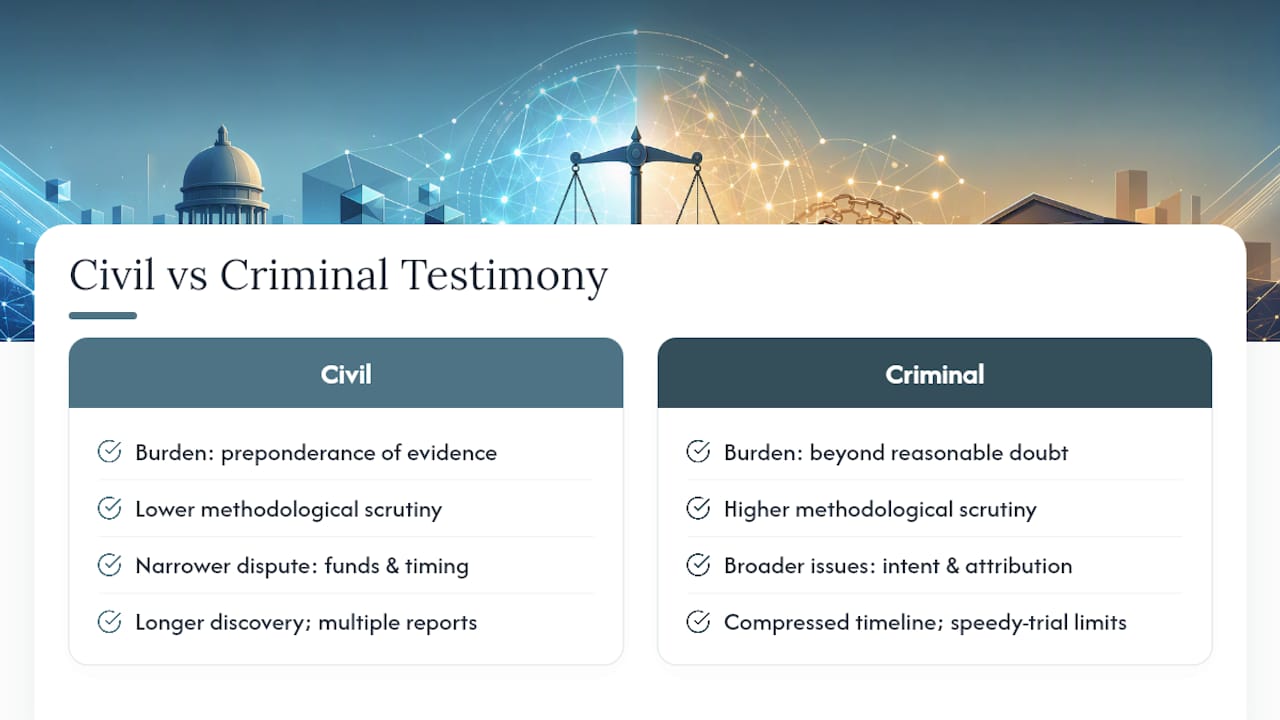
The burden of proof shapes almost everything about how a crypto expert testifies, and that difference shows up long before anyone reaches the witness stand. In civil litigation, the standard is preponderance of the evidence, meaning an expert’s opinion needs only to make the disputed fact more likely true than not. In criminal proceedings, the government has to prove its case beyond a reasonable doubt, and every step of an expert’s analysis faces sharper scrutiny because the stakes for the defendant are categorically higher.
That difference changes how an expert builds and defends a report. Criminal-side testimony, whether for the prosecution or the defense, has to withstand a level of methodological attack that most civil cross-examinations never reach. Defense experts in criminal matters spend significant time probing whether the government’s forensic analyst can explain every assumption behind an address attribution, since a single unsupported leap can undercut an entire chain of custody argument.
Civil experts, by contrast, often work within a narrower dispute. A mining contract disagreement or a divorce asset trace doesn’t usually require proving intent or attributing criminal conduct. It requires establishing what happened to specific funds and when, which tends to keep the analysis more contained.
Pacing differs too. Criminal cases move on a docket controlled by constitutional speedy-trial protections, compressing an expert’s preparation window. Civil cases give more room for extended discovery, multiple rounds of expert reports, and rebuttal analysis. An expert comfortable in one setting isn’t automatically ready for the other, and counsel should ask directly about experience in the specific track their case sits on.
Where the Conventional Advice on Crypto Expert Testimony Falls Short
Most guidance treats hiring a crypto expert like hiring any other litigation specialist: check the resume, confirm the certifications, sign the engagement letter. That misses the actual risk. The real failure point isn’t credentials. It’s methodology that can’t survive a documented challenge, delivered by someone who has never had their analysis torn apart in a deposition.
Counsel should prioritize operational history over academic polish every time those two things trade off. An expert who has spent years tracing live fraud cases under deadline pressure will generally hold up better on cross-examination than one with an impressive certificate and no scar tissue from a hostile deposition. The Bitcoin Fog and 2024 rulings both point to the same lesson: courts aren’t skeptical of blockchain forensics as a category anymore. They’re skeptical of experts who can’t defend their own assumptions.
The single biggest mistake I see in how firms approach this is waiting too long to bring an expert in. By the time a case theory is locked and a demand letter is already sent, the forensic trace should already exist. Retain early, document everything, and treat the expert relationship as part of case strategy from day one, not a box to check before trial.
— cristian
How Recovera Forensics Supports Litigation Teams
Recovera Forensics is a direct option for counsel and litigants who need a technical investigation, not just an opinion on stolen or hidden crypto. The firm’s core work covers digital fraud investigation, wallet activity analysis, and building forensic reports structured for legal proceedings from the first data pull, rather than retrofitted for court after the fact.
Engagements typically start with an intake covering transaction exports, wallet addresses, and any prior correspondence with an exchange or counterparty. From there, Recovera Forensics builds a documented transaction trace with preserved chain-of-custody records designed to hold up against the same reliability challenges courts apply under FRE 702.
If you’re evaluating whether a case needs this level of forensic support, start with a consultation through Recovera Forensics to walk through what documentation you already have and what a court-ready trace would require.
Sources
- Federal Rules of Evidence Rule 702 — Expert testimony (Cornell LII)
- Jury finds operator of Bitcoin Fog guilty of running darknet cryptocurrency mixer (US DOJ)
FAQ
Who Is the Most Trusted Crypto Expert?
There’s no single universally recognized “most trusted” expert. Trust comes down to a documented testimony history, transparent methodology, and certifications like CCFI or Chainalysis Reactor Certification that a specific court has already tested and accepted.
Do Expert Witnesses Give Testimony?
Yes, but only testifying experts do. Consulting experts advise counsel confidentially behind the scenes and never appear on the record, while testifying experts submit sworn reports and answer questions in deposition and at trial.
Can You Get Your Money Back if You Get Scammed on Crypto?
Recovery is possible in some cases through forensic tracing, exchange freezes, and legal action, but it’s never guaranteed and depends heavily on how quickly funds are traced before they move through a mixer or offshore exchange. A chargeback and recovery pathway built on documented tracing gives victims and counsel the strongest starting position.
How Much Is an Expert Witness Paid?
Fee structures vary by task: hourly rates for investigative tracing, flat fees for a defined court-ready report, and separate day rates for deposition and trial testimony that typically run higher to account for preparation time.