There is no fixed clock for a crypto investigation. The first hours decide how much can be done, blockchain tracing usually moves in days or weeks, and anything that depends on exchanges, courts or foreign agencies can stretch into months or years. This guide walks through each phase in order, so you know what is happening to your case and where the waiting comes from.
TL;DR
- The first 24 to 72 hours matter most: report to IC3, preserve evidence and flag the receiving exchange while funds may still be reachable.
- Tracing a theft on the public ledger is the fast part. Identifying who owns an address and freezing money is the slow part.
- Cross-border requests can take months or years, so a finished trace is not a finished case.
- A completed investigation does not guarantee recovery. Funds usually return only through a court or a cooperating institution.
- Anyone who promises a recovery date, or asks for money up front to “unlock” funds, should be treated as a red flag.
Table of Contents
- The timeline at a glance
- Phase 1: The first 24 to 72 hours
- Phase 2: Blockchain tracing, days to weeks
- Phase 3: Exchanges, freezes and law enforcement, weeks to months
- Phase 4: Courts and restitution, months to years
- Why two similar cases take very different amounts of time
- A warning about “fast recovery” promises
- Our perspective
- How Recovera can help
- FAQ
- Sources
The timeline at a glance
Cases differ, but most follow the same sequence. The durations below are ranges drawn from how the stages work, not promises. Only the first row is tied to a published figure; the rest depend on your facts.
| Phase | What happens | What drives the duration |
|---|---|---|
| Hours 0 to 72 | Report, preserve evidence, alert exchanges | How fast you act |
| Days to weeks | Blockchain tracing and a written report | Number of wallets, chains, mixers and bridges |
| Weeks to months | Exchange requests, freezes, law enforcement review | Exchange compliance teams, legal process |
| Months to years | Civil suit, criminal case, asset restoration | Courts, foreign cooperation, the offender |
Phase 1: The first 24 to 72 hours
This is the only phase you fully control, and it is where timing changes outcomes. The FBI’s Recovery Asset Team works with financial institutions to try to freeze fraudulent transfers, but success depends heavily on reporting within hours of the loss.
Do these things, roughly in this order:
- File a complaint with IC3. The FBI encourages victims to submit a complaint even when no money was lost. Include transaction hashes, wallet addresses, the cryptocurrency types and amounts, and the dates and times. Our walkthrough on filing a U.S. IC3 complaint and preserving crypto evidence covers the steps in detail.
- Add the story around the transfer. The FBI also asks for how you met the scammer, the platforms used, website domains or apps, and contact identifiers such as names, emails and phone numbers.
- Save everything unaltered. Screenshots, chat exports, emails, exchange statements and wallet histories. Do not delete the conversation, even if it is embarrassing.
- Contact the exchange you sent from and any exchange you believe received the funds. Security or compliance teams can be asked for a temporary freeze, although a court order is usually required before they release anything they hold.
If you want a tighter checklist for this window, see our 24 to 72 hour crypto investigator checklist and the guide on whether exchanges can freeze stolen crypto.
Phase 2: Blockchain tracing, days to weeks
Once the evidence is organized, an analyst follows the money. Tracing reviews transaction histories to follow funds from one address to another, and commercial tools help investigators analyze transactions and cluster addresses. The work ends when funds reach an off-ramp, such as a KYC-compliant exchange where legal tools can compel the identification of account holders.
How long this takes depends on the shape of the theft:
- A simple path. Funds move from your wallet to a few intermediate addresses and then to an exchange deposit address. A trace can be fairly quick.
- A layered path. Funds are split across dozens of wallets, swapped between tokens, or moved across chains. The Department of Justice lists rapid and complex transactions, chain hopping, anonymity-enhanced coins and mixers as techniques that make tracing harder.
- A dead end. Funds sit in a non-custodial wallet that never touches a regulated service. You can still document the path, but there is no one to send a request to.
The output should be a written forensic report: a transaction graph, the addresses involved, timestamps, and a clear statement of what is established and what is only probable. One limit is worth knowing early. Tracing does not by itself name the person behind an address. Off-chain information, including exchange records obtained through legal process, is what identifies owners.
For the methods behind this phase, see our pages on blockchain forensics, tracing the flow of funds and transaction graph analysis. If your funds were on Ethereum, tracing Ethereum transactions to an exchange is the relevant guide.
Phase 3: Exchanges, freezes and law enforcement, weeks to months
Here the clock leaves your hands. Exchanges freeze accounts through their own internal processes or in response to legal process, and victims can also pursue civil litigation to seek recovery. Speed varies with the exchange, the country it operates in and how clear the evidence package is.
A few points shape this phase:
- Private firms cannot seize. The FBI notes that private sector recovery companies cannot issue seizure orders. A forensic firm’s job is to produce the evidence that lets an exchange, a lawyer or a prosecutor act.
- Law enforcement has its own priorities. U.S. agencies use forensic tools and specialized units to trace and seize assets in criminal cases, with restitution as a goal where possible. The Justice Department created the National Cryptocurrency Enforcement Team in October 2021 for complex cases involving exchanges, mixers and laundering infrastructure. Individual losses may be folded into larger cases, which sets the pace.
- Big freezes are possible. In one landmark pig butchering case, Tether froze 39 wallet addresses holding $225 million in stolen USDT. It shows what close cooperation between stablecoin issuers and federal agencies can achieve, and it is not a typical timeline for a single victim.
Our guides on exchange-to-exchange tracing and on what to report so police open an investigation explain how to get a case in front of the right desk.
What to expect after reporting to IC3
IC3 does not give you a case number to chase or a status portal for a recovery. The FBI may contact victims it has identified by email or phone, and it will never ask for money. Silence in the weeks after a report is common and does not mean your report was ignored. It is also why many victims commission their own technical report in parallel.
Phase 4: Courts and restitution, months to years
A seizure is not a refund. After U.S. authorities seize digital assets, victims typically must establish their legal rights through judicial claims or administrative restoration procedures. Blockchain analysis can help trace funds, but recovery depends on whether the assets reach a court or cooperating institution.
If the offender is abroad, expect more delay. Many service providers operate overseas, and responding to mutual legal assistance requests can take months or years. Crimes that originate abroad can also raise sovereignty questions and extradition obstacles.
Why two similar cases take very different amounts of time
The same loss amount can produce a three-week case or a three-year one. The main variables:
- How quickly you reported. Hours matter for freezes.
- Where the funds landed. A U.S. regulated exchange can respond to U.S. legal process. Foreign platforms with different record-keeping standards, and jurisdictions that do not cooperate, slow everything.
- Obfuscation. Mixers, bridges and chain hopping add analysis time and may end the trail.
- Evidence quality. Complete hashes, addresses, timestamps and communications let an analyst start immediately. Gaps need reconstruction.
- Type of scam. Phishing drains, pig butchering, rug pulls and fake trading platforms leave different traces. See our guides on phishing recovery, pig butchering and rug pulls.
A warning about “fast recovery” promises
The FBI warns victims to be wary of companies claiming they can recover lost cryptocurrency, noting that such entities often charge up-front fees and may themselves be part of fraudulent recovery schemes. Its guidance repeats that claims to recover funds may be another scam.
Use that as a filter. A legitimate forensic engagement describes what it can establish (a documented trail, a report usable by counsel), not a guaranteed return of money or a date. Ask what the deliverable is, who will receive it and what happens if the trail ends at a private wallet.
Our perspective
Most victims arrive asking one question: when will I get it back? We cannot answer that honestly at intake, and we would rather say so. What we can answer is the timeline of the work we control: preserving evidence, tracing the flow of funds, and producing a report that a lawyer, an exchange compliance team or an investigator can act on.
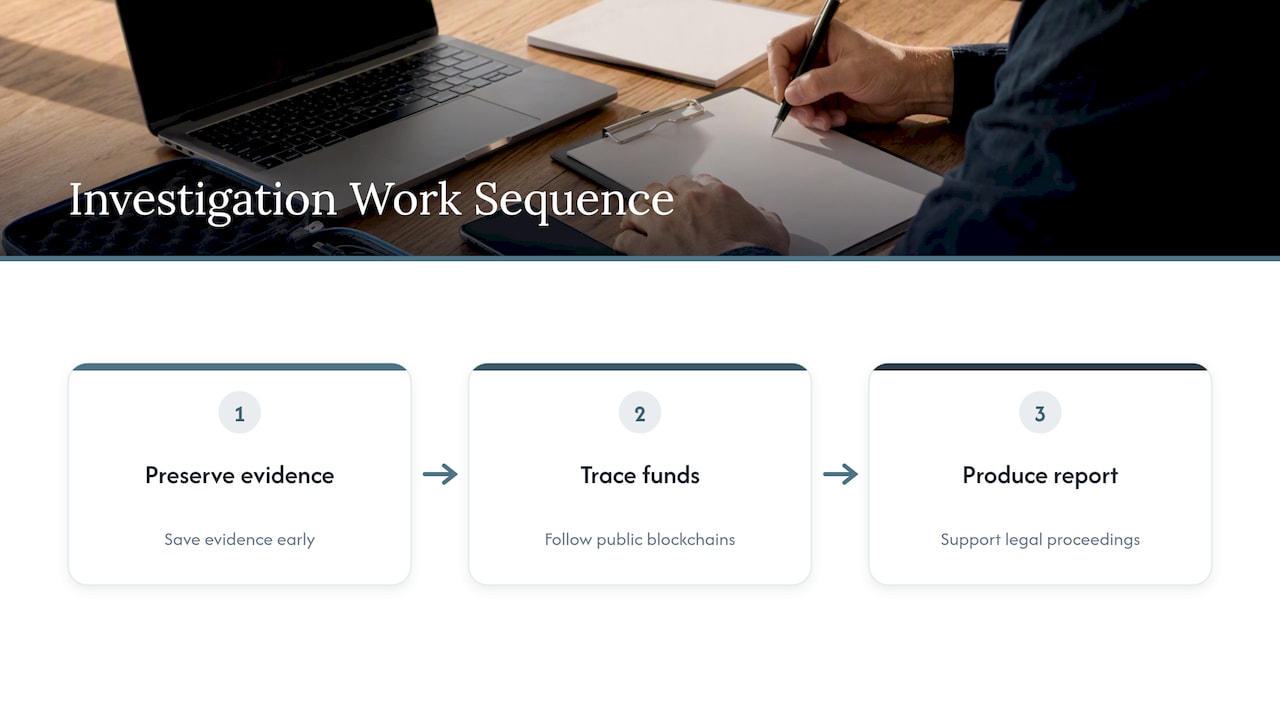
We treat the investigation as evidence building, not as a recovery guarantee. Our approach is to follow transaction patterns on public blockchains, connect wallet activity to possible fraud networks, and document what is certain and what is inference, including through mixers and bridges. Reports are written so they can support legal proceedings, and we work directly with law firms when a case goes that way.
The most common regret we hear about is lost time before anyone saved the evidence. If you take one thing from this article, take that.
— cristian
How Recovera can help
If you have lost cryptocurrency to a scam and need a documented trace, we investigate stolen crypto, preserve evidence and digital footprints, run OSINT attribution work, and prepare technical reports. See our cryptocurrency scam investigation services. Law firms can look at our services for professional offices, and the step-by-step crypto fraud investigation guide shows what an engagement involves before you commit. Pricing is quoted per engagement.
FAQ
How long does a crypto scam investigation take?
The tracing and reporting stage typically runs days to weeks, depending on how many wallets, chains and mixers are involved. Exchange responses, law enforcement review and court processes add months, and cross-border requests can take months or years. No honest provider can give a fixed date.
Is it too late if the scam happened weeks or months ago?
Not necessarily for investigation, but freezes become less likely as time passes. Report to IC3 now and preserve all records. A trace can still document the path and identify exchanges that hold relevant account records, which counsel can pursue through legal process.
Will the FBI get my money back?
The FBI may reach out if it identifies you as a victim, but a report is no guarantee of recovery. Even after a seizure, victims usually have to establish their rights to the assets through a claims process.
Can a forensic investigator freeze my crypto?
No. Private firms cannot issue seizure orders. A forensic report supports requests made to exchanges, attorneys and law enforcement, who hold the legal authority to act.
Sources
- Cryptocurrency, Internet Crime Complaint Center (IC3)
- Cryptocurrency Investment Fraud, FBI
- Increase in Cryptocurrency Recovery Scams, IC3 PSA 2023
- FBI Guidance for Cryptocurrency Scam Victims, IC3 PSA 2023
- Consumers Intending to Invest with Cryptocurrency, FBI Richmond
- Using Blockchain Analysis From Investigation to Trial
- How To Strengthen International Law Enforcement Cooperation, DOJ NCET report
- Report of the Attorney General, DOJ, September 2022
- Report of the Attorney General, DOJ restoration procedures
- Cryptocurrency Investment Scams, CRS, May 2025
- The $225 Million Crypto Seizure, Baker McKenzie
- Crypto Fraud and Asset Recovery, Digital Asset Law
- How to Recover Stolen Cryptocurrency: Legal Steps