TRC-20 token tracing means reading the public TRON ledger to see where tokens such as USDT went after they left your wallet. Every transfer is recorded with sender, recipient, amount and time, so you can follow stolen funds hop by hop. What the ledger cannot tell you on its own is who stands behind an address. That takes additional evidence, usually from an exchange or other service provider, obtained through legal process.
This guide shows how to locate a stolen TRC-20 transfer, follow it through later wallets, check that what you see is genuine, save the right evidence and report in the United States. It also says plainly what tracing can and cannot do for recovery.
TL;DR
- A TRC-20 transfer is permanently visible on TRON: addresses, amounts, timestamps and transaction hashes can all be looked up and followed.
- Tracing shows movement, not identity. Linking an address to a real person usually needs an exchange or service provider’s records, obtained through legal process.
- Save the transaction hash, addresses, contract, amounts and every scam message before you do anything else, then report to the FBI’s IC3 and the FTC.
- Crypto payments typically cannot be reversed, and the FBI warns about recovery services that demand upfront fees, so check any provider before paying.
- A structured forensic report turns raw explorer data into something a law firm or investigator can use.
Table of Contents
- What TRC-20 tracing reveals, and what it cannot prove
- How to find a stolen TRC-20 transaction
- Following the tokens through later transfers
- Checking that the transaction and token are genuine
- Evidence to save right away
- Where to report in the United States
- Can tracing get the money back?
- Our perspective: a trace is a starting point for a case
- When a professional trace makes sense
- FAQ
- Sources
What TRC-20 tracing reveals, and what it cannot prove
TRC-20 is the token standard on the TRON network. USDT on TRON is the best-known example, and it is popular for payments and scams alike because transfers are fast and cheap. The Federal Trade Commission explains that cryptocurrency transactions are typically recorded on a public blockchain and may include amounts and the sender and recipient wallet addresses.
From that public record, tracing can reveal:
- the addresses that sent and received the tokens
- the amount and token contract involved
- the timestamp and block of each transfer
- the transaction hash, which uniquely identifies the transfer
- everything those addresses did afterward, including onward transfers
What it cannot reveal by itself is a name. The U.S. Department of Justice notes in a court filing that an address owner is generally anonymous, but that blockchain analysis can sometimes identify the owner and other addresses controlled by the same person by studying transaction history and address clusters. The same document explains that tracing may lead investigators to exchanges, whose records obtained through subpoenas or other legal process can sometimes reveal who was responsible.
The IRS makes a similar point in its training material on digital assets: transactions can generally be traced through the blockchain, and the trail may lead to an exchange or service provider where ownership can be identified.
So think of tracing as a map, not a verdict. It shows the route. It does not hand you the identity, and it does not guarantee that anyone can be made to return the money.
Why the trail gets harder to read
A real theft rarely stays in one wallet. In a 2022 Department of Justice statement of facts, investigators followed stolen cryptocurrency through numerous wallets, exchanges, darknet-market accounts and chain-hopping activity. The tracing supported the investigation, but additional financial and other evidence was still needed to connect the activity to particular people.
The scale can be large. In June 2025 the Department of Justice said blockchain analysis combined with other investigative techniques was used to connect more than $225.3 million in cryptocurrency to alleged investment-fraud laundering, with hundreds of thousands of transactions dispersing the proceeds across addresses and accounts.
For a single victim, the picture is usually smaller, but the same patterns appear: funds are split into several addresses, swapped to another token, bridged to another chain, or parked for weeks before moving.
How to find a stolen TRC-20 transaction
Start with what you have. If the money left your own wallet or exchange account, your app history or withdrawal confirmation shows a transaction hash (also called a transaction ID). That string is the key to everything else.
- Copy the hash and the destination address from your wallet or exchange history. If you only have a screenshot, retype carefully and check every character, because a single wrong character points to a different record.
- Open a TRON block explorer and search by hash. TRON’s explorer documentation says transaction records show the sender, recipient, block height, transaction hash and production time, and that transactions can be searched by hash.
- Read the token transfer section, not only the top line. For a TRC-20 transfer, the TRX fields on the main record can look unrelated. The token amount, token contract and real recipient appear in the token transfer details and event log.
- Confirm the recipient matches what you expected. In address-poisoning and phishing cases, the recipient is often a look-alike of an address you used before, matching the first and last characters only.
- Note the status. A transaction should show as successful and confirmed before you treat it as a completed transfer.
If you were given a link or screenshot by someone else, including the scammer, do not trust it. Search the hash yourself on an explorer you opened directly. A fabricated screenshot of a “pending” or “frozen” transfer is a common ploy.
Using the API for larger histories
Explorer pages are fine for a handful of transfers. Once the funds have been split across dozens of addresses, scripts save time. TRON’s developer documentation says the TronGrid v1 API exposes an account’s TRC-20 transfer history, covering incoming and outgoing transfers, with optional filtering by token contract. The endpoint is GET /v1/accounts/{address}/transactions/trc20, and it supports pagination so you can retrieve a full history page by page.
This matters for evidence. A screenshot of one explorer page shows a moment in time. An exported, timestamped record of an address’s full history is easier to review and to hand to an investigator.
Following the tokens through later transfers
Once you know the first receiving address, the work becomes repetitive and methodical.
- Pull the receiving address’s TRC-20 transfer history, filtered to the token contract of the asset you lost, so unrelated tokens do not clutter the view.
- Find the outgoing transfers that follow your incoming one. Compare amounts and timing. A deposit of 10,000 USDT followed minutes later by several smaller outflows is a typical split.
- Repeat for each new address. Keep a running table: address, date, amount in, amount out, next address, and notes.
- Mark the points where the trail stops being a simple wallet: a deposit to an address that receives many unrelated incoming transfers often belongs to a service, such as an exchange. That is the most useful kind of endpoint.
- Watch for token swaps and bridges. If USDT on TRON is swapped or bridged to another network, the TRC-20 history ends at that contract, and the trail continues on a different chain with different tools.
The United Nations Office on Drugs and Crime points out that secondary-market USD₮ transfers can occur between individuals, exchanges, custodians, businesses and self-hosted wallets without Tether’s involvement, while the blockchain records can still be analyzed to trace fund movements. In practice, this means the issuer is not a party to every hop, and the ledger itself is your main source.
A simple worked example
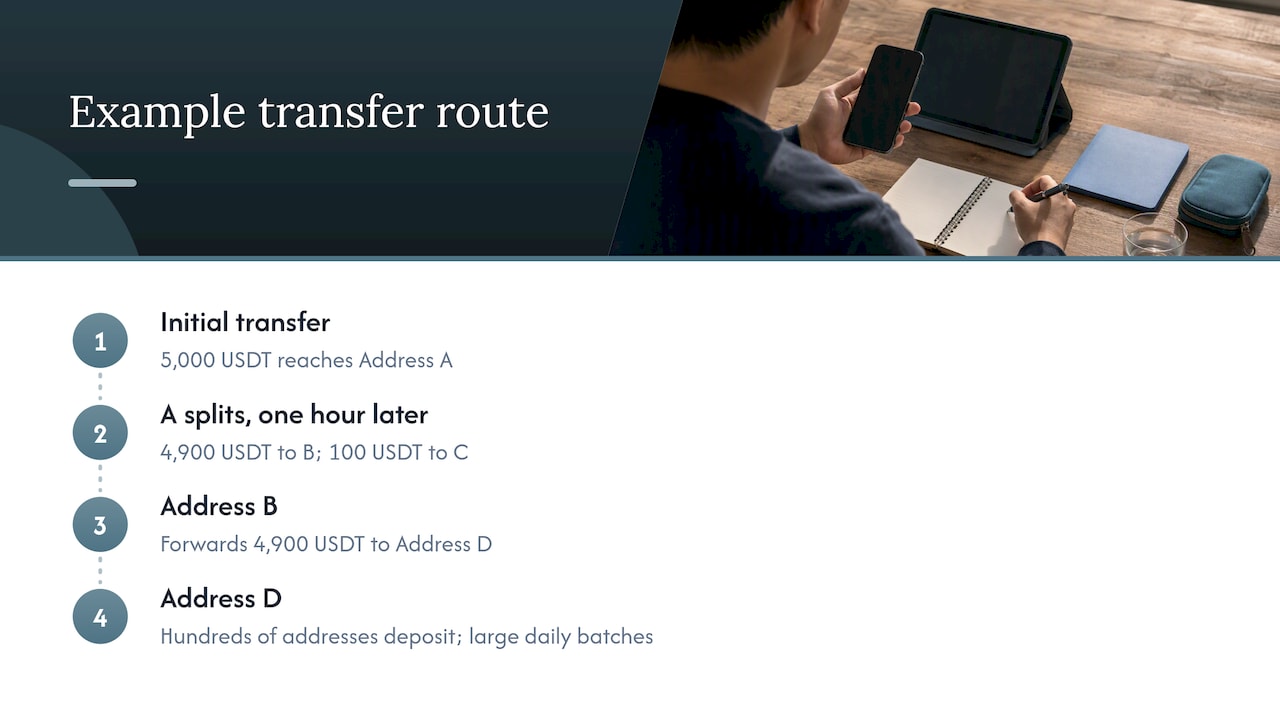
Say you sent 5,000 USDT on TRON to an address you believed belonged to a trading platform. Your hash shows the transfer succeeded. The receiving address, call it Address A, sends 4,900 USDT to Address B an hour later and 100 USDT to Address C. Address B forwards everything to Address D, which receives deposits from hundreds of different addresses and sends large batches onward daily. That pattern suggests D is a deposit address at a service. You now have a concrete lead: the service that controls D is the entity that may hold identifying records, and a lawyer or investigator can direct a request to it. You still do not know the person behind A, only the route.
Checking that the transaction and token are genuine
Tracing is only as good as the facts you start from. Two checks prevent most mistakes.
Confirm the network and the contract. TRC-20 assets are identified by contract address, not by name or ticker. Fake tokens can carry the name “USDT” and an identical logo. TRON’s exchange integration guidance says to verify the network and identify the TRC-20 asset by contract address.
Confirm the transfer actually executed. The same documentation says a valid TRC-20 deposit should be identified from a successfully executed transaction receipt that contains the token contract’s Transfer event, and that a function selector or parameters alone do not prove execution succeeded. In plain terms: a transaction that was broadcast but failed does not move tokens, and an explorer entry that merely looks like a transfer is not proof.
This also protects you from the reverse problem, where a scammer shows you a “transfer” that never happened to convince you to ship goods or release funds.
Keep the limits in mind. Checking a transaction confirms technical facts such as whether a transfer occurred, its confirmation status, amount, token and addresses. It does not tell you whether the funds are clean or who controls the address.
Evidence to save right away
Public blockchain data does not disappear, but the surrounding evidence does: chats get deleted, scam sites go offline, apps are removed. Save what only you hold first.
For each fraudulent transfer, record the details TRON’s documentation treats as the core identifiers: the network, the asset (contract address), the transaction ID, block height and hash, the sender, the recipient, the raw amount, the execution result and where you found the information. The developer guide lists these fields for exactly this purpose.
Then add the human side. The FBI’s Internet Crime Complaint Center lists examples of evidence to retain: cryptocurrency receipts, wire receipts, emails with full headers, web pages, hard-drive images, network logs, malware, chat transcripts and telephone logs. IC3 says it does not collect evidence or accept attachments with a complaint, so keep originals secure because investigators may ask for them later.
A practical checklist:
- Screenshots and exports of the scam chat, with usernames and dates visible
- The scam website address and any app names or download links
- Your wallet’s transaction history, exported if possible
- Bank and exchange statements showing how you bought and sent the crypto
- Emails in their original form, with headers
- A written timeline, in your own words, while memory is fresh
Handling matters if the case may go to court. Our guides on preserving digital evidence and crypto chain of custody explain how to keep the record defensible, and the first 72 hours checklist covers what to do in what order.
Where to report in the United States
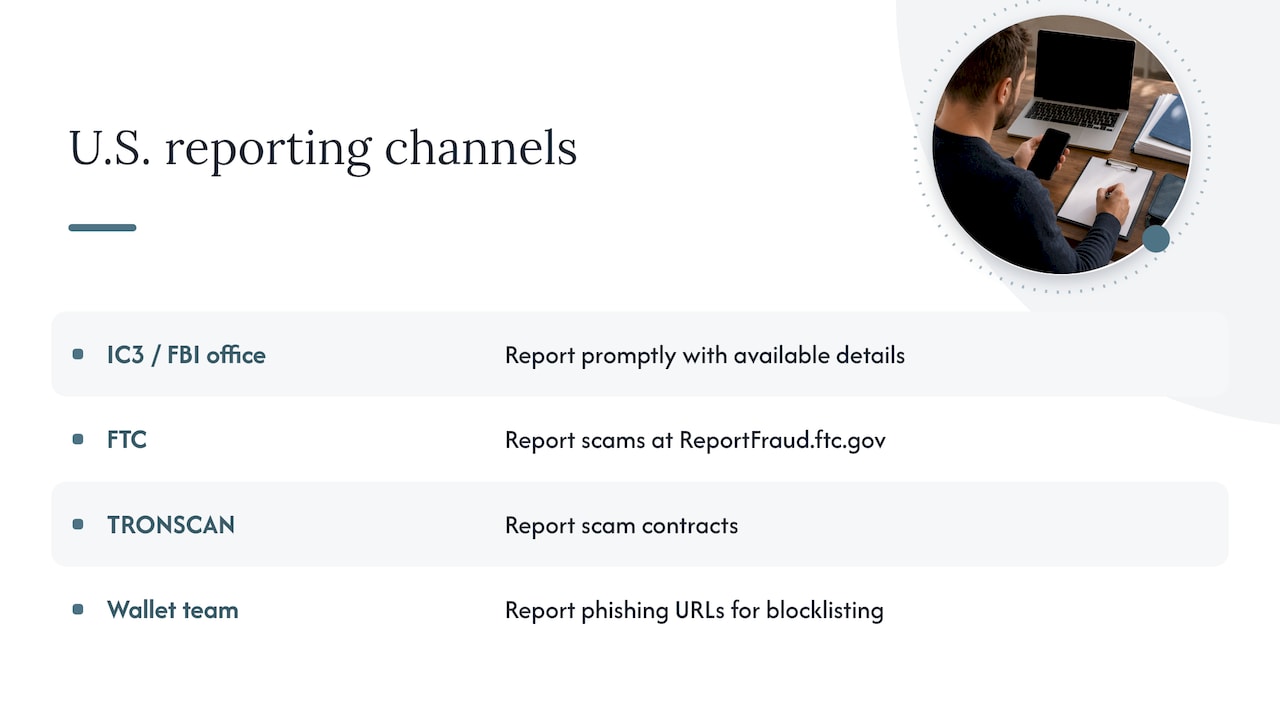
The FBI’s guidance for cryptocurrency victims says to report promptly to IC3 or a local FBI field office. Include the addresses, cryptocurrency type and amount, date and time, transaction hash, scam-related communications and identifiers, domains or apps, exchanges used and your timeline. The FBI says not to wait: if transaction information is unavailable, report anyway with everything you have. Our walkthrough of filing an IC3 complaint goes through the form step by step.
Also report to the FTC. It says crypto payments typically cannot be reversed and asks you to report scams at ReportFraud.ftc.gov, including the scammer’s wallet address. The reporting instructions say the site asks what happened, payment details, timing, how you encountered the scam and identifying information, then gives you a report number and next steps.
Two TRON-specific steps help other users. TRON’s security guide says to report scam contracts on TRONSCAN so the team can flag malicious contracts, and to report phishing URLs to the relevant wallet team so it can blocklist the domain in its extension.
Wondering what happens after you file? Our page on what to report to trigger a police investigation sets realistic expectations.
Can tracing get the money back?
Sometimes, but never by default, and nobody honest can promise it. Tracing is what makes recovery possible: it finds the services that received the funds, and it gives law enforcement, courts and platforms something specific to act on. Whether funds are frozen, seized or returned depends on speed, where the money landed and who has the legal power to act.
The FTC advises victims to tell the cryptocurrency company that the transaction was fraudulent and ask whether it can reverse it, while recognizing that crypto payments typically cannot be reversed. If your funds went through an exchange you use, contact its fraud team first, with your transaction hash in hand.
Be careful about who you hire next. The FBI encourages reporting even when no financial loss occurred and warns consumers to be wary of recovery services, particularly those charging an upfront fee. Victims are a target for a second wave of scams, and “we can hack the scammer’s wallet” or “guaranteed return” are red flags. Legitimate forensic work produces documentation of what happened and where the funds went, not magic.
Questions to ask any provider before you pay:
- What exactly will I receive: a report, a consultation, testimony support?
- Do you promise recovery? (If yes, walk away.)
- How do you document your method so another expert could check it?
- Will you work with my attorney and law enforcement?
- Are fees and scope written down before work starts?
Our perspective: a trace is a starting point for a case
We see the same pattern again and again. A victim has spent days staring at an explorer page, certain that the answer is in there somewhere. The data is real, but explorer pages answer “where did it go?” and not “who received it, and can that be proved?”
Our work is to turn the public record into something others can rely on. That means tracing the funds across wallets, including through mixers and bridges, connecting wallet behavior to wider fraud networks where the evidence supports it, and writing it up in a technical report that a law firm can use in legal proceedings. We are careful about what we claim. If a trail ends at a service, we say so and explain who could hold the next piece. If an inference is only an inference, the report labels it that way.
We also tell victims what they should not expect. We do not promise returns, because recovery depends on facts we do not control. What we can offer is a clear, documented account of what happened, prepared the way investigators and courts expect, so that every later step starts from solid ground rather than screenshots.
— cristian
When a professional trace makes sense
Manual tracing works for a single transfer to a single address. Consider professional help when funds were split across many wallets, crossed to another chain, or touched a mixer, when the amount justifies a legal claim, or when your attorney needs a report rather than a spreadsheet.
Recovera Forensics investigates cryptocurrency scams, performs OSINT and digital attribution work, preserves evidence and prepares technical reports for legal proceedings. See our cryptocurrency scam investigation services, or, if you are an attorney, our support for professional offices. For background on the method, read how blockchain forensics traces and proves crypto fraud and how to identify scam wallets.
FAQ
Can I trace a TRC-20 transaction without technical skills?
Yes, for a first look. Paste your transaction hash into a TRON block explorer and read the token transfer details to see the recipient, amount and time. Following funds across many wallets is slower and easier to get wrong, so keep a written log of each hop as you go.
Does tracing tell me who stole my USDT?
Not by itself. The blockchain shows addresses, not names. Investigators can sometimes link addresses to a person by analyzing address clusters or by obtaining exchange records through subpoenas or other legal process, but that step needs lawful requests and additional evidence.
Can Tether freeze stolen USDT on TRON?
We cannot promise that, and it is not something a victim controls. Transfers happen between wallets, exchanges and businesses without the issuer’s involvement, so the realistic first steps are reporting to IC3 and the FTC and notifying any exchange the funds touched. Law enforcement and counsel decide what further action is possible.
How fast do I need to act?
Immediately. The FBI advises against waiting to file an IC3 complaint, and funds can move through several addresses in minutes. Save your evidence first, then report with whatever information you have, and add details later.
Should I pay a recovery company upfront?
Be very cautious. The FBI warns consumers to be wary of recovery services, particularly those charging an upfront fee. Ask for a written scope, no guarantee of results, and a clear description of what you will receive.
Sources
- FTC: What to know about cryptocurrency and scams
- U.S. Attorney, District of New Jersey: blockchain analysis explained
- IRS: The fundamentals and tax treatment of digital assets
- DOJ: Statement of facts (2022)
- DOJ: Civil forfeiture complaint, $225M cryptocurrency
- TRON documentation: Guide to the blockchain explorer
- TRON developers: TRC-20 transaction history
- UNODC: Stablecoins, illicit finance and public-private cooperation
- TRON developers: Exchange and custodial wallet integration
- FBI IC3: Frequently asked questions
- FBI IC3: Guidance for cryptocurrency victims
- FTC: Crypto payments and scams
- FTC: How to report fraud at ReportFraud.ftc.gov
- TRON developers: Security and safety on TRON
- FTC: What to do if you were scammed
- FBI IC3: Cryptocurrency