Tracing funds on the Avalanche C-Chain starts with three things: the victim’s wallet address, the transaction hash of each transfer out, and a block explorer that reads the C-Chain. From there you follow every hop, label what you can identify, and watch for the points where funds leave the chain, such as a bridge, a swap or an exchange deposit. This guide shows how that works, where amateur tracing breaks down, and what a forensic investigation adds when the goal is recovery or a court filing.
TL;DR
- The C-Chain is Avalanche’s EVM-compatible smart contract chain, so its addresses look like Ethereum addresses and the tracing logic is familiar.
- Start with your own wallet address and the transaction hashes. Export them before you do anything else.
- A public explorer shows transfers, token movements and contract calls. It does not tell you who owns a wallet or where funds went after a bridge.
- Moves between the C-Chain and the X-Chain or P-Chain use a separate kind of transaction that ordinary EVM views can miss.
- Speed matters: the strongest recovery routes usually run through an exchange deposit, and those windows close quickly.
Table of Contents
- What the C-Chain is and why it matters for tracing
- Before you trace: collect and preserve the basics
- Reading the C-Chain with a block explorer
- The part most guides skip: atomic transfers between Avalanche chains
- Where stolen funds usually go next
- Signs that a wallet belongs to an operation, not an individual
- What a block explorer cannot tell you
- Our perspective: what we see in Avalanche cases
- Why speed and scale matter in the US
- A practical first-48-hours plan
- When to hire a forensic investigator
- How Recovera Forensics can help
- FAQ
- Sources
What the C-Chain is and why it matters for tracing
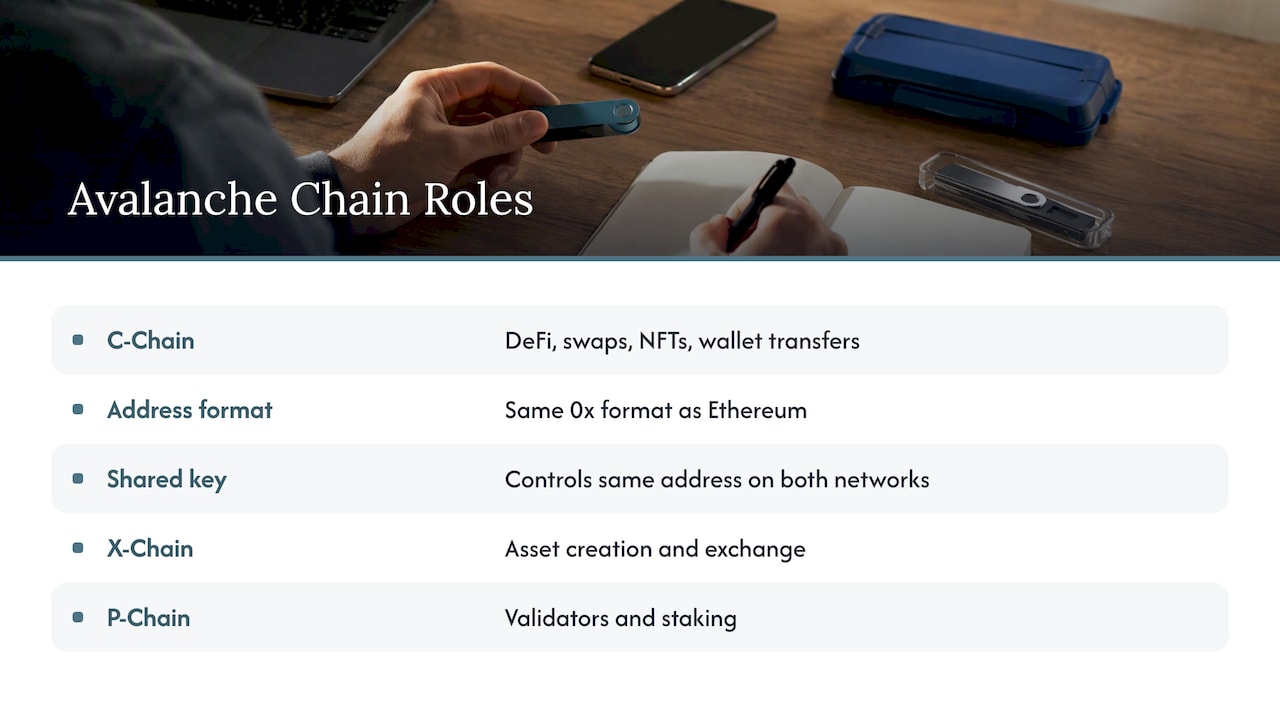
Avalanche runs several chains. The C-Chain (Contract Chain) is the one where most DeFi activity, token swaps, NFTs and wallet-to-wallet transfers happen. Because it is EVM-compatible, a C-Chain address has the same 0x format as an Ethereum address, and the same private key controls the same address on both networks.
That has two consequences for a victim.
First, the scammer’s address on Avalanche may be the same address they use on Ethereum, Arbitrum, BNB Chain and other EVM networks. Looking up that one address across chains often reveals a much larger picture than the single transfer you suffered.
Second, the tooling is mature. Standard EVM concepts apply: native AVAX pays gas, tokens follow the ERC-20 standard, approvals can be granted to contracts, and every action leaves a transaction hash. If you have traced an Ethereum theft before, our guide to tracing Ethereum transactions to an exchange uses the same method you will use here.
The other Avalanche chains handle different jobs. The X-Chain is built around asset creation and exchange, and the P-Chain coordinates validators and staking. Funds can move between them, and that is where tracing gets trickier, as covered below.
Before you trace: collect and preserve the basics
Do this first, before you analyze anything. Explorer pages change, labels get edited, and scammers sometimes delete the sites and chats that connect them to a wallet.
Gather:
- Your wallet address on the C-Chain (the 0x address, not a seed phrase; never share a seed phrase with anyone).
- Every transaction hash for money that left your wallet, including approvals you signed.
- The destination address for each transfer.
- Timestamps with time zone, amounts and token names or contract addresses.
- Off-chain evidence: the scam site URL, chat logs, emails, payment screenshots, phone numbers, usernames and any invoices or “account manager” messages.
Save full-page captures of the explorer pages, and export CSVs where the explorer allows it. Record the date and time you captured them. If you expect to file a police report or a lawsuit, read our digital evidence preservation guide so the files hold up later.
Reading the C-Chain with a block explorer
The main public explorer for the C-Chain is SnowTrace, which is operated by Routescan after the original Etherscan-powered version was discontinued in November 2023. It lets you search transactions, addresses and blocks. Avalanche’s own tooling also offers an explorer that covers the C-Chain and other Avalanche chains in one place.
The tabs that matter
Paste the victim address or a transaction hash into the search bar, then work through these views:
- Transactions: the normal transfers and contract calls. Look at the “to” address, the value and the method called.
- Internal transactions: AVAX moved by smart contracts rather than directly by a wallet. Many theft flows hide here, especially when a malicious contract forwards funds.
- Token transfers: ERC-20 movements, including stablecoins such as USDC and USDT. Scam losses are often in stablecoins, not AVAX.
- Approvals: permissions your wallet gave to a contract. A “drainer” scam often succeeds through a single approval, and the funds then leave without a fresh signature.
- Contract tab: whether the receiving contract is verified, and what its code does.
What a first-pass trace looks like
Take a simple example. A victim sends 5,000 USDC from their C-Chain wallet to an address a fake support agent provided. On the explorer you see that the receiving wallet:
- Receives the 5,000 USDC.
- Within minutes, splits it into several smaller amounts.
- Swaps part of it into AVAX through a decentralized exchange.
- Sends the rest to a bridge contract.
Each of those steps is a decision point. The split tells you the operator is managing multiple wallets. The swap shows which DEX was used. The bridge call tells you the funds are leaving Avalanche, and you need the destination chain and address to keep going.
For a methodical way to record each hop, see our walkthrough on tracing the flow of funds for legal recovery.
The part most guides skip: atomic transfers between Avalanche chains
Moving AVAX between the C-Chain and the X-Chain or P-Chain does not work like an ordinary EVM transfer. It uses an export from one chain and an import on the other. According to Avalanche’s explorer, these imports and exports are not EVM transactions: they sit in block extra data and never show in standard eth_* calls.
In practice, this creates a gap. Suppose the stolen funds vanish from a C-Chain address with no obvious destination in the normal transaction list. The money may have been exported to the X-Chain or P-Chain. A tracer who only looks at EVM-style views will conclude the trail is dead. It isn’t. You need the explorer’s cross-chain (atomic) view for that address, and often the X-Chain or P-Chain address format, which differs from the 0x format.
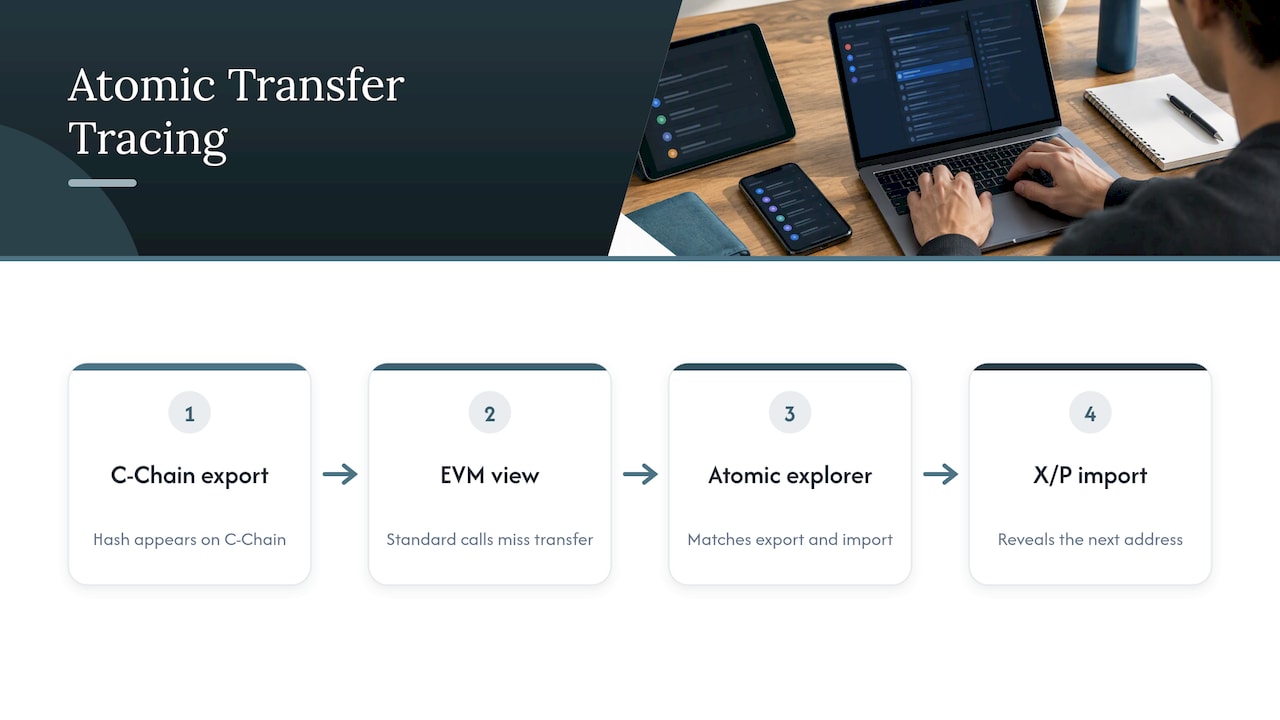
This is a good example of why a basic wallet lookup can stop short. It is also a reason to keep the original hash list: the export transaction shows up on the C-Chain side, and the matching import on the other chain gives you the next address.
Where stolen funds usually go next
The C-Chain is rarely the end of the road. Scam operators move funds toward a place where they can cash out. Common paths:
| Path | What you see on the C-Chain | What to do next |
|---|---|---|
| Direct deposit to an exchange | Transfer to an address that receives many deposits from unrelated wallets | Identify the exchange, record the deposit hash, and prepare a formal request through proper channels |
| Swap into another token | Interaction with a DEX router contract | Follow the output token and the receiving address |
| Bridge to another chain | Call to a bridge contract with a destination chain parameter | Find the matching transaction on the destination chain |
| Cross-chain atomic export | Export tx to X-Chain or P-Chain | Use the atomic view and follow the import |
| Mixer or privacy layer | Deposit into a mixing contract or service | Needs timing, amount and pattern analysis; not a simple lookup |
| Peer-to-peer or OTC cash-out | Small repeated transfers to many fresh wallets | Requires clustering and off-chain intelligence |
Exchange deposits are the most useful finding for a victim, because a regulated exchange holds identity records and can sometimes act on a proper legal request. Our guide on exchange-to-exchange tracing explains how funds are followed across several platforms.
Signs that a wallet belongs to an operation, not an individual
A single transfer to a single address tells you little. Patterns tell you much more. When we review a case, we look for:
- Fan-out and fan-in: one wallet splitting funds across many, then consolidating them again.
- Consistent timing: transfers that happen within minutes of each deposit, suggesting automation or a managed process.
- Shared funding source: several “separate” scam wallets all received their gas AVAX from the same address.
- Repeated victims: the same address receiving similar-sized deposits from many unrelated wallets in a short period.
- Reuse across chains: the same address active on Ethereum and other EVM networks.
These checks are the core of wallet activity analysis. We list the six checks that analysts need before presenting findings in court in our wallet activity analysis guide.
What a block explorer cannot tell you
Explorers are excellent at showing what happened. They are not built to say who did it. Be careful with these limits:
- Labels are not proof. A tag such as “Exchange” or “Scam” on a public explorer is a hint. It may be out of date, community-sourced or wrong.
- Ownership is not shown. A wallet is a string of characters. Linking it to a real person or company needs outside evidence such as exchange records, domain data, social media and similar open-source material.
- Bridges break the visible trail. On one side you see a deposit into a bridge, on the other a withdrawal. Matching the two requires timing, amounts and bridge-specific data.
- Fresh wallets look innocent. Operators rotate wallets. A clean-looking address may be the third hop of a long chain.
This is why we separate monitoring from investigation. Monitoring alerts you that something moved. Investigation reconstructs the full route and builds the evidence. We explain the difference and why the first 72 hours matter in transaction monitoring vs investigation.
Our perspective: what we see in Avalanche cases
We approach every Avalanche case the way we approach any chain: as a reconstruction problem. The question is never only “where did the coins go?” It is “can we show a connected, documented route from the victim’s wallet to a point where someone can act?”
A few things we have learned to insist on:
- Treat the C-Chain as one chapter. Because the address format matches Ethereum, the same actor often appears on several networks. We trace across them and across bridges rather than stopping where Avalanche ends.
- Check the cross-chain view early. When funds seem to disappear, an atomic export is one of the first things to rule out.
- Link on-chain activity to off-chain identity. Open-source intelligence, domain and social media research, and exchange-side leads turn a wallet cluster into a named lead.
- Write for the reader who will challenge it. A forensic report has to be understandable to a lawyer, a court or an exchange compliance team. Every hop needs a hash, a timestamp and a stated method.
- Be honest about outcomes. Tracing improves the odds of recovery. It does not guarantee it. If the funds went through a mixer or were cashed out peer to peer, we say so plainly.
If you want a broader view of our method, our page on blockchain forensics covers how we trace and prove crypto fraud.
— cristian
Why speed and scale matter in the US
Crypto crime is large and growing. The FBI’s Internet Crime Complaint Center reported that losses across all reported internet crime reached $16.6 billion in 2024, a record, and its report identifies cryptocurrency as a medium that fuels investment fraud and other schemes. Most individual victims are not told this when they report: law enforcement can take time to act, and funds can move across several chains within hours.
If you are in the US, reporting to IC3 and local police should happen in parallel with tracing, not instead of it. Our guide on what to report to trigger a police crypto investigation shows what officers typically need to see. A traced route with hashes and a clear summary gives them something concrete to work from.
A practical first-48-hours plan
- Stop further loss. Move any remaining assets to a new wallet created on a clean device. Revoke token approvals for the compromised address through an approval-management tool.
- Preserve everything. Capture explorer pages, export histories, and save all messages.
- Build your hash list. One line per transfer: date, time, amount, token, from, to, hash.
- Do a first pass on SnowTrace. Note the first three or four hops and any bridge or exchange interaction.
- Check the atomic view if funds seem to vanish without a destination.
- Report. File with IC3 and your local police, and notify the exchange you used if the funds left from a custodial account.
- Get an independent review before paying anyone who promises to recover your funds. Be wary of anyone who asks for your seed phrase or an upfront “unlock” fee.
For a longer checklist with public guidance alongside ours, see the 24 to 72 hour investigator checklist.
When to hire a forensic investigator
A DIY trace is a good start. It is often enough to describe what happened to the police. It is rarely enough when:
- The amount is significant relative to your finances.
- Funds crossed a bridge, a mixer or several chains.
- You want a report that a lawyer can attach to a complaint or motion.
- You suspect the operator is behind multiple victims and multiple wallets.
- You need to identify the scam wallets quickly so an exchange can be approached. See how we identify scam wallets within hours.
If your case may reach court, the evidence must be collected and explained properly. Our overview on using crypto forensics in a US court covers the four steps that matter, and crypto fraud legal options outlines the routes open to US victims. Speak with a licensed attorney in your state about which route fits your facts.
How Recovera Forensics can help
We investigate stolen cryptocurrency on Avalanche and other networks by analyzing transaction patterns on public blockchains, tracing how funds moved, and connecting wallet activity to wider fraud networks. Our work includes OSINT and digital attribution, evidence preservation, and technical reports prepared for legal proceedings. We also work with law firms that need forensic support for their clients. You can see the full list on our digital fraud investigation and crypto recovery page, or start from our home page to tell us about your case. Pricing is set per engagement, so there is no published rate; we scope the work after we review what you have.
FAQ
Can you trace crypto on the Avalanche C-Chain?
Yes. Every C-Chain transaction is public and permanent, and an explorer such as SnowTrace lets anyone follow transfers between addresses. The limits come later: bridges, mixers and off-chain cash-outs make the trail harder, and identifying who owns a wallet needs evidence beyond the chain itself.
Is Avalanche built on Ethereum?
No. Avalanche is its own network with its own consensus and validators. The C-Chain is EVM-compatible, which means it runs the same kind of smart contracts and uses the same address format as Ethereum. That compatibility is why one address can show activity on both networks.
Why did my AVAX disappear without showing a destination?
It may have moved through a cross-chain export to the X-Chain or P-Chain. Those atomic transfers are not ordinary EVM transactions, so a standard transaction list can omit them. Check the explorer’s cross-chain view for your address and save the export transaction hash.
Can stolen Avalanche funds be recovered?
Sometimes, but no honest provider can promise it. Recovery is most realistic when funds reach a regulated exchange that can act on a legal request, or when the operator can be identified. A prompt, well-documented trace improves those odds. Be cautious about anyone who guarantees results or asks for your seed phrase.
Should I report to the police before hiring an investigator?
Do both, and do not wait on one for the other. File a report with IC3 and local police, and keep your evidence organized so that the same trace supports both the report and any later legal step. A forensic report can give officers and attorneys a clear route to review.
Sources
- SnowTrace integration page, Avalanche Builder Hub
- C-Chain atomic transactions, Avalanche explorer
- 2024 IC3 Annual Report, FBI