If you sent crypto to an “escrow” agent and the other party vanished, or the escrow site suddenly demanded more money, you were almost certainly dealing with a fake. A crypto escrow scam investigation traces where your coins went on the public blockchain, documents who controlled the receiving wallets, and turns that into a report you can hand to law enforcement, your lawyer or a court. It cannot promise a refund, and anyone who says otherwise is a red flag. It can, however, give your case the evidence it lacks right now.
This guide explains how these scams work, what to do in the first hours, what an investigation actually produces, and how to avoid the second scam that targets people who have already been robbed.
TL;DR
- A fake escrow scam uses a neutral-sounding “middleman” to collect your crypto, then keeps it or invents new fees to hold you in the scheme.
- Report to the FBI’s IC3 and the FTC first, and save every hash, address, chat and screenshot before anything disappears.
- A forensic investigation traces funds, links wallets to wider fraud networks and produces a report suitable for legal proceedings. It does not guarantee recovery.
- Recovery in the US usually runs through government seizure and remission, so your documentation matters.
- Never pay upfront fees to a stranger who contacts you offering recovery. The FBI warns about fictitious law firms doing exactly that.
Table of Contents
- How a fake crypto escrow scam works
- The first 24 hours: what to do and what to save
- What a crypto escrow scam investigation involves
- Can you actually get your money back?
- Beware of the second scam: fake recovery services
- How to avoid it happening again
- Our perspective: evidence first, promises never
- When to bring in a forensic investigator
- FAQ
- Sources
How a fake crypto escrow scam works
Real escrow is simple in principle: a neutral party holds the buyer’s funds until the seller delivers, then releases them. Guides to legitimate crypto escrow describe a sequence of agreement, deposit, delivery, confirmation and release, with an arbitrator if there is a dispute. The scam copies that look and removes the neutrality.
The pattern we see most often has the same moving parts:
- A deal that needs trust. A private sale of a car, a domain, an NFT, an OTC trade, a freelance job, or an “investment” introduced by someone you met online.
- A suggested escrow. The scammer proposes a particular escrow site or agent, often one they control. A professional-looking website, fake reviews and a live chat window do the rest.
- The deposit. You send crypto to an address the “escrow” provides. From that moment you no longer control the funds.
- The stall. The seller never delivers, or the escrow reports a problem: a “release fee,” a “tax,” a “verification deposit,” a “compliance hold.” Each payment is presented as the last step before you get your money.
- The disappearance. When you stop paying, the site goes quiet or offline.
In some versions the escrow is real software but the buyer or seller on the other side is fictitious. In others, the whole transaction is a story told to you by one person using several identities. For an investigation the distinction matters less than one fact: your funds moved to wallets that someone else controlled.
Warning signs worth checking against your own case
- The escrow was proposed by the counterparty, not chosen independently by you.
- You were asked to move the conversation to Telegram or WhatsApp.
- Fees appeared after you had already deposited.
- Payment had to be in crypto or gift cards. The FBI lists upfront fees, crypto or gift card payment and pressure to use private messaging as common red flags in crypto fraud and recovery schemes.
- Support staff cannot be reached outside the chat window, and the company has no verifiable registration or physical address.
If several of these fit, treat the case as fraud rather than a dispute that will resolve itself.
The first 24 hours: what to do and what to save
Blockchain records do not vanish, but the context around them does. Chats get deleted, websites go down and accounts are closed. Preserve first, investigate second.
Stop sending money
Do not pay any “release fee,” however plausible. Each additional payment adds to the loss and tells the operator you are still engaged.
Capture the evidence
Collect and store copies outside the device you used for the deal:
- Transaction hashes (TXIDs) for every payment, plus the sending and receiving wallet addresses.
- The exact date, time and amount of each transfer, and the asset and network used (for example USDT on Tron versus Ethereum).
- The escrow website URL, screenshots of every page, and any contract or terms it showed.
- Full conversation exports from email, chat apps and social media, including usernames and profile links.
- Invoices, listings, ad copy, bank or exchange statements showing how you bought the crypto.
Our guides on saving evidence in the first 72 hours and on what to do in the first 24 hours go through this list in more detail. For a view of how preserved material is later tested, see our digital evidence preservation guide.
Report to the right agencies
File a complaint with the FBI’s Internet Crime Complaint Center at ic3.gov and with the FTC at reportfraud.ftc.gov. Your report feeds government-led investigations and any future compensation process. The scale is real: the FBI’s 2024 report logged 149,686 crypto-related complaints and more than $9.3 billion in losses, with investment fraud the largest share. If you are 60 or older, the IC3 page lists the National Elder Fraud Hotline at 833-372-8311 to help with filing.
Our seven-step IC3 walkthrough shows what to include so the complaint is useful rather than generic. If you want to know what happens to a report afterward, read whether police will investigate crypto scams.
Tell your exchange or bank
If the funds left from a regulated exchange or you paid through a bank, contact their fraud teams right away with the transaction details. Exchanges can sometimes flag or restrict accounts when they are shown credible evidence, which is why speed counts. Our article on tracing Ethereum transactions to an exchange explains how a deposit address links to a platform that can act.
What a crypto escrow scam investigation involves
People often imagine an investigator “hacking back” the coins. That is not what happens, and it would not be lawful. A forensic investigation works from public data and open sources.
| Stage | What happens | What you receive |
|---|---|---|
| Intake and preservation | Your hashes, chats and screenshots are catalogued and secured | A documented evidence set |
| On-chain tracing | Funds are followed from your payment through intermediate wallets | A map of the flow of assets |
| Wallet analysis | Receiving wallets are examined for patterns, clustering and links to known fraud infrastructure | Findings on who may control them |
| OSINT and attribution | Domains, social profiles, ads and contact details are researched | Links between the escrow site and other scam operations |
| Reporting | Findings are written up in a structured technical report | A document suitable for law enforcement, counsel or court |
Following the money
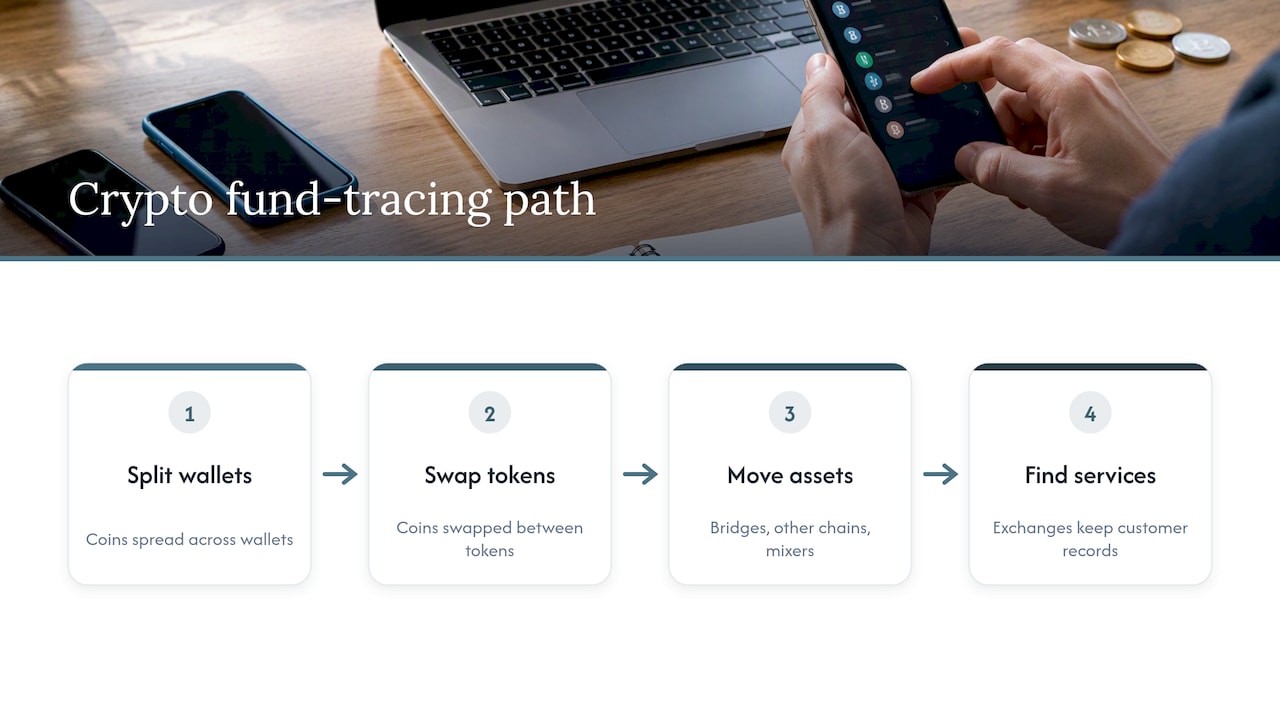
Scammers rarely leave funds where you sent them. Coins are split across many wallets, swapped between tokens, moved over bridges to other chains and sometimes passed through mixers. A basic wallet tracker shows the first hop. A proper investigation reconstructs the full path and notes where funds touched services that keep customer records, such as exchanges. Those points are where legal requests can later be directed. See our overview of blockchain forensics and how to prove crypto fraud for the method in plain language.
Connecting the escrow to a network
A fake escrow site is seldom a one-off. The same wallets, hosting, templates, support scripts and payment addresses tend to show up across many victims. Linking your case to those patterns strengthens it, because investigators and prosecutors act on networks, not single losses. Our page on identifying scam wallets within hours describes that first step.
The report
The deliverable is a technical report that states what was found, how, and with what confidence. A report built to be read by lawyers explains the methodology, lists the data sources and keeps facts apart from inference. If a lawsuit is realistic, how crypto forensics is admitted in US court is worth reading early, since it shapes how evidence should be gathered.
Can you actually get your money back?
Honestly: sometimes, but rarely, and not on a schedule. The CFTC and DOJ both stress that recovery is hard because blockchain transactions cannot simply be reversed, and that no one can guarantee an outcome.
When money does come back at scale, it usually comes through the government. In July 2026, the US Attorney’s Office for the District of Columbia and the Secret Service announced civil forfeiture complaints seeking more than $25 million in cryptocurrency tied to international fraud schemes. Seized funds can then be returned to victims through a formal process. In April 2026 the DOJ announced a remission process for OneCoin victims using funds recovered through forfeiture.
Two lessons follow for an escrow scam victim:
- Remission depends on property being finally forfeited, and victims who documented their losses well with the FBI or the relevant US Attorney’s Office are more likely to be contacted when a program opens. A clear, organized report helps you there.
- Private investigation and government action are complementary. A forensic report can show investigators where your funds went and which wallets belong to a wider network, which is the kind of lead that supports seizure.
Our goal in every engagement is a documented, defensible case, not a promise of a payout.
Beware of the second scam: fake recovery services
Victims of escrow fraud are prime targets for recovery fraud. The CFTC describes recovery scams as advance-fee fraud aimed at people already harmed by other frauds. The FBI has warned about fictitious law firms that contact victims, sometimes impersonating real attorneys or government agencies, and ask for fees to “release” funds.
Use these checks before hiring anyone, including us:
- Unsolicited contact is a warning. A legitimate firm does not need to find you through a message that arrived out of nowhere.
- No government agency charges you for help, and none authorizes a private firm to act in its name. Any “government-authorized recovery” claim is false.
- Verify independently. Look up attorneys through your state bar, and call organizations using numbers you find yourself, not those in the message.
- Refuse guarantees. Nobody can promise a result on a blockchain case.
- Be wary of payment in crypto or gift cards and of pressure to switch to private messaging.
- Ask for the scope in writing: what will be investigated, what the deliverable is, and what is not promised.
The FBI has also noted that many polished recovery sites are themselves fraudulent. The IC3 has published a public service announcement on recovery scams worth reading before you speak to anyone.
How to avoid it happening again
Most escrow scams succeed because the victim accepts the counterparty’s choice of escrow. Choose the escrow yourself, check that it is independently verifiable, and be suspicious when a stranger insists on one specific service. Never deposit funds to an address you cannot confirm through a second channel. A written crypto risk management checklist can help you set limits on exposure and decide in advance what you will and will not do under pressure.
Our perspective: evidence first, promises never
We built our work around one belief: a victim’s best asset after a scam is a clear record. When people come to us after an escrow fraud, they are usually ashamed, hurried and sometimes already contacted by a second scammer. The first thing we do is slow the case down.
We look at the trail the way an investigator would, not a wallet tracker. A single hop to a receiving address tells you very little. What matters is where funds are consolidated, whether they cross bridges or mixers, which services they touch and whether the same infrastructure appears in other fraud. That is why we pay attention to wallet behavior, open-source attribution and preservation together, rather than as separate tasks.
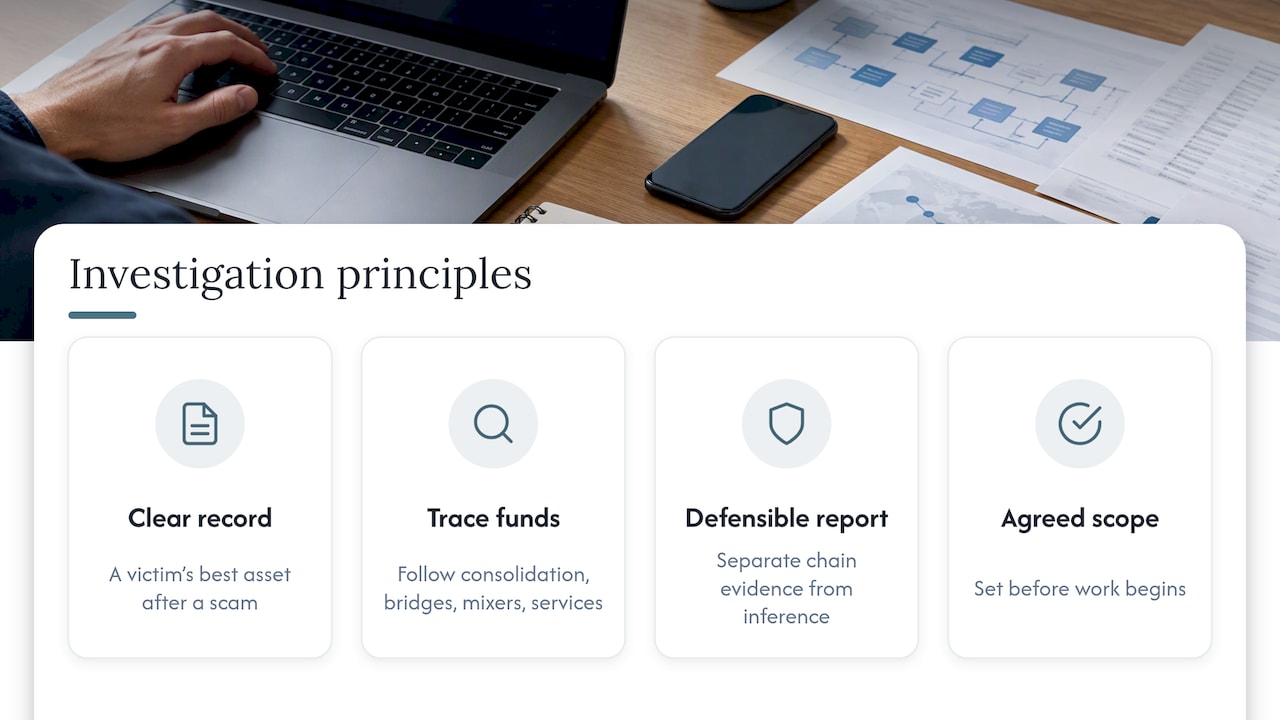
We also work with law firms. A report that survives scrutiny must separate what the chain proves from what we infer, and say so plainly. We would rather give you a modest, honest report than an impressive one that falls apart when a lawyer or judge questions it.
And we will tell you when an investigation is unlikely to change your outcome. A transparent process, with the scope agreed before work begins, is part of treating victims fairly.
— cristian
When to bring in a forensic investigator
An investigator makes sense when:
- The amount lost is significant enough to justify a documented case.
- You are preparing to file a police report, a civil claim or a request to an exchange, and need a structured account.
- The scam involved several wallets, chains or identities that you cannot follow yourself.
- Your attorney needs a technical report to support a claim or a subpoena.
It makes less sense when the loss is small and the transfers are simple, or when the only goal is a guaranteed refund. In that case, reporting and preserving evidence is still worthwhile.
We handle cryptocurrency scam investigations, OSINT attribution and evidence preservation for individuals, and offer technical analysis and reports for law firms. If you are not sure where your case stands, our step-by-step crypto fraud investigation guide lays out the process before you contact anyone.
FAQ
Can a crypto escrow scammer be traced?
Often the funds can be traced, because public blockchains record every transfer. Tracing the money is not the same as identifying or catching the person, which usually needs exchange records and law enforcement powers. A forensic report helps by showing investigators where funds went and which wallets are linked.
Will reporting to the FBI get my crypto back?
Not directly or quickly. Reports to IC3 and the FTC feed government investigations, and when assets are seized, a formal remission process may later compensate verified victims. Detailed documentation improves the chance that you are identified when that happens.
Should I pay a fee to a company that says it can recover my funds?
No, not on the strength of an unsolicited message. Upfront fees, guarantees and pressure to use private messaging are the hallmarks of recovery fraud. Verify any firm independently and get the scope of work in writing before paying anything.
What evidence do I need for an escrow scam investigation?
Transaction hashes, wallet addresses, dates and amounts, the escrow site URL with screenshots, and full chat exports with usernames. Add bank or exchange statements showing how you acquired the crypto. Store copies away from the device you used for the deal.
Sources
- FBI: Fictitious Law Firms Targeting Cryptocurrency Scam Victims
- FBI IC3 2024 Internet Crime Report
- IC3 PSA on cryptocurrency recovery scams (June 2024)
- CFTC: Fraud in 3 Acts
- CFTC: Don’t be Re-Victimized by Recovery Frauds
- DOJ, District of Columbia: Investigations into Cryptocurrency Scams Result in Seizure of More Than $25 Million
- DOJ: Compensation Process for OneCoin Fraud Victims
- Secured.fyi: What Is Crypto Escrow?