Yes, Dash PrivateSend transactions can often be traced. PrivateSend is a CoinJoin implementation, not a shielded-pool system, so the mixing rounds sit on a public ledger where analysts can study them. Tracing is not guaranteed, and it takes real work on amounts, timing, fees and what happens after the coins leave the mix. But if scammers moved your DASH through PrivateSend, that does not mean the money vanished.
This guide explains how the mechanism works, what forensic analysts look at, where tracing gets harder (including the newer Orchard transactions), and what a victim or attorney should do in the first days.
TL;DR
- PrivateSend (now called CoinJoin in Dash’s own documentation) combines inputs from many users into one transaction. Dash’s documentation describes it as consumer-grade privacy.
- Privacy on Dash is opt-in, so most DASH activity is fully visible and easy to cluster. Mixed coins add steps to an investigation, not a wall.
- Published research shows that the way mixing fees are paid can leak information about who mixed what.
- Newer Orchard transactions use zero-knowledge proofs and may be harder to follow. Speed matters, and so does preserving evidence early.
- If you lost funds, document everything now and have a forensic analyst review the flow before assuming the trail is cold.
Table of Contents
- What PrivateSend actually is
- Why Dash is easier to investigate than a privacy-default coin
- How analysts trace through a Dash mix
- Where tracing gets harder
- A worked example
- Our perspective
- What to do in the first days
- How Recovera Forensics can help
- FAQ
- Sources
What PrivateSend actually is
PrivateSend was Dash’s name for its built-in mixing feature. Current documentation calls the same feature CoinJoin, and describes it as a non-custodial method: your wallet never hands coins to a mixing service. Instead, it exchanges messages with a masternode, which assembles a transaction containing inputs from several participants and outputs of identical denominations.
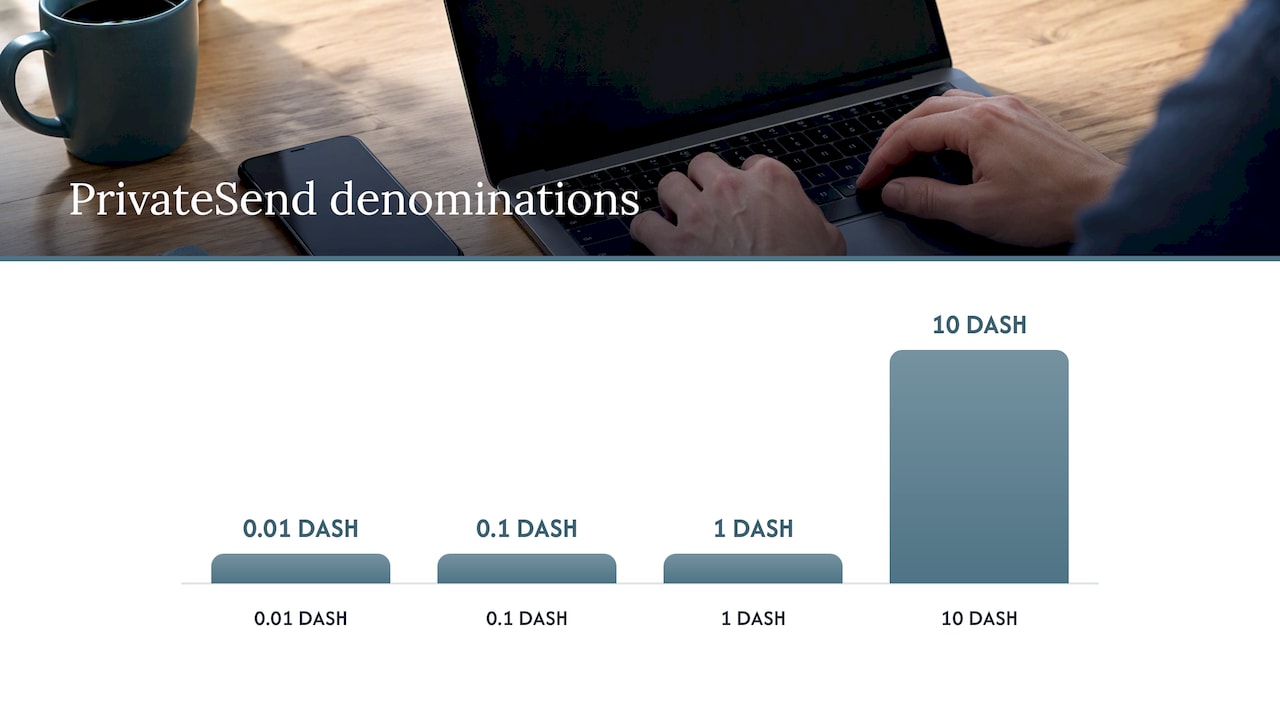
The idea is simple. If five people each put in the same amount and five outputs of that same amount come out, an outside observer cannot tell by amount alone which output belongs to which input. Repeat that across several rounds and the possible links multiply.
Two design details matter for tracing:
- Fixed denominations. An academic survey of cross-ledger tracing notes that PrivateSend restricts outputs to specific denominations (0.01, 0.1, 1 and 10 DASH). That prevents accidental fingerprinting by odd amounts, but it also gives analysts a predictable structure to look for.
- Multiple rounds. Dash’s documentation recommends a default of four mixing rounds for consumer-grade privacy, while stating that users should not treat it as total concealment of their history from blockchain analysis firms.
The network’s own developers are blunt about the limits. In a letter to the U.S. Treasury’s FinCEN, Dash Core Group argued that PrivateSend is functionally comparable to Bitcoin CoinJoin and does not offer anonymity in the way shielded-address coins do. That framing is useful if you are a victim: the thieves probably believed they were invisible, and they may not be.
Why Dash is easier to investigate than a privacy-default coin
Monero and Zcash shielded pools hide sender, receiver and amounts by default. Dash does the opposite: privacy is a setting that a user turns on. Forensic practitioners point out that this opt-in model gives investigators leverage. Most network activity is public, so an analyst can map where the funds came from and where they went after a mix. The academic literature on Dash mixing discusses this base-layer transparency as a lever for breaking the anonymity of mixed transactions.
In practice that means:
- The unmixed part of the trail is ordinary UTXO analysis. Before a scammer sends coins into a mix, those coins move like any Bitcoin-style funds. Standard clustering heuristics, such as inputs spent together, apply.
- The mix itself is bounded. A CoinJoin round has a finite set of participants and fixed output sizes. That is a much smaller haystack than the whole chain.
- The exit is where scammers get sloppy. To cash out, coins eventually reach an exchange, a payment processor or a wallet tied to a person. Each of those is a point where identity can attach.
If you want the general method behind this kind of work, our guide on how to trace the flow of funds in crypto for legal recovery walks through it step by step.
How analysts trace through a Dash mix
No single trick defeats CoinJoin. Analysts stack several weak signals until a link becomes defensible. Here are the ones that matter most for Dash.
Mixing fee payments
The most specific published finding concerns fees. A study of fee payments in the Dash CoinJoin implementation found that the fee payment process leaks privacy information, which opens a path to partial deanonymization. The mechanics are subtle, but the lesson is plain: a mix that seems clean at the denomination level can still carry a traceable signature in how participants pay for it.
Entry and exit patterns
A victim’s stolen funds rarely arrive in a mix in neat form. They arrive in a specific amount, at a specific time, from a cluster already flagged during the investigation. If an analyst can see roughly 480 DASH go into a mixing session, then see denomination outputs of matching total appear within a short window and consolidate into one wallet, that pairing is evidence. It is circumstantial on its own, but it is the kind of pattern that gets stronger when several independent signals agree.
Post-mix discipline
Most failures of privacy happen after the mix. Users who mix coins and then recombine them with unmixed funds, send everything to one exchange deposit address, or spend mixed outputs alongside tainted ones undo much of the benefit. Scam operators tend to move quickly and carelessly, because they are handling many victims’ funds and want to cash out. Careless post-mix handling is common in exactly the cases our clients bring us.
Off-chain context
Blockchain data alone rarely proves who is behind a wallet. OSINT (open-source intelligence) fills the gap: reused usernames, forum posts, domain registrations, social profiles, and the infrastructure behind a fake trading site. Linking an address to a person or a platform is often what turns a technical trace into something a lawyer can use.
Where tracing gets harder
Honesty matters more here than optimism. Some situations make a Dash trace slower or less conclusive:
- Many rounds and large participant pools. More mixing rounds and more users in each session widen the set of plausible links.
- Splitting and peeling. Scammers who divide funds into many small pieces and move them through multiple wallets add hops to follow.
- Chain hopping. Swapping DASH for another asset through a bridge or instant exchange moves the trail to a different ledger. The trace continues, but it needs data from both chains.
- Time. Coins that sit for months and are cashed out in small amounts are harder to associate than coins moved in a rush.
Orchard and zero-knowledge proofs
The biggest shift is recent. According to CoinMarketCap’s Dash coverage, Dash launched support for Orchard transactions on October 15, 2026, bringing Zcash-style zero-knowledge proof technology to provide stronger optional privacy. If funds enter that kind of shielded transaction, techniques built around CoinJoin patterns will not apply in the same way, and analysts need different tools and different expectations.
Two points keep this in perspective. First, Orchard is optional, like PrivateSend, so the surrounding trail (where the coins came from and where any transparent output went) remains visible. Second, most scam losses that occurred before this launch involved transparent transactions or classic CoinJoin mixing, and the older techniques still apply to them.
A worked example
To make this concrete, here is a simplified, hypothetical scenario (not a real case):
- A victim sends 300 DASH to an address given by a fake investment platform.
- Within hours, the funds move to a second wallet, then are split into denominations and fed into several CoinJoin sessions.
- Over the following days, mixed outputs arrive in a set of fresh wallets. Two of those wallets later consolidate into a single address.
- That address deposits into an account at a regulated exchange.
An analyst starts at step 1 and works forward. Steps 1 and 2 are straightforward. Step 3 is where fee data, timing and consolidation behavior are weighed. Step 4 is the payoff: a regulated exchange holds identity records and can be approached through a legal process. The report documents each link, notes how confident the analyst is in each, and says plainly where an inference replaces a certainty. That candor is what makes a report useful to an attorney, and what makes it hold up when challenged.
It also shows why trace Ethereum transactions to an exchange and freeze funds style work and Dash work share a goal: getting to the point where a real institution can act.
Our perspective
We see the same misunderstanding repeatedly. A victim looks up the scammer’s wallet, sees PrivateSend or CoinJoin activity, reads a forum thread claiming mixed coins cannot be traced, and gives up. We would argue that is the wrong conclusion.
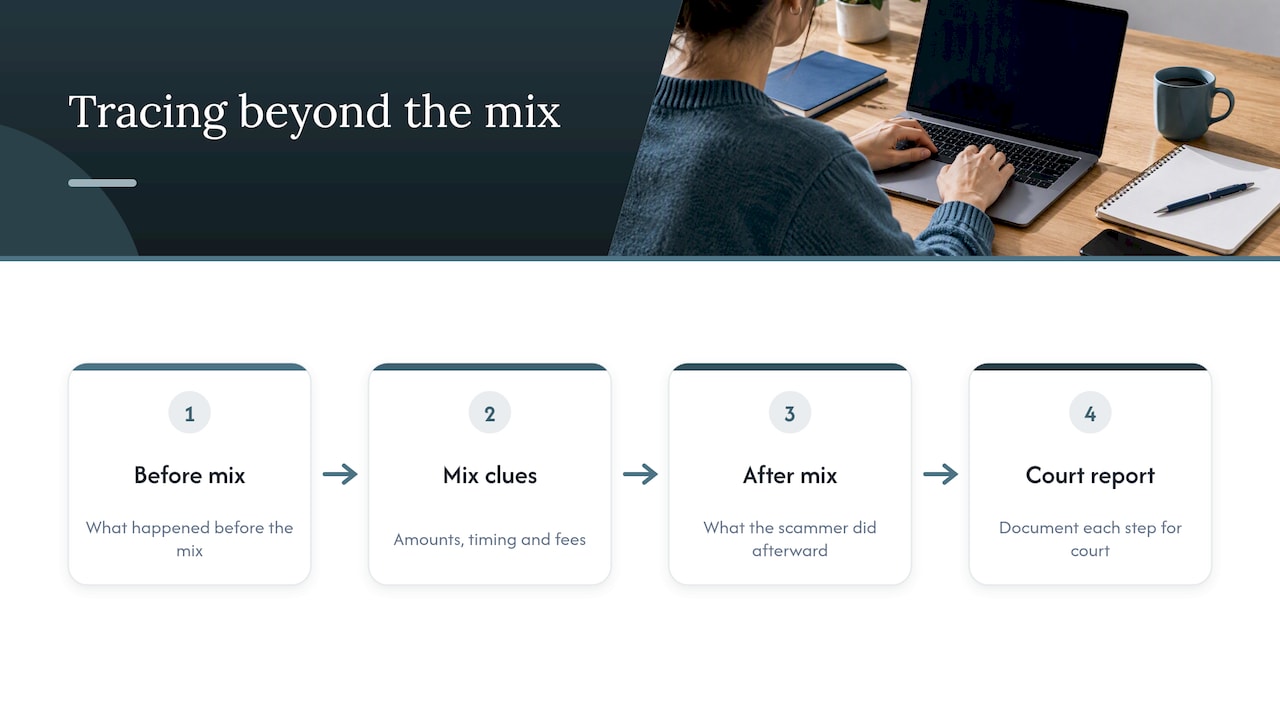
Our approach is to treat a mix as one stage of a longer path, not the end of it. We analyze what happened before the mix, what the mix leaves behind in amounts, timing and fees, and what the scammer did afterward. We connect wallet behavior to wider fraud networks, and we document each step in a form a lawyer can put in front of a court. We do not promise that every trace ends at an exchange. Some do not, and we say so early rather than after you have paid for hope.
We also believe the best results come from moving quickly. Evidence degrades, funds move, and exchanges act faster on a clear, well-documented report than on a vague complaint. Orchard adds a new reason to ask a specialist sooner rather than later.
— cristian
What to do in the first days
If you lost DASH, or any crypto, to a scam and suspect it passed through a mixer, take these steps in order.
- Stop sending money. Recovery “agents” who contact you after a loss are a second wave of fraud. Do not pay anyone upfront who guarantees a return.
- Save everything. Keep transaction IDs, wallet addresses, chat logs, emails, screenshots, website URLs and any payment confirmations. Do not delete the app or the conversation. Our guides on digital evidence preservation and crypto chain of custody explain how to keep it admissible.
- Write the timeline. Date, time, amount and destination address for every transfer you made.
- Report it. In the United States, our article on what to report to trigger police crypto investigations covers what to include so your report is actionable.
- Get a forensic review. A trace should come before any legal strategy, because it tells you whether there is a destination worth pursuing. Our 24 to 72 hour triage guide explains when to reach out.
If you are an investor tracking the broader picture, remember that Dash’s regulatory standing also affects what can be done. As of October 22, 2026, CoinMarketCap lists DASH near $52.14 with a market capitalization of about $672.99 million, and exchanges have been reassessing listings of privacy-enhanced coins. Fewer venues can mean fewer cash-out points, which sometimes helps tracing and sometimes pushes scammers to less regulated routes. For daily market context and sentiment on the asset side, plain-language market indicators and sentiment tools can help you read conditions without the noise.
How Recovera Forensics can help
We investigate stolen cryptocurrency through blockchain forensics, wallet activity analysis and OSINT, and we prepare technical reports built for legal proceedings. For cases involving mixers, bridges and chain hops, we reconstruct the asset flow and show how each link was established. We also support law firms that need technical analysis behind a client’s claim.
If you were defrauded and want to know whether your funds can be followed, see our cryptocurrency scam investigation services. Attorneys can review our services for professional offices. For background on the discipline, start with blockchain forensics: how to trace and prove crypto fraud.
FAQ
Can Dash PrivateSend be traced?
Often, at least partly. PrivateSend is a CoinJoin variant on a public blockchain, and research has shown that features such as mixing fee payments can leak information. Success depends on the number of rounds, how the user handled the coins afterward, and whether the trail reaches a regulated service.
Is PrivateSend the same as CoinJoin?
They refer to the same feature. Dash’s current documentation uses the name CoinJoin, while many articles and forum posts still say PrivateSend. Either way, it is a non-custodial mixing method, not a shielded transaction type.
Does the new Orchard upgrade make Dash untraceable?
No. Orchard brings zero-knowledge proofs and may make shielded transfers harder to follow, but it is optional. The activity before and after a shielded step usually stays visible, and older transactions are unaffected.
How long do I have to act after losing crypto?
There is no legal countdown for a trace, but practical urgency is high. Funds can be moved, cashed out or swapped across chains within hours. Preserving evidence and requesting a review quickly gives analysts and exchanges the best chance to act.
Will a forensic report guarantee I get my money back?
No honest provider can promise that. A report shows where funds went and how confidently that can be established. It gives you and your attorney a factual basis to approach exchanges, law enforcement or a court.
Sources
- CoinJoin, Dash documentation
- CoinJoin and InstantSend, Dash user documentation
- Tracing Transactions Across Cryptocurrency Ledgers (arXiv)
- Dash Core Group letter to FinCEN, March 29, 2021
- Academic chapter on Dash mixing and deanonymization (ACM)
- The Privacy Impact of Dash Mixing Fee Payments (Springer)
- Dash price prediction and Orchard news (CoinMarketCap)
- Dash price and market data (CoinMarketCap)