Yes, exchanges can freeze stolen crypto under specific conditions: custodial platforms can lock accounts and deposit addresses, and issuers like Tether and Circle can blacklist stablecoin balances tied to flagged wallets. These freezes usually depend on custody, token type, or a law enforcement request, so acting within 24 to 72 hours gives you the best shot at preserving any option.
TL;DR:
- Act within 24 to 72 hours: report the theft to IC3 and local police with transaction hashes, wallet addresses, and timestamps, then request an exchange hold.
- Preserve screenshots, device images, and email headers, and avoid moving remaining funds until you receive professional guidance, since further transfers can complicate tracing.
- A stablecoin blacklist affects only that token on that chain; swaps, bridges, and mixers can move funds beyond an issuer’s control.
- A temporary hold usually becomes a seizure only through a court order, supported by transaction hashes, exchange KYC records, and coordinated forensic evidence.
Table of Contents
- How exchange freezes and issuer blacklists actually work
- Legal orders, seizure warrants, and the role of federal strike forces
- Your 24 to 72 hour checklist after stolen crypto
- Forensics in practice: tracing, triage, and timing
- What a freeze can realistically achieve
- Our take: when professional help actually changes the outcome
- How Recovera Forensics supports victims who need to move fast
- FAQ
- Sources
- Authoritative links used in this article
How exchange freezes and issuer blacklists actually work
Freezing stolen crypto means something different depending on who holds it and what kind of asset it is. A centralized exchange that custodies your funds can place an internal hold on an account the moment its risk team flags suspicious activity, often triggered by KYC mismatches or a direct law enforcement request. That stops withdrawals but does not undo a transfer already sent to an external wallet the exchange does not control.
Stablecoin issuers operate differently. Tether and Circle can add a flagged wallet address to an on-chain blacklist, freezing the tokens at that address so they become unspendable even though the wallet itself stays outside any exchange’s custody. DOJ filings document cases where Tether froze USDT at specific addresses and later cooperated in reissuing tokens to law enforcement after a seizure warrant was issued.
These tools have real limits:
- A stablecoin blacklist only stops that specific token on that specific chain; it does nothing once funds are swapped into another asset.
- Native coins like Bitcoin and Ether have no issuer to ask for a freeze.
- Cross-chain bridges let stolen funds hop networks before any blacklist request can catch up.
Legal orders, seizure warrants, and the role of federal strike forces
A freeze by an exchange or issuer is a temporary hold. Converting it into an actual recovery usually requires a court order. Federal agencies pursue this through seizure warrants and forfeiture actions, which legally compel an exchange or issuer to transfer frozen assets to a law-enforcement-controlled wallet.
The scale these actions can reach is significant. The Scam Center Strike Force reported freezing, seizing, and forfeiting more than $580 million in cryptocurrency in a short operational window, working with the FBI and DOJ.
A few things make that kind of result possible:
- Investigators typically need transaction hashes and KYC records before an exchange or issuer will act on a freeze request.
- Coordinated cases pair blockchain forensics with formal legal filings, which is what turns a hold into a seizure.
- These strike forces prioritize cases by scale and investigatory value, not every report gets this level of resources.
Your 24 to 72 hour checklist after stolen crypto
What you do in the first few days shapes whether a freeze is even possible. Move through these steps in order:
- File a report with IC3 and your local police department, including transaction hashes, wallet addresses, and timestamps.
- Contact the exchange where funds were deposited and request a hold, noting that you may need to follow up with a subpoena for KYC data if the exchange does not act voluntarily.
- Preserve every piece of evidence, screenshots, device images, email headers, before you touch anything else.
- Avoid moving any remaining funds in your wallet until you have professional guidance, since further transfers can complicate tracing.
- Decide whether to bring in a forensic investigator or attorney, especially if the amount lost justifies a formal report for legal proceedings.
Our step-by-step evidence preservation checklist walks through exactly what to gather before you contact an exchange or file with IC3. A broader walkthrough of the recovery process is also available in our practical guide for victims.
Pro Tip: Save transaction hashes and wallet addresses in a plain text file the moment you notice the theft; exchanges and investigators both move faster when you hand them exact data instead of screenshots alone.
Forensics in practice: tracing, triage, and timing
A forensic investigation starts with triage: sorting what happened, when, and across which wallets. From there, an investigator builds a transaction graph, clusters wallet addresses by behavior, and tags any deposit that lands on a known exchange. That last step matters most, because it’s what lets an exchange or law enforcement act on a specific account.
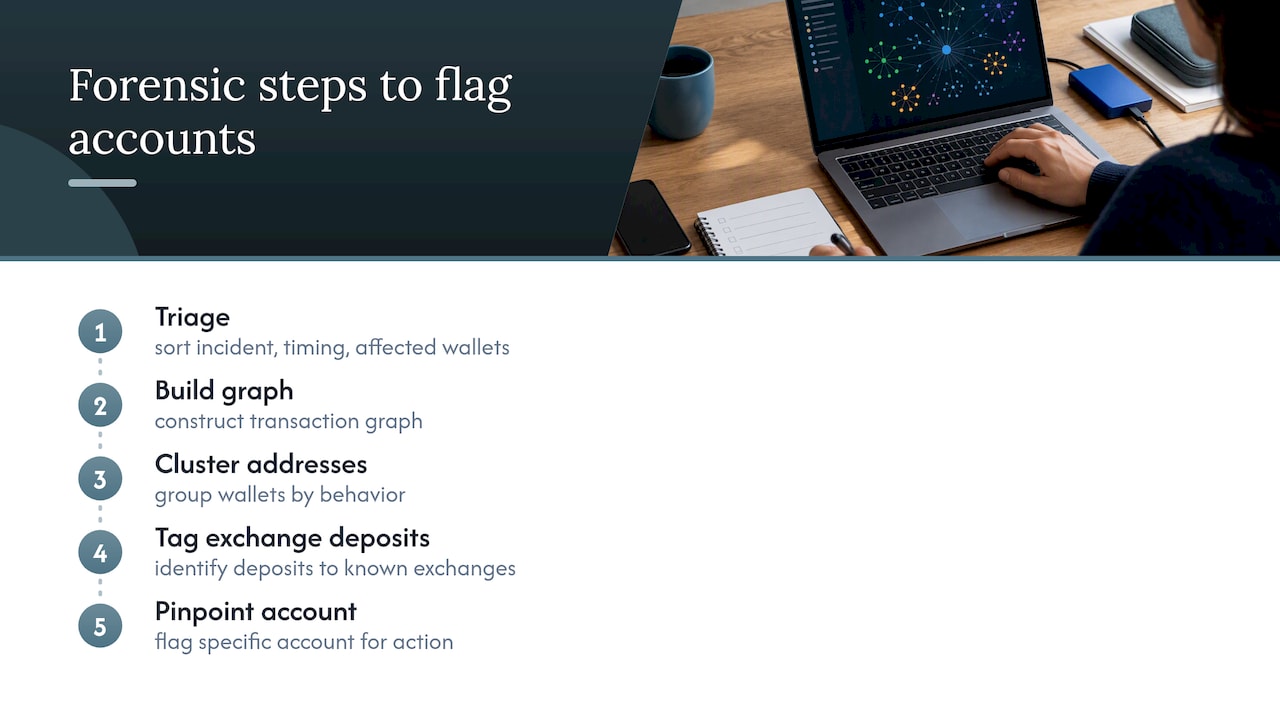
Timing drives the outcome. Triage completed within the first 24 to 72 hours has a meaningfully better chance of catching funds before they move through a mixer or bridge, since on-chain links and exchange deposit traces degrade fast once funds keep hopping.
The end product is a report built for use outside a spreadsheet, chain-of-custody documentation, annotated transaction graphs, and a narrative connecting wallets to deposit points, handed to investigators or counsel as the basis for a preservation or seizure request. Our blockchain forensics overview breaks down what goes into that kind of report.
Pro Tip: Ask any investigator you hire whether their report is built to be submitted to law enforcement or a court, not every forensic write-up is.
What a freeze can realistically achieve
Freezes work best against simple, slow-moving theft. They struggle against swaps into other tokens, cross-chain bridges, privacy coins, and fast movement through decentralized exchanges or mixers, all of which break the chain a freeze request depends on.
The Scam Center Strike Force’s $580 million in freezes and forfeitures shows what’s possible at scale, but a freeze is a tool that buys time for investigation, not a guaranteed refund.
Our take: when professional help actually changes the outcome
We see the clearest results when victims engage forensic support within that first 24 to 72 hour window, especially in large thefts or cases crossing multiple wallets and chains. Good triage and a documented report strengthen both the law enforcement path and any civil claim, but no report can promise a freeze or a recovery. What it can do is put real evidence in front of the people with the power to act.
— cristian*
How Recovera Forensics supports victims who need to move fast
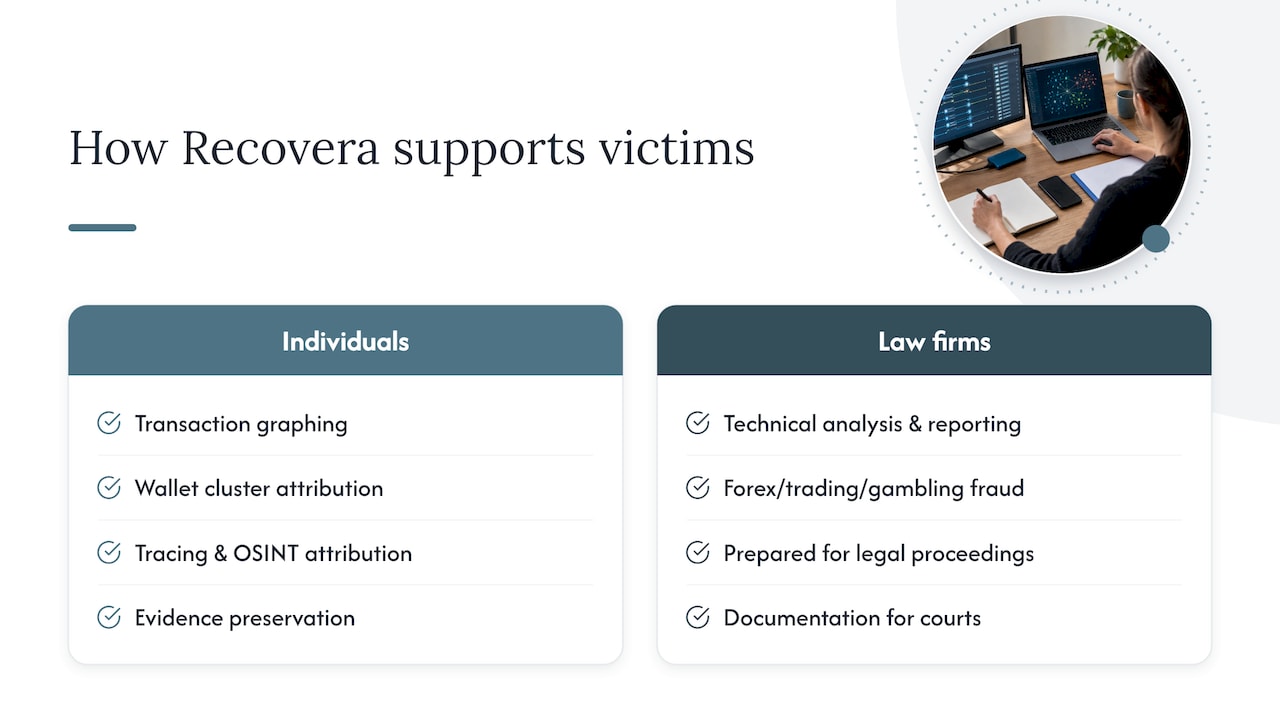
We build forensic reports featuring transaction graphing, wallet cluster attribution, and documentation prepared for legal proceedings. Our Cryptocurrency Scam Investigation and related services cover tracing, OSINT attribution, and evidence preservation for individuals, while law firms can bring us in through our technical analysis and reporting services for Forex, trading, and gambling fraud cases. Engagements are billed per case, and timely contact after discovering a theft can improve evidence preservation. If you’re weighing a legal route alongside forensics, this legal guide for scam victims from a crypto fraud law firm outlines what documentation courts expect.
FAQ
Is it possible to get stolen crypto back?
Recovery is possible in some cases, particularly when funds land quickly on a centralized exchange that can freeze the deposit or when a stablecoin issuer blacklists the tokens before they move further. It becomes far harder once funds pass through mixers, cross-chain bridges, or privacy coins, so speed and documentation matter more than any single tool.
Can crypto exchanges be hacked?
Yes, exchanges can be hacked, and when that happens the stolen funds often move through the same tracing and freeze mechanisms used for individual theft cases. Reporting the incident to IC3 and preserving transaction records applies whether the breach happened at the exchange level or in your personal wallet.
I lost a large amount when my cryptocurrency was stolen. How can I recover it?
Start by filing a report with IC3 and your local police, then contact the exchange that received the funds to request a hold while you gather transaction hashes and wallet addresses. For losses significant enough to justify legal action, a forensic investigation can build the documentation investigators or attorneys need to pursue a freeze or seizure.
Is it safe to hold crypto on exchanges?
Holding crypto on a centralized exchange adds a layer of recourse that self-custody wallets don’t have, since the exchange can freeze an account under its own risk controls or a law enforcement request. It also means trusting that exchange’s security and compliance practices, so reviewing its KYC and AML procedures before depositing funds is worth the time.
Sources
- DOJ complaint and affidavit describing Tether freezes and related tracing
- D.C. Scam Center Strike Force seizures top $580 million
- IC3 public service announcement: documenting incidents and avoiding follow-up scams
Authoritative links used in this article
These are the primary government sources cited above, useful if you want to review the original filings or report an incident directly.
- DOJ complaint and affidavit describing Tether freezes and related tracing
- D.C. Scam Center Strike Force seizures top $580 million
- IC3 public service announcement: documenting incidents and avoiding follow-up scams