Yes. Blockchain forensic evidence is admissible in U.S. courts when it clears four hurdles: authentication under FRE 901/902, methodological reliability under FRE 702/Daubert, an unbroken chain of custody, and off‑chain corroboration tying wallet activity to a real person. Courts do not treat blockchain analysis as exotic evidence anymore. They treat it like any other technical output. Specialized forensic firms build court-ready reports around exactly these four pillars, because judges reward foundation, not jargon.
TL;DR:
- Blockchain analysis is admissible in court when properly authenticated, reliable, and supported by chain-of-custody and off-chain corroboration.
- Raw data must be exported, hashed immediately, and handled with detailed logs to prevent allegations of data tampering and ensure reproducibility.
- Subpoenas should target early requests to exchanges, especially offshore platforms, and include IP logs and KYC records to strengthen wallet ownership claims.
- Expert testimony requires clear qualifications, methodological transparency, and scope discipline to withstand Daubert challenges and avoid exclusion.
- Documentation habits, careful handling of chain-of-custody, and pairing blockchain data with corroborating off-chain records are essential for courtroom success.
Table of Contents
- Using Crypto Forensics in Court: The Evidentiary Framework Judges Apply
- Preservation and Chain of Custody: Making Blockchain Evidence Reproducible
- Off‑Chain Corroboration: Turning Wallet Labels Into Provable Identities
- Expert Testimony Strategy: Qualifying Witnesses and Surviving a Daubert Challenge
- Common Pitfalls and Defense Strategies to Anticipate
- Selected U.S. Case Law and Precedent That Inform Current Practice
- A Pretrial Checklist for Counsel and Investigators
- A Practitioner’s Note From Recovera Forensics
- How Recovera Forensics Supports Court-Ready Investigations
- Authoritative Primary Sources and Practitioner References
- Sources
- FAQ
Using Crypto Forensics in Court: The Evidentiary Framework Judges Apply
Judges don’t invent new rules for blockchain data. They run it through the same evidentiary framework used for phone records, spreadsheets, and surveillance footage, then ask whether the proponent laid a proper foundation.
FRE 901/902 governs authentication. A transaction hash, wallet address, or block explorer screenshot has to be shown to be what it claims to be. FRE 902(13) and (14) allow self-authentication of certain machine-generated records when paired with a qualified certification, which is why hash values and system-generated metadata carry so much weight at this stage.
FRE 803(6) covers business records, and exchange transaction histories or KYC files often qualify if a custodian can testify to how they were generated and kept.
FRE 1006 permits summary exhibits, which matters enormously in crypto cases. Nobody wants a jury reading 40,000 raw transactions. A summary chart tracing funds from Wallet A to Wallet B to a named exchange account is admissible under 1006 if the underlying data was itself admissible and made available to opposing counsel.
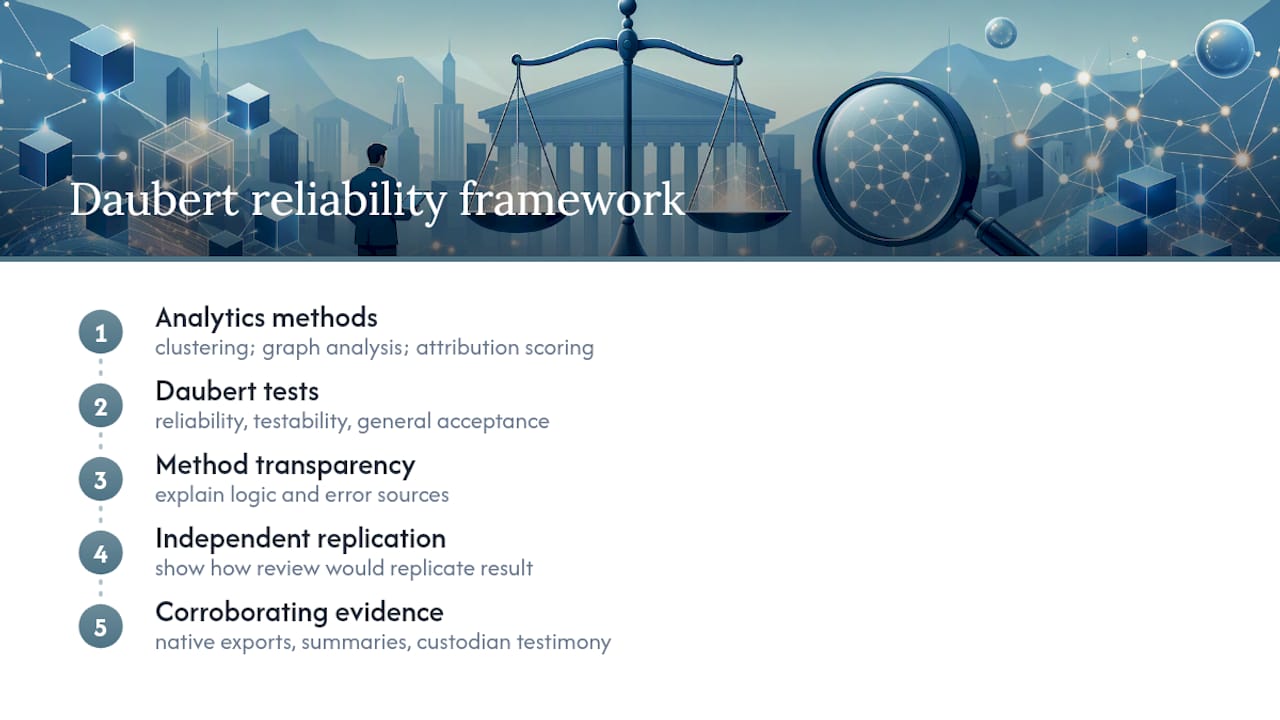
FRE 702/Daubert is where most fights actually happen. Courts ask whether the analytical method (clustering heuristics, transaction graph analysis, attribution scoring) is reliable, testable, and generally accepted, and whether the expert applied it correctly to the facts. Courts have found blockchain analytics admissible when the expert can explain the method’s logic, its error sources, and how independent review would replicate the result. Method transparency tends to matter more than the tool’s brand name.
Practically, counsel should retain an expert early, request native data exports rather than screenshots wherever possible, and build the Daubert record months before trial, not the week of a motion hearing.
Preservation and Chain of Custody: Making Blockchain Evidence Reproducible
Blockchain data is permanent, but your access to it and your proof of how you accessed it are not. A defensible investigation starts with capturing raw, native data before anything gets summarized or interpreted.
- Export raw data first. Pull native transaction data, wallet histories, and exchange records in their original file formats, not just PDFs of dashboards.
- Hash everything at collection. Compute a cryptographic hash (SHA-256 is standard) for every file the moment it’s collected, and log that hash before any analysis begins.
- Log the handler chain. Record who touched the data, when, on what device, and for what purpose, from first collection through final report.
- Document the tools. Note software name, version number, query parameters, and the system clock setting used for every analytical run.
- Preserve annotated and raw versions separately. Keep the untouched original alongside any working file where an analyst added notes or highlights.
- Capture screenshots with visible timestamps. When a live blockchain explorer or exchange dashboard has to be screenshotted, include the URL bar, system clock, and page metadata in the frame.
Preserving raw exports and hashing them immediately is one of the details evidentiary hearings turn on most often, according to TRM Labs’ guidance on court-ready reporting. A gap in that log, even a small one, gives opposing counsel an opening to argue the evidence was altered or mishandled.
Pro Tip: Hash your raw export files twice, once immediately after download and once again right before drafting the final report. If the two hashes match, you’ve just proven nothing was touched in between, and that comparison alone can shut down a spoliation argument before it starts.
For deeper protocol on logging and hashing standards, Recovera’s guide to crypto chain of custody breaks down the documentation format investigators use case to case.
Off‑Chain Corroboration: Turning Wallet Labels Into Provable Identities
A blockchain only tells you that Wallet A sent an amount of bitcoin to Wallet B. It never tells you who owns either wallet. That gap is where cases get won or lost, and it’s why vendor cluster labels alone should never be the last step in an investigation.
Exchange KYC records are often sufficient when the exchange is a regulated U.S. or allied-jurisdiction entity willing to respond to a subpoena voluntarily. But when a wallet routes through an offshore platform, a mixer, or a decentralized exchange with no compliance department, counsel needs a court order or a formal subpoena to compel identity records, IP logs, and login metadata.
Practical steps for building that corroboration layer:
- Send subpoenas to exchanges as early as possible; account data and IP logs may be deleted according to retention schedules.
- Request IP login history alongside KYC documents, since IP addresses can place a suspect’s device at the time of a specific transaction.
- Document every vendor response, including partial or “no records” replies, and file them in a chain-of-custody appendix rather than discarding them.
- Coordinate subpoena timing across platforms so a suspect can’t move funds the moment one exchange gets served.
Practitioners caution against what’s sometimes called the “accuracy trap”: treating a vendor’s clustering algorithm as proof of ownership rather than as a lead that still needs independent verification. Attribution only becomes evidence once it’s backed by a document, a subpoena response, or a witness. Recovera’s approach to blockchain forensics leans on that same principle, pairing on-chain tracing with the legal process needed to convert a lead into a name.
Expert Testimony Strategy: Qualifying Witnesses and Surviving a Daubert Challenge
Fact testimony and expert opinion are not the same thing, and conflating them is a common way cases stumble. A fact witness can testify that a transaction occurred on a specific block at a specific time. Only a qualified expert can testify about what that transaction pattern means, and courts scrutinize that leap closely.
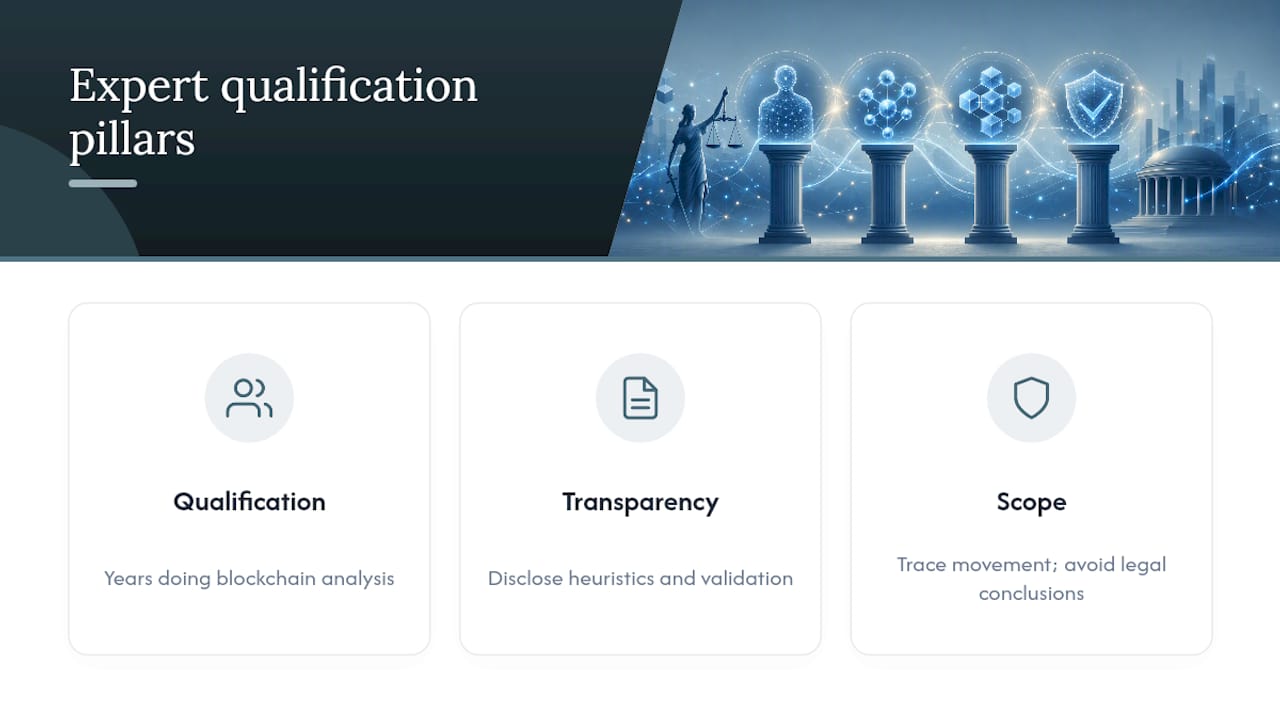
Qualification comes from domain experience: years spent doing blockchain analysis, prior testimony in similar cases, and specific technical training in the tools used. An expert who has only ever run one commercial platform without understanding its underlying logic is an easy target on cross.
Methodology transparency is the second pillar. The expert should be prepared to disclose which heuristics were applied (common-input-ownership, address reuse patterns, exchange deposit tagging), what the known error sources are, and what validation steps confirmed the output before it went into the report. Courts that have rejected Daubert challenges to blockchain analytics did so specifically because experts could explain method reliability and back it with corroborating evidence, not because the tool itself was presumed trustworthy.
Scope discipline matters just as much. A forensic expert should testify to where the money went and how the trace was built. Whether that conduct constitutes fraud, theft, or a securities violation is a legal conclusion for the jury and the court, not the witness.
Common Pitfalls and Defense Strategies to Anticipate
Defense counsel has a predictable playbook against blockchain evidence, and most of it targets gaps that were entirely preventable.
- Unverified vendor clusters. If an investigator relies on a tool’s “high confidence” label without independent verification, defense counsel will ask whether the analyst actually confirmed the underlying logic.
- Chain-of-custody gaps. Missing timestamps, unexplained gaps in handler logs, or screenshots without visible metadata invite spoliation arguments.
- Mixer and bridge complications. When funds pass through a mixing service or a cross-chain bridge, attribution confidence drops, and an expert who overstates certainty here is vulnerable on cross.
- Undisclosed tool settings. Failing to log software version numbers or query parameters means the analysis can’t be replicated, which is fatal under Daubert’s reproducibility factor.
None of these pitfalls require exotic defenses to counter. They require documentation habits that should already be standard practice long before a case reaches a courtroom.
Selected U.S. Case Law and Precedent That Inform Current Practice
Two recent cases give counsel the clearest roadmap available right now.
In United States v. Sterlingov, the court rejected a Daubert challenge to blockchain analytics performed using Chainalysis Reactor. The government’s experts prevailed because they demonstrated the method’s reliability and paired the analytics with corroborating evidence rather than resting on the software’s output alone.
In SEC v. Balina, the SEC’s use of on‑chain records held up specifically because the analysis was supported by documentary corroboration, not blockchain data in isolation. That pairing of on‑chain tracing with off‑chain records is now the closest thing to a formula for admissibility in federal civil litigation.
Other rulings have gone the opposite direction: testimony gets excluded when an expert can’t explain the heuristic behind a clustering conclusion or admits the analysis wasn’t independently validated. The pattern across every one of these outcomes is consistent. Judges are not gatekeeping the technology. They’re gatekeeping the foundation underneath it, a distinction worth reading further in Recovera’s guide to blockchain evidence admissibility.
A Pretrial Checklist for Counsel and Investigators
Before filing exhibits or naming an expert, run through this sequence:
- Preserve raw data and compute hashes at first contact with any wallet, exchange record, or transaction history.
- Send subpoenas or exchange requests immediately, since account data on foreign or unregulated platforms disappears fast.
- Draft the report with a clear executive summary, a disclosed methodology section, labeled exhibits (TXIDs, block heights, hash values), and a chain-of-custody appendix.
- Line up your expert’s qualifications and prior testimony history before opposing counsel raises them first.
| Task | Why it matters |
|---|---|
| Hash raw exports at collection | Proves data wasn’t altered later |
| Subpoena exchanges early | Records and IP logs get purged on retention schedules |
| Disclose tool versions and parameters | Required for Daubert reproducibility |
| Separate on‑chain, analytical, and attribution findings | Keeps testimony scoped and defensible |
A Practitioner’s Note From Recovera Forensics
Experienced forensic investigators report that cases fall apart on documentation, not on the blockchain data itself. Reproducibility beats confidence every time a report reaches cross-examination.
— cristian
How Recovera Forensics Supports Court-Ready Investigations
Recovera Forensics is built specifically for cases that need to survive a courtroom, not just satisfy curiosity about where stolen funds went. The firm’s cryptocurrency scam investigation and OSINT services trace wallet activity, reconstruct transaction flows through mixers and bridges, and produce documentation designed to hold up under a Daubert challenge rather than fall apart at first cross-examination. For law firms managing the litigation side, Recovera’s technical analysis and reporting services for professional offices cover expert consulting, subpoena coordination guidance, and report drafting built around the same chain-of-custody and methodology-disclosure standards this guide walks through.
Before reaching out, gather what you already have: native exports of transaction data, screenshots with visible timestamps, any exchange correspondence, and a rough timeline of what happened. That head start alone can shave weeks off an investigation. Start the process through Recovera’s scam investigation services page to get a case review moving.
Authoritative Primary Sources and Practitioner References
Counsel building a motion or brief around blockchain evidence should keep these close: the United States v. Sterlingov trial materials for the Daubert analysis of blockchain analytics, the SEC v. Balina litigation release for civil corroboration standards, the FBI IC3 Annual Report for the scale of crypto-enabled fraud driving these cases, and TRM Labs’ framework for investigators on separating on‑chain, analytical, and attribution evidence layers. Firms coordinating multi‑disciplinary investigations may also want forensic accounting support alongside blockchain analysis, particularly in cases involving traditional banking trails.
This article is general information, not a substitute for advice from a qualified lawyer. Consult a qualified legal professional about your own circumstances before acting on anything here.
Sources
- SEC enforcement release (SEC v. Balina)
- United States v. Sterlingov (trial court materials)
- TRM Labs — Building strong cases with blockchain evidence
FAQ
How much does a digital forensic investigation cost?
Cost depends on case complexity, the number of wallets and platforms involved, and whether expert testimony is required. Recovera Forensics does not publish flat rates online; current pricing is available directly through the service inquiry page.
What kind of cases use digital forensics?
Digital forensics, including crypto forensic techniques, applies to criminal fraud prosecutions, civil asset recovery, securities enforcement actions, divorce and asset-hiding disputes, and corporate embezzlement investigations. Any case where a transaction trail needs to be authenticated and explained to a judge or jury can benefit from it.
Who investigates crimes involving cryptocurrency?
Federal agencies like the FBI and Secret Service investigate large-scale crypto crime, often coordinating through the IC3 reporting system, while private forensic firms like Recovera Forensics handle civil recovery cases and support law firms with technical reports for litigation.
Can crypto be taken in a lawsuit?
Yes. Once a wallet or exchange account is identified and its ownership is proven through subpoenas or KYC records, courts can order asset freezes, garnishment, or turnover of cryptocurrency holdings the same way they would with a bank account.
Is blockchain analytics software alone enough to prove a case in court?
No. Courts consistently expect vendor analytics to be paired with off‑chain corroboration, such as exchange records or subpoena responses, before attribution findings carry evidentiary weight.