Recovery after a phishing attack is possible in a real share of cases, but never guaranteed. It depends almost entirely on speed and documentation. The single most important move: preserve the transaction hash, wallet addresses, and every screenshot before you touch anything else, then stop moving funds from the affected device. From there, a qualified forensic investigator and immediate reports to exchanges and law enforcement are what convert a trace into an actual chance at recovering stolen cryptocurrency.
TL;DR:
- Recovery chances increase significantly if funds are quickly traced and sent to a regulated exchange with strong KYC records.
- Proper documentation of the theft, including transaction hashes and screenshots saved as PDFs, is essential for any legal freeze or recovery attempt.
- On-chain and off-chain analysis, such as clustering addresses and connecting wallets to identities, are crucial steps in monitoring stolen funds’ movement.
- Recovery timelines vary from weeks for direct exchange stops to months or years if funds pass through mixers or cross-chain routes.
- Hiring a reputable forensic investigator requires verifying their successful freeze trigger experience, courtroom record, and transparent methodology before engagement.
Table of Contents
- Phishing Crypto Recovery: Your First-Hours Checklist
- How Do Investigators Trace Stolen Crypto?
- Evidence, Documentation, and Legal Steps to Freeze Funds
- What Are Realistic Recovery Odds and Timelines?
- How Should You Vet a Blockchain Forensic Investigator?
- Recovera Forensics: What We Actually Deliver
- The Overrated Advice and the One Thing That Actually Matters
- Get an Emergency Forensic Consult Started
- Sources
- FAQ
Phishing Crypto Recovery: Your First-Hours Checklist
What you save in the first hour often decides whether an exchange freezes anything at all. Attackers frequently move stolen funds within minutes, so the window for action closes fast.
Before you do anything else, gather:
- The transaction hash (TXID) and its block explorer link
- Sending and receiving wallet addresses, plus the token contract and chain name
- Screenshots of the phishing message, fake site, or wallet approval prompt
- Device logs, browser history, and full email headers from the phishing message
Then take these steps in order:
- Disconnect the compromised device from the internet, but do not wipe it
- Do not send any remaining funds anywhere, even to “protect” them; that muddies the trail investigators need
- Move any surviving assets only from a separate, clean device into a brand-new wallet
- Contact the receiving exchange’s security or compliance team directly, citing the exact deposit address and TXID
- File a report with the FBI’s Internet Crime Complaint Center, and open a report with local police or a cybercrime unit
Documentation is what makes exchange freeze requests actionable. A vague message saying “I got scammed” gets ignored. A message with the exact hash, timestamp, and destination address gets escalated, because rapid, documented reporting is a prerequisite for exchanges to act on freeze requests.
Pro Tip: Save everything as PDFs or timestamped screenshots, not just links. Block explorer pages and social media posts get edited or deleted, and a broken link is useless as evidence six months later.
How Do Investigators Trace Stolen Crypto?
Blockchain forensics starts at the theft transaction and builds outward. Investigators construct a transaction graph mapping every hop the stolen funds take, including internal transactions and token swaps on EVM chains like Ethereum, where a simple transfer can hide several intermediate contract calls.
From there, the work splits into two tracks:
- On-chain clustering. Analysts group addresses likely controlled by the same actor using signals like UTXO co-spend patterns on Bitcoin or repeated behavioral fingerprints across EVM wallets. This gets probabilistic fast. Two addresses spending from the same input in one transaction are almost certainly linked; a shared gas-funding pattern is a weaker signal that needs corroboration.
- Off-chain correlation. This is where a pseudonymous address becomes a name. Investigators use exchange labels, KYC records, IP logs, and open-source intelligence, sometimes backed by subpoenas, to connect a wallet to a real identity.
Specialist platforms matter here. Public block explorers rarely include entity labeling or demixing capability, which is why professional forensic tooling from firms like Chainalysis exists to fill that gap for complex cross-chain tracing.
The entire workflow points toward one goal: finding a chokepoint. That’s the moment stolen funds touch a regulated exchange, custodial wallet, or OTC desk, because that’s where KYC records can convert an anonymous trace into an actionable identity. A detailed walkthrough of tracing Ethereum transactions to an exchange shows exactly what that graph looks like in practice. Without a chokepoint, tracing tells you where the money went. It doesn’t get it back.
Evidence, Documentation, and Legal Steps to Freeze Funds
A trace is not a legal weapon until it’s documented properly. Courts don’t accept “trust me, I followed the money.” They require a chain of custody: a record of who collected each piece of evidence, when, and with what tools, because that documentation is what lets forensic testimony survive evidentiary challenges like the Daubert standard.
Attribution in blockchain forensics is probabilistic, not absolute. A credible report quantifies its confidence level and documents the exact heuristics used, so a judge or opposing counsel can weigh the evidence on its actual merits rather than take it on faith.
For an exchange or prosecutor to act, they typically need:
- A clear, timestamped transaction graph showing the theft and subsequent movement
- Identified deposit addresses at a regulated platform
- A formal request routed through law enforcement, not just a victim’s email
The legal instruments that follow include urgent freeze requests to exchanges, subpoenas for account disclosure, seizure warrants, and civil provisional remedies filed alongside a criminal complaint. Coordination matters as much as the paperwork. Investigators, victims, and counsel need to move together, and law enforcement, whether that’s IC3, the FBI, or a state cyber unit, needs to be looped in early rather than as a last resort. A full breakdown of chain of custody requirements for U.S. cases covers what documentation actually needs to look like before a court will consider it.
What Are Realistic Recovery Odds and Timelines?
Some cases resolve in weeks. Others take years and still come up empty. The difference usually comes down to a handful of variables.
- The stolen funds land directly on a KYC-verified exchange
- The attacker launders slowly instead of cashing out immediately
- The attacker makes an operational security mistake, like reusing an address
- The victim reports within hours, not days
Odds drop sharply when funds pass through mixing services, privacy coins, or rapid cross-chain hopping across bridges that don’t share data. Offshore platforms with weak cooperation policies compound the problem.
A simple exchange-touch case, where stolen funds sit at a single identifiable platform, can resolve in weeks. Cases involving mixers or multiple chain hops routinely stretch into months or years and sometimes never resolve. Even a well-documented trace depends on jurisdictional cooperation and platform willingness to act; tracing tells you where the money is, but recovery requires someone with legal authority over that platform to actually move.
How Should You Vet a Blockchain Forensic Investigator?
Before hiring anyone, ask direct questions and demand specifics.
- Have they successfully triggered exchange freezes before, and can they describe the process without vague generalities?
- Do they have courtroom testimony experience, or has their work ever survived a Daubert-style challenge?
- What tools do they use, and will they explain their methodology rather than treat it as a black box?
- Can they show a sample report structure before you commit?
- What’s their billing model, retainer versus flat fee versus contingency, and is it in writing?
Red flags are easy to spot once you know what to look for: anyone guaranteeing recovery, anyone asking for your private keys or seed phrase, and unsolicited messages promising fast returns are all signs to walk away immediately. Before reaching out to any firm, gather your transaction hashes, wallet addresses, and any police report number. That preparation alone speeds up the first consult significantly.
Recovera Forensics: What We Actually Deliver
Recovera Forensics builds forensic investigations around detailed transaction pattern analysis on public blockchains, not surface-level wallet lookups. The goal is a report that holds up in legal proceedings, not just a spreadsheet of addresses.
What that looks like in practice:
- Transaction tracing and clustering that connects wallet activity to broader fraud networks, rather than stopping at the first hop
- Court-oriented reporting built with legal admissibility in mind from the start, not retrofitted after the fact
- Direct coordination with victims, counsel, and, where needed, exchanges and law enforcement contacts
Before contacting Recovera, have your transaction hash, wallet addresses, and any screenshots ready. That’s the same evidence set that makes any forensic engagement move faster, whether you work with Recovera or another qualified firm.
The Overrated Advice and the One Thing That Actually Matters
Most guides on phishing crypto recovery bury the real lever under a pile of general security tips. Password hygiene and hardware wallets matter for prevention, but once funds are gone, none of that changes your odds. What changes your odds is speed of documentation and how fast you get evidence in front of someone who can act on it.
The conventional wisdom oversells “reporting to the police” as if that alone triggers action. It doesn’t. A police report without a precise transaction graph and identified deposit address usually sits in a queue. What moves the needle is pairing that report with a forensic trace that names a specific chokepoint, because that’s the piece an exchange or prosecutor can actually act on.
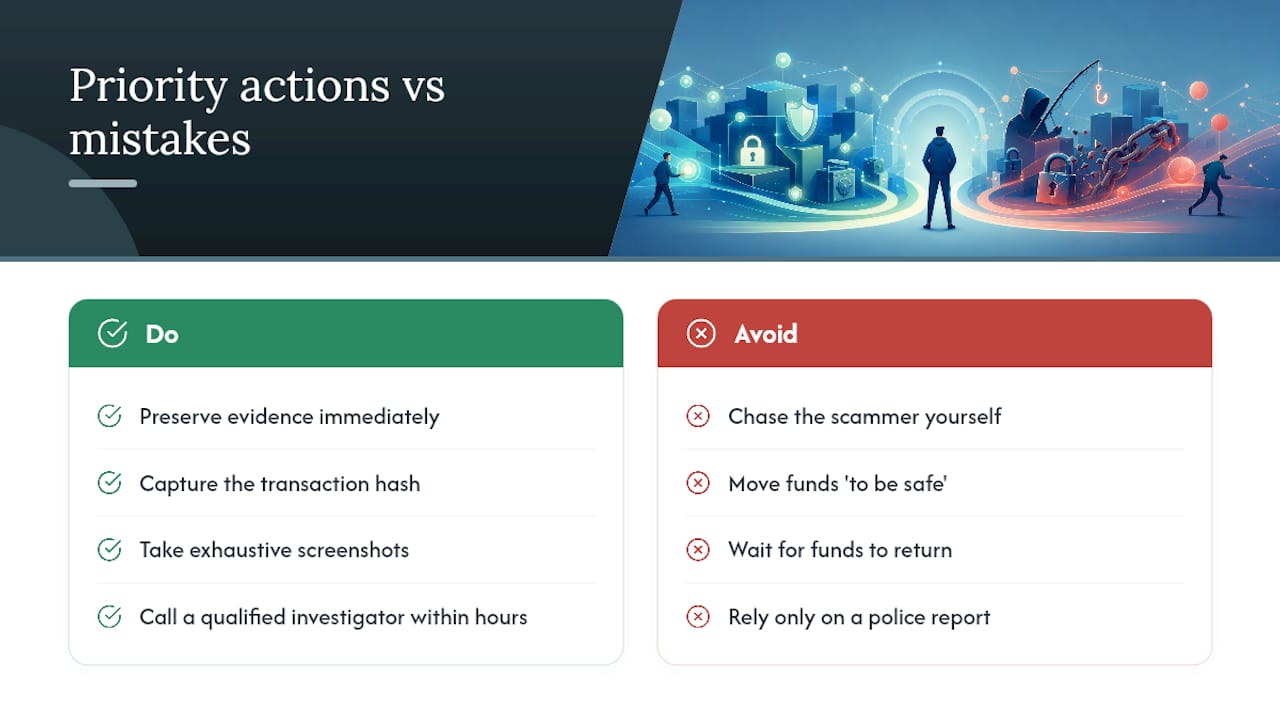
If you take one thing from this: prioritize preservation over panic. Don’t chase the scammer, don’t move funds “to be safe,” and don’t wait to see if the money “comes back on its own.” Get the hash, get the screenshots, and get a qualified investigator looking at the graph within hours, not days. That’s the difference between a case that has a shot and one that never had a chance.
— cristian
Get an Emergency Forensic Consult Started
Waiting even a day after a phishing loss can close off chokepoints that were open the hour it happened. Some forensic services are built for exactly that urgency: a direct path to forensic tracing and legal-grade reporting, instead of the guesswork of trying to piece together a transaction graph yourself.
To start an emergency consult, have ready: the transaction hash, all wallet addresses involved, screenshots of the phishing message or site, and a police report number if you’ve already filed one. That’s the same evidence set covered in the step-by-step action guide for crypto fraud investigation, and it’s what lets a forensic team start tracing immediately instead of spending the first day gathering basics.
Review the full scam investigation services if you’re an individual victim, or the dedicated services for law firms and professional offices if you’re counsel building a case for a client. Reach out today with your evidence in hand and get a forensic timeline started before the trail goes cold.
Sources
- IC3 public service announcement (PSA) — evidence preservation and reporting
- Academic discussion of evidentiary standards and chain of custody
- Blockchain Council guide: tracing and recovering stolen cryptocurrency
- Chainalysis: What is blockchain forensics?
This article is general information, not a substitute for advice from a qualified financial advisor. Consult a qualified financial professional about your own circumstances before acting on anything here.
FAQ
Can Stolen Crypto From a Phishing Attack Be Recovered?
Partial or full recovery is possible in some cases, especially when stolen funds land on a regulated exchange quickly, but it’s never guaranteed. Success depends on fast evidence preservation, forensic tracing, and whether the funds hit a chokepoint like a KYC-verified platform where identity records can be tied to the wallet.
What Should I Do First After a Phishing Crypto Theft?
Preserve the transaction hash, wallet addresses, and screenshots immediately, then stop moving any remaining funds from the compromised device. File a report with IC3 and contact the receiving exchange’s security team directly with the exact transaction details.
How Long Does a Crypto Recovery Investigation Take?
A case where stolen funds sit at a single identifiable exchange can resolve in weeks. Cases involving mixers, privacy coins, or multiple cross-chain hops often stretch into months or years, and some never resolve.
What Does a Blockchain Forensic Investigation Cost?
Pricing for services like cryptocurrency scam investigation and OSINT tracing varies by case complexity and is available on request. Most firms bill per engagement rather than a flat rate, since tracing scope depends heavily on how many chains and hops are involved.
Is It Safe to Hire a Crypto Recovery Firm?
It’s safe if the firm never asks for your private keys or seed phrase and never guarantees results upfront. Legitimate investigators focus on documented transaction tracing and court-ready reporting, not promises of a fast payout.