Yes, if funds moved recently, involved significant value, or touched an exchange, contact a paid blockchain-forensics firm now rather than waiting. The first outcome is a rapid triage: an initial review of your wallet activity and transaction history that tells you whether the case is traceable, what it will cost to investigate, and whether you need immediate exchange escalation or a full investigation. Firms such as Recovera Forensics build these findings into litigation-ready reports for exactly this purpose.
TL;DR:
- Contact a forensic firm immediately if funds moved recently, touched an exchange, or involved large sums, to avoid the trail going cold.
- A rapid triage within 24 to 72 hours confirms traceability and outlines investigation scope, helping determine if further action is worthwhile.
- Full investigations, depending on complexity, can take weeks to months and cost between $20,000 and $75,000, with staged billing to control expenses.
- Organized evidence before engagement, like transaction hashes and screenshots, reduces costs, speeds up the process, and improves case clarity.
- For successful legal action, forensic reports must include clear methodology, chain-of-custody records, and exhibit-ready transaction timelines.
Table of Contents
- When Should You Contact a Forensic Investigator?
- What Does a Paid Forensic Investigation Actually Deliver?
- What Should You Gather Before Contacting a Forensics Firm?
- How Do You Choose a Credible Blockchain-Forensics Firm?
- How Do Forensic Findings Support Your Legal Case?
- An Investigator’s View on Realistic Recovery Expectations
- How Recovera Forensics Can Help After a Crypto Scam
- Sources
- FAQ
When Should You Contact a Forensic Investigator?
Speed matters because stolen crypto rarely sits still. Once funds hit a mixer, cross to another chain through a bridge, or get chopped into dozens of small transfers, tracing gets harder and slower by the hour. Fast, disciplined action early gives investigators the best shot at identifying an exchange deposit before records get purged or the trail goes cold.
Watch for these signals that mean you should call now, not next week:
- Funds have already moved to a mixer, privacy coin, or cross-chain bridge.
- Part of the stolen amount touched a known exchange deposit address.
- The loss involves a large sum relative to your finances, or multiple victims are affected.
- The scam involved a romance con, a fake investment platform, a compromised wallet, or business payment fraud.
Some cases need a lawyer involved from day one, particularly business fraud or multi-victim schemes headed toward civil suits. In most individual cases, though, running triage and contacting counsel in parallel gets you moving faster on both tracks at once.
What Does a Paid Forensic Investigation Actually Deliver?
A forensics engagement is not a magic recovery button. It is a structured technical process that produces specific outputs, on a specific timeline, with real limits attached.
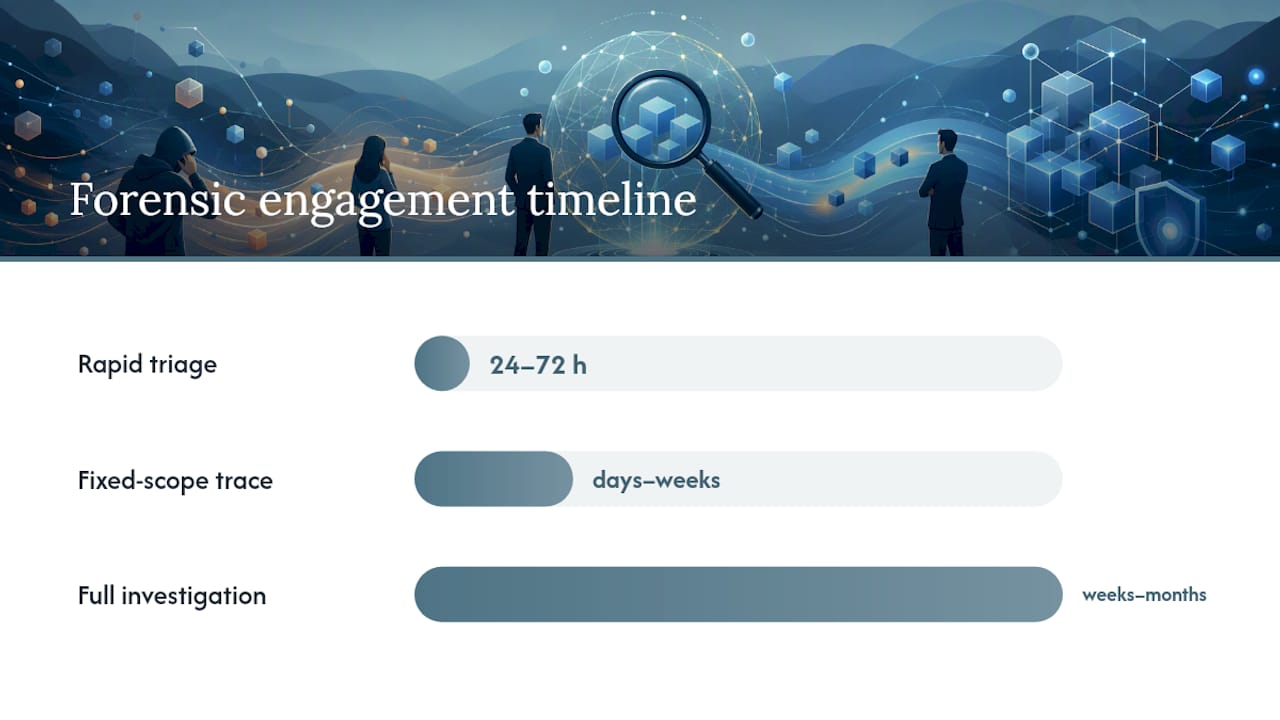
Here is roughly how it unfolds:
- Rapid triage (24 to 72 hours): a preliminary review of wallet addresses and transaction hashes to confirm traceability and scope the case.
- Fixed-scope trace (days to weeks): detailed transaction mapping that follows the funds through swaps, bridges, and mixers to identify exchange touchpoints.
- Full investigation (weeks to months): a comprehensive, litigation-grade report with exhibits, methodology notes, and exchange identification suitable for subpoenas or civil filings.
Pro Tip: Ask any provider upfront which stage your case is likely to require. A scam involving one wallet-to-exchange hop is a very different job than funds laundered through several mixers.
A qualified provider should be able to support litigation workflows, exchange escalation, and cross-chain tracing as standard parts of the process, not add-on extras. That said, no legitimate firm can promise you will get your money back. Investigators can trace on-chain activity and identify likely exchange deposits, but they cannot reverse a blockchain transaction, force an exchange to freeze funds, or compel a scammer to return anything. Those outcomes depend on law enforcement, exchange compliance teams, or a court order, working from the technical findings the investigation produces.
What Should You Gather Before Contacting a Forensics Firm?
The single biggest lever you control over cost and speed is how organized your evidence is before intake. Organizing transaction hashes, screenshots, and communications ahead of time turns a vague, expensive scoping conversation into a fast, accurate one.
Before you reach out, pull together:
- Every wallet address involved, both yours and the scammer’s, if known.
- Transaction hashes (TXIDs) for each transfer connected to the loss.
- Screenshots of the platform, app, or website used, including KYC or verification screens.
- Exchange account messages, deposit and withdrawal records, and any support tickets.
- Email headers saved as raw .eml files, not just screenshots of the inbox.
- Full chat logs from Telegram, Discord, WhatsApp, or wherever contact happened.
- Payment confirmations, bank statements, or card charge records tied to the transfer.
Preserve everything in its original format. A screenshot of an email loses the header data that proves origin and timing, so export the .eml file directly from your mail client rather than photographing the screen. The checklist for a court-ready report covers this in more depth if you want a fuller walkthrough before your first call. Organized, timestamped evidence keeps the scope tight, which usually keeps the invoice smaller too.
How Do You Choose a Credible Blockchain-Forensics Firm?
Not every outfit calling itself a “crypto recovery service” is legitimate, and the space attracts its share of secondary scams targeting people who already lost money once. Vet any firm with the same seriousness you would a surgeon.
Ask direct questions before signing anything:
- Does the team include people with backgrounds in law enforcement, cybercrime units, or financial-crime investigation?
- Can they show (without breaching confidentiality) how past reports were used in litigation or exchange escalation?
- What does a sample report actually contain: methodology, exhibits, chain-of-custody notes?
- Is pricing staged, such as a triage fee separate from a fixed-scope investigation, or is it one open-ended retainer?
A firm that guarantees recovery, pressures you into a large upfront payment before any triage, or reaches out to you unsolicited after you posted about your loss online is behaving exactly like the scammers who took your money in the first place.
Costs vary by complexity, but full investigations commonly range from about $20,000 to $75,000 depending on how many hops the funds took and how many jurisdictions are involved. A staged model, triage first, then a fixed-scope trace, then a full investigation only if warranted, keeps that cost tied to actual findings instead of an open-ended retainer. Confirm too that a human investigator reviews the case rather than relying purely on automated tools: complex laundering paths through mixers and DeFi bridges usually need a trained analyst’s judgment, not just a software graph. For more on spotting bad actors in this space specifically, Recovera’s breakdown of recovery scam red flags is worth a read before you hire anyone.
How Do Forensic Findings Support Your Legal Case?
Forensics and legal counsel do different jobs, and confusing the two wastes time. The investigator’s job is to produce defensible technical evidence: where the funds went, when, and through which exchanges. The attorney’s job is to turn that evidence into leverage, whether that means a preservation letter, a subpoena, a temporary restraining order, or a civil suit.
Retaining a crypto-literate attorney alongside your forensic investigator matters because forensic reports rarely recover anything by themselves. They are the technical foundation an attorney needs to act.
For a report to actually hold up in that process, it should include:
- A clear methodology section explaining how the trace was performed.
- Chain-of-custody documentation showing evidence wasn’t altered after collection.
- A transaction timeline mapped against exchange deposit and withdrawal events.
- Exportable exhibits an attorney can attach directly to a subpoena or court filing.
If you are still assembling your legal team, a checklist of questions for urgent legal situations can help you vet counsel with the same rigor you’re applying to the forensics firm. Once both pieces are in place, running them in parallel rather than sequentially is usually what saves the most time.
An Investigator’s View on Realistic Recovery Expectations
The scam victims I see get burned twice are the ones who skip straight to hope and skip past evidence. A measured, evidence-first approach doesn’t feel as satisfying as a promise of getting your money back, but it’s what actually widens your legal options later.
Recovera Forensics builds every report to hold up in court, not just to look impressive in an email. That means chain-of-custody discipline from the first file you send us.
My advice stays simple: preserve your originals, demand a written scope before you pay anything, and get a lawyer working in parallel from the start. The cases that go somewhere are the ones built on documentation, not urgency alone.
— cristian
How Recovera Forensics Can Help After a Crypto Scam
Recovera Forensics gives you a technical alternative to guesswork: real blockchain tracing, backed by a team with law enforcement and financial-crime backgrounds, producing reports built for court rather than for a sales pitch. Our cryptocurrency scam investigation and evidence preservation services start with the same triage-first approach described above, so you know your scope and cost before committing to a full engagement. Law firms working with affected clients can also review our litigation-focused reporting services built specifically for professional offices handling fraud cases.
An initial triage typically reviews your wallet addresses, transaction hashes, and available exchange records to confirm whether the funds are traceable and what a fixed-scope investigation would involve. If you have your evidence organized, or even if you don’t yet, request a case review and we’ll walk you through what happens next.
Sources
- Digital Asset Recovery and Enforcement — FRB Law
- How to hire a blockchain forensic firm after your crypto was stolen — InvestorClaims
- Anchain
FAQ
How Soon Should I Contact a Forensics Firm After a Scam?
Contact one as soon as you confirm you were scammed, especially if funds have moved recently or touched an exchange. Waiting even a few days can let a trail through mixers or bridges go cold.
Can a Forensic Investigation Guarantee I Get My Money Back?
No legitimate firm can guarantee recovery, since investigators can trace funds and identify exchange touchpoints but cannot reverse blockchain transactions or force a return. Recovery ultimately depends on law enforcement, exchange cooperation, or a court order acting on the technical evidence.
How Much Does a Blockchain-Forensics Investigation Cost?
Full investigations commonly range from about $20,000 to $75,000 depending on case complexity, though many firms, including Recovera Forensics, start with a lower-cost triage before quoting a fixed scope. Current service pricing is available directly through Recovera’s service page.
Do I Need a Lawyer if I Hire a Forensics Firm?
Yes, in most cases. Forensic reports rarely recover assets on their own, so an attorney is usually needed to turn the technical findings into subpoenas, preservation letters, or civil action.
What’s the First Deliverable I’ll Receive?
Most engagements start with a triage memo within 24 to 72 hours, summarizing whether the funds are traceable and what a full investigation would involve. That memo is what determines the next steps and cost.